

Find a Trusted Local Buyer for Your Diamond Ring
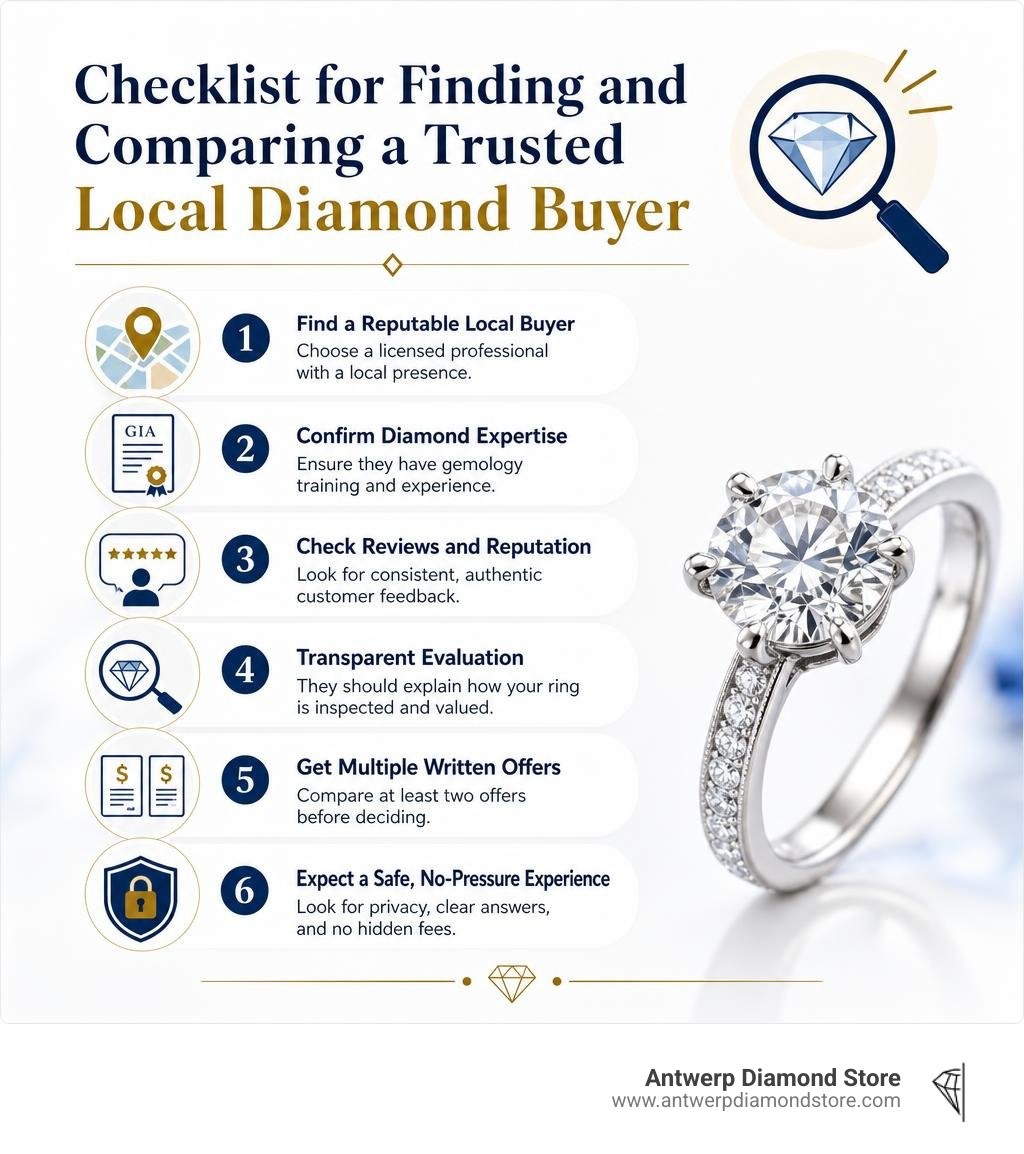
To find a jewelry store that buys diamond rings near me, choose a licensed local buyer with gemology expertise, clear reviews, and a no-pressure in-person evaluation. Ask the store to explain how it values your diamond's carat weight, cut, color, clarity, certification, setting, and current resale demand. Then get at least two written offers before you decide.
A strong local buyer should let you watch the inspection, answer direct questions, and provide a clear offer without hidden fees or a consignment wait. Bring any GIA or other lab paperwork you have, but do not assume you cannot sell without it. A qualified buyer can inspect and grade an uncertified ring in person.
For an affluent seller who values privacy and speed, a local appointment can offer a practical balance: direct evaluation, secure handoff, and payment once you accept an offer. This guide explains how to spot credible buyers, compare quotes fairly, and understand what your ring may be worth before you sell.
How to Choose the Best Jewelry Store That Buys Diamond Rings Near Me
Selling fine jewelry is an intimate financial transaction. Whether you are letting go of an engagement ring from a past chapter, liquidating an inherited family heirloom, or upgrading your personal collection, finding the right local buyer makes all the difference between a frustrating lowball offer and a smooth, rewarding sale.
When searching for a local buyer, your goal is to locate an established specialist who evaluates diamonds transparently, understands the luxury secondary market, and conducts business with absolute integrity. Let’s look at the baseline qualifications and trust signals you should examine before scheduling a visit.
What Credentials to Look For in a Jewelry Store That Buys Diamond Rings Near Me
Not all retail storefronts possess the technical capability to evaluate fine diamonds accurately. Many traditional retail jewelers focus exclusively on selling new inventory at markup and lack the secondary market connections needed to make competitive cash offers.
When vetting potential buyers, look for these key professional credentials:
Gemological Credentials: The evaluators on staff should have formal training from accredited institutions. Look for specialists holding Graduate Gemologist (GG) or Diamond Graduate credentials from the Gemological Institute of America (GIA).
Gemological Equipment: A reputable firm will have professional-grade gemological microscopes, diamond refractometers, ultraviolet lamps, and precision carat scales calibrated to the hundredth of a point.
Third-Party Appraisals: If you want an objective valuation before selling, you can consult an independent jewelry appraiser who does not buy or sell jewelry. This gives you a clear baseline before seeking a formal gia ring appraisal.
Secondhand Dealer Licensing: Municipalities require legitimate jewelry buyers to hold an active secondhand dealer license. This ensures they follow strict consumer protection and anti-fraud regulations.
Evaluating Buyer Reputation and Store Transparency
Credentials on the wall are vital, but day-to-day business ethics matter just as much. Transparent buyers evaluate your items directly in front of you—never taking your ring into a back room away from your sight.
To gauge reputation, examine verified customer feedback across Google and independent rating platforms. Check whether the business maintains an A+ rating with the Better Business Bureau (BBB). Read both positive and critical reviews to see how they treat clients during in-person assessments.
A reputable store will follow proven jewelry appraisal tips 2026 standards: explaining their pricing criteria openly, breaking down the value of the center diamond versus the mounting, and presenting a firm, no-obligation cash offer without pressure.
Key Factors That Determine Your Diamond Ring Resale Value
Understanding how buyers calculate an offer protects you from unrealistic expectations and helps you spot unfair quotes. The secondary market value of a diamond ring is fundamentally different from its retail replacement value (the inflated figure typically printed on insurance documents for replacement coverage).
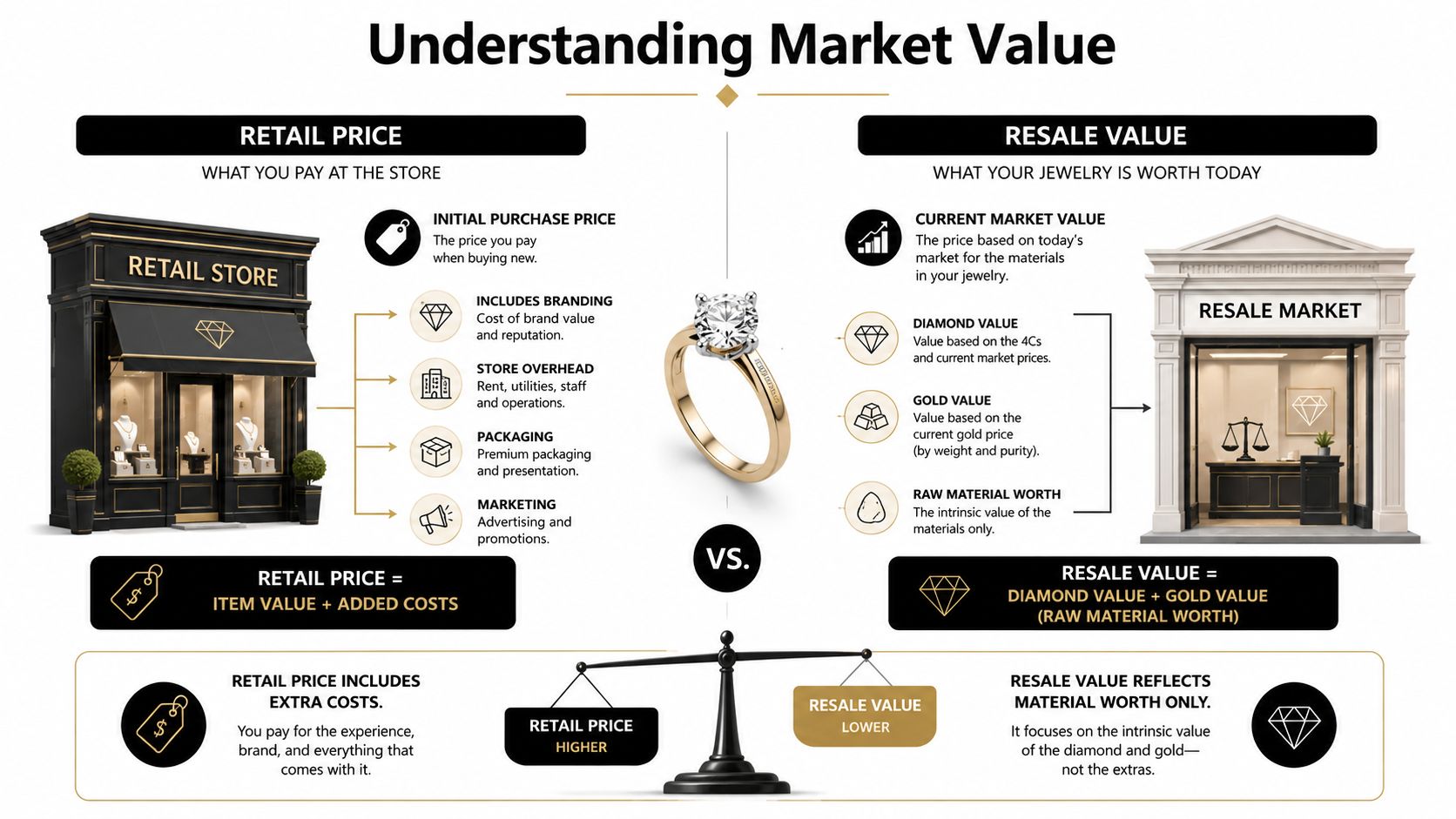
A realistic resale offer accounts for intrinsic raw materials, craftsmanship, and real-time secondary market liquidity. To understand these dynamics, use a diamond resale value calculator to get a sense of secondary pricing before your appointment.
The 4Cs, Precious Metal Weight, and Lab Certifications
The universal standard for grading diamonds centers on the 4Cs, developed by the GIA:
Carat Weight: Larger diamonds are rarer and command higher prices per carat. For multi-stone rings, evaluators distinguish between the center stone's weight and the total carat weight.
Color: Graded on an alphabetical scale from D (colorless) to Z (light yellow or brown). Reviewing a standard diamond color grades chart shows that near-colorless diamonds (grades D through H) command the strongest market demand.
Clarity: Assesses internal characteristics and external blemishes. Understanding what is an inclusion in a diamond helps explain why stones with VVS or VS clarity grades earn higher cash offers than stones with visible SI or I inclusions.
Cut: A well-cut diamond reflects light brilliantly. Even a stone with high color and clarity will suffer in value if a poor cut causes it to appear dull.
Beyond the 4Cs, certification matters. A laboratory grading report from GIA, AGS, or EGL USA substantiates your stone's quality, allowing buyers to calculate diamond price offers with tighter margins.
The origin of your stone is equally critical; in today's market, natural diamonds retain meaningful resale value, whereas the secondary market for lab grown vs natural diamond jewelry is substantially lower due to continuous drops in production costs. Finally, the precious metal in your setting—whether 14k gold, 18k gold, or platinum—is weighed and calculated based on real-time market spot prices.
Designer Brands, Antique Eras, and Market Demand
Not every ring is valued solely by its raw diamond weight and metal scrap price. Signed designer jewelry and authentic antique pieces carry strong collector appeal.
Designer Provenance: When selling designer diamond jewelry from heritage houses like Tiffany & Co., Cartier, Harry Winston, or Van Cleef & Arpels, the signature hallmark, original boxes, and brand certificates add considerable value above the intrinsic stone price.
Antique & Vintage Eras: Rings from the Victorian, Edwardian, and Art Deco eras feature rare hand-cut stones (such as Old Mine or Old European cuts) and intricate filigree. When navigating how to sell antique jewelry, an expert estate jewelry appraisal ensures you receive a premium for the piece's historical significance rather than just its melt value.
Comparing Local Diamond Buyers vs. Alternative Selling Channels
When looking to sell fine jewelry, you have several primary selling routes: local jewelry buyers, pawn shops, online mail-in services, and peer-to-peer marketplaces. Each channel offers different trade-offs between speed, security, and net payout.
Channel | Payout Speed | Security & Privacy | Valuation Accuracy | Best For |
|---|---|---|---|---|
Local Estate Jeweler / Diamond Specialist | Immediate (Same Day) | High (Private in-person appointment) | High (GIA-trained staff, market-based offers) | Fine diamonds, luxury engagement rings, designer pieces |
Pawn Shop | Immediate (Same Day) | Moderate (Public storefront) | Low to Moderate (Often pays base scrap metal value) | Emergency cash needs for general consumer goods |
Mail-In Online Buyer | Delayed (3 to 7+ business days) | Moderate (Requires insured shipping) | Variable (Initial phone estimates often decrease upon receipt) | Sellers without access to reputable local specialists |
Peer-to-Peer Marketplace | Slow (Weeks to months) | Low (Scam risks, payment disputes, meetups) | Theoretical retail price (Minus high platform fees & risk) | Low-to-mid value fashion jewelry |
Finding a Direct End-Buyer Jewelry Store That Buys Diamond Rings Near Me
If your goal is to find where to sell my diamond ring near me, working with a direct end-buyer offers major financial advantages. Direct estate jewelers maintain active retail storefronts, private collector networks, and established global dealer connections.
Because these stores buy pieces directly for their own resale inventory rather than wholesaling them to third-party scrap refiners, they can pay substantially more. Bypassing middleman broker fees ensures you get the highest net payout when deciding where to sell jewelry for cash.
Local Direct Buyers vs. Remote and Delayed Resale Channels
While online mail-in buyers advertise heavily, sending high-value fine jewelry through the mail carries stress and uncertainty. Packages can be delayed, transit insurance claims are notoriously complex, and remote buyers frequently lower their initial "quote" once they have your item in hand.
Similarly, selling your ring for cash at a pawn shop typically results in steep discounts because pawn brokers deal in diverse merchandise rather than specialized gemology. Opting for a local specialist allows you to sell diamond ring safely and walk out with verified cash for diamond ring transactions on the very same day.
Step-by-Step Diamond Evaluation and Selling Process
A legitimate jewelry buying process should feel clear, professional, and completely stress-free. Here is what happens during a standard professional evaluation:
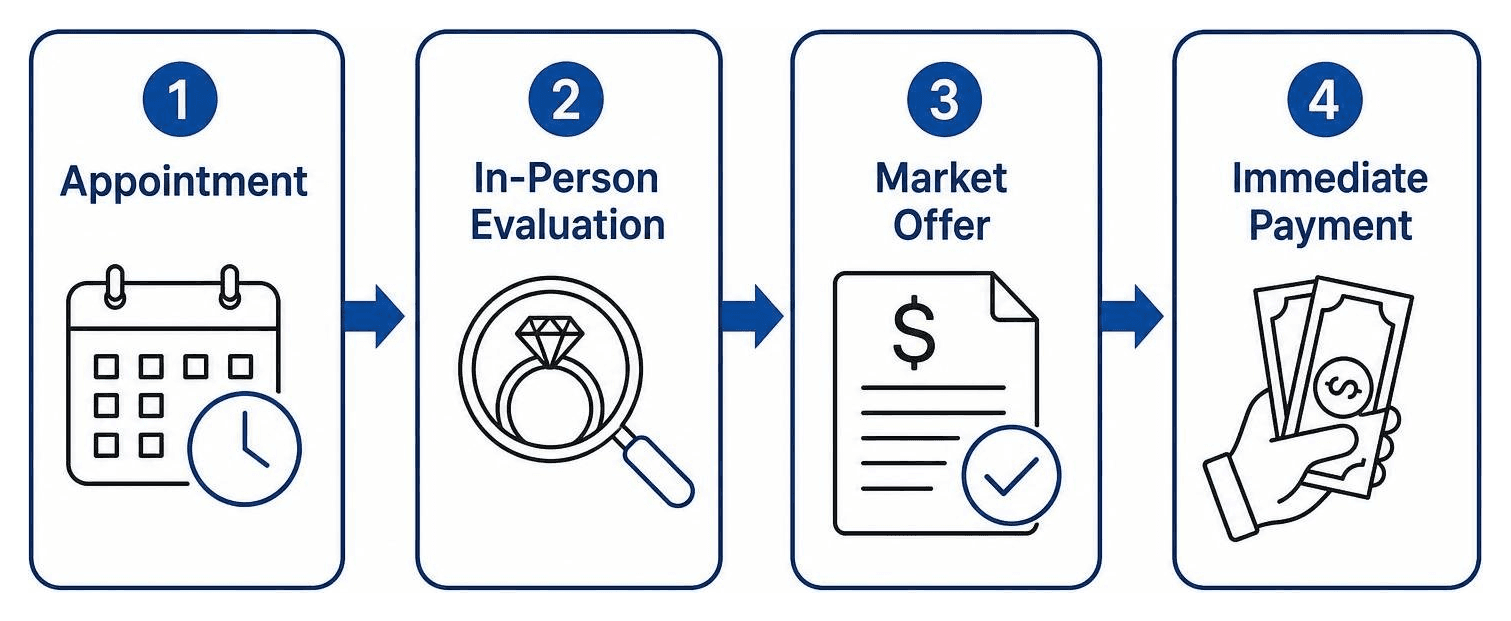
Understanding how to sell diamonds empowers you to stay in complete control of the transaction from start to finish.
In-Person Appraisals and Instant Offer Formulations
When you arrive at the store, the evaluator will explain how to appraise jewelry based on the physical characteristics of your piece:
Cleaning & Preparation: The ring is ultrasonic-cleaned to remove dirt and oils so the diamond's true color and clarity can be examined.
Loupe & Microscope Inspection: The specialist inspects your stone under 10x magnification to examine facet symmetry, polish, girdle inscriptions, and internal clarity characteristics.
Metal Testing: The mounting is tested (often via non-destructive electronic testing or acid scratch testing) to verify gold or platinum purity.
Real-Time Valuation: When you ask them to appraise my diamond, the specialist consults current wholesale diamond indices and secondary market trading data to formulate a firm cash offer.
Paperwork, Verification, and Immediate Payment Options
Once an offer is presented, there should never be any pressure to accept. If you decide to move forward:
Identity Verification: Per local secondhand dealer laws, you will provide a valid government-issued photo ID (driver's license or passport).
Bill of Sale: A brief purchase agreement is drawn up detailing the jewelry specifications, purchase price, and transfer of ownership.
Payment Disbursement: When choosing where to sell fine jewelry, confirm payment methods in advance. Professional buyers provide immediate payment via your choice of cash, cashier’s check, or direct bank wire transfer before you leave the office.
Frequently Asked Questions About Selling Diamond Rings Locally
Can I Sell a Diamond Ring Without Original Paperwork or GIA Certification?
Yes. While having original grading certificates, retail receipts, or warranty cards makes the evaluation faster, it is not required. Reputable diamond buyers have certified gemologists who can verify the genuine diamond meaning and grade the stone's 4Cs in real time using in-house gemological tools.
How Do I Compare Multiple Local Offers to Get the Best Price?
To ensure you get top market value:
Schedule evaluations with at least two different diamond specialists or estate jewelers.
Ask each buyer for a written breakdown of what they are paying for the center diamond versus the precious metal mounting.
Educate yourself on baseline wholesale values by researching how much is a diamond of similar cut, clarity, and carat weight selling for on secondary exchanges.
Compare the final net payout amounts, ensuring no hidden appraisal or processing fees are deducted.
What Types of Diamond Rings Do Local Jewelry Stores Buy?
Professional diamond buyers purchase a wide variety of fine jewelry, including:
Modern and classic engagement rings (solitaire, halo, three-stone, and pavé settings)
A certified gia certified engagement ring of any carat weight
Vintage, Edwardian, and Art Deco cocktail rings
Diamond eternity bands and wedding rings
Inherited family heirlooms and estate pieces when selling inherited jewelry
Loose unmounted diamonds (typically 0.50 carats and larger)
Conclusion
Finding the right local jewelry store to sell your diamond ring does not have to be stressful. By seeking out credentialed, GIA-trained gemologists, verifying secondhand dealer licensing, and prioritizing transparent in-person evaluations, you can sell your fine jewelry with total confidence.
At Antwerp Diamond Store, we specialize in buying fine diamonds, luxury jewelry, high-end watches, and designer goods. We provide our clients with private, appointment-only consultations in Atlanta, GA, delivering transparent market-based valuations and immediate payouts without hidden fees or sales pressure.
Before you sell, take the time to learn how much to value a diamond ring on today's secondary market, and contact our team to schedule your confidential, no-obligation evaluation.