Estate jewelry appraisal is a formal, documented valuation of inherited or pre-owned jewelry tied to a specific purpose, such as insurance, probate, sale, or donation. The same piece can produce very different numbers because the purpose changes the value premise, and industry guidance puts liquidation value at 25% to 50% of retail while fair market value for estate settlement is often 40% to 60% of retail (estate jewelry appraisal guide).
That is why the ring in your hand can feel confusing. One family member wants a probate document, another wants a resale quote, and the insurer wants replacement value, so the numbers are not supposed to match. If you've just opened a jewelry box from a parent, grandparent, or spouse, the first job is to figure out which valuation you need before anyone starts talking price.
Table of Contents
What Estate Jewelry Appraisal Means
A real estate jewelry appraisal is not a guess, a sales pitch, or a quick “we buy” number. It is a written valuation that identifies the item, explains why it is being appraised, and ties the value to a specific market endpoint, which is why the same heirloom can be appraised differently for insurance, probate, donation, or resale (Rapaport on appraisal write-ups).
What makes it formal
A qualified appraisal has to state the purpose clearly, because value does not float on its own. For estate tax filings and charitable donations, the IRS requires a qualified appraisal for any single item or group of similar items valued over $5,000, while insurance reports are usually written at replacement value rather than resale value. That distinction matters when you are deciding whether a ring should be insured, divided, donated, or sold quickly (estate jewelry appraisal guide).
Practical rule: if the paper does not say what the appraisal is for, the number on it is easy to misread.
A person who inherits a box of rings, chains, and a diamond pendant in Atlanta or Buckhead may get a spot quote from a buyer down the street, but a formal appraisal serves a different purpose. It creates documentation that can support insurance, probate, or estate records, which are not the same as a purchase offer.
For readers in Sandy Springs, Alpharetta, Roswell, Brookhaven, and Midtown Atlanta, the confusion usually starts with a simple question: what is this jewelry worth, and worth for what? A family may need to keep it, insure it, divide it, or consider a sale, and each choice calls for a different kind of value. An appraisal helps when that next step needs a documented figure instead of a casual opinion.
If you are sorting fine jewelry from costume pieces and want a clearer starting point, a guide to what fine jewelry includes can help you sort the basics before you book an appointment.
The Four Value Definitions Every Seller Should Know
A single inherited diamond ring can carry four different values, and none of them is “wrong.” The number changes with the question being asked, which is why an insurance report, an estate report, and a buyer's offer can land in very different places.

The value premise changes the number
Replacement value answers one question, what would it cost to buy an equivalent item new today? That is the figure insurers usually want. Fair market value asks what a willing buyer and seller would agree to in an open market, which is the standard used for estate settlement and reporting tied to estate administration (estate jewelry appraisal guide, WealthManagement on jewelry in estate planning).
Liquidation value reflects a quick-sale price, and intrinsic value looks at the metal, stones, and craftsmanship without leaning on retail demand. For a diamond ring, the same item can be documented as a replacement piece for insurance, a fair market piece for probate, and a liquidation piece if the family wants cash quickly. That is why two qualified appraisers can reach different numbers and still be technically correct.
A buyer's offer usually sits in a different economic lane than a formal appraisal. The offer reflects the buyer's market, not the document's purpose.
Value Type | What It Measures | Typical Use | Range vs. Retail |
|---|---|---|---|
Replacement Value | Cost to replace with an equivalent item | Insurance | Higher than resale value |
Fair Market Value | Price a willing buyer and seller would agree on | Probate, estate settlement, donation | Below retail replacement |
Liquidation Value | Price achievable in a quick sale | Rapid resale, estate liquidation | Lower than fair market value |
Intrinsic Value | Metal, stones, and craftsmanship | Material analysis, baseline review | Usually below retail |
The estate framework uses fair market value, not sale proceeds, for reporting tied to the estate. If that is the reason you are appraising a family ring, the appraisal has to speak that language (WealthManagement on jewelry in estate planning). For a resale estimate, the question changes again, which is why a diamond resale value calculator is a different tool from a formal valuation.
When and Why to Get an Appraisal
A real estate jewelry appraisal is not a guess, a sales pitch, or a quick number. It is a report built around a purpose, and that purpose changes the value definition behind the figures. A family ring heading into probate, a necklace being insured, and a brooch being offered for resale all sit in different lanes, even if the same piece is involved.

Insurance, probate, sale, donation, and collateral
For insurance coverage and scheduling, the report should use replacement value and describe the item clearly enough that a future claim can be handled without confusion. A signed Cartier bracelet, for example, should be identified carefully, with enough detail to show what was owned and what would need to be replaced if the piece were lost.
For estate settlement and probate, the report needs to fit the estate framework and the family's reporting needs, including Form 706 when applicable. The estate jewelry appraisal guide explains that this type of appraisal serves a different purpose from insurance, and that distinction matters when the jewelry is part of an estate file or a shared inheritance.
For sale to a buyer or at auction, the question shifts to the amount a market will support. A diamond pendant divided between siblings may call for a fair market number so the family can divide value more evenly, while a family that wants to sell quickly may need a liquidation view instead. The number in the appraisal is only useful if it matches the transaction being considered.
For charitable donation, the value standard changes again. The report needs to support the donation purpose, not a resale outcome, so the appraiser has to write with that use in mind rather than with an eye toward a shop offer or auction estimate.
For using jewelry as collateral for a loan, lenders usually want clear identification, condition notes, and support for the value conclusion. That is why intended use matters so much. If the goal changes later, the older report may no longer answer the right question, and a new appraisal is usually the safer path.
For readers in Atlanta, Buckhead, Sandy Springs, Alpharetta, Roswell, Brookhaven, and Midtown Atlanta, this is usually the point where families realize that one document does not solve every problem. Insurance, probate, and sale economics each use their own logic, and a report written for one purpose will not automatically fit another. That gap between a formal appraisal number and what a seller receives is the part many people miss until they are already trying to divide, insure, or sell the piece.
Useful shortcut: decide whether your first need is protection, division, documentation, or sale, then ask for the valuation that matches that need.
For a practical starting point before you book, how to appraise jewelry gives a helpful overview of what appraisers look for and why the process starts with the intended use.
How the Appraisal Process Works Step by Step
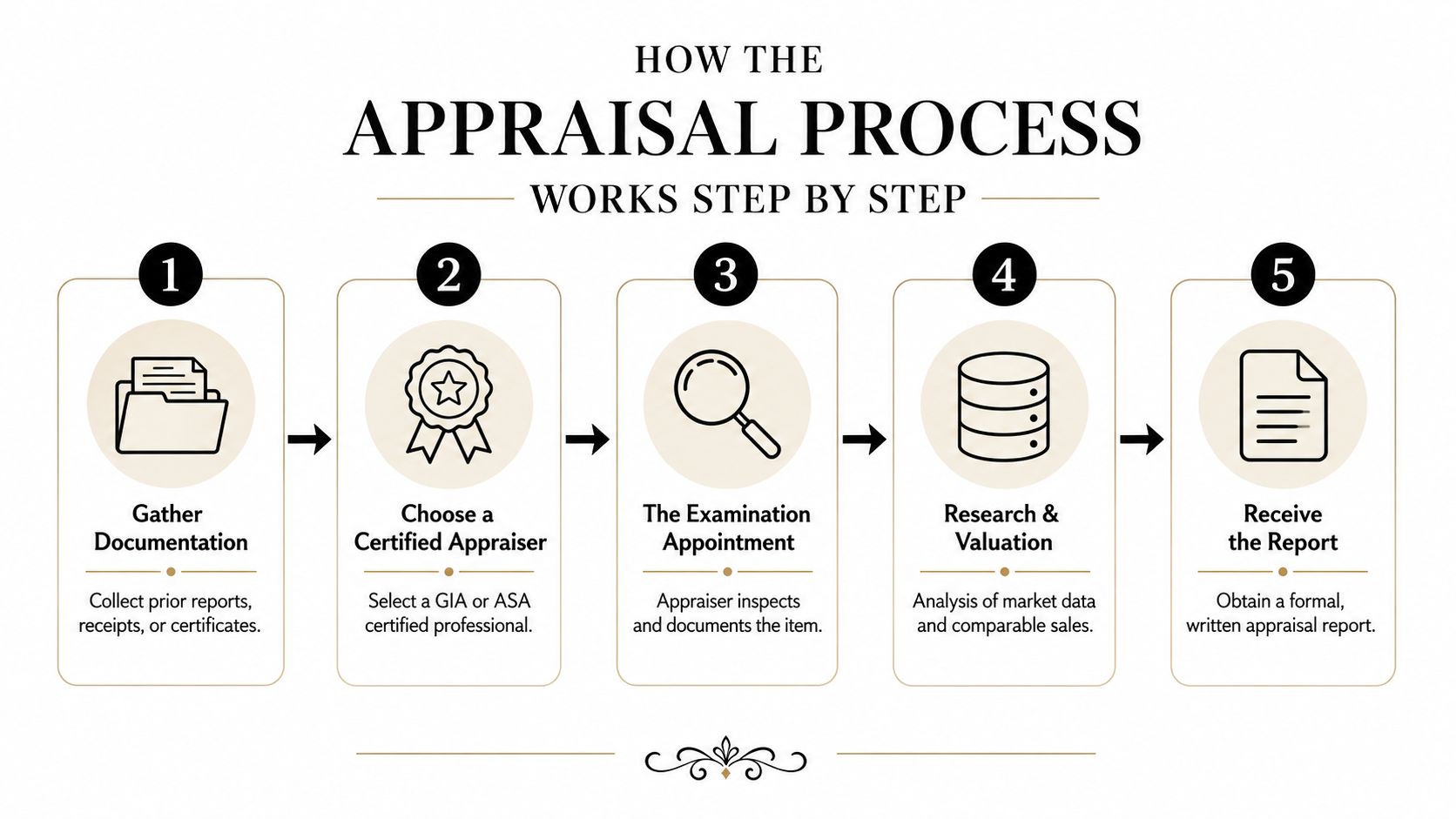
A family opens a jewelry box in Atlanta and finds a ring, a brooch, and a watch that all look valuable in different ways. The appraisal process sorts out what each piece is, what condition it is in, and which value question the report is meant to answer. That matters because a formal appraisal number and a seller's actual payout often sit in different ranges, especially in the Georgia market where people may be preparing for insurance, probate, division among heirs, or a sale.
What to bring before the visit
Bring prior reports, receipts, certificates, family notes, and any photos that show the piece being worn. If you know there were repairs, write that down. A note about a loose stone, resized shank, replaced clasp, or inherited box can save time and help the appraiser read the piece correctly, the same way a mechanic wants the service history before opening a car hood.
For a practical overview of the process, how to appraise jewelry gives a useful starting point before you book. The goal is not to arrive with a perfect archive. The goal is to arrive with the context you have, because even partial family records can help separate fine jewelry from costume pieces and point the appraiser toward the right questions.
What happens during the examination
The appraiser measures, weighs, and documents the piece, then identifies metal purity, hallmarks, construction, and condition. Diamonds are described in GIA or AGS terminology, and carat weight should be recorded to the nearest 0.01 ct (GJ appraisal report checklist). The written description should also capture dimensions, maker's marks, gross or net weight, and whether there is patina, wear, or evidence of prior repair (jewelry appraisal checklist).
A careful examination can also show why two pieces that look similar are not valued the same. A newer replacement stone, a hidden solder line, or a setting that has been repaired several times can change how the report is written and how the item is interpreted later. For larger collections, an on-site appraisal can take 2 to 4 hours, and the written report can take 1 to 2 weeks (Prism News on inherited estate jewelry). That timeline depends on how many items need to be documented and how much research is required.
A complete report should state the intended use, effective date, currency, and value label, such as Replacement Value (jewelry appraisal checklist). That is the part many people overlook when they later compare reports, and it is one reason the same ring can seem to change value on paper even though the piece itself has not changed. The written format matters as much as the inspection, much like the way how cellular gate openers work depends on both the hardware and the instructions that control it.
Costs, Credentials, and How to Choose an Appraiser
A seller in Atlanta can hold two documents that seem to disagree, yet each one may be doing a different job. One might estimate what a jeweler would charge to replace the piece for insurance purposes, while another tries to estimate what a buyer might pay in the local market. That gap is where many estate jewelry owners get confused, because the number on the page is only useful if you know what question it answers.
The right appraiser should be able to explain what they are valuing, why they are using that value premise, and how the report will be used. If they cannot answer those questions clearly, the document may not help you later, especially if you are deciding whether to sell in Atlanta, elsewhere in Georgia, or through a broader estate process.
What appraisal fees usually look like
Appraisal pricing is commonly structured as hourly rates, per-item fees, or value-based pricing. Final cost can change with travel, collection size, and report complexity. A single ring is usually simpler than a mixed estate group that includes watches, loose stones, and older jewelry that needs more research.
A proper appraisal report should identify the item type, style and era, maker's marks and hallmarks, high-resolution photographs, carat weight to the nearest 0.01 ct, diamond color on the D to Z scale, a current effective date, currency, and an explicit label such as Replacement Value. That is the kind of structure described in a jewelry appraisal checklist and a GJ appraisal report checklist. Those details matter because they show what was examined, how the piece was described, and what kind of value the report is trying to support.
Credentials and independence matter
Look for an appraiser who can explain the report in plain language, including intended use, intended user, and the method used to support the value. A strong write-up should make the logic visible, which is why clear documentation is so important in a Rapaport on appraisal write-ups. The appraiser should also be able to separate appraisal work from a purchase offer, since those are different assignments even when the same person handles both.
That distinction is easier to see if you compare it to a home inspection and a buyer's offer. The inspection tells you what condition the house is in, while the offer tells you what someone is willing to pay. Jewelry works the same way. An independent third-party appraiser evaluates and documents; a buyer evaluates with a purchase price in mind. If you want help sorting that out before you book an appointment, an independent jewelry appraiser can be a useful starting point.
Before you hire anyone, ask:
What is the intended use? A proper appraiser should ask this first.
Do you provide sample reports? That helps you judge clarity and completeness.
How do you disclose conflicts of interest? Independence should be explicit.
What methodology do you use? Comparable sales, cost, and object-specific evidence should be explained.
Do you handle mixed collections? That matters for estate boxes with jewelry and watches.
A buyer can also be honest and still have a different goal from an appraiser. A person making an offer is focused on the transaction in front of them, while an appraiser is supposed to document the piece in a way that can stand up later when a family member, insurer, or estate attorney reviews it. That is why sellers in Atlanta and greater Georgia often do better when they treat appraisal as a separate step before they decide where to sell.
Common Mistakes, Misconceptions, and Red Flags
One of the easiest mistakes to make is reading a formal appraisal as if it were a cash offer. The number on the page may be higher or lower depending on the value definition used, and it often serves a different purpose than the price a buyer will pay. Insurance replacement value, fair market value, and liquidation value do not behave the same way, so the figure in the report should be matched to the reason you asked for it. That gap matters in Atlanta and across Georgia, where families often need one document for estate records and a different number for a sale decision.
Old appraisals, vague reports, and online-only shortcuts
An older appraisal can still be useful for family history, but it should not be treated as a current price. Jewelry condition changes, market conditions shift, and the date tied to the opinion matters just as much as the number itself. A report without a clear effective date leaves too much room for confusion, especially if heirs, attorneys, or insurers are trying to rely on it later. A vague document that skips methodology or does not explain the value premise is just as weak.
Online-only valuations can help you get a rough starting point, but they are not the same as a written appraisal that is built for legal, tax, or insurance use. For items that need an IRS-qualified appraisal, the report has to do more than estimate value in passing. It needs to be specific, documented, and tied to the intended use (jewelry appraisal guide).
Red flags include:
No intended use stated on the report
Missing effective date
No methodology or comparable basis
Overly generic descriptions
The appraiser is also the buyer
That last point causes a lot of confusion. A person can make an honest offer and still be working from a different goal than an appraiser. The offer is about what that buyer will pay right now. The appraisal is supposed to document the piece in a way another reader can understand later.
If the report does not explain why the value was chosen, the number is easy to misuse.
Another common mistake is cleaning inherited jewelry before anyone has examined it. Surface wear, patina, and repair traces can help identify age, authenticity, and prior work. Removing those details can make the item harder to evaluate and can weaken the report if someone later asks how the opinion was formed. Bring the piece as it was found, and include boxes, receipts, letters, or family notes if you have them.
It also helps to check whether the appraisal date matches the question you are trying to answer. A document prepared for insurance, probate, donation, or equitable division may not solve a resale problem, even if the piece is the same one. Families in Atlanta, Buckhead, Sandy Springs, Alpharetta, Roswell, Brookhaven, and Midtown Atlanta often run into this when the estate file looks complete but the sale process still needs a separate market conversation. That difference is easy to miss if the report sounds official but does not fit the job.
For many heirs, the safest habit is simple. Read the intended use first, then read the value definition, then decide whether the report matches your purpose. A clear appraisal should help answer a specific question, not leave you guessing what the number was meant to do.
How Antwerp Diamond Fits Into the Appraisal Picture
A buyer's evaluation and a formal appraisal serve different ends, but they can work together when you're deciding what to do with inherited jewelry. If you need a resale-oriented opinion first, Antwerp Diamond offers a free online evaluation as a starting point, then follows with private in-person appointments in Buckhead, Roswell, Las Vegas, Fort Lauderdale, and Houston, plus insured shipping for remote clients.
Where a buyer's offer fits
Antwerp Diamond's specialists review current pricing data, item condition, brand authenticity, and serial-number verification to create no-obligation offers. That's useful if you want a realistic resale number before you commit to a formal report or a sale decision. It's a different value type from replacement value or fair market value, so it should be used as a buyer perspective, not as a substitute for a written appraisal.
That distinction matters for Atlanta, Buckhead, Sandy Springs, Alpharetta, Roswell, Brookhaven, and Midtown Atlanta sellers who are comparing inherited jewelry, designer watches, and other luxury items. A buyer quote helps with resale planning. A formal appraisal helps with insurance, probate, donation, or recordkeeping.
Antwerp Diamond's recent acquisitions have included Audemars Piguet, Cartier, Hermès, and diamond jewelry, which shows the brand focus on luxury goods and high-value pieces. The business is independent and not affiliated with the brands it references. That independence is important, because authentication and pricing should stand on their own merits.
Use a buyer evaluation when you want to understand what the market might pay. Use a formal appraisal when you need a documented value for a specific purpose.
If you already have an estate appraisal and want to know whether a cash offer lines up with it, comparing the two side by side can be helpful. The appraised value may be appropriate for insurance or estate settlement, while the buyer's number reflects the economics of a purchase today. That gap is normal, and it doesn't mean either document is mistaken.
Frequently Asked Questions and Next Steps
An estate jewelry appraisal often raises the same practical questions, and the answer usually depends on purpose. A report for insurance, probate, donation, or family division is not a live market quote, so the number on the page should be read the same way you would read a label on a bottle of wine, as information tied to a specific use and date, not as a promise of what someone will hand over in cash.
How often should an estate jewelry appraisal be updated? Usually when the purpose changes, the condition changes, or the report is old enough that the market context no longer feels current. An appraisal is tied to a date and intended use, so an older report should not be treated as a current selling price.
Is a formal appraisal required to sell jewelry? No. You can sell without one, but a formal report gives you written support when you need documentation for insurance, probate, donation, or family division. A buyer's offer and an appraisal serve different jobs, and that difference matters when you are comparing a resale number with a document prepared for legal or administrative use.
Does inherited jewelry have to be reported on Form 706? Jewelry included in an estate is part of the estate whether or not it carries sentimental value. The reporting framework uses fair market value, not what you might receive in a quick sale, when personal property is listed. As noted earlier, WealthManagement on jewelry in estate planning discusses that distinction in estate planning terms.
Does a buyer's written offer count as an appraisal? No. A written offer can help you understand what a seller might pay today, but it does not replace a formal document that states the intended use, methodology, and effective date.
If you are in Atlanta, Buckhead, Sandy Springs, Alpharetta, Roswell, Brookhaven, or Midtown Atlanta, the next step is usually simple. Start with a free online evaluation from Antwerp Diamond or book a private in-person appointment. Remote sellers can also use insured shipping, and you can request a no-obligation offer before deciding whether to sell. For a practical comparison between a resale quote and a formal report, review where to sell jewelry online before you choose how to proceed.
If you want a careful second opinion on inherited jewelry, Antwerp Diamond can review your item, explain the resale side clearly, and help you understand how that differs from a formal appraisal. Visit Antwerp Diamond to start with a free online evaluation or arrange a private appointment in person.