

An independent jewelry appraiser usually charges $75 to $200 per hour or $50 to $150 per item, and the right one gives you an unbiased opinion because they are not involved in buying or selling your jewelry. That independence matters when you need a value you can trust for insurance, estate planning, legal matters, or understanding what you own.
A lot of people start in the same place. You open a box from a family estate, find an old diamond ring in a drawer, or realize your insurance policy asks for an appraisal. Then the confusion begins. Is the jeweler who offered a free appraisal really appraising it, or trying to buy it? Is the number on the paper supposed to reflect replacement cost, resale value, or something else entirely?
The answer usually comes down to one word: independence. If the person valuing your jewelry also wants to buy it, sell it, trade it, or use it to generate a sale, you need to slow down and ask better questions.
Table of Contents
What Is an Independent Jewelry Appraiser?
You inherit your grandmother's ring. It looks important, maybe old, maybe valuable, but you don't know whether it's a diamond, what the metal is, or what kind of document you need for insurance. That is where an independent jewelry appraiser comes in.
An independent jewelry appraiser is a professional whose job is to evaluate jewelry and provide an opinion of value without trying to buy or sell the piece. That separation is the foundation of trust. You are paying for expertise and documentation, not sitting through a sales conversation.
A proper appraisal is different from casual advice at a jewelry counter. The appraiser examines the item, identifies the materials, studies workmanship and condition, and prepares a written report tied to a specific purpose. That purpose could be insurance coverage, estate settlement, donation, or another formal use.
Practical rule: If the person valuing the piece also hopes to profit from acquiring it, their opinion and your interests are no longer perfectly aligned.
That doesn't mean every jeweler is untrustworthy. It means the role matters. A store that sells jewelry serves one function. An independent appraiser serves another.
This distinction becomes even more important with fine jewelry, antique pieces, signed designer items, and diamond jewelry where quality differences can significantly affect the result. If you're still learning the basics of what qualifies as valuable jewelry, this guide to fine jewelry basics is a useful starting point before you book an appraisal.
What Are the Different Types of Jewelry Appraisals?
One of the biggest mistakes first-time clients make is assuming jewelry has one fixed number attached to it. It doesn't. The value depends on why the appraisal is being written.
Why one ring can have different values
Take a diamond ring as an example. If you need to insure it, the appraiser may be estimating what it would cost to replace that item in the appropriate retail market. If the ring is part of an estate, the assignment may call for a different standard of value. If you're trying to sell quickly, the number you're hoping to realize is different again.
That isn't a trick. It's normal appraisal practice.
The right appraisal starts with the right question. Not "What is this worth?" but "Worth for what purpose?"
If your goal is insurance, it also helps to understand how scheduled coverage works. A plain-language overview of Florida All Risk valuables coverage gives a helpful look at why insurers ask for detailed item descriptions and valuation documents.
The four common appraisal purposes
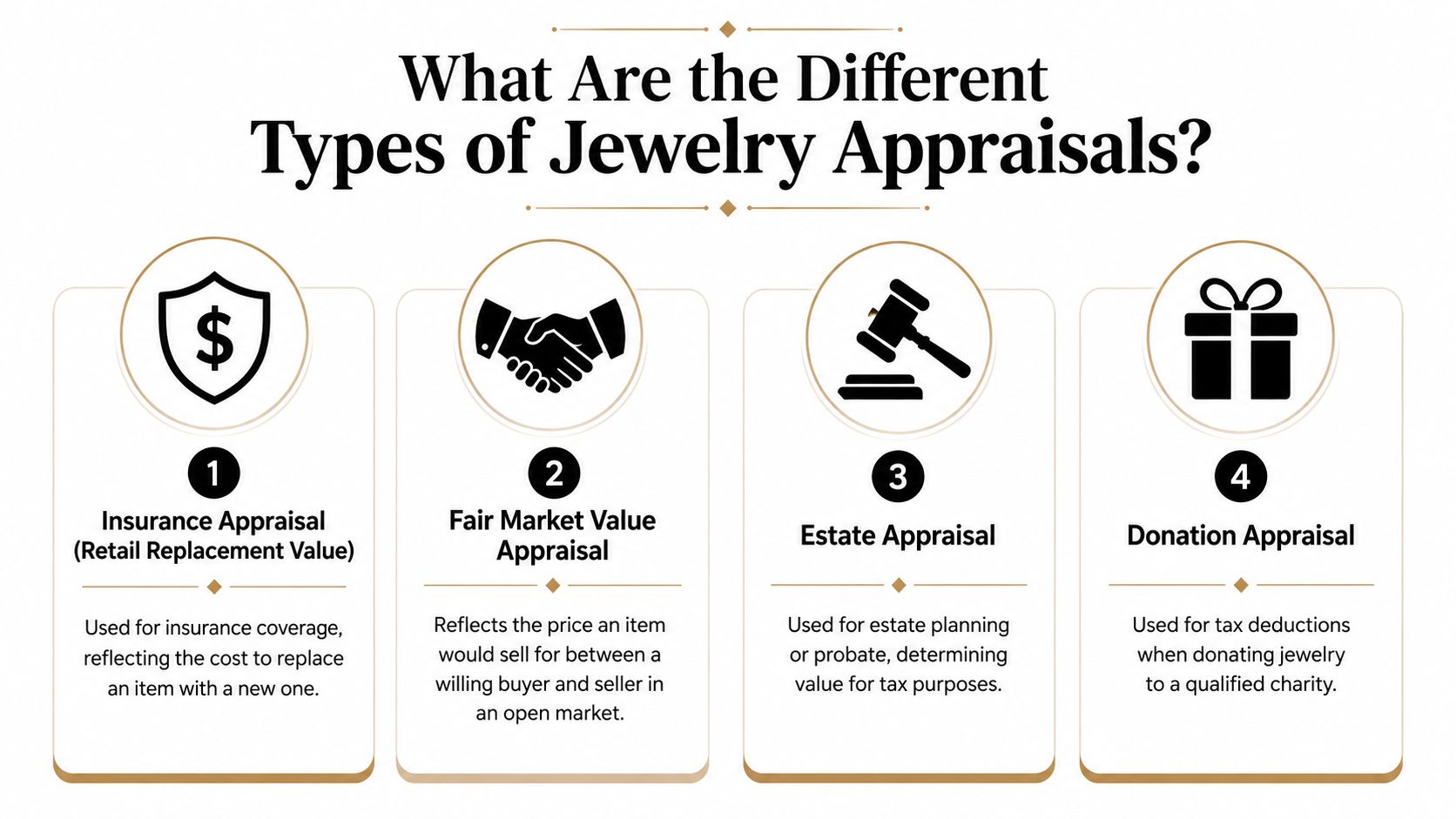
Appraisal type | What it is used for | What to expect |
|---|---|---|
Insurance appraisal | Insurance coverage and replacement planning | Usually focused on what it would cost to replace the item with one of like kind and quality |
Fair market value appraisal | Situations such as estate matters or certain legal contexts | Based on a market transaction between a willing buyer and willing seller |
Estate appraisal | Estate planning or probate use | Tailored to the estate purpose and reporting requirements |
Donation appraisal | Charitable contribution documentation | Prepared for donation-related valuation needs |
A few points often confuse people:
Insurance value isn't a resale promise. It's written for replacement, not for what a buyer will hand you today.
Fair market value is context-driven. It reflects a specific type of transaction, not a generic guess.
Estate work needs careful wording. The intended use should be clear before the appraiser starts.
Donation appraisals are specialized. If that's your reason, say so upfront.
When you call an appraiser, tell them the actual reason you need the report. That single step prevents many expensive misunderstandings.
What Credentials Should a Jewelry Appraiser Have?
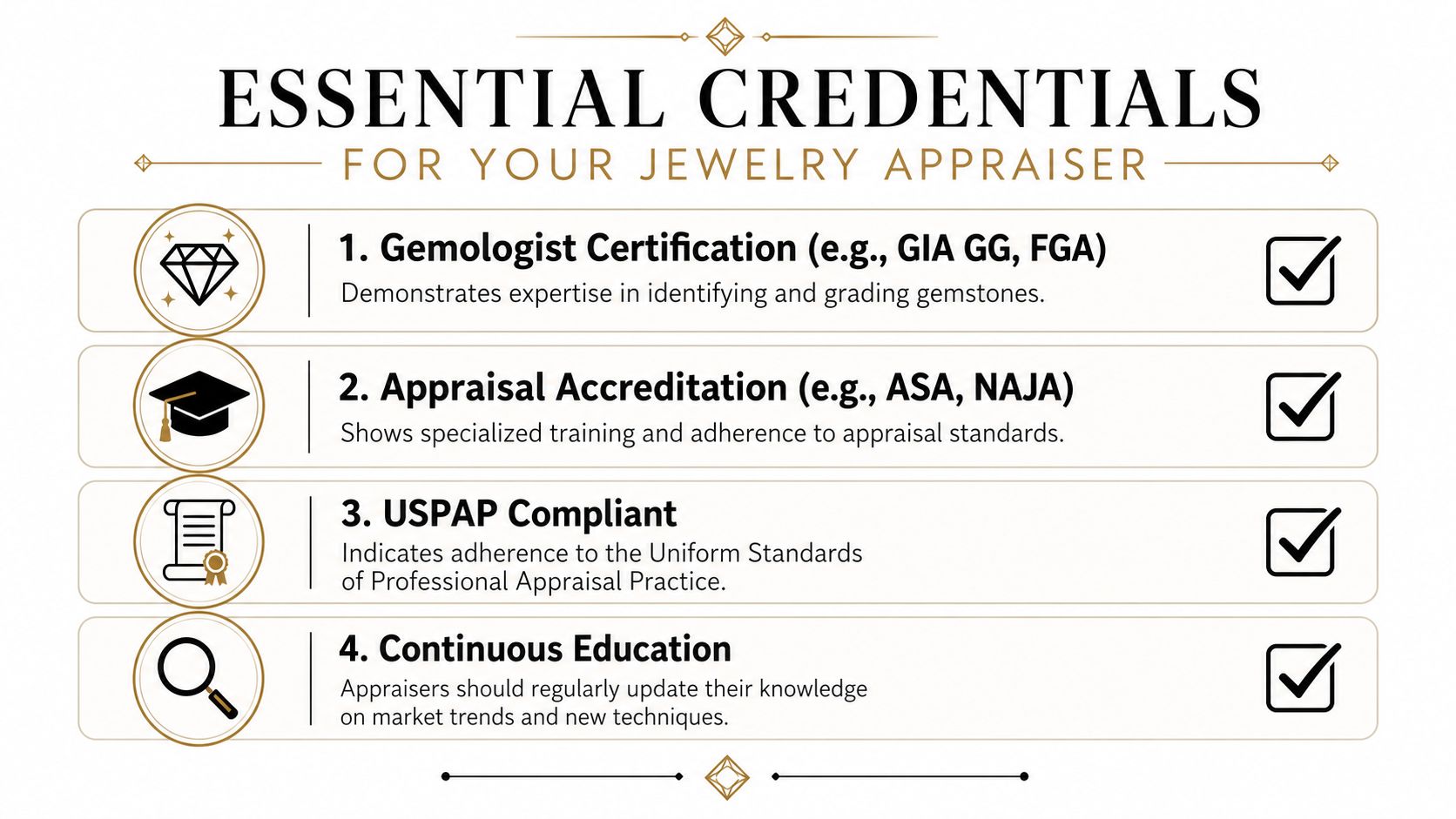
The jewelry appraisal field can confuse consumers because there is no federal or state requirement mandating certification for jewelry appraisers in the United States, which is why credentials matter so much. The industry guidance from Jewelers of America explains that a credible appraiser should have at least a Graduate Gemologist (G.G.) diploma from GIA or equivalent training and active membership in organizations such as NAJA, AGS, ISA, or ASA, which require adherence to USPAP standards in professional practice and ethics, as outlined by Jewelers of America on jewelry appraisals.
The baseline training to look for
The first thing I want to see is gemological training. A person cannot competently appraise diamond jewelry, colored stone jewelry, or fine estate pieces if they cannot correctly identify and grade what they are looking at.
A GIA Graduate Gemologist credential is a strong baseline because it shows formal study in gemstone identification and grading. If you're evaluating diamond paperwork and quality terminology before or after an appraisal, this overview of a GIA certified engagement ring can help connect the grading side to the valuation side.
Here is a practical checklist:
Gemological education: Look for a G.G. diploma or equivalent training.
Appraisal organization membership: NAJA, AGS, ISA, or ASA are meaningful names to verify.
USPAP compliance: This signals the appraiser follows recognized standards for ethics and report writing.
Relevant experience: Antique jewelry, modern diamond jewelry, luxury watches, and signed designer pieces don't all require the same background.
Why appraisal memberships matter
Membership alone isn't magic, but it is evidence that the appraiser participates in a professional framework. That matters because, in an unlicensed environment, consumers need outside ways to judge competence and ethics.
The American Society of Appraisers notes that Accredited Members need at least two years of full-time appraisal experience and Accredited Senior Appraisers need five years, and it also explains that the NAJA Certified Master Appraiser credential requires completion of the NAJA Appraisal Studies Course and a practical appraisal examination. Those details are useful benchmarks when you're vetting experience through the American Society of Appraisers gem and jewelry appraiser information.
A few designations and concepts deserve plain-English translation:
ASA points to structured appraisal training and experience.
NAJA is a recognized jewelry-specific appraisal organization.
ISA is another respected appraisal body for personal property.
USPAP is the ethical and performance standard serious appraisers follow.
ICGA is especially important if independence is your main concern because it signals the appraiser does not buy or sell jewelry.
If someone can't clearly explain their credentials, or seems irritated that you asked, keep looking.
Independent Appraiser vs Jewelry Buyer What Is the Difference?
People often find this confusing. Both an appraiser and a buyer may look at your ring, ask about paperwork, inspect the mounting, and talk about diamonds or gold. But they are doing different jobs for different reasons.
The simplest way to tell them apart
An independent appraiser sells an opinion of value. A jewelry buyer makes an offer to purchase.
Those are not the same service, even when the inspection looks similar from the outside.
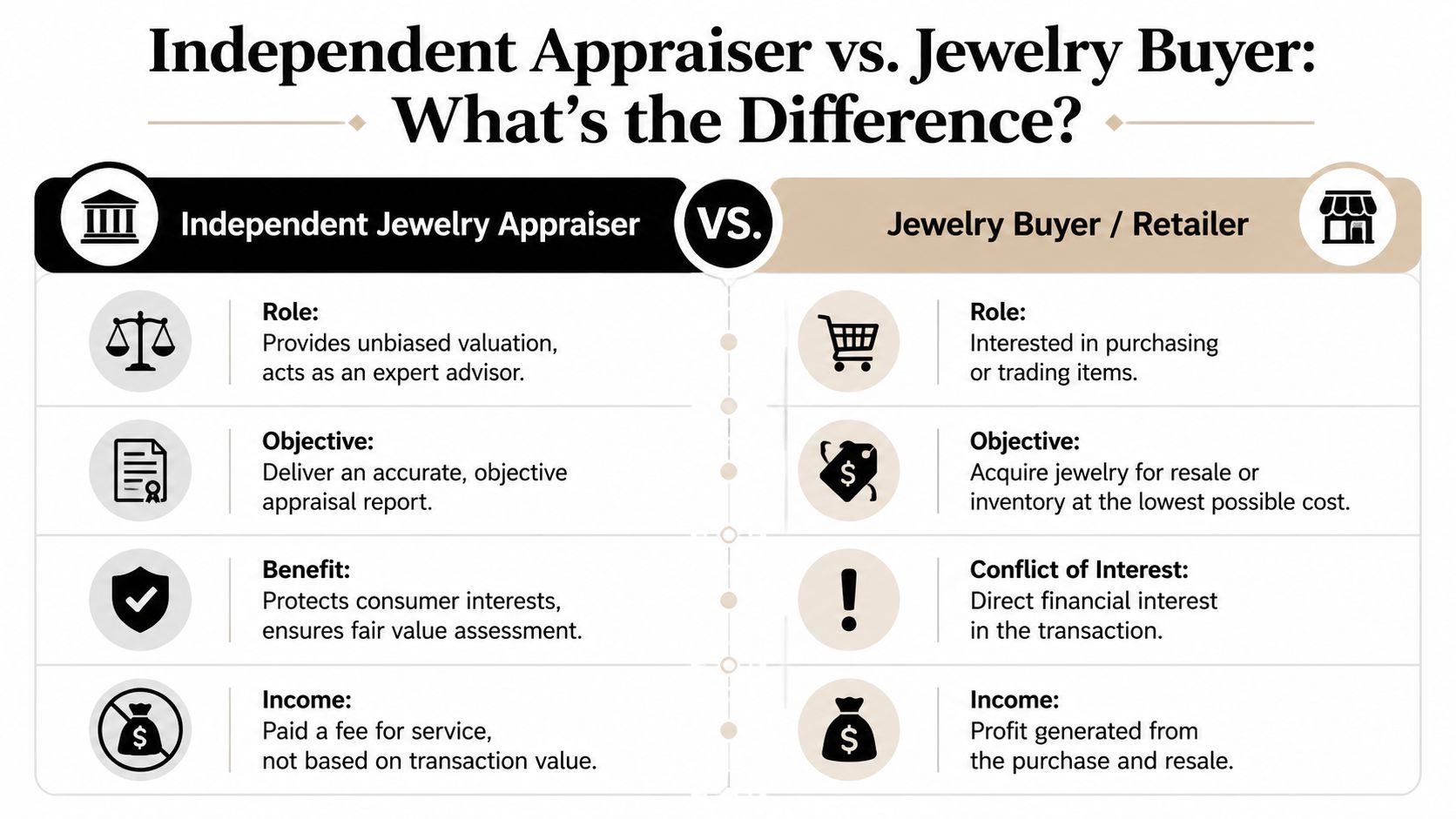
Question | Independent appraiser | Jewelry buyer |
|---|---|---|
Primary role | Evaluate and document value | Purchase for resale, inventory, or refining |
How they get paid | Fee for professional service | Profit on the transaction |
Main output | Written appraisal report | Offer amount |
Whose side they are on | Hired to provide an objective opinion | Acting in a transaction with their own financial interest |
Best use case | Insurance, estate, legal, documentation | Selling jewelry, gold, diamonds, watches, or luxury items |
A buyer may be honest and experienced. In fact, many are very skilled at evaluating current resale demand. But a purchase offer is still a purchase offer. It is not a neutral appraisal for insurance or estate use.
If your real goal is selling, you should absolutely seek a qualified buyer. Just don't confuse a buying conversation with an independent valuation. If you're preparing for that step, this guide on where to sell fine jewelry helps explain what serious buyers look for.
How to spot a salesperson disguised as an appraiser
The warning signs are often subtle.
A person says the appraisal is free, but quickly shifts into what they can pay you. Or they avoid discussing report standards and instead talk about how hard the item will be to resell. Or they offer to "help" by valuing it and buying it in the same breath.
The core consumer risk is clear: there is no federal license for jewelry appraisers in the U.S., and USPAP forbids fee structures based on the final appraised value, a key protection against inflated or biased results from anyone with a sales incentive, as discussed in this explanation of how to appraise your appraiser and why USPAP matters.
Use this simple test:
If they charge a percentage of value, walk away.
If they want to buy the item while calling themselves independent, ask for clarity.
If they won't show credentials, walk away.
If they won't state the purpose of the appraisal in writing, walk away.
If "free appraisal" leads straight to a purchase pitch, treat it as a sales appointment.
A real independent appraiser is comfortable being paid only for judgment, documentation, and time.
That independence is why insurers, attorneys, and families handling estate matters often prefer a separate appraiser first, then a separate buyer later if the item will be sold.
What Happens During a Professional Appraisal?
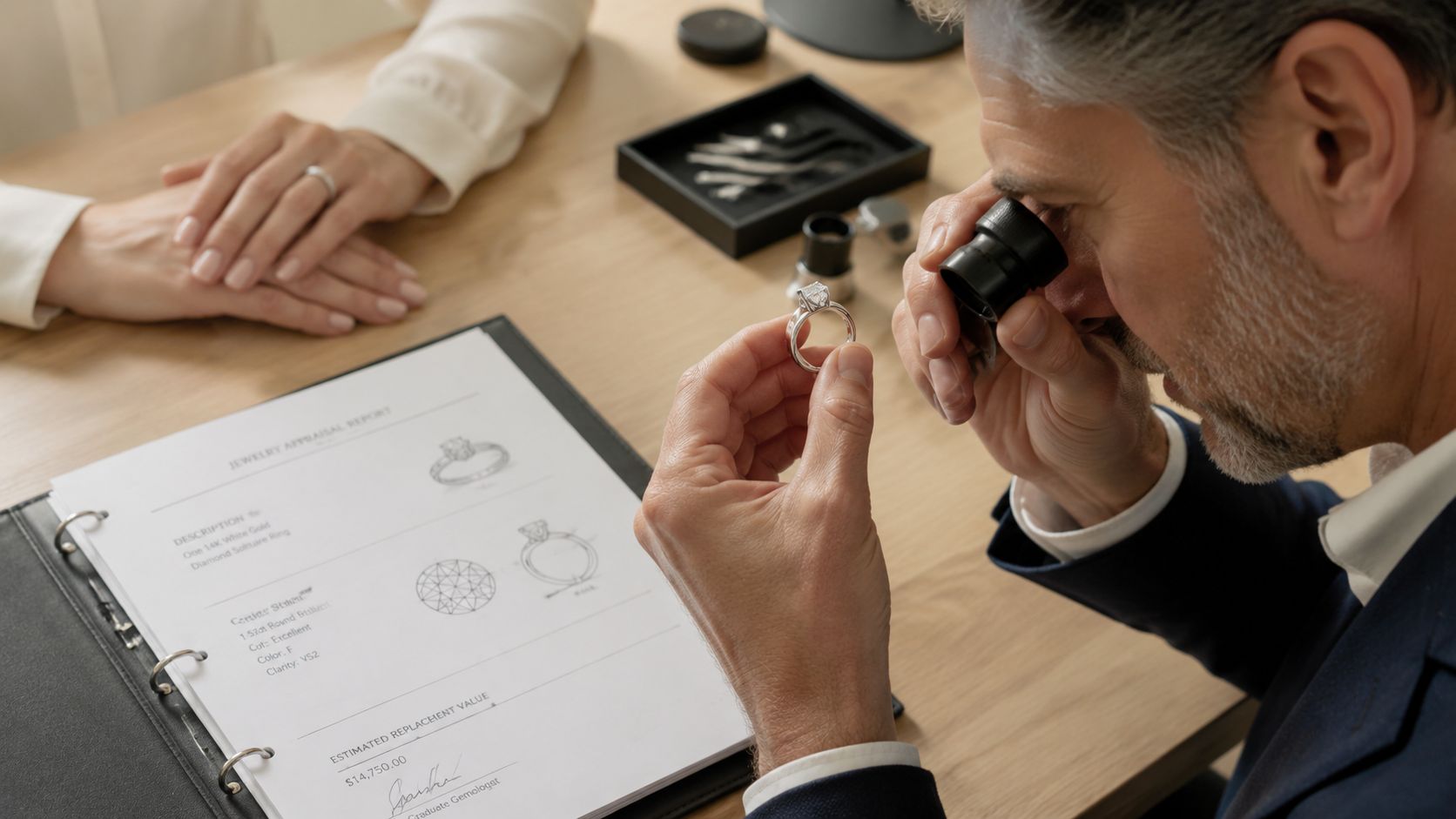
Most first-time clients expect an appraisal to be quick and mysterious. In reality, a professional appraisal is methodical. Good appraisers work like investigators. They observe, test, measure, compare, photograph, and document.
What to bring and how to prepare
Bring the jewelry itself, of course, but also bring anything that helps establish identity or history. That may include an older appraisal, a diamond grading report, a sales receipt, brand documentation, repair records, or prior insurance paperwork.
Don't scrub antique or delicate pieces aggressively before the appointment. Light cleaning may be fine, but heavy polishing can sometimes remove clues or worsen wear on fragile settings.
A typical prep list looks like this:
Bring documents: Old appraisals, receipts, grading reports, and brand papers can help.
Bring matching pieces together: Earrings, suites, and sets should stay together.
State your purpose clearly: Insurance, estate, donation, or resale planning changes the assignment.
Ask about turnaround time: Some reports are produced quickly, while others require more research.
For a broader overview of the process itself, this article on how to appraise jewelry gives a useful companion read.
What the appraiser actually does
A competent appraisal requires specialized tools. Professional setups commonly include a binocular microscope, refractometer, precision scale, and synthetic diamond screener, and the equipment investment for a proper lab setup ranges from $10,000 to over $15,000, according to this discussion of equipment used by independent appraisers.
That equipment supports several tasks:
Identification
The appraiser determines whether the stones are diamond, sapphire, emerald, or another material, and whether metal appears to be gold, platinum, or silver.Measurement and grading
Stones are measured, mounted items are assessed carefully, and quality factors are recorded.Condition review
The appraiser notes chips, abrasion, worn prongs, previous repairs, or replacement parts.Photography and documentation
The final report should include clear images and a detailed written description.
This short video gives a visual sense of what a professional evaluation environment can look like.
A strong report should let another professional understand what the item is, how it was identified, and what kind of valuation was developed. That report is the core product you are paying for.
How Much Does a Jewelry Appraisal Cost?
For most consumers, this is the first practical question. The short answer is straightforward: an independent jewelry appraisal typically costs $75 to $200 per hour or $50 to $150 per item, and reputable appraisers use fixed fees rather than charging a percentage of the jewelry's value, as explained in this guide to independent jewelry appraisal pricing.
Common pricing models
Most independent appraisers charge in one of two ways:
Hourly billing: Common when a piece is complex or when several items need to be reviewed.
Per-item pricing: Often used for straightforward single pieces such as a ring, pendant, or bracelet.
Both methods can be legitimate. What matters is that the fee is based on time or item count, not on how high the appraiser can push the number.
Percentage-based pricing is a conflict problem, not a luxury feature.
What affects the final fee
Not every appraisal takes the same amount of work. A simple wedding band and a signed vintage Cartier brooch aren't comparable assignments. The fee can vary based on the item's complexity, how many pieces you bring, the appraiser's qualifications, and geographic market.
In larger metro areas such as Atlanta, Buckhead, Sandy Springs, Alpharetta, Roswell, Brookhaven, Midtown Atlanta, and the broader Georgia market, you'll often find rates that align with these national ranges, especially when the work involves detailed gemological examination and formal written reporting.
You may also encounter reduced pricing for multiple items in one appointment. Some firms offer lower per-item rates after the first piece because batch work can be more efficient while still requiring careful documentation.
If you own more than jewelry, the same pricing logic often applies to luxury watches and other valuables. This example of a watch appraisal process shows how condition, documentation, and model details can influence evaluation work across categories.
Frequently Asked Questions About Jewelry Appraisals
How often should jewelry be re-appraised
There isn't one universal schedule. Insurance companies may have their own requirements, and market conditions can change over time. If the piece is important, ask both your insurer and your appraiser when an update makes sense for your situation.
Can an appraisal be done from photos
Photos can help with a preliminary conversation, but a serious appraisal usually requires in-person examination. An appraiser needs to inspect condition, measurements, mountings, gemstone identity, and other details that images often miss.
Does an appraisal guarantee a selling price
No. An appraisal is an opinion of value for a stated purpose. A selling price depends on buyer demand, brand, condition, documentation, timing, and the specific market where the item is offered.
How do I find an appraiser near me
Start by verifying credentials and association memberships, then confirm that the person is independent and not trying to buy the item. When seeking an appraiser in Atlanta, Buckhead, Sandy Springs, Alpharetta, Roswell, Brookhaven, Midtown Atlanta, or elsewhere in Georgia, inquire whether they handle your type of piece, such as diamond jewelry, antique jewelry, luxury watches, or estate collections.
A good screening script is simple:
Ask what credentials they hold
Ask whether they buy or sell jewelry
Ask whether they follow USPAP
Ask what kind of report you will receive
Ask how they charge
Is a free appraisal ever really free
Sometimes it is free because it isn't an appraisal in the formal sense. It may be a sales consultation or a purchase evaluation. That can still be useful if your goal is to sell, but it should not be confused with an independent written appraisal.
Should I bring my original diamond grading report
Yes, if you have one. A grading report can provide helpful reference information. The appraiser may still need to verify details independently, but original paperwork is usually worth bringing.
Can the same person appraise my jewelry and buy it later
They can, but that changes the nature of the relationship and can introduce a conflict. For insurance, estate, or legal needs, many people prefer a separate independent appraiser first, then a separate buyer if they later decide to sell.
Conclusion Your Next Step for Valuation
If you need a value you can trust, independence is the deciding factor. A certified independent jewelry appraiser gives you an opinion that isn't tied to a purchase, a trade, or a sales quota. That's why this route makes the most sense for insurance documentation, estate matters, and any situation where objectivity matters more than speed.
If your goal is different, and you're ready to sell rather than document value, the next step isn't another appraisal. It's a real market offer from a qualified buyer who can evaluate condition, demand, brand, and resale potential.
If you want a professional, low-pressure next step, Antwerp Diamond offers confidential evaluations for fine jewelry, diamonds, luxury watches, gold, silver, and other high-value assets. Clients in Atlanta, Buckhead, Roswell, and beyond can request an in-person review or start with an online evaluation to understand their selling options clearly.