
Getting a watch appraisal in NYC usually means booking time with a qualified appraiser, bringing the watch and any paperwork you have, and paying for a formal valuation. For insurance or estate purposes, that formal appraisal typically costs $150 to $500 per watch, and in a major market like New York it can often be completed in about 1 to 3 hours when the piece is straightforward.
If you're holding a Rolex, Patek Philippe, Cartier, Omega, or another high-value watch, the question usually isn't just "what is it worth?" It's "what kind of value do I need, how fast can I get it, and how do I avoid a shallow estimate dressed up as an expert opinion?" In New York City, those questions matter because the market moves quickly, buyers are specialized, and small details like condition, service history, or missing papers can change the outcome.
A proper watch appraisal in NYC should feel calm, specific, and transparent. You should know what the appraiser is evaluating, what the fee covers, and whether the final number is meant for insurance, estate work, or a realistic sale decision.
Table of Contents
Your Guide to Luxury Watch Appraisal in NYC
People often start this process in the same way. They open a drawer, revisit a watch they haven't worn in years, or realize their insurance paperwork is outdated. In New York, the next step isn't to rely on a quick online estimate. It's to get a formal, purpose-specific valuation from someone who understands how luxury watches trade in a dense resale market.
A proper appraisal isn't only for sellers. It can also support insurance replacement value, estate settlement, or fair market value documentation. Those are different assignments, and the appraiser should say which one they're preparing before they ever quote a number.
If you're early in the research stage, it can help to compare your piece against broader discussions of value-driven luxury watches, especially if you're trying to understand where your watch sits in the wider market. If the watch is older, niche, or inherited, a more focused read on vintage watch valuation can help you spot the details that tend to matter before you book an appointment.
A good appraisal answers two questions at once: what the watch is, and what kind of value is being assigned to it.
In NYC, speed matters, but speed alone doesn't mean quality. The best outcomes usually come from a straightforward process: confirm the appraisal purpose, bring the watch and documentation, allow the appraiser to inspect condition and authenticity, and expect a written result if you need formal use. That keeps the process practical and avoids confusion later if you decide to insure, divide, or sell the piece.
How to Choose a Qualified Watch Appraiser in NYC
A client walks into a Midtown office with a Rolex inherited from his father and one direct question: “What is it worth?” In New York, the right answer starts with another question. Worth for insurance, for an estate file, or for a cash sale today. A qualified appraiser separates those assignments before examining the watch, because each one can produce a different number.
What a real appraiser evaluates
A credible NYC appraiser should explain the valuation process in plain English. One New York source notes that appraisers consider brand, model, age, condition, market demand, rarity, and authenticity, and that box and papers can materially affect the result, especially for modern luxury models. The same source also points out that formal watch appraisals are commonly prepared for insurance replacement, fair market value, and estate purposes (Gold Standard NYC watch buyer guidance).
That framework matters in this market. A modern steel sports Rolex may have a very different pricing pattern from a Cartier Tank or a Patek Philippe Calatrava, even when all three are high-quality watches. Recent volatility has made that gap more obvious. Some modern references rose too fast, then corrected, while classic dress models often saw more modest changes. An appraiser who still relies on last year's headline prices can miss the current market by a wide margin.
Condition is where experience shows. Case polish, bracelet stretch, service parts, lume changes, dial refinishing, and movement originality all affect value differently depending on the watch. On one piece, replacement hands may be a modest deduction. On another, especially a vintage example, they can change the conclusion in a serious way.
What to ask before you book
Before you leave a watch with anyone, ask a few direct questions and listen for clear answers:
What type of appraisal are you preparing? Insurance appraisals usually reflect a higher replacement cost. A purchase offer reflects real cash value in the current market.
Do you inspect the watch in person, and what do you check? The appraiser should mention case, dial, movement, serial or reference details, and signs of replacement or repair.
Will I receive a written document? If the appraisal is for insurance, estate, or legal use, a verbal estimate is not enough.
How is the fee structured? A flat appraisal fee is easier to evaluate than a vague promise tied to a future transaction.
How current is your market data? In NYC, inventory moves quickly, and expert availability matters when prices are shifting.
If I later decide to sell, do you also explain the difference between appraisal value and an offer to buy? That distinction should be clear from the start, especially if you are comparing the appraisal with options for selling a watch for instant payment.
A qualified appraiser should also be comfortable saying, “This one needs more research.” That is a good sign, not a weakness. Watches with swapped parts, uncertain provenance, or uncommon references should not receive a fast, polished number just to keep the appointment moving.
Practical rule: If someone quotes a value without asking about the reference, condition, service history, or supporting paperwork, treat it as a rough opinion, not a formal appraisal.
Preparing Your Watch and Documents for Appraisal
Clients often help or hurt their own appraisal before they walk in. The best preparation isn't complicated, but it does require restraint. Bring the watch as it is, gather whatever documentation you have, and avoid trying to "improve" it right before inspection.
What to bring to the appointment
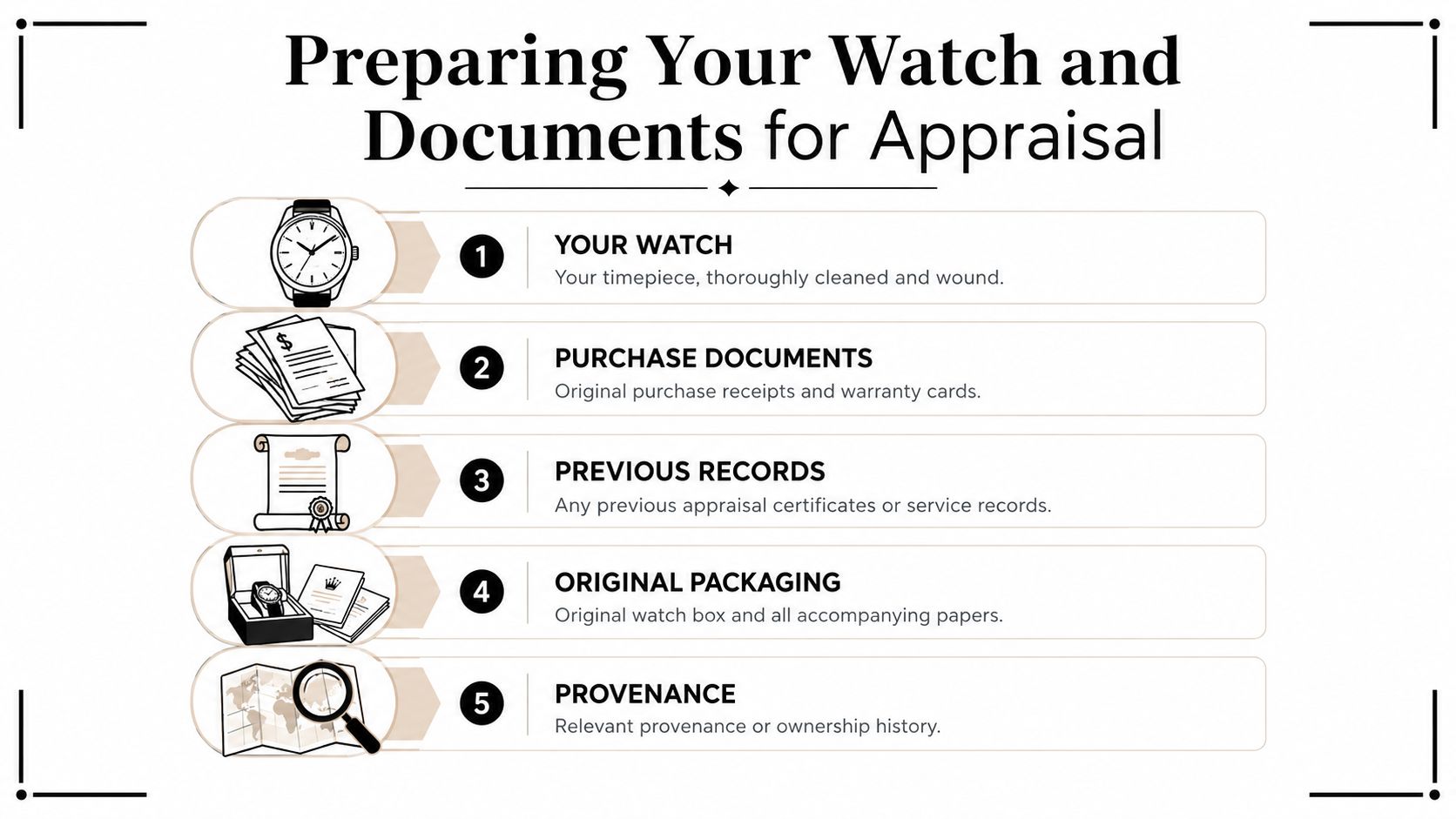
Start with the obvious item, the watch itself. Then gather the supporting pieces that help establish provenance and specification:
Original box and papers: These can strengthen buyer confidence and help confirm the exact model.
Warranty card or sales receipt: Helpful when there are questions about age or original point of sale.
Service records: Useful if the watch has had factory or independent work.
Prior appraisal documents: Not because the old number controls the new one, but because they can help clarify what was identified before.
Ownership history: Particularly useful for inherited or vintage pieces.
A first pass can also happen remotely if you're not ready to book a formal appointment. Many owners start with a preliminary review through services that explain how to get a free watch evaluation before deciding whether a full written appraisal is necessary.
What not to do before appraisal day
Don't polish the watch. Don't swap parts back and forth. Don't assume a deep clean helps. For modern pieces, aggressive cosmetic prep can hide wear patterns an appraiser needs to see. For vintage pieces, it can be worse.
One industry guide notes that certified experts in a major market like NYC can often complete an appraisal in about 1 to 3 hours, that formal appraisals are usually not free, and that they commonly cost $150 to $500 per watch. The same guide recommends updating insured-watch appraisals every 2 to 3 years to reflect market change (Big Watch Buyers appraisal guidance).
That timeline tells you two things. First, the process is often efficient when the watch is straightforward. Second, the written valuation isn't meant to last forever. If the watch is insured, inherited, or likely to be sold later, current paperwork matters.
In-Person vs Secure Mail-In Evaluation Options
For watch appraisal NYC clients, the practical question is often logistical. Do you want to sit across from the appraiser in a private office, or would you rather handle the process remotely with a secure shipping chain and documented intake?
When in-person makes more sense
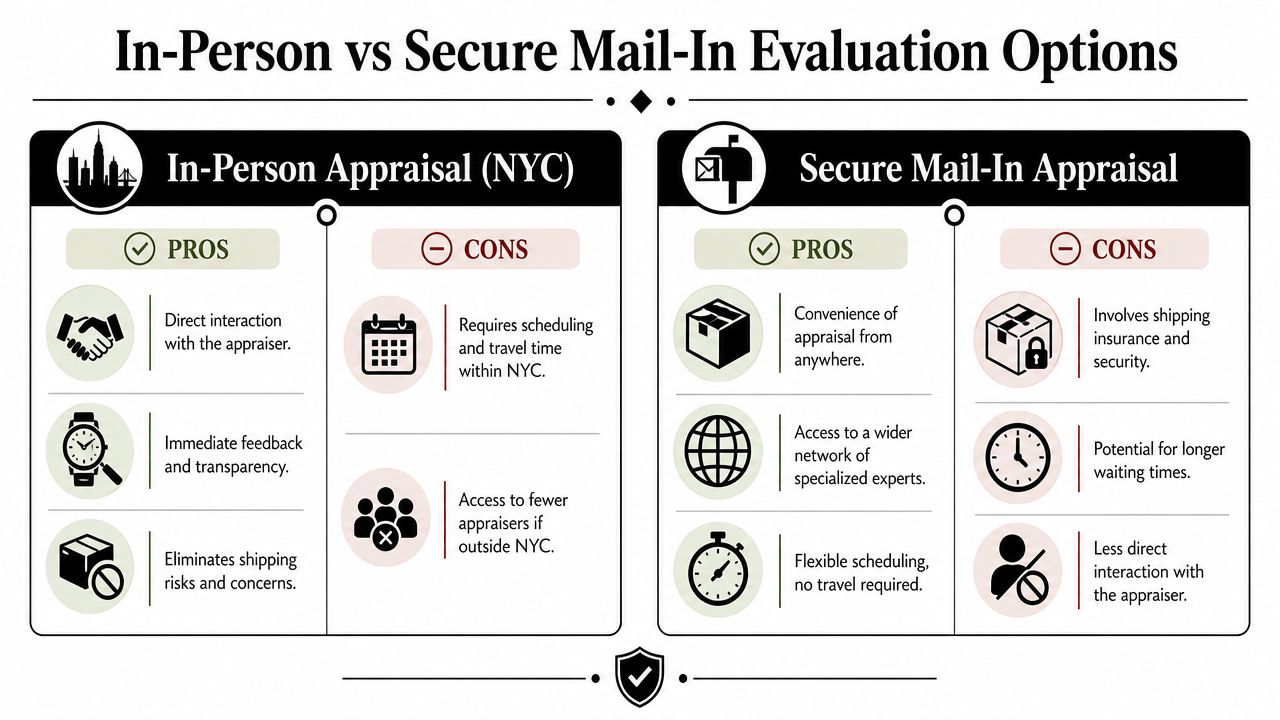
An in-person appointment is usually the right fit if you're in Manhattan, Brooklyn, Queens, or the wider metro area and want immediate clarity. You can ask questions in real time, watch the intake process, and leave with less uncertainty about who handled your piece and how.
That matters most for owners of complicated, sentimental, or very high-value watches. Face-to-face evaluation also makes it easier to discuss details like bracelet condition, replaced parts, missing links, or prior service work.
A lot of clients want to see how an expert handles a luxury watch before they commit. This short overview helps illustrate the process:
When mail-in can be the better fit
Mail-in evaluation works for clients outside NYC, for owners who prefer discretion, or for people comparing several specialists before choosing where to sell. It isn't necessarily less professional, but it does depend on clear chain-of-custody procedures, insurance, and communication.
A secure mail-in option should explain packaging, intake confirmation, and how the watch is documented once received. If that process is vague, pause. If it's structured, it can be very effective, especially for clients researching online watch buyers before moving to a formal appraisal or sale.
Option | Best for | Main advantage | Main trade-off |
|---|---|---|---|
In-person | NYC-area owners | Direct interaction and immediate discussion | Requires travel and scheduling |
Secure mail-in | Remote or private clients | Convenience from anywhere | Requires comfort with shipping procedures |
Some owners don't need a choice between speed and safety. They need a process that is explicit about both.
Understanding Appraisal Costs and Identifying Red Flags
The biggest mistake first-time clients make is assuming a watch has one true number attached to it. In practice, the fee structure, the type of report, and the purpose of the valuation all shape what you're paying for and what number you receive.
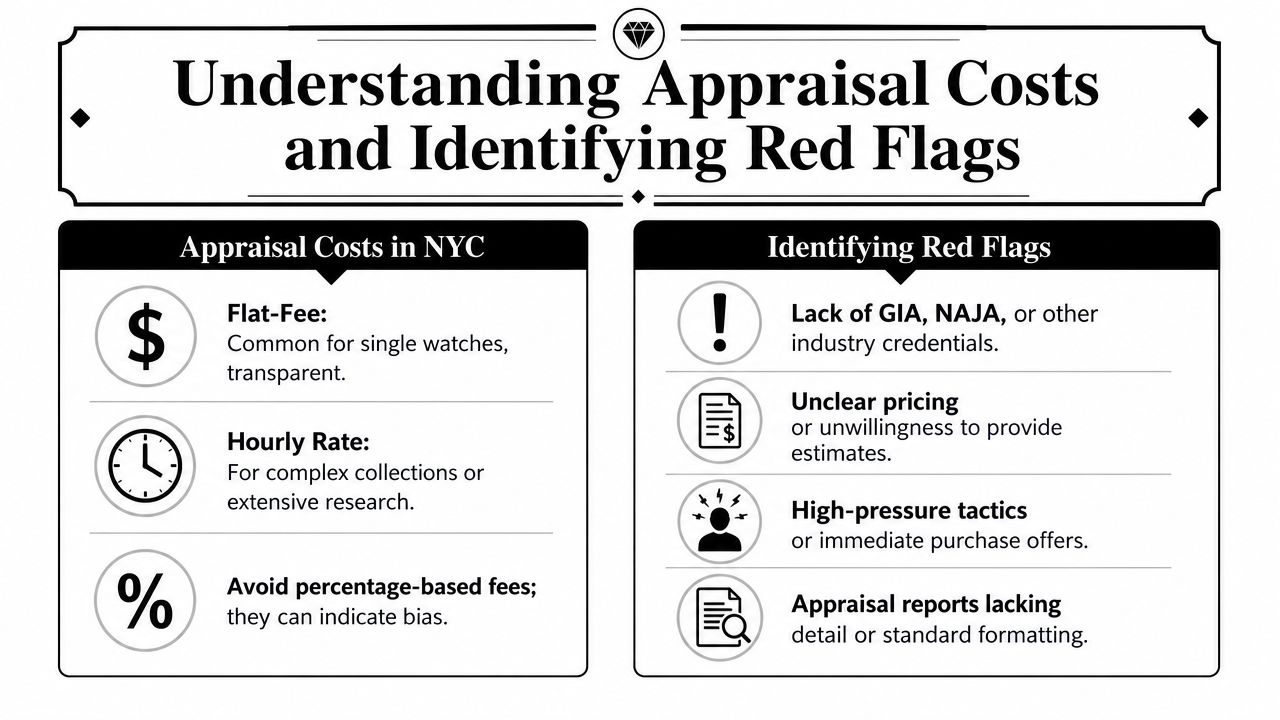
What watch appraisal fees look like in NYC
Published NYC examples show watch appraisals starting around $75, with simple non-diamond Rolex or Omega pieces around $125 to $200, and pocket or unsigned watches around $150. The same pricing discussion aligns with broader industry guidance that a flat fee of roughly $150 to $500 per watch is common, and it warns that percentage-based fees are a major red flag because they can bias the valuation (NY City Woman appraisal pricing examples).
That warning matters more than many clients realize. If the appraiser earns more by assigning a higher number, the incentive is wrong from the start. A flat fee or clearly stated hourly arrangement is cleaner.
The red flags that should make you walk away
Watch for these problems:
Percentage-based pricing: This is the clearest conflict issue.
Pressure to sell immediately: A formal appraiser shouldn't rush you into a transaction.
Vague language: If the explanation stays fuzzy, the report may be too.
No distinction between appraisal types: Insurance value and fair market value are not interchangeable.
Outdated market logic: Recent watch pricing hasn't stayed fixed.
One NYC watch appraisal source notes that the luxury watch market experienced significant post-pandemic softening, and warns that an appraisal that ignores recent trade data may overstate value, while one based only on retail may understate real saleability (Diamond Source NYC appraisal discussion).
That is the practical heart of the issue. An insurance appraisal is often built around replacement assumptions. A cash buying offer is based on what a buyer can realistically pay today after considering demand, liquidity, and resale risk. If you're exploring a sale of a modern sports model, it helps to compare that appraisal logic against real-world selling guidance for pieces like Rolex by reviewing what influences a direct sale of a Rolex watch.
If someone gives you the highest possible number without explaining the assignment type, that's usually a sales tactic, not careful valuation.
From Appraisal to Action Selling Your Luxury Watch
A common NYC scenario goes like this. You leave an appraisal appointment with a document that looks strong on paper, then a buyer quotes a lower number the same week. That gap is usually not a mistake. It reflects two different assignments.
An insurance appraisal is written around replacement cost. A purchase offer is based on real cash value today, after a buyer accounts for demand, condition, service risk, originality, and how quickly the watch can be resold in the current market. In New York, where clients often want answers quickly and qualified specialists are available, that distinction matters because the next step can happen fast.
Recent price swings have made the difference more visible, especially for modern models that moved sharply during and after the pandemic boom. If you are selling a contemporary Rolex, Patek Philippe, Audemars Piguet, or another heavily traded brand, an older valuation can set the wrong expectation. A careful buyer will price from current trading reality, not from a peak market memory.
The practical next step is to compare your appraisal with an actual buy-side conversation. Ask for the basis of the offer. Ask whether the buyer sees any deductions for polish, replacement parts, stretch, missing accessories, overdue service, or weak demand for that exact reference. Clear answers matter more than hearing the highest headline number first.
Some owners do better with consignment or auction. Others want privacy, speed, and a defined closing process. For that comparison, this guide to selling high-end watches lays out the main sale routes and the trade-offs behind each one.
Antwerp Diamond is one example of a private NYC office that handles evaluations and direct purchase discussions. The useful part is not the name. It is the process. A serious buyer should explain how they moved from your appraisal to a cash number, what market comps they are using, and whether the offer is firm, conditional, or subject to inspection.
Good appraisal work gives you a starting point. Good selling decisions come from matching that paper value to the right real-world option.
Frequently Asked Questions About Watch Appraisals
Question | Answer |
|---|---|
How long does a watch appraisal in NYC usually take? | In a major market like NYC, a straightforward appraisal can often be completed in about 1 to 3 hours when handled by certified experts. |
How much does a formal watch appraisal cost? | Formal appraisals commonly fall in the $150 to $500 range per watch, though some NYC examples start lower for simple pieces. |
Are box and papers really important? | Yes. They can materially affect how confidently an appraiser identifies and values the watch, especially for formal reports and resale discussions. |
Is an insurance appraisal the same as a cash offer? | No. An insurance appraisal is usually prepared for replacement purposes, while a cash offer reflects what a buyer can realistically pay in the current market. |
How often should I update my appraisal? | A common recommendation is every 2 to 3 years for insured watches, because market values can move over relatively short periods. |
If you'd like a clear next step, Antwerp Diamond is a practical place to start. You can request an evaluation, discuss your watch privately, and decide whether you need a formal appraisal, a market opinion, or a direct offer without pressure.


