
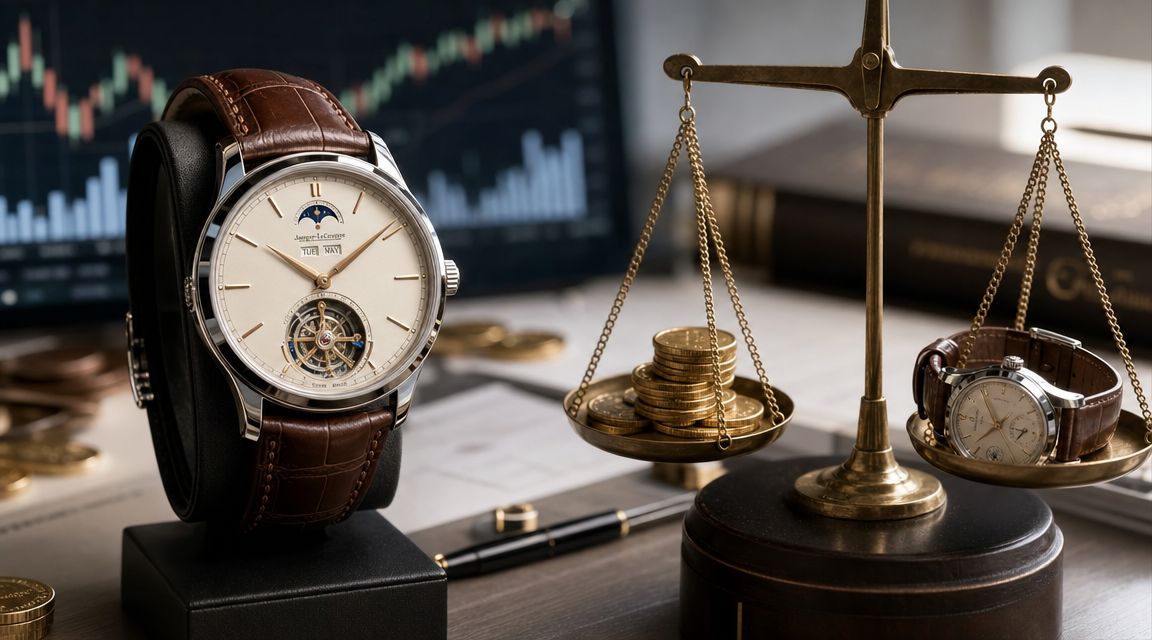
Generally, watches are not a better investment than traditional assets like stocks. A 2025 analysis found the overall watch market returned 5.68% annually, compared with 12.85% for equities and 13.06% for gold, though a few top brands such as Audemars Piguet and Patek Philippe came much closer to stock-market performance.
That's the right lens for this topic. A good watch can be a store of value, a wearable luxury asset, and sometimes a profitable resale piece. But most watches are not broad-market investment vehicles, and sellers who ignore servicing, insurance, dealer spread, and liquidity often overestimate what their watch is really worth.
If you own a Rolex, Patek Philippe, Audemars Piguet, Cartier, or another high-end watch in Atlanta, Buckhead, Sandy Springs, Alpharetta, Roswell, Brookhaven, Midtown Atlanta, or elsewhere in Georgia, the practical question isn't just whether watches can appreciate. It's whether your exact reference, in your exact condition, can sell at a price that still makes sense after all the friction.
Table of Contents
Are Watches a Good Investment? The Short Answer
Sometimes, but usually not in the way people hope.
A small number of luxury watches can hold value well and may appreciate over time. Most watches won't beat stocks, and many won't even beat their own ownership costs once you factor in maintenance, insurance, and the discount required to sell quickly.
That's why I don't treat watches as default investments. I treat them as passion assets with selective upside. If you buy a strong reference from a top brand, keep it in excellent condition, retain the box and papers, and sell into healthy demand, you may do well. If you buy on impulse, overpay for hype, or assume any luxury watch will rise, the outcome is usually much weaker.
Practical rule: Buy a watch because you'd still be comfortable owning it if the resale market softens.
There's also a portfolio question here. Many buyers who look at watches are really exploring tangible assets outside public markets. If that's your mindset, this overview of alternative investments for portfolios gives useful context on where collectibles and hard assets fit, and where they don't.
Three realities separate successful watch owners from disappointed ones:
Model selection matters: A category can look healthy while most individual references lag.
Exit strategy matters: Dealer sale, private sale, consignment, and collateral loan all produce different outcomes.
Net return matters: The number you can realize is what counts, not the highest asking price you found online.
A watch can absolutely be a smart place to park value. It's just rarely the simple, automatic investment story people want it to be.
How the Luxury Watch Market Performs
A 2025 analysis summarized by Business Insider's report on luxury watch returns put average annual watch-market returns at 5.68% from January 2019 to September 2024. In the same comparison, equities returned 12.85%, gold returned 13.06%, and real estate returned 3.14%.
That gap matters.
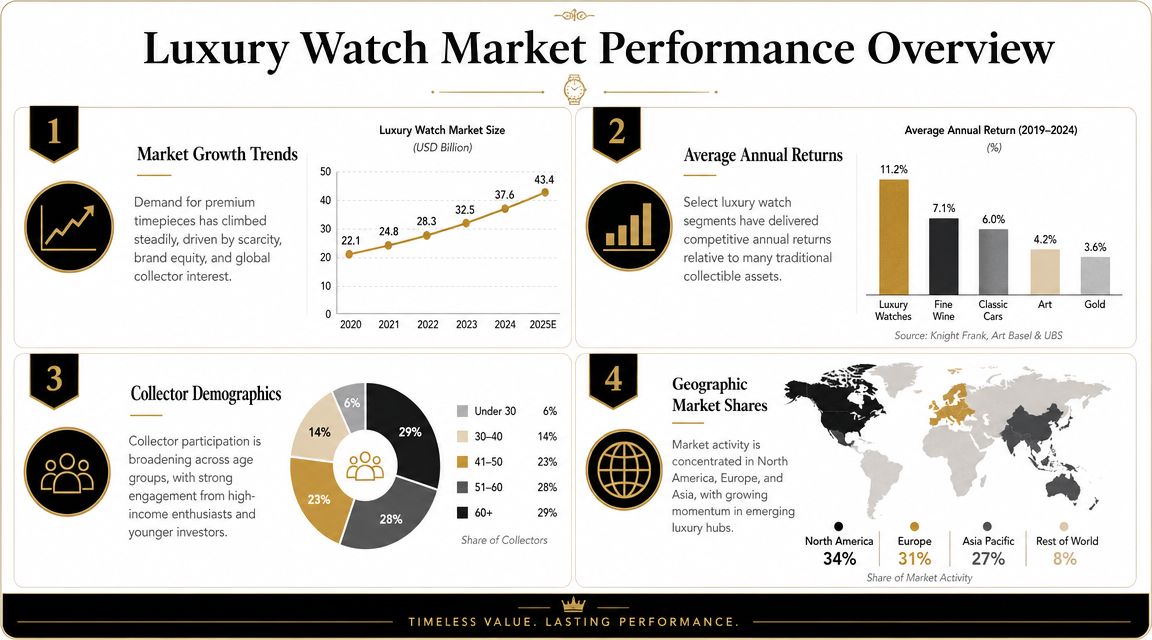
The headline many buyers miss is simple. Watches held up reasonably well in that period, but the category did not beat the strongest mainstream alternatives. The same analysis also reported 3.90% annual volatility for watches, the lowest among the asset classes compared, which helps explain why some owners view high-end watches as a store of value rather than a growth asset.
For a seller, low volatility is only part of the picture. A price chart may look stable while your actual exit value is reduced by dealer spread, consignment fees, shipping, insurance, authentication friction, and the discount needed to attract a fast buyer. Gross market performance and net seller return are not the same thing.
Here is the practical read:
Market view | What it means in real life |
|---|---|
Broad watch market return lagged equities and gold | Category exposure alone was not enough to produce top-tier returns |
Low volatility in the study period | Prices were steadier, but steadier prices do not guarantee a profitable exit |
Wide spread between brands and references | Results depended heavily on what you owned and how easily it could be sold |
Demand also behaves differently from one model to the next. Some references clear quickly with little negotiation. Others sit for months and only move after repeated price cuts. For a simple framework behind that behavior, this primer on understanding price elasticity explains why scarcity helps only when buyer demand is strong enough at the asking price.
Why a few brands behave differently
The strongest performance came from a narrow group, not from the market as a whole. In the same analysis cited earlier, Audemars Piguet averaged 11.68% annual returns and Patek Philippe averaged 10.92%, both much closer to the MSCI World Index benchmark of 12.85% than the broader watch category.
That pattern matches what I see in actual valuations. Buyers do not bid on “luxury watches” as a single asset class. They bid on specific references with known production levels, clear transaction history, and an established base of secondary-market buyers.
Even inside Rolex, pricing is not uniform. A useful example is this review of Rolex Oyster Perpetual Datejust price trends, which shows how condition, dial configuration, age, and buyer depth can change resale outcomes within one brand family.
A market average gives context. Your result depends on whether your watch is one of the few references buyers compete for, or one of the many that trade at a discount once selling costs are included.
What Factors Drive a Watch's Resale Value
Resale value starts with the watch itself, not with the price you paid.
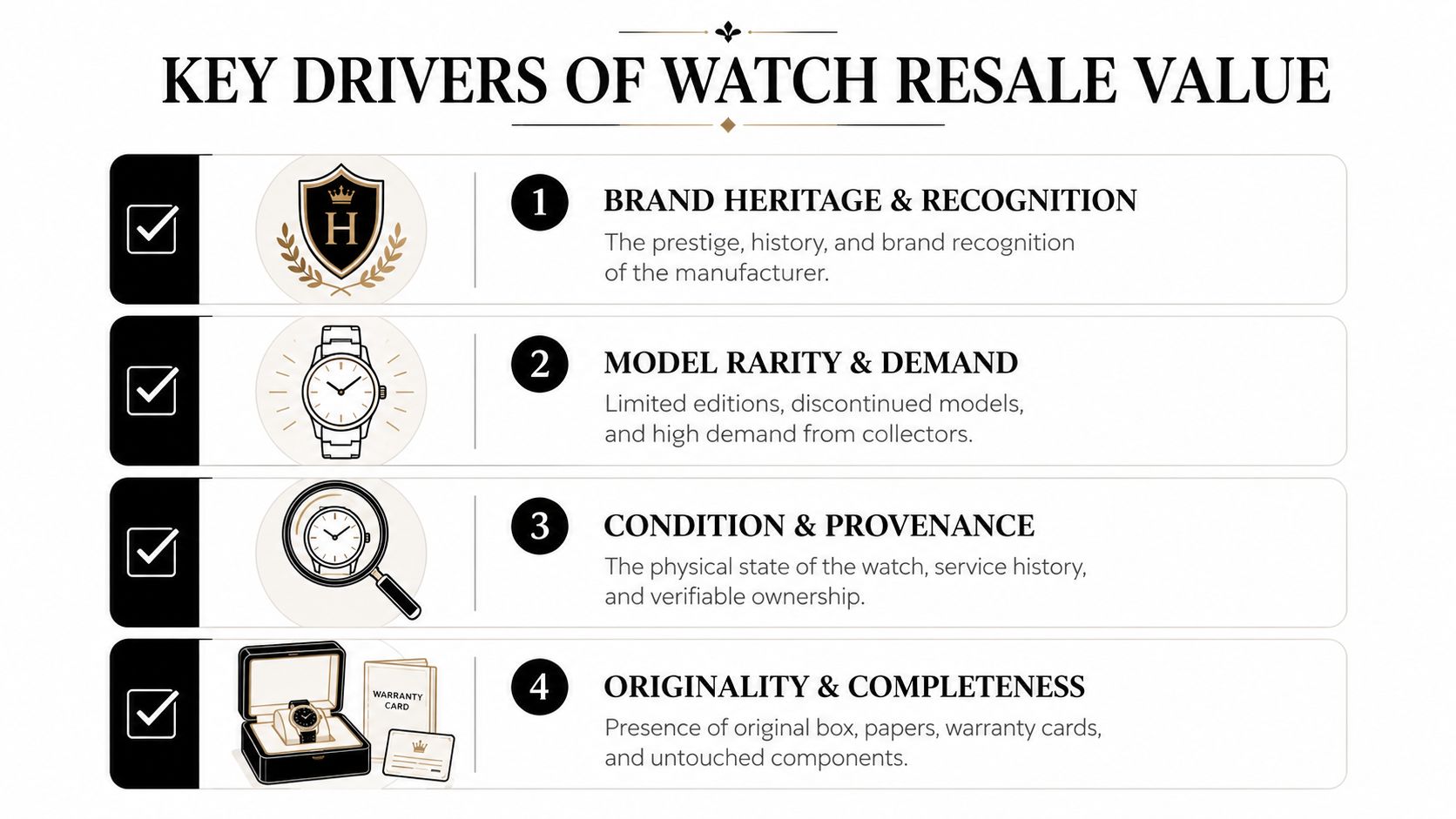
Chrono24's market commentary notes in its discussion of whether watches are really a good investment that not every expensive watch is a good investment, and that make, model, condition, and rarity are decisive. The same source also stresses that high-quality watches from brands such as Rolex, Patek Philippe, and Audemars Piguet have shown over decades that values can remain stable or increase, helped by limited production and sustained demand.
Brand and model matter first
Brand gets attention, but model closes the deal.
A Rolex with deep secondary-market demand is not priced the same way as a slower-moving Rolex. The same is true for Patek Philippe, Audemars Piguet, Cartier, and other luxury names. Buyers don't pay a premium just because a watch is expensive at retail. They pay for references that are known, trusted, and easy to resell later.
Four value drivers tend to show up repeatedly:
Brand recognition: Rolex, Patek Philippe, and Audemars Piguet usually get the strongest buyer confidence because more buyers already understand them.
Specific reference: Case size, metal, dial configuration, bracelet type, and production era can all change resale interest.
Rarity: True scarcity can help, but not every “limited” watch becomes desirable.
Collector familiarity: Watches that have a clear place in the market are easier to price and easier to move.
A lot of owners make the same mistake here. They assume rarity automatically creates value. It doesn't. Rare and unwanted is still unwanted.
Condition, originality, and paperwork change the outcome
Once the brand and reference pass the first test, buyers turn to how complete and original the watch is.
Heavy polishing can soften case lines. Replacement parts can weaken collector interest. Dial damage, bracelet stretch, moisture exposure, and inconsistent service history can all raise questions. Even if a watch is authentic, uncertainty lowers confidence, and lower confidence lowers offers.
Here's what usually helps resale:
Sharp condition: Clean case geometry, healthy bracelet, working movement, and presentable crystal.
Original components: Collectors generally prefer period-correct hands, dial, bezel, and bracelet.
Documentation: Box, papers, warranty card, receipts, and service records support authenticity and buyer confidence.
Provenance: A traceable ownership and service story reduces friction during the sale.
Appraiser's view: The best offers usually go to watches that are easy to authenticate, easy to compare, and easy for the next buyer to trust.
For owners who want to understand how a professional review works, this guide to a watch appraisal process is useful because it shows what specialists look at beyond the dial and case.
The Risks and Hidden Costs of Investing in Watches
At this point, the investment story usually breaks down.
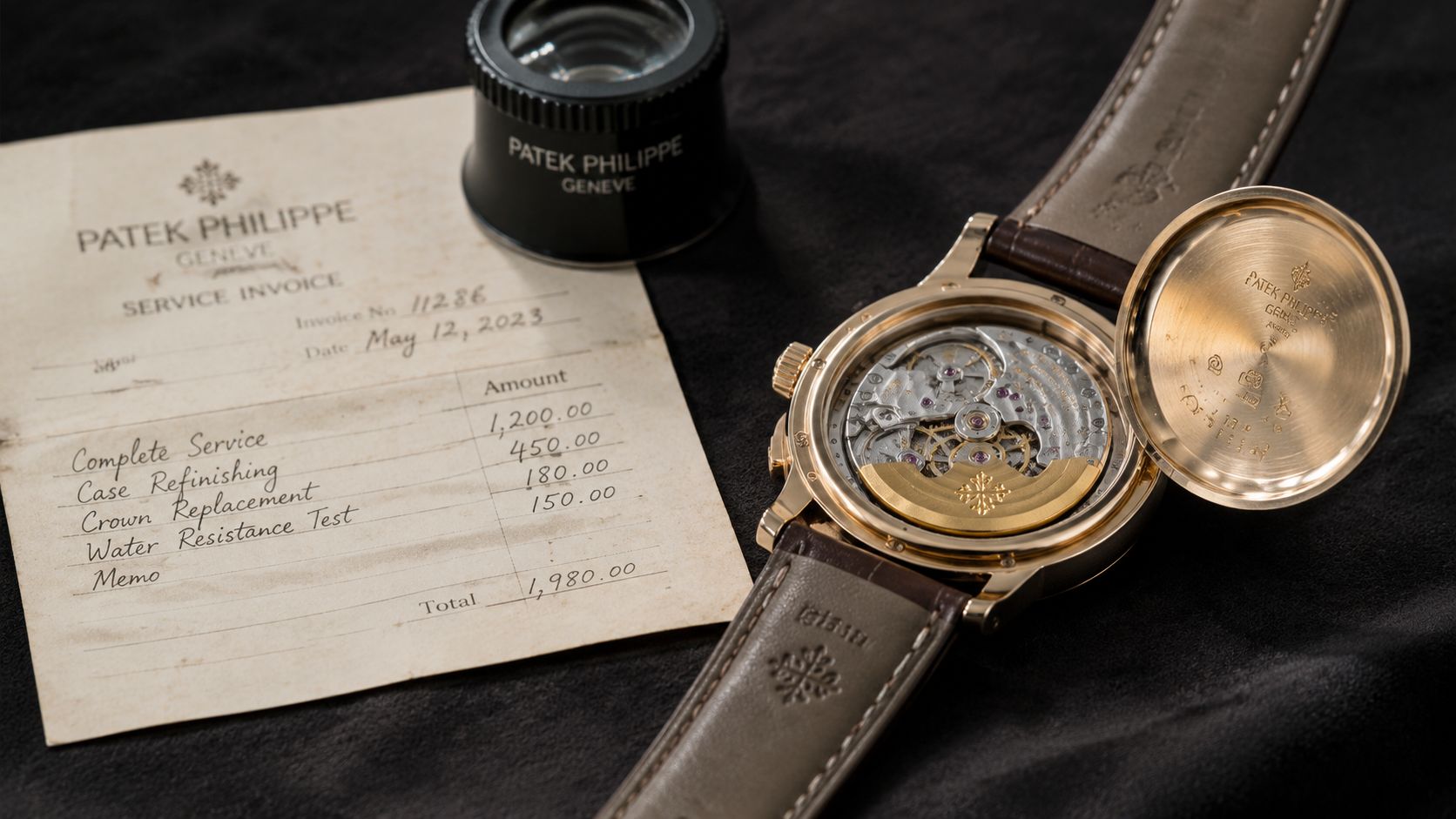
A watch can rise on paper and still be a disappointing asset once you sell it. WatchCharts points out in its analysis on watch investing versus the S&P 500 that a watch must outperform not just inflation but also holding costs such as servicing and insurance, plus transaction fees, to beat a passive equity benchmark. The same analysis notes that the S&P 500 has historically returned about 10% annually over long periods.
Paper gains are not cash in hand
Owners often anchor to optimistic online listings. That's not the same as net resale value.
A realistic exit price gets reduced by friction at several points:
Dealer spread: A dealer has to leave room for authentication, holding time, and resale margin.
Servicing: Mechanical watches need maintenance, and overdue service can hurt salability.
Insurance and storage: Valuable pieces cost money to protect properly.
Sales channel fees: Consignment and marketplace selling can reduce what you keep.
Bob's Watches makes a useful qualitative point in its editorial coverage of watch investing: a major gap in many articles is the lack of realism around tax, transaction costs, dealer spread, servicing, insurance, and liquidity. That omission matters because owners can show a positive paper return and still underperform after all-in costs.
Liquidity is where many owners get surprised
A stock can usually be sold quickly at a visible market price. A watch doesn't work that way.
The true market for a watch depends on brand, model, condition, timing, and buyer confidence. Some pieces have active demand and multiple credible buyers. Others may sit for a long time unless the seller accepts a discount. Fast liquidity and top-dollar pricing rarely arrive together.
If you think about watches as part of a broader personal balance sheet, this guide to investment risk assessment is a useful companion because it frames risk in terms of volatility, downside, time horizon, and exit conditions, which is exactly how luxury assets should be judged.
If you're comparing your sale options, this overview of online watch buyers can help you understand how speed, convenience, and payout often trade off against each other.
How to Evaluate Your Watch's Potential Value
The fastest way to misprice a watch is to start with a guess and defend it. Start with verification instead.
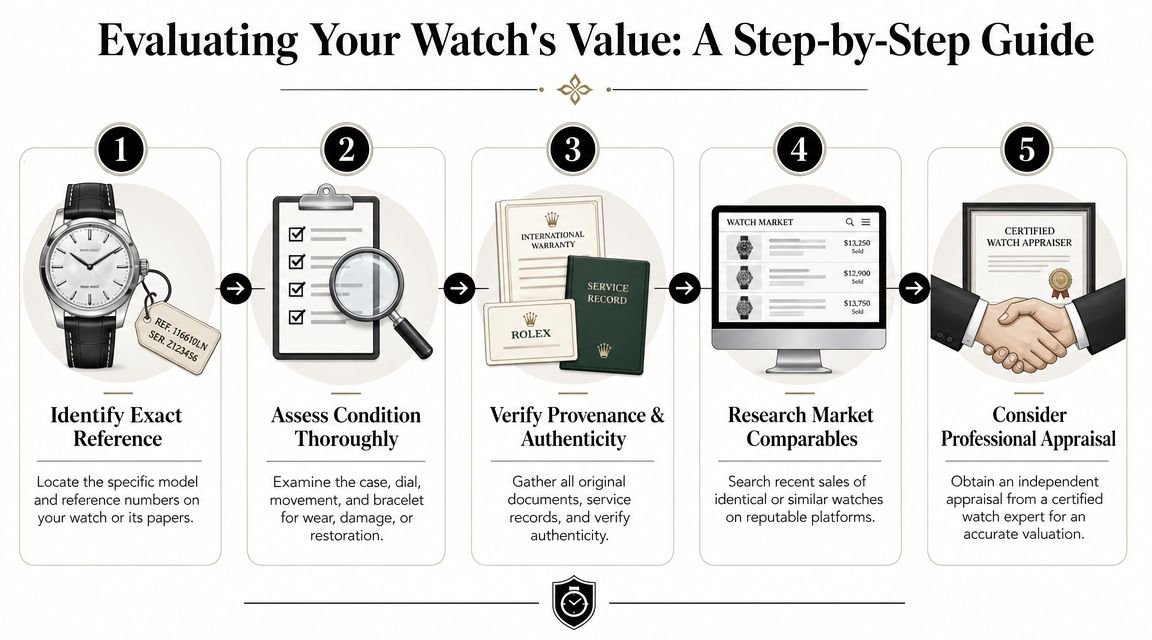
A practical five-step review
Use a disciplined process before you talk numbers.
Identify the exact reference
Look at the reference number, serial details, case material, dial configuration, bracelet, and any matching documents. “Rolex Datejust” is not enough. The exact watch matters.Assess condition objectively Check the case edges, bracelet wear, crystal, dial, lume, crown action, and overall functionality. Be careful with subjective labels like mint or perfect. Buyers usually apply stricter standards than owners do.
Gather the full set
Box, papers, warranty card, receipts, and service records can all help. Missing paperwork doesn't make a watch unsellable, but complete sets are usually easier to place.
A vintage specialist's perspective can help here. This article on vintage watch valuation is especially relevant if your watch is older, unusual, or hard to compare with current market inventory.
This short video is also useful if you want to see what professionals consider during a hands-on review.
When to get a professional opinion
The last two steps are where owners usually save time and avoid costly assumptions:
Review comparable sales carefully: Asking prices are easy to find, but they aren't proof of what buyers paid.
Get an expert valuation: A professional can identify originality issues, marketability, missing components, and realistic resale channels.
For owners in Atlanta and nearby areas such as Buckhead, Sandy Springs, Alpharetta, Roswell, Brookhaven, and Midtown Atlanta, Antwerp Diamond Store is one local option for in-person watch evaluation. A proper review should focus on authentication, condition, documentation, and current secondary-market demand, not just a headline estimate.
Bring the watch, any service records, and all original packaging. The more complete the file, the cleaner the valuation.
What Should You Do With Your Luxury Watch?
If you're asking whether your watch is an investment, the most useful next step is to stop thinking in categories and start thinking in specifics.
A strong brand helps. A sought-after reference helps more. Original condition, complete paperwork, and a realistic exit plan often matter just as much as the name on the dial. The difference between a great watch and a great watch investment is usually the net amount you can realize.
If your goal is to sell, borrow against, or understand what you own, get a market-based evaluation before making assumptions. That's especially important in the Atlanta and greater Georgia market, where many owners have inherited watches, received gifts, or bought during very different pricing conditions.
If you're ready to explore next steps, this guide on how to sell my Rolex watch gives a practical overview of what buyers review and how to prepare your watch for a serious offer.
FAQs About Investing in Luxury Watches
Question | Answer |
|---|---|
Which watch brands tend to hold value best? | The strongest long-term reputation tends to center on Rolex, Patek Philippe, and Audemars Piguet, but value still depends on the exact reference, condition, and completeness. |
Do all luxury watches go up in value? | No. Many don't. Expensive at retail does not automatically mean desirable on the resale market. |
Are watches better than stocks as investments? | Usually no, especially on a broad category basis. A few models can perform well, but most owners shouldn't expect stock-like returns. |
Does box and papers really matter? | Yes. Complete documentation improves buyer confidence and can make the watch easier to authenticate and resell. |
Is a limited edition always a good investment? | No. Some limited editions are thinly traded and speculative. Scarcity only helps if real buyer demand exists. |
Where can I get my watch evaluated in Atlanta? | Look for an experienced local buyer or appraiser who can inspect the watch in person, verify authenticity, and explain current resale demand in plain English. |
If you want a clear, no-pressure assessment of your watch's current market value, Antwerp Diamond offers in-person evaluations and remote options for owners who want to sell, appraise, or better understand a luxury timepiece. Bring the watch, any original box and papers, and service records if you have them.