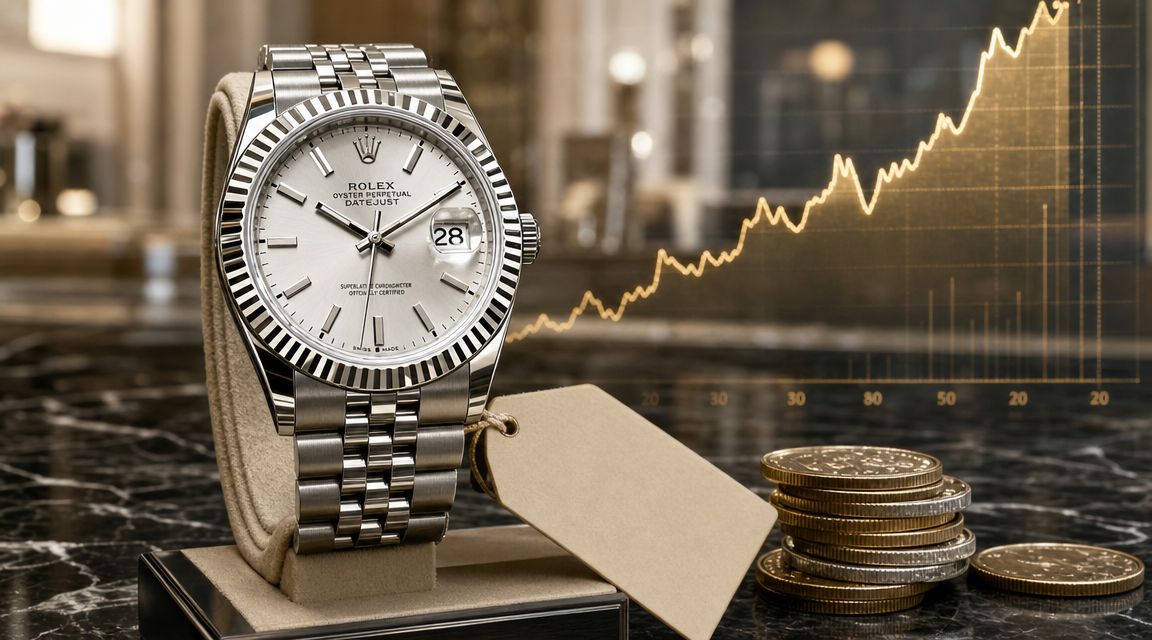
A Rolex Datejust price spans a wide range, from roughly $5,000 for older pre-owned steel examples to $11,850 for a current U.S. retail 41 mm Oystersteel and white-gold model, while gem-set versions can climb to $50,000+ and even around $150,000. If you're trying to pin down the true Rolex Oyster Perpetual Datejust price for your watch, the key factor isn't the model name alone. It's the exact reference, size, bracelet, bezel, condition, and whether today's resale market is paying above or below retail for that setup.
That gap is where many sellers get tripped up. They search one headline price, but a buyer looking at your Datejust is evaluating a series of value levers that can push an offer up or down fast. If you want a realistic number before you sell, borrow against, or appraise your watch, you need to look at the Datejust the same way a professional buyer does.
Table of Contents
What Is the Price of a Rolex Datejust in 2026
The short answer is that there isn't one Rolex Datejust price. There is a price spectrum, and it's wider than many owners expect.
Independent pricing guidance shows the Datejust spans from roughly $5,000 for entry-level pre-owned vintage steel examples to $11,850 USD for a current Rolex U.S. retail 41 mm Oystersteel and white-gold model, while gem-set or off-catalog versions can reach $50,000+ and even around $150,000 for exclusive pavé diamond editions, according to SwissWatchExpo's Datejust pricing guide.
That means a seller who asks, "What's the Rolex Oyster Perpetual Datejust price?" is usually asking the wrong question. A buyer isn't valuing the family name alone. They're valuing your exact watch.
Why the range is so wide
A Datejust can look similar across references, but the pricing changes once you get into the details:
Size matters: Smaller case sizes, 36 mm classics, and 41 mm modern pieces don't all trade the same way.
Metal matters: Steel, two-tone, and more precious configurations sit in different value bands.
Configuration matters: A Jubilee bracelet and fluted bezel can place one Datejust above another that seems close at first glance.
Market timing matters: Retail pricing and resale pricing move on separate tracks.
Practical rule: If you want a usable estimate, start with the reference number and build from there. If you start with "Datejust," you're still too broad.
What this means for sellers
If you're in Atlanta, Buckhead, Sandy Springs, Alpharetta, Roswell, Brookhaven, Midtown Atlanta, or elsewhere in Georgia, the right next step isn't guessing from generic listings. It's narrowing your watch to the exact spec and then comparing that against current buying demand.
Here's the simple framework professionals use:
Question | Why it matters |
|---|---|
What reference is it? | This identifies the core model and movement generation. |
What size is it? | Different buyers prefer different case sizes. |
What metal and bezel does it have? | These are major price drivers. |
What bracelet is on it? | Bracelet style changes desirability. |
What condition is it in? | Wear, polish, and originality affect offers. |
Does it have box and papers? | Documentation improves buyer confidence. |
Most owners don't need a bigger watch glossary. They need an accurate valuation process.
Why Retail Price Is Not Resale Value
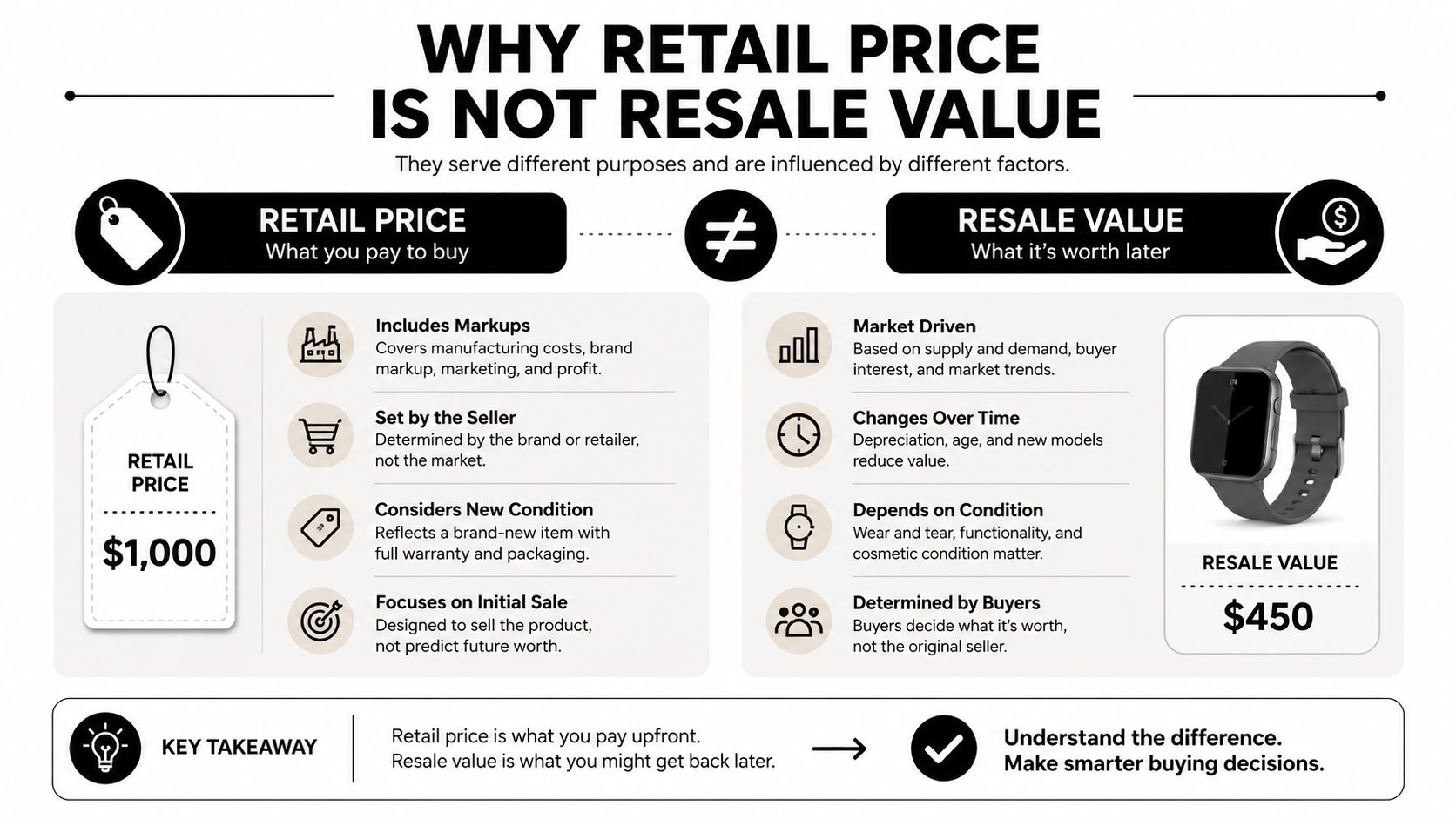
Retail price is the manufacturer's posted price. Resale value is what a real buyer will pay today. Those two numbers often overlap loosely, but they are not the same thing.
Rolex's U.S. lineup shows how quickly retail pricing changes even within one family. The Datejust starts at $7,900 for an Oystersteel 31 mm model, rises to $11,650 for the 41 mm Oystersteel and white-gold version, and reaches $13,900 for an Oystersteel and Everose-gold 31 mm configuration, according to Rolex's official Datejust model page.
What retail tells you
Retail gives you a starting anchor. It tells you where Rolex positions that watch in its catalog. It also tells you that two Datejusts with the same name can sit far apart because of metal, bezel, and size.
What retail doesn't tell you is what your watch is worth on the open market. A seller who relies on MSRP alone usually misses one of two realities:
the resale market may pay less than retail for that configuration
the resale market may pay more than retail for that configuration
What resale tells you
Resale is about buyer behavior. It's driven by what people want right now, how easy the watch is to source, and how your example compares with others on condition and completeness.
A steel Datejust with a more desirable setup can outperform a less desirable watch with a higher retail tag. On the other hand, a two-tone or smaller-size Datejust with a stronger MSRP doesn't automatically command the strongest cash offer.
Retail is a catalog number. Resale is a negotiation based on demand, condition, and confidence.
A seller's trade-off
If you're selling privately, you can ask for more, but you'll have to manage authentication concerns, payment risk, and time. If you're selling to a professional buyer, the offer reflects what the buyer can pay based on current resale demand, service risk, and carrying cost.
That difference is normal. It isn't lowballing by definition. It's the spread between a listed asking price and a market-backed buying price.
For most owners, the practical question isn't, "What did Rolex charge for a Datejust like mine?" It's this: "What will a serious buyer pay for my exact watch without delay or uncertainty?"
What Factors Determine a Datejust's Resale Value
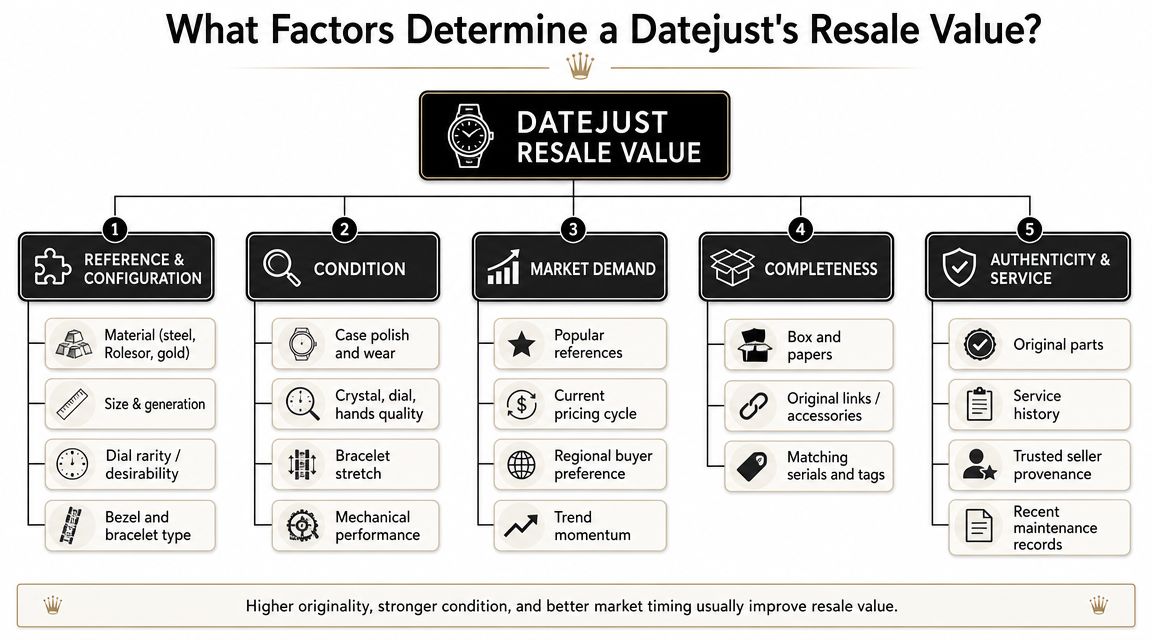
Professional buyers don't appraise a Datejust by vibe. They break it into parts, then weigh those parts against current market demand.
The Datejust's technical side matters too. Rolex uses the Caliber 3235, with an approximately 70-hour power reserve and a date complication, and official product information notes how bracelet and bezel combinations create distinct pricing tiers, with a 36 mm steel Datejust around $7,750 at retail and a 41 mm steel version around $8,500, while Jubilee and fluted configurations command added premium, as shown on Rolex's Datejust 126234 product page.
Model reference and size
Reference number comes first because it identifies the case size, movement generation, production era, and base configuration. A modern 41 mm buyer isn't shopping the same way as a vintage 36 mm buyer, even if both watches say Datejust on the dial.
Size affects liquidity. Some watches appeal to a wider pool of buyers, while others sell more narrowly. That's why valuation starts with the exact reference, not the family name.
If you're trying to understand how older references are assessed, this guide to vintage watch valuation is a useful companion.
Materials and metal mix
Material changes both perception and price. Steel is the entry point for many buyers. Two-tone can attract a different buyer profile. More premium metals usually raise replacement cost, but they don't all move equally fast in resale.
Often, sellers make a bad assumption. They see more gold and expect a stronger offer every time. In practice, the best cash offer comes from the combination that has the healthiest buyer demand, not just the highest original catalog price.
Bezel and bracelet style
On the Datejust, bezel and bracelet aren't small details. They are major value drivers.
A fluted bezel generally carries a stronger premium than a smooth bezel because it changes both the visual identity and the material profile of the watch. The Jubilee bracelet is also a known value lever because many buyers see it as the classic Datejust look.
Why this matters in the real world
Two Datejusts can share the same size, dial family, and year range, yet trade several thousand dollars apart once one has a fluted bezel and Jubilee bracelet and the other has a smoother, sportier setup.
That's why a serious buyer will examine:
Bezel type: Smooth and fluted don't sit in the same tier.
Bracelet type: Jubilee and Oyster appeal to different buyers.
Bracelet condition: Stretch, wear, and replacement parts matter.
Dial configuration
Dial value can be subtle or dramatic. Some dials are broadly liquid because they appeal to many buyers. Others attract a narrower collector audience.
A seller should know whether the dial is standard, factory-set, replaced, refinished, or showing signs of tampering. Originality matters. So does legibility, color desirability, and whether the dial fits the watch's era.
A polished case can be forgiven more easily than a questionable dial. Buyers can accept wear. They are much less forgiving about originality issues.
Condition and mechanical health
Condition is where an online estimate often falls apart. Buyers look at the case, lugs, bezel wear, bracelet stretch, clasp integrity, crystal condition, and movement performance.
Over-polishing can hurt value because it softens the case lines that experienced buyers want to see. Heavy wear can also drag an offer down if the buyer expects service work after purchase.
Signs that often affect an offer
Condition factor | Typical impact on buyer confidence |
|---|---|
Sharp case lines | Supports stronger confidence |
Heavy polish | Raises concerns about lost metal |
Bracelet stretch | Can reduce appeal |
Clean crystal and clasp | Improves presentation |
Strong movement function | Reduces service concern |
Box papers and service history
Box and papers don't magically make a weak watch strong, but they help. They support provenance, reduce buyer hesitation, and make the watch easier to resell.
Service records can help too, especially when they clarify recent maintenance or confirm authenticity-linked details. Still, paperwork is secondary to the watch itself. An overworked or altered watch with papers won't outrun a cleaner, more original example.
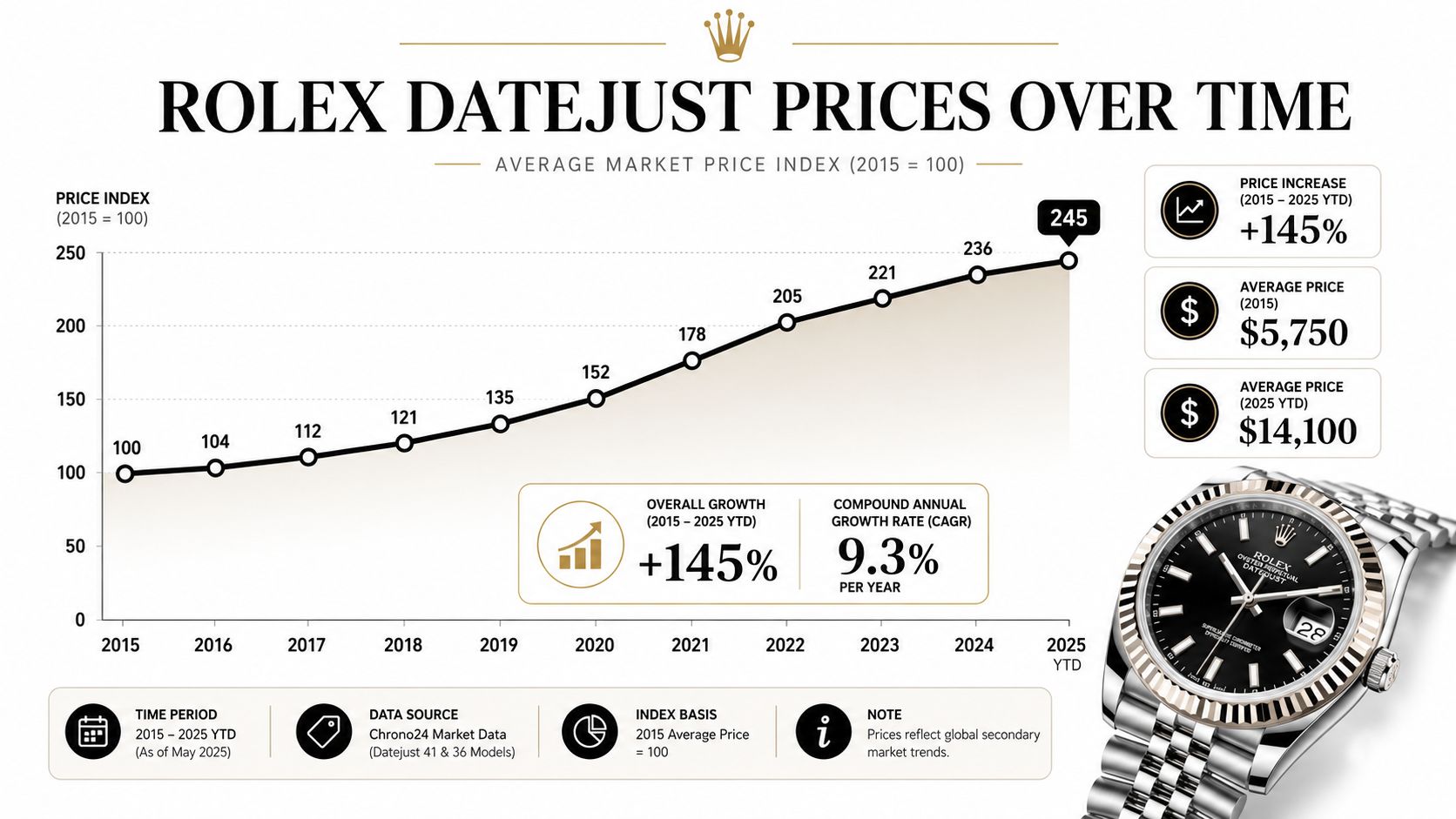
How Have Rolex Datejust Prices Changed Over Time
Datejust pricing hasn't moved in a straight line. Anyone selling today should understand that the market has already had a sharp rise, a peak, and a correction.
Bob's Watches reports that the average Rolex category price rose from about $2,000 in 2010 to $13,426 in 2025, a gain of more than 550%. In the same market report, the Datejust specifically peaked at $9,926 in March 2022 after a 396% increase from 2010, then corrected to about $8,500 by May 2025, according to the Bob's Watches Rolex market report.
The run-up and correction
That pattern matters because many owners still anchor to peak-era expectations. They remember what similar watches were asking during the hottest period and assume that's still the market.
It often isn't. A professional buyer will look at the correction first, then judge whether your exact configuration has held stronger or softened more than the broader category.
Here's the useful takeaway:
Peak memories can distort expectations
Current offers reflect today's liquidity
Certain configurations remain stronger than others even during corrections
Why recent retail resets matter
Another layer is the recent change in retail anchors. One market source says Rolex raised retail prices by about 7% in January 2026, while secondary-market guides already show modern steel Datejust 36 and 41 models commonly trading around $9,000 to $19,500 depending on reference and configuration, as discussed in Bob's Watches' 2026 Datejust pricing overview.
That doesn't mean every Datejust suddenly became worth more overnight. It means sellers and buyers are now negotiating against a higher retail backdrop. Some references benefit because the new MSRP makes a clean pre-owned piece look more attractive. Others won't see the same effect if demand is flat or buyer preference has moved elsewhere.
Higher retail pricing can support resale sentiment, but it doesn't erase the difference between a store tag and a cash offer.
For sellers in the greater Georgia market, timing matters less than preparation. If your watch is a sought-after configuration, complete, and in honest condition, you'll usually be in a stronger position than someone who waited for a headline about Rolex prices to rise.
How Professional Buyers Appraise a Rolex Datejust
A serious appraisal starts with the watch in hand. Photos help, but they don't replace direct inspection.
Authentication comes first
The first job is confirming that the watch is authentic and internally consistent. The buyer checks the reference, serial placement, dial details, bracelet, clasp codes where relevant, and general manufacturing fit. If the watch is opened, the movement and inside case details should align with the reference and era.
Then comes condition. Under magnification, a buyer looks for polish history, lug shape, bezel wear, bracelet stretch, replacement parts, crystal issues, and signs of moisture or poor prior repair.
If you're new to the process, this overview of how to sell high-end watches helps explain what experienced buyers focus on before making an offer.
Then the market test
After the watch passes the authenticity and condition review, the next question is simpler. How easy is this exact Datejust to place in the current market?
That answer depends on the spec, buyer demand, completeness, and how much post-purchase work the next owner or dealer will need to absorb. A strong watch is one that's easy to trust and easy to resell. A weaker watch may still have value, but it usually comes with friction.
A professional buyer typically weighs these points together:
Authenticity confidence: No inconsistencies between parts and reference
Mechanical confidence: No obvious service red flags
Commercial appeal: Desirable size, bezel, bracelet, and dial combination
Exit path: A realistic view of how the watch will perform when offered to the next buyer
In practice, the fairest appraisals come from buyers who can explain their reasoning clearly. If they can't tell you why one Datejust trades above another, they probably aren't valuing it with enough precision.
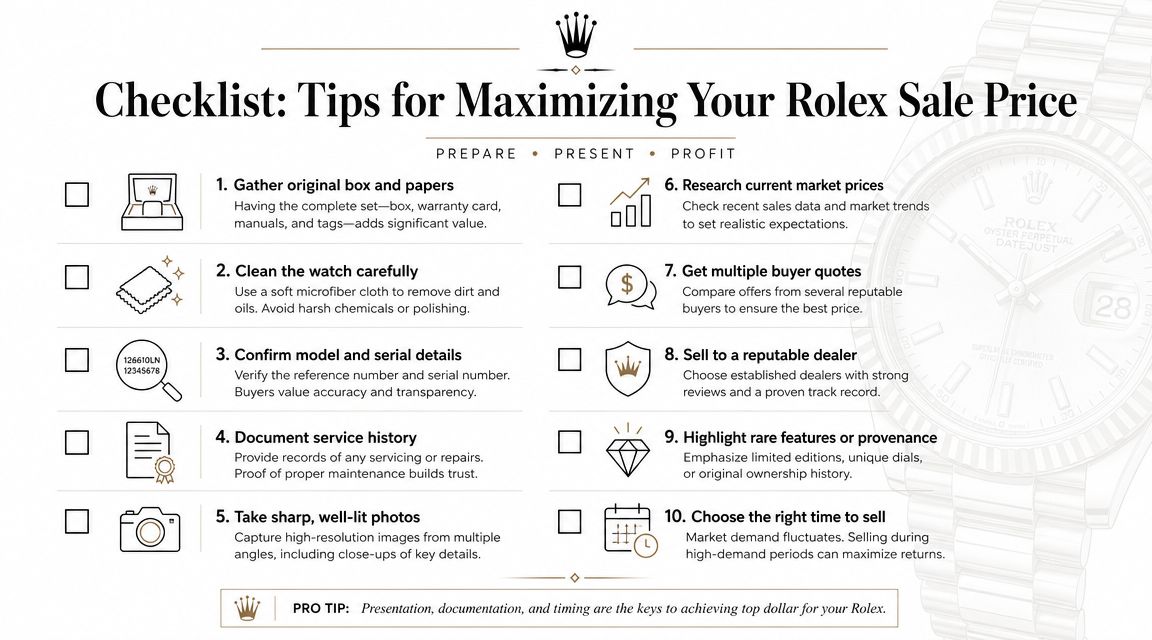
Tips for Maximizing Your Rolex Sale Price
Most sellers don't lose value because they own the wrong watch. They lose value because they present it poorly, service it unwisely, or choose the wrong selling route.
What helps before you sell
Start with preparation, not polishing. Gather everything tied to the watch and present it cleanly.
Collect the full set: Box, warranty card, booklets, service receipts, and extra links all help a buyer assess completeness.
Take accurate photos: Good lighting, clear dial shots, clasp photos, and side angles reduce friction in the quoting stage.
Know the reference: A seller who can identify the exact reference usually gets a faster and more accurate evaluation.
Ask for more than one opinion: Different buyers specialize in different watch profiles.
If you're comparing sale routes, this guide on selling my Rolex watch covers the practical differences between direct sale options.
What usually hurts value
The biggest mistake I see is unnecessary cosmetic intervention. Owners try to make the watch look newer and end up removing the details collectors and informed buyers want preserved.
Avoid these moves unless a trusted specialist has advised them for a specific reason:
Don't over-polish the watch: Sharp edges and original case proportions matter.
Don't replace parts casually: Non-original or mismatched parts can complicate the sale.
Don't rely on asking prices alone: Listings show ambition, not necessarily completed deals.
Don't hide flaws: Honest disclosure speeds up serious offers.
Clean the watch gently, gather the paperwork, and leave the metal alone unless you know exactly why you're changing it.
Choosing the right sale path
A private sale may produce a higher asking number, but it can take longer and brings more buyer-screening work. Consignment can work for some sellers, but it also adds time and uncertainty. A direct buyer is usually the cleanest route if speed, security, and clarity matter.
For owners in Buckhead, Roswell, Sandy Springs, Alpharetta, Brookhaven, Midtown Atlanta, and across Georgia, Antwerp Diamond is one option for an in-person or remote evaluation when you want a straightforward watch review and offer process without relying on guesswork.
Sell Your Rolex Datejust Confidently in Atlanta
A Rolex Datejust doesn't have one fixed price. It has a value range, and your place in that range depends on the exact reference, configuration, condition, and how the current resale market sees that watch today.
That matters if you're selling in Atlanta or nearby areas like Buckhead, Sandy Springs, Alpharetta, Roswell, Brookhaven, or Midtown Atlanta. A local, in-person review lets a buyer assess authenticity, wear, bracelet condition, and completeness in a way online estimates usually can't.
The safest move is usually the simplest one. Get the watch reviewed by someone who can explain the result in plain English and tie the offer back to real market logic.
If you want to compare options close to home, this guide to where to sell a luxury watch near me is a practical place to start.
Frequently Asked Questions About Rolex Datejust Prices
Is a Rolex Datejust a good watch to hold value
It often holds value well relative to many luxury goods, but value depends heavily on the specific configuration and the market cycle. I wouldn't treat any watch as guaranteed financial upside. I'd treat a Datejust as a strong, highly liquid luxury watch with better resale visibility than many lesser-known models.
Are vintage Datejusts valued differently from modern ones
Yes. Vintage buyers often focus more on originality, dial correctness, and case preservation. Modern buyers still care about originality, but they also weigh movement generation, bracelet style, wear level, and whether the watch feels close to current production expectations.
Can I know my Datejust value from the serial number alone
No. A serial number helps identify era and supports authentication work, but it doesn't tell the full story. You still need the reference, size, bezel, bracelet, dial, condition, and documentation profile.
Does box and papers always increase the price
Usually, they help, especially by improving buyer confidence and resale ease. But they don't override the fundamentals. A complete set with heavy wear or questionable parts won't outperform a cleaner, more correct watch solely because it has paperwork.
Should I service my Rolex before selling it
Not automatically. A fresh service can help in some situations, but unnecessary polishing or incorrect parts replacement can hurt value. Get the watch evaluated first, then decide whether service improves the sale outcome.
Are online watch buyers a good option
They can be, if the process is transparent and the buyer explains how they evaluate authenticity, condition, and market demand. This guide to online watch buyers is useful if you're comparing remote offers with local in-person evaluations.
If you'd like a clear, no-pressure review of your Rolex Datejust, Antwerp Diamond offers evaluations for sellers who want to understand current market value before making a decision. You can start online or arrange an in-person appointment if you're in Atlanta, Buckhead, Roswell, or the broader Georgia market.