

To sell a luxury watch near you for the strongest local result, gather the box and papers first, get a professional in-person evaluation, compare the offer against the current market, and complete the transaction in a secure setting with immediate payment. If you're choosing between a quick sale and a higher but slower route, consignment commissions typically run 15%–30% and often close in 60–120 days, while reputable specialty dealers can sometimes move from quote to cash in as little as 24 hours.
If you're reading this, there's a good chance you have a Rolex, Cartier, Patek Philippe, or Audemars Piguet in a drawer, a safe, or on your wrist right now, and you're trying to decide whether to sell locally or deal with strangers online. Most sellers don't need more hype. They need a clean process, a realistic price expectation, and a transaction that feels private and safe from start to finish.
That matters even more in Atlanta, Buckhead, Sandy Springs, Alpharetta, Roswell, Brookhaven, Midtown Atlanta, and the broader Georgia market, where sellers often want discretion as much as value. A local appointment can solve both, but only if you understand how buyers evaluate watches, where value gets lost, and which selling channel fits your priorities.
Table of Contents
Your Guide to Selling a Luxury Watch Locally
How to Prepare Your Watch for a Top-Value Offer
What to bring to the appointment
What to do and what not to do
What actually influences the offer
Understanding the Professional Watch Evaluation Process
Authentication comes before pricing
Condition grading is more detailed than most sellers expect
Market comps translate the watch into a real offer
Choosing the Right Buyer for Your Watch
Comparing Watch Selling Channels
How local sellers should decide
What usually works best
Navigating Offers and Finalizing the Sale Securely
What a real offer should reflect
How to close the deal safely
Frequently Asked Questions About Selling a Watch
Do I need the original box and papers
Should I repair my watch before selling it
Can I sell a watch locally without meeting strangers
How fast can I get paid
What brands do local buyers usually want
Your Guide to Selling a Luxury Watch Locally
When people search sell luxury watch near me, they usually want three things at once: privacy, speed, and a fair offer. The practical route is straightforward. Prepare the watch, bring everything you have with it, meet with a specialist buyer, listen to how they value it, and decide whether a direct sale or slower channel fits your situation.
That process works because local selling lets you verify the buyer before the watch leaves your possession. You can see the office, ask questions face to face, and confirm how payment will happen before agreeing to anything. For many owners, that's a better fit than listing a high-value watch online and sorting through messages from unknown buyers.
There's also a market reason to compare local options carefully. Boston Consulting Group notes that online sales already exceed both auction and store sales, and online is on track to account for close to 60% of secondhand luxury watch transactions. BCG also notes that some highly sought-after preowned models can sell for more than retail, which is why sellers near major markets benefit from buyers with real-time pricing visibility and strong demand awareness, especially for rare or recently discontinued references (Boston Consulting Group on luxury watch market trends).
Practical rule: Don't choose a buyer based on the first ad you see. Choose the buyer who can clearly explain authentication, condition grading, and how today's market affects your exact reference.
In the Atlanta area, that usually means looking for a private appointment in Buckhead, Roswell, Sandy Springs, Alpharetta, Brookhaven, or Midtown Atlanta rather than meeting someone in a parking lot or trying to ship a watch before you trust the process. A specialist office is built for exactly this kind of transaction.
One local option sellers often consider is Antwerp Diamond Store, which buys authentic luxury watches through private in-person evaluations and online preliminary reviews for owners who want a discreet local process.
How to Prepare Your Watch for a Top-Value Offer
Preparation affects both the offer and the speed of the appointment. A buyer can move faster and price more confidently when the watch arrives with its supporting materials and a clear ownership trail.

What to bring to the appointment
Start with the obvious items, then think like an appraiser. Anything that helps confirm originality, completeness, and care can strengthen buyer confidence.
Original box: This helps present the watch as a complete piece rather than a loose watch without supporting materials.
Warranty card or papers: These are useful for confirming reference details and ownership history.
Purchase receipt: If you still have it, bring it.
Service records: These matter when they show brand service or competent professional work.
Extra bracelet links or strap accessories: Missing links can reduce who the next buyer can wear the watch immediately.
Any replaced original parts you kept: For some watches, that can matter.
If you want a broader overview before the appointment, this guide on how to sell high-end watches is a useful companion.
What to do and what not to do
A lot of sellers unintentionally hurt value by trying to make the watch look newer than it is. That's especially common with vintage pieces and desirable sport models.
Use this checklist:
Wipe it gently: Use a soft dry microfiber cloth to remove fingerprints and surface dust.
Don't polish it at home: Amateur polishing can soften edges, alter case lines, and make the watch less attractive to informed buyers.
Don't swap parts casually: A non-original clasp, dial, bezel insert, or bracelet component can change value materially.
Charge or wind it if appropriate: If the watch runs, the buyer can assess function faster.
Take clear photos before you go: Front, back, clasp, bracelet stretch, papers, and accessories. This helps your records and can support an initial remote conversation if needed.
A watch doesn't need to be perfect to sell well. It does need to be honestly presented.
What actually influences the offer
Some sellers assume cosmetics decide everything. They don't. In practice, these details tend to shape the conversation most:
Completeness: Full set versus watch only
Originality: Original dial, hands, bezel, bracelet, and movement matter
Service history: Clean records can reduce uncertainty
Condition: Case wear, bracelet wear, crystal issues, and functionality all count
Reference desirability: Certain configurations have deeper demand
The best preparation isn't overworking the watch. It's making the watch easy to verify. That saves time, reduces doubt, and usually leads to a cleaner offer.
Understanding the Professional Watch Evaluation Process
A real watch evaluation isn't a quick glance across the counter. A specialist buyer follows a specific workflow because high-value watches need to be authenticated, documented, and matched against current market reality before any serious offer can be made.
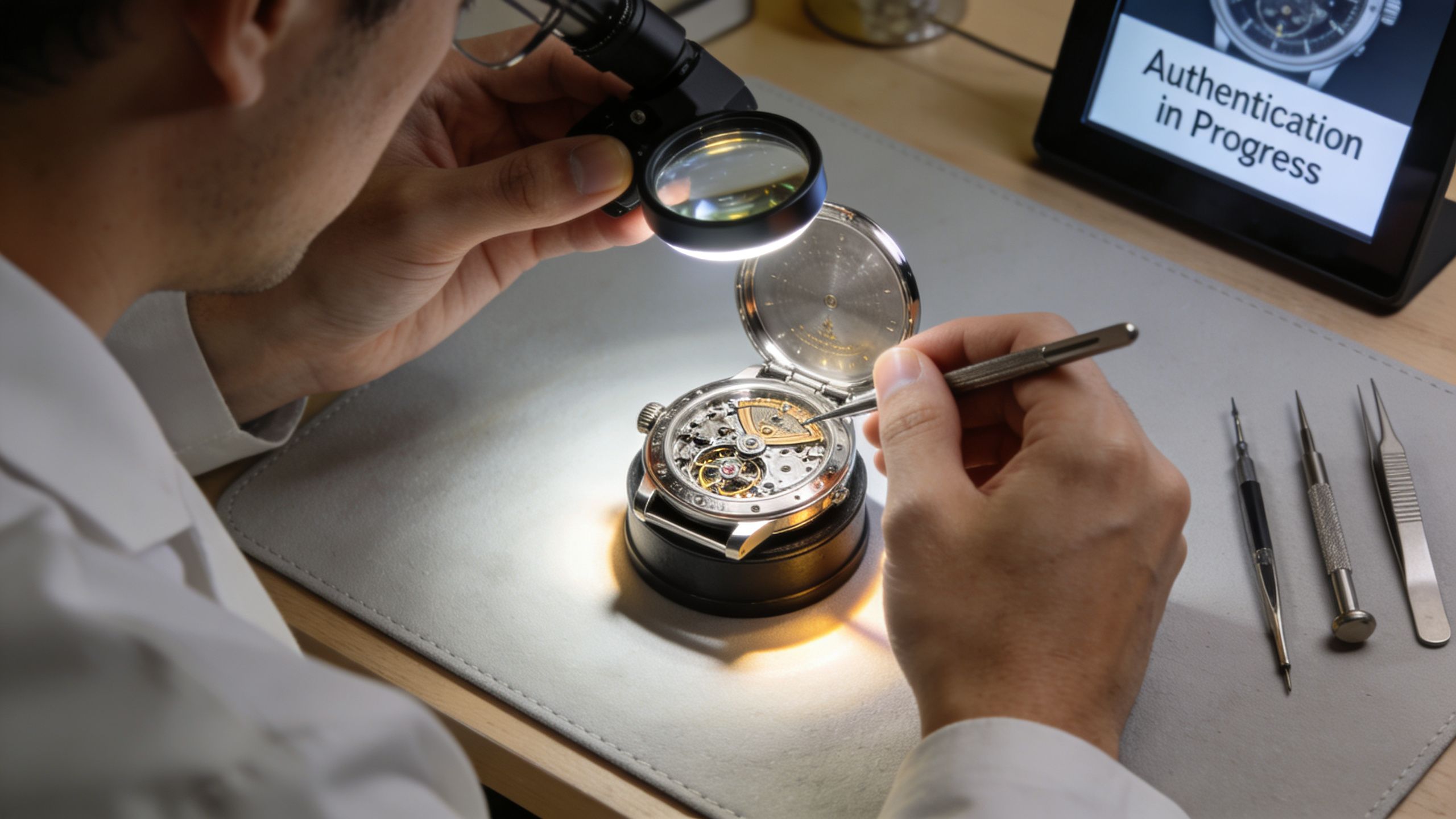
Professional guides describe the process in clear terms: authenticate the watch first, document the model, reference, serial, and condition, then compare it against live market comps. Those same guides note that reputable specialty dealers can convert quote to cash through secure wire transfer in as little as 24 hours, which is why direct specialist sales are often the fastest low-friction route for major-market sellers (ECI Jewelers on where to sell luxury watches).
Authentication comes before pricing
If a buyer can't authenticate the watch properly, the rest of the valuation doesn't mean much. The core checks usually include:
Reference and serial review: The buyer confirms that the case, movement, and identifying details align with the model.
Component consistency: Dial, hands, bezel, crown, bracelet, clasp, and caseback should match what the watch is supposed to be.
Movement inspection: On some pieces, internal inspection helps confirm authenticity and detect tampering or replaced parts.
Service and modification review: Some changes are harmless. Others reduce buyer confidence or resale flexibility.
A seller doesn't need to master all of this before the appointment. But you should expect the buyer to care about it. If they don't, that's a warning sign.
Condition grading is more detailed than most sellers expect
Condition isn't just "used" or "mint." A specialist looks at the parts that affect resale confidence and the cost of getting the watch retail-ready.
Typical checkpoints include:
Evaluation area | What the buyer looks for |
|---|---|
Case | Sharpness of edges, dents, over-polishing, corrosion |
Bracelet or strap | Stretch, wear, replaced parts, fit, condition |
Crystal | Chips, scratches, replacement history |
Dial and hands | Originality, moisture damage, lume condition |
Movement and function | Timekeeping, winding, date change, chronograph performance |
One useful parallel is how specialists evaluate other premium materials. The same demand for precision and current market logic appears in resale categories beyond watches, such as where to sell platinum, where authenticity, condition, and current market pricing all shape the offer.
If the buyer can't explain why your watch falls into a certain condition range, you don't yet have a transparent evaluation.
Market comps translate the watch into a real offer
Many sellers get confused at this stage. They remember what they paid, what they saw listed online, or what a friend claimed a similar watch was worth. A professional buyer has to look at what comparable watches are trading for now, adjusted for condition, completeness, and liquidity.
The same expert guidance warns against unrealistic pricing and weak condition disclosure. It even gives a simple example: a watch bought for £5,000 and now trading around £4,000 may only attract offers ranging from roughly £3,000 to £4,000 depending on the channel and current market pressure, which shows why seller expectations and real market pricing don't always match.
Choosing the Right Buyer for Your Watch
The best buyer for your watch depends on what you care about most. Some sellers want the fastest possible sale. Others want the highest theoretical upside. Many want privacy first, then a fair immediate offer.
That's why "sell luxury watch near me" can lead you to very different businesses. A neighborhood jeweler, a pawn shop, a specialist watch buyer, a consignment dealer, and a private individual all operate differently.
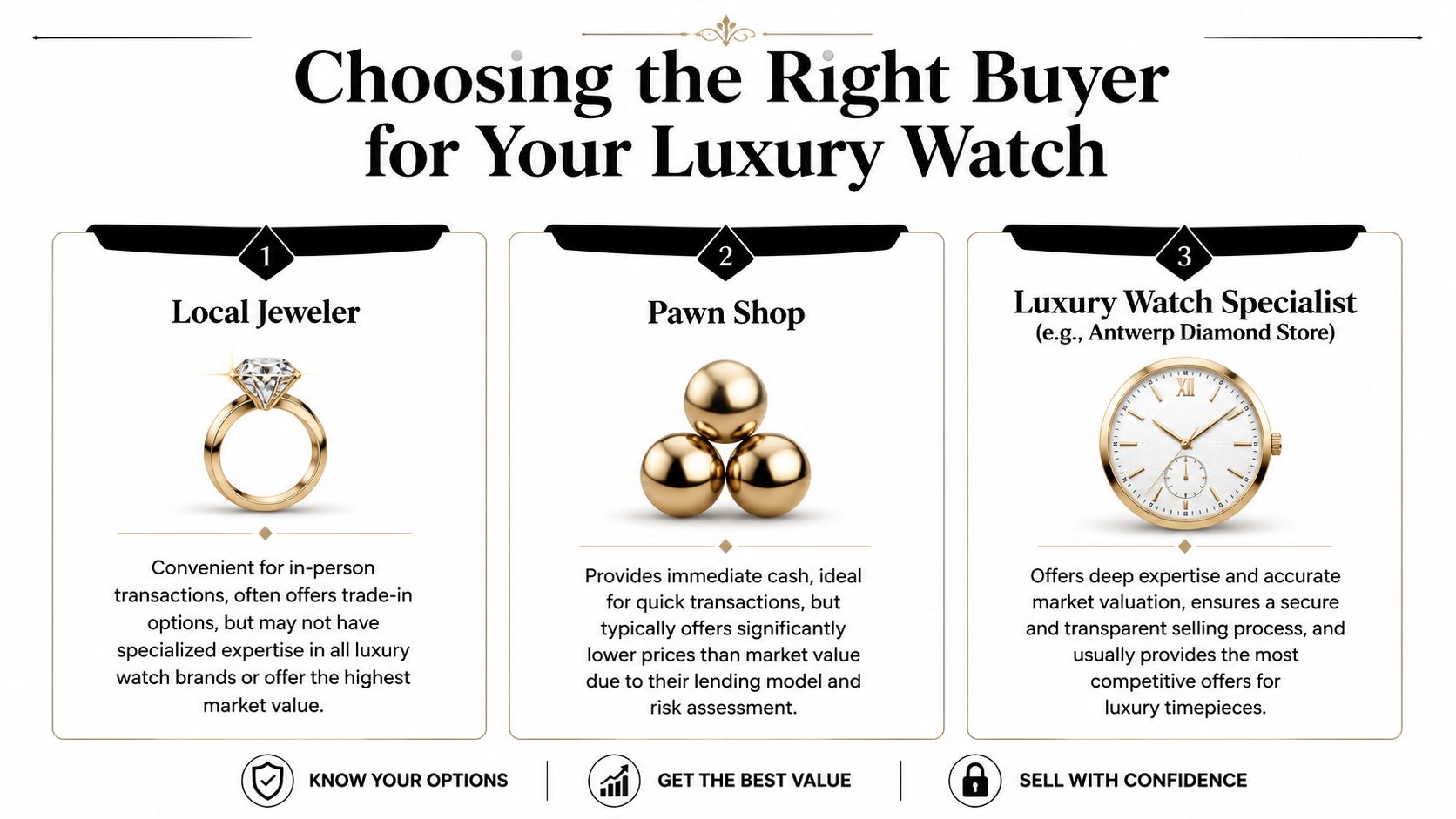
Comparing Watch Selling Channels
Industry guides put real structure around the biggest trade-off. Consignment commissions are typically 15%–30%, and the common closing window is about 60–120 days. Those same guides say consignment may return about 10%–15% more than a quick direct sale, but you wait longer, the watch remains unsold until a buyer appears, and you retain ownership risk until the transaction closes (Watch My Diamonds on direct sale vs consignment).
Here is the side-by-side view most sellers need:
Channel | Typical Payout Speed | Potential Payout | Security & Convenience |
|---|---|---|---|
Specialist watch buyer | Fast, often same day after evaluation | Usually strong for direct sale, especially on liquid references | High, if handled in a professional office with documented payment |
Local jeweler | Moderate | Can be fair, but depends on watch expertise | Often convenient for in-person visits |
Pawn shop | Fast | Often lower because the business model prioritizes risk control and quick turnover | Convenient, but usually not ideal for maximizing value |
Consignment dealer | Slow, often 60–120 days | Can be higher, sometimes about 10%–15% more than a quick direct sale | Less immediate, seller waits and retains ownership risk until sold |
Private sale | Unpredictable | Highest theoretical upside, sometimes near full asking price | Highest fraud, safety, and payment risk |
If you're comparing online and local routes, this article on online watch buyers can help frame the trade-offs.
How local sellers should decide
For Atlanta-area sellers, the decision often comes down to four questions:
Do you need immediate payment, or can you wait?
If timing matters, direct sale usually makes more sense than consignment.Is your watch common and liquid, or niche and collector-driven?
A current Rolex sport model often trades differently from a vintage complication or less common reference.How private does the process need to be?
Many sellers in Buckhead, Roswell, and Alpharetta don't want public listings or repeated meetings with strangers.How much friction are you willing to accept for a possible upside?
Chasing the last increment of value can mean more waiting, more negotiation, and more uncertainty.
Some sellers focus too much on the top number and not enough on the path required to reach it.
A local specialist is usually the cleanest baseline because it gives you a real offer attached to a real process. Once you have that, you can judge whether a slower route is worth it.
What usually works best
For most owners of Rolex, Cartier, Patek Philippe, and Audemars Piguet, these patterns hold up well in practice:
Use a specialist first for price discovery: That gives you a grounded starting point.
Treat pawn shops as a speed option, not a valuation benchmark: They solve a different problem.
Use consignment when the watch has collector appeal and you can wait: It isn't ideal for every seller.
Be cautious with private buyers: The price can look attractive until meeting logistics, payment verification, and fraud risk enter the picture.
A secure local sale isn't about taking the first offer. It's about getting the first credible offer, then deciding from a position of control.
Navigating Offers and Finalizing the Sale Securely
Once the offer is on the table, the sale becomes less about watches and more about judgment. This is the point where sellers either protect their value and privacy, or give it away by rushing.

What a real offer should reflect
A legitimate offer should connect directly to the evaluation. If the buyer can't explain the number, you don't have enough information to decide.
Ask about these points:
Condition adjustment: What wear or missing elements influenced the offer?
Completeness: Did the presence or absence of box, papers, links, or service records affect pricing?
Current demand: Is the reference trading quickly, or is the buyer taking on more holding risk?
Originality: Are all key parts correct for the watch?
The market isn't static. Market commentary notes that the watch market has cooled from its 2022 peak, with the Bloomberg Subdial Watch Index falling materially through 2024 and 2025. For some models, that means selling now may be more advantageous than waiting, although authentication, service history, originality, and box-and-papers completeness still remain major value drivers (Nicholas Estate Buyers on watch resale conditions).
How to close the deal safely
The safest local transaction has a controlled setting, clear paperwork, and verified payment. That sounds basic, but it's where many private sales go wrong.
Use this closing checklist:
Meet in a professional office: Not a hotel lobby, coffee shop, or parking lot.
Confirm payment method before handing over the watch: Secure wire transfer, cashier's check, or cash if you're comfortable and local law permits.
Avoid reversible or ambiguous payment methods: Personal checks and casual app transfers can create problems.
Review the bill of sale: Make sure the watch details and agreed terms are documented.
Bring identification if requested: Serious buyers often need it for transaction records.
A practical next step for sellers who want speed is to review how instant payment for watch sales usually works, including what to confirm before the watch changes hands.
The safest deal is the one that stays boring. Clear office, clear paperwork, clear payment, no improvisation.
If you don't like the offer, walk away politely and compare. A secure buyer won't pressure you for an immediate yes. They know informed sellers make cleaner transactions.
Frequently Asked Questions About Selling a Watch
The local watch market has matured around fast appraisals, secure transactions, and immediate payment. Specialist buyers in major U.S. markets already operate this way, offering private appointments and evaluations for brands like Rolex, Cartier, and Patek Philippe, which is why many sellers now prefer the specialist route over informal private selling (Diamond Source NYC on watch buying appointments).
Do I need the original box and papers
No, but they help.
A watch can still be sold without them if the buyer can authenticate it confidently. Box, papers, service records, and extra links usually improve confidence and make the watch easier to resell, which can support a stronger offer.
Should I repair my watch before selling it
Not automatically.
Some repairs help, and some only add cost. If the issue is cosmetic or the watch is older, it often makes sense to let the buyer evaluate it first and explain whether service or repair would improve your net result.
Can I sell a watch locally without meeting strangers
Yes.
That's one of the strongest reasons to work with a specialist office. A private appointment gives you a controlled environment, professional handling, and documented payment instead of an informal meetup with someone responding to a listing.
How fast can I get paid
That depends on the buyer and the watch, but direct specialist sales are generally the fastest route.
Consignment is slower because the watch must sell first. A direct local buyer can often evaluate, make an offer, complete the paperwork, and pay promptly once the deal is agreed.
What brands do local buyers usually want
The most commonly requested brands tend to include Rolex, Patek Philippe, Cartier, and Audemars Piguet.
That said, demand is model-specific. Buyers also care about originality, condition, and whether the watch is a complete set. A less famous model in excellent original condition can sometimes be easier to place than a more famous model with issues.
If you're also comparing how resale works across other categories, this overview of the best place to sell gold gives a useful parallel on how local buyers assess value, liquidity, and trust.
If you want a private, straightforward evaluation in the Atlanta market, Antwerp Diamond is one option for sellers who prefer an in-person review, clear pricing logic, and secure payment without the uncertainty of a public listing. Bring your watch, box, papers, and any service records you have, then compare the offer with confidence before making your decision.


