

If you're searching “sell my diamond ring near me,” the practical answer is this: most sellers receive 30% to 60% of the original retail price in the resale market, and the strongest results usually come from preparing the ring properly, understanding fair market value, and comparing reputable local buyers before accepting an offer.
That matters because many people start this process in a hurry. A breakup, an inherited piece, a financial decision, or a ring sitting unworn in a drawer can push you to look for the nearest buyer today. The smart approach has three phases: prepare the ring and its paperwork, get clear on what the ring is worth in today's market, and then vet local buyers so the transaction is secure and transparent.
For sellers in Atlanta, Buckhead, Sandy Springs, Alpharetta, Roswell, Brookhaven, Midtown Atlanta, and the greater Georgia market, local convenience matters. But convenience alone shouldn't decide where your ring goes. The quality of the evaluation, the clarity of the offer, and the professionalism of the buyer matter more.
Table of Contents
How to Prepare Your Diamond Ring for a Successful Sale
Start with presentation and paperwork
A simple pre-sale checklist
A simple photo setup that works
Understanding Your Ring's True Market Value
Why retail price and resale value are different
The valuation terms sellers confuse most often
Why an outside appraisal can help
How to Find and Vet Reputable Local Buyers
What to look for before you book an appointment
How buyer type affects your experience
Questions worth asking in advance
What to Expect During Your In-Person Appointment
What happens when you arrive
How the ring is examined
Negotiating Your Offer and Finalizing the Sale Securely
How to respond to an offer calmly
What paperwork and payment should look like
Frequently Asked Questions About Selling Diamond Rings
Can I sell a diamond ring without a GIA report
What if the ring is inherited and I have no receipt
Should I sell the ring or borrow against it
Does the setting matter or is it all about the diamond
Is a local buyer always better than an online buyer
How many buyers should I talk to
How to Prepare Your Diamond Ring for a Successful Sale
A ring that looks neglected usually gets treated like neglected inventory. A ring that's clean, documented, and photographed well is easier to evaluate and easier to trust.
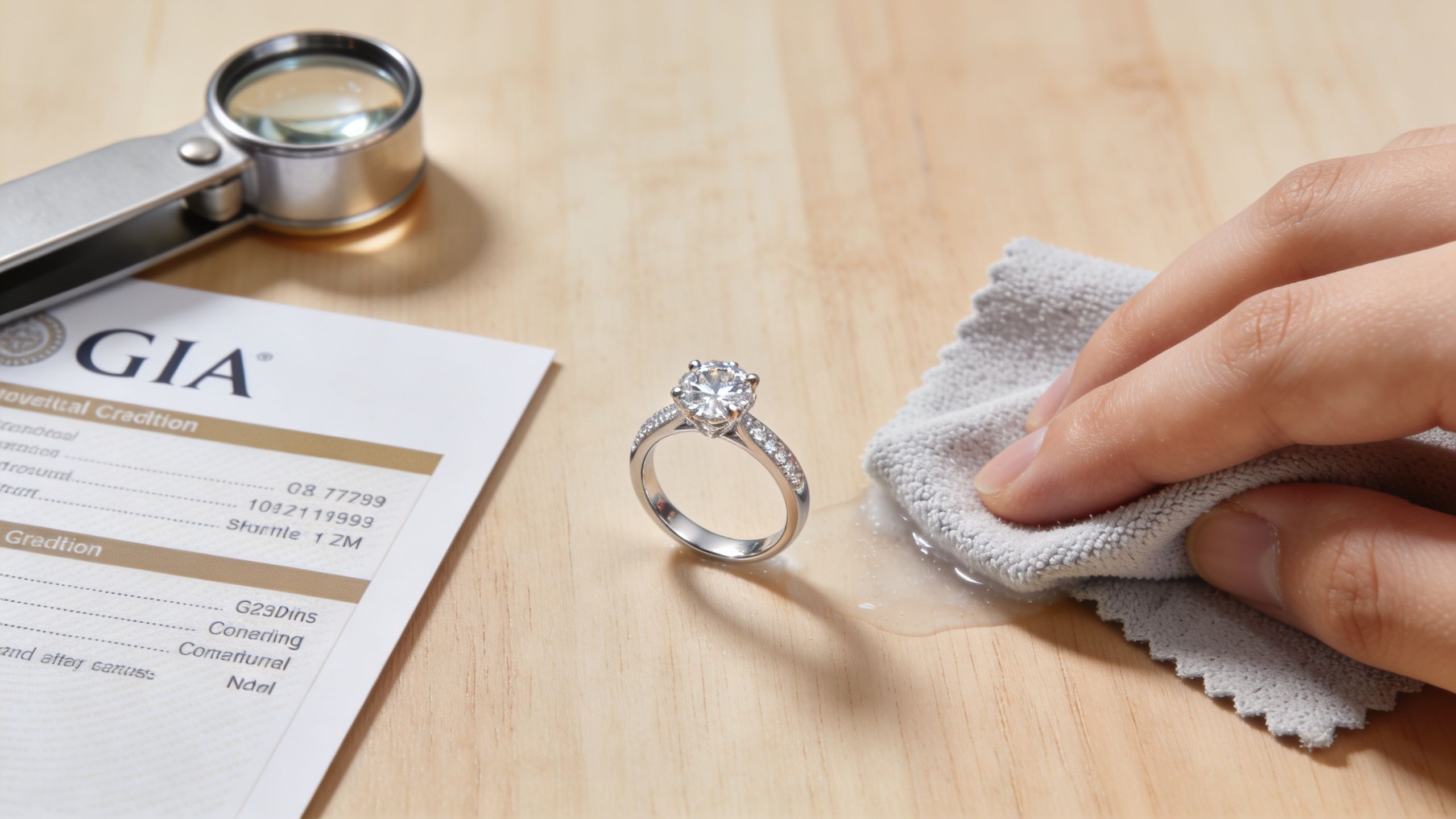
Start with presentation and paperwork
Clean the ring gently before anyone sees it. Mild soap, warm water, and a soft brush are usually enough for a basic home cleaning. The point isn't to make the ring look “new.” The point is to remove lotion film, dust, and residue that can hide the stone's cut, brightness, and overall condition.
Then gather every document you still have. A GIA or AGS grading report matters because it gives the buyer a starting point for the 4Cs: carat, color, clarity, and cut. Original receipts, prior appraisals, service records, branded boxes, and even old insurance paperwork can help establish provenance and reduce uncertainty.
Practical rule: Never assume the buyer will “figure it all out” for you. The more complete your file is when you walk in, the easier it is to get a confident offer.
The prep work is worth the time. According to Qollateral's selling diamond jewelry guide, a complete pre-sale preparation cycle typically takes 5 to 10 business days and can improve valuation by 15% to 35% versus selling immediately. The same source notes that high-quality imagery can increase qualified buyer inquiries by 40% to 50% for online evaluations.
If you're selling more than one item, the discipline is the same. This broader guide to selling unwanted items is useful because it reinforces a truth that applies to jewelry as much as anything else: organized sellers make better decisions than rushed sellers.
A simple pre-sale checklist
Use this checklist before contacting local buyers:
Clean the ring carefully: Use mild soap, warm water, and a soft brush. Avoid harsh chemicals and aggressive polishing.
Collect grading documents: Prioritize GIA or AGS reports, then receipts, appraisals, and repair history.
Photograph the ring in good light: Take top view, side view, profile, hallmark shots, and close-ups of the center stone.
Note visible condition issues: Loose prongs, chipped melee, worn shank, resizing seams, and scratched metal all matter.
Write down what you know: Purchase year, original retailer, stone specifications, and whether the ring has been altered.
Get your categories straight: Insurance paperwork is not the same as a resale valuation.
Compare specialty markets too: If you're also evaluating other luxury items, this guide on selling high-end watches shows how documentation and condition affect trust across categories.
A simple photo setup that works
You don't need a studio. You do need consistency.
Place the ring on a plain background near a window. Turn off yellow overhead lights if they create glare. Take photos straight on and at an angle, and include one image of any report number or hallmarks if visible. Poor photos make serious buyers hesitate because they can't tell if they're seeing dirt, wear, fluorescence effects, or actual damage.
A common mistake is overcleaning or trying to “improve” the ring before the sale with repairs that may not add value. If a prong is dangerously loose, mention it. Don't guess your way through a repair unless a qualified jeweler has advised it.
Understanding Your Ring's True Market Value
The hardest part of selling a diamond ring isn't finding a nearby buyer. It's accepting that the ring's resale market value often has little to do with what you paid in a retail store.
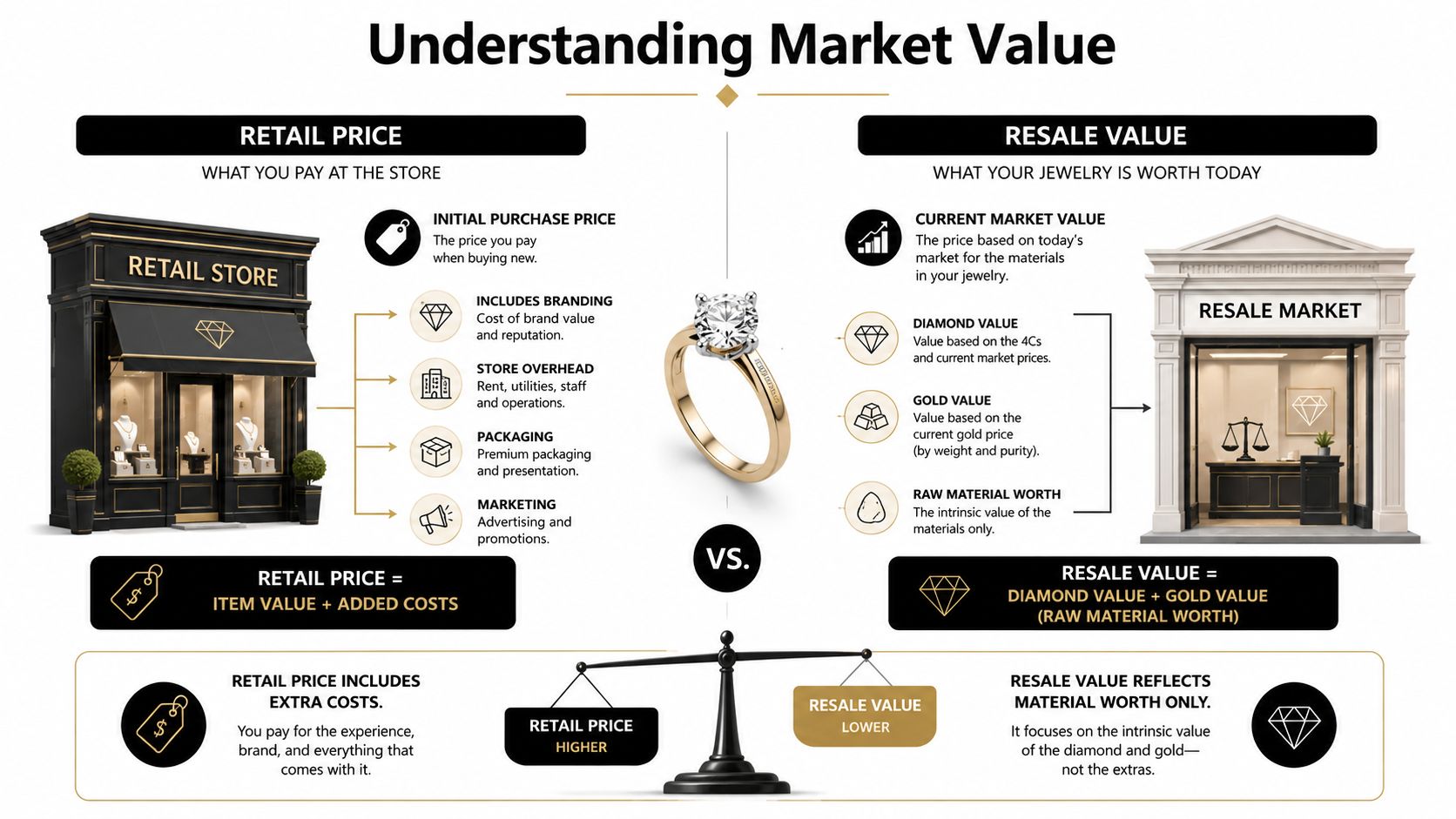
Why retail price and resale value are different
Retail jewelry prices include more than the diamond and metal. They also include store overhead, branding, staffing, inventory carrying costs, warranties, and profit margins. That's why the resale market works differently from the original showroom purchase.
According to Diamond Banc's diamond selling guide, sellers typically receive 30% to 60% of the original retail price in the diamond resale market, in large part because retail pricing often includes 100% to 200% markups. The same source gives a simple example: a ring purchased for $10,000 at retail might realistically sell for $3,000 to $6,000 on the secondary market.
That number surprises people, especially when they're holding an insurance appraisal that looks much higher. But insurance figures usually reflect replacement cost, not what a buyer will pay today in a resale setting.
A professional offer should explain the ring's value in plain language: the diamond, the mounting, the documentation, the condition, and current resale demand.
The valuation terms sellers confuse most often
The confusion usually starts with words that sound similar but mean different things. Here's the cleanest way to separate them:
Term | What it means | Why it matters when selling |
|---|---|---|
Retail price | What you paid in a jewelry store | Useful as history, not as current market value |
Insurance appraisal | Estimated replacement cost | Often higher than resale expectations |
Fair market value | What a knowledgeable buyer might pay in the current market | The most relevant framework for a sale |
Scrap or component value | Value of the metal and reusable parts | Important if the ring has limited resale appeal as a finished piece |
A buyer assessing your ring is usually looking at current demand for the center stone, the quality of the cut, whether the grading report is credible, and whether the setting contributes value or just adds weight and labor. A branded setting or a period piece can matter, but many rings trade primarily on the quality and salability of the diamond.
That's also why personalization can cut both ways. Engraving may add sentiment for the owner, but it rarely raises resale value. If you're thinking about jewelry personalization in another context, this overview of Sugar Land gift engraving and personalization is a good reminder that customization is usually about meaning, not resale.
Why an outside appraisal can help
A seller who understands the ring's likely fair market range walks into the appointment with better questions. You're less likely to anchor emotionally to the purchase price, and more likely to focus on what a buyer is seeing.
If your collection includes other precious metal jewelry, the same discipline applies across categories. This article on where to sell platinum is relevant because it shows how metal value and resale demand can diverge depending on the item, not just the raw material.
How to Find and Vet Reputable Local Buyers
A nearby buyer is only useful if they're credible. That's the core issue behind most “sell my diamond ring near me” searches.
In Atlanta and the surrounding market, sellers often compare a local jeweler, a pawn-oriented operation, a mail-in platform, and a specialist diamond buyer. Each can serve a purpose, but they don't evaluate with the same depth or explain value the same way.
One of the clearest pain points in this market is uncertainty. A consumer jewelry report summarized by Diamond Exchange Houston found that 67% of sellers felt uncertain about whether they received fair value, which is why transparent, no-obligation pricing matters so much during the local search.
What to look for before you book an appointment
Start with signals that show how the business operates.
Private evaluation process: Serious sellers often prefer a discreet office over an open retail counter.
Clear explanation of offers: The buyer should explain what drives the number, not just state it.
Relevant specialization: Selling a diamond ring isn't the same as selling scrap gold.
No pressure to decide instantly: A professional office should be comfortable with you taking time to think.
Visible business identity: Look for a real address, established contact information, and a consistent local presence in Buckhead, Roswell, Sandy Springs, Alpharetta, Brookhaven, Midtown Atlanta, or nearby.
A specialist buyer doesn't need flashy language. They need a disciplined process.
How buyer type affects your experience
The buyer category often tells you what kind of offer process you'll get.
Buyer type | What usually works well | Common trade-off |
|---|---|---|
Specialized diamond buyer | Stronger understanding of grading, current resale demand, and buyer confidence factors | May be selective about what they purchase |
Local retail jeweler | Convenient if they already know your market or offer trade options | Some focus more on selling new inventory than buying estate pieces |
Pawn-focused buyer | Fast if speed is your only priority | Often less educational, less specialized, and more transactional |
For many sellers, the deciding factor isn't just price. It's whether the offer makes sense when it's explained. Antwerp Diamond Store is one local option in this category, offering private evaluations and no-obligation offers for diamond jewelry and other luxury assets, which is the sort of process sellers should look for whether they choose that office or another buyer.
If a buyer can't explain the role of the grading report, condition, and current market demand, you don't have enough information to make a calm decision.
This is also why broad “cash for gold” messaging can be too narrow for diamond jewelry. If you're comparing how different buyers handle precious materials more generally, this page on the best place to sell gold is useful for understanding why item category matters.
Questions worth asking in advance
Ask these before you drive across town:
Do you evaluate in person, privately, and by appointment or walk-in?
Will you review the diamond and the setting separately if needed?
Do you want me to bring certificates, receipts, or prior appraisals?
Can you explain how you arrive at the offer?
Is the offer no-obligation?
A short video can also help you get a feel for how professional jewelry buyers discuss the process before you book time.
What to Expect During Your In-Person Appointment
Most first-time sellers are less worried about the ring than the room. They want to know what will happen, how long it will take, and whether the process will feel adversarial.
What happens when you arrive
A professional appointment usually starts with intake. You present the ring, any grading reports or receipts, and basic history if you know it. If the ring is inherited or older, that's normal. A buyer doesn't need a romantic backstory, but they do need the facts you have.
You should expect a calm environment and a clear handoff of the item. Good offices handle the piece in front of you, explain what they're checking, and answer questions as they go. If the process feels secretive from the start, pay attention to that feeling.
How the ring is examined
The gemologist or buyer will usually inspect the stone under magnification, look at the mounting, and verify what can be verified from documentation. They're checking the 4Cs, but also practical resale factors such as fluorescence, wear, damage risk, matching between the stone and paperwork, and whether the setting helps or hurts marketability.
Tools matter here. A loupe, microscope, scale, and metal testing equipment aren't there for show. They help separate assumptions from evidence.
Here's what that often looks like in real time:
Stone review: The diamond is checked for size, visible inclusions, cutting style, and general make.
Mounting review: The ring's metal, craftsmanship, wear, and any repair issues are noted.
Document match: Report details are compared against what's physically present.
Marketability review: The buyer considers whether the ring is easiest to sell as a complete piece, for the center stone, or partly for its materials.
“A good appointment should feel like an explanation, not a mystery.”
A serious buyer will usually talk through the decision in layers. First the center diamond. Then the mounting. Then the role of condition and paperwork. Then current market appetite for that specific style or stone profile. That's how you tell whether you're in a valuation meeting or just being handed a number.
If you've never sold a luxury item before, think of it this way: the ring is being translated from sentimental ownership into market language. The more clearly that translation is done, the more confident you can be in the offer.
Negotiating Your Offer and Finalizing the Sale Securely
Once you hear the offer, slow down. You don't need to negotiate aggressively to negotiate well.
How to respond to an offer calmly
Start by asking the buyer to break the offer down. You're not challenging them. You're making sure you understand what portion reflects the diamond, what reflects the setting, and whether missing paperwork or condition affected the number.
If the offer feels light, ask a direct question: “What would need to be different about the ring or documentation for this number to change?” That usually produces more useful information than saying you expected more.
You can also decline politely and continue comparing buyers. If you're evaluating offers across multiple luxury categories, this article on online watch buyers is a useful comparison point for how documentation and trust shape remote versus in-person transactions.
What paperwork and payment should look like
Before finalizing, review the sale documents carefully. You should expect a written record of the transaction and a copy for your files.
Secure payment methods vary by office and transaction size, but professionalism matters more than speed alone. Ask when payment is issued, how it's delivered, and whether you'll receive a receipt or bill of sale at the same time.
A clean sale usually includes these basics:
Your identification is verified
The item description is recorded clearly
The final offer is stated in writing
You receive a copy of the paperwork
The payment method is explained before you commit
If anything feels rushed or unclear, pause. A legitimate buyer won't object to that.
Frequently Asked Questions About Selling Diamond Rings
Can I sell a diamond ring without a GIA report
Yes, you can. But missing certification often affects the offer because the buyer has to assume more risk and may need to invest in further verification. According to Diamonds Above, the absence of a GIA report or similar certification can lead buyers to discount offers by 15% to 30% or more, and a worn or damaged setting can also reduce value.
What if the ring is inherited and I have no receipt
That's common. Bring whatever you do have, such as old appraisals, family paperwork, ring boxes, or repair records. An experienced buyer can still evaluate the ring in person, but inherited jewelry often benefits from a patient, documentation-first approach rather than a same-day rush sale.
Should I sell the ring or borrow against it
That depends on whether you want permanent liquidation or temporary access to funds while keeping the option to reclaim the item. If ownership matters and you're still deciding, a collateral-based option may be worth reviewing before you sell outright. Antwerp's jewelry loan process is one example of how that alternative works in practice.
Does the setting matter or is it all about the diamond
The center diamond usually drives the conversation, but the setting still matters. Damage, excessive wear, weak prongs, outdated styling, and missing accent stones can all affect how easily the ring can be resold or reused.
Is a local buyer always better than an online buyer
Not always. Local appointments are useful when you want immediate, face-to-face answers and a hands-on evaluation. Online channels can widen your options, but they depend heavily on shipping, imagery, and trust in the process.
How many buyers should I talk to
Enough to understand whether the explanations are consistent. If one office clearly explains the ring and another avoids specifics, the difference in professionalism is already telling you something.
If you're ready to move from research to a real evaluation, Antwerp Diamond is a practical place to start. Bring your ring, any grading reports or receipts you have, and your questions. A clear in-person review can help you decide whether to sell now, wait, or explore another option without pressure.


