
Understanding Gold Value: Spot Price, Karat Purity, and Weight Calculations
Before you walk into any shop or mail your pieces away, you need to understand how gold is priced. The foundation of all gold trading is the live market spot price, which represents the current global price for one troy ounce of 100% pure gold. A troy ounce is slightly heavier than a standard grocery store ounce, coming in at exactly 31.1 grams (or 20 pennyweights, abbreviated as dwt).
Because pure gold (24-karat) is too soft for daily wear, jewelry is blended with other metals like copper, silver, or zinc. The karat rating tells you exactly how much pure gold is in your item:
24K Gold: 99.9% pure gold
18K Gold: 75.0% pure gold
14K Gold: 58.3% pure gold
10K Gold: 41.7% pure gold
To learn more about how these alloy percentages change value, check out our guide on What is the Difference Between 14K and 18K Gold.
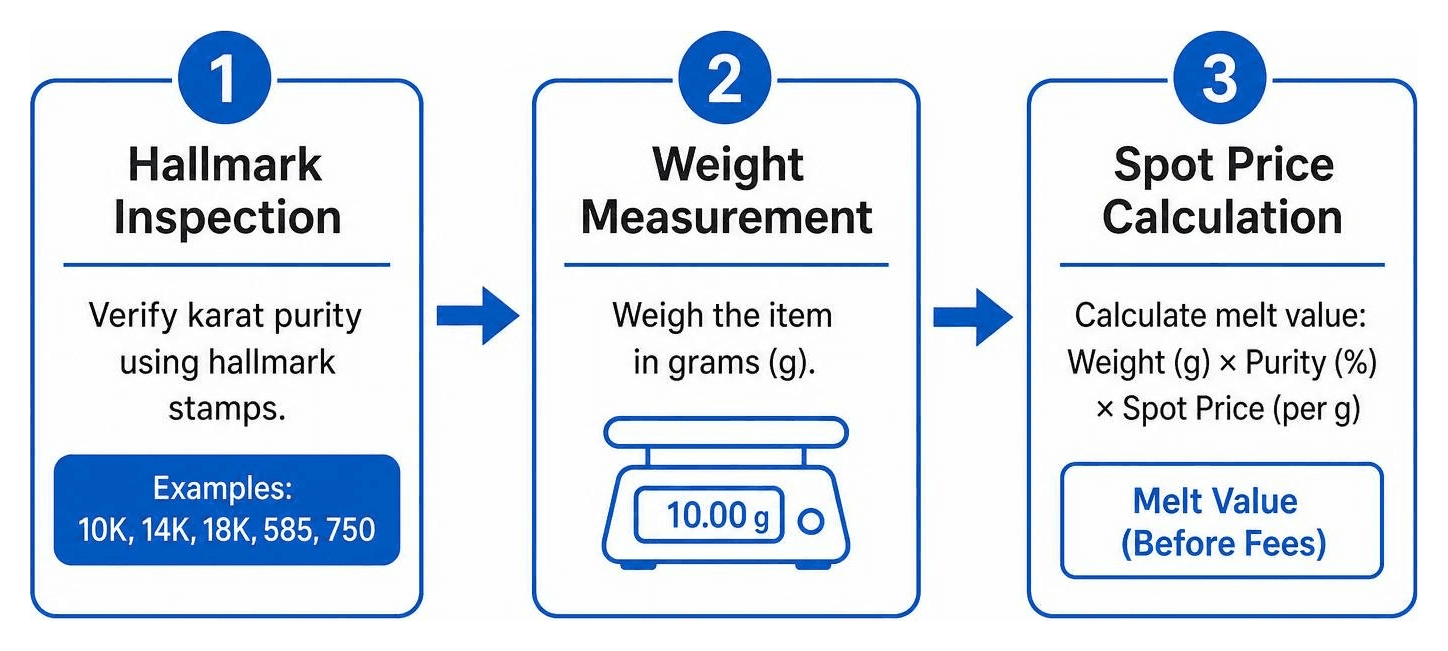
To calculate your item’s intrinsic metal content (its melt value), you multiply its total weight by its purity percentage, then multiply that result by the active spot price per gram. For example, if you have a 10-gram 14K gold chain, it contains 5.83 grams of pure gold (10 grams x 0.583). If the live spot price of pure gold is $80 per gram, the raw melt value of your gold is $466.40. No scrap buyer pays 100% of melt value for standard jewelry because they must cover refining costs and overhead, but knowing this baseline prevents you from accepting unfair lowball offers.
How to Calculate Gold Purity and Weight Before Visiting the Best Place to Trade in Gold Jewelry
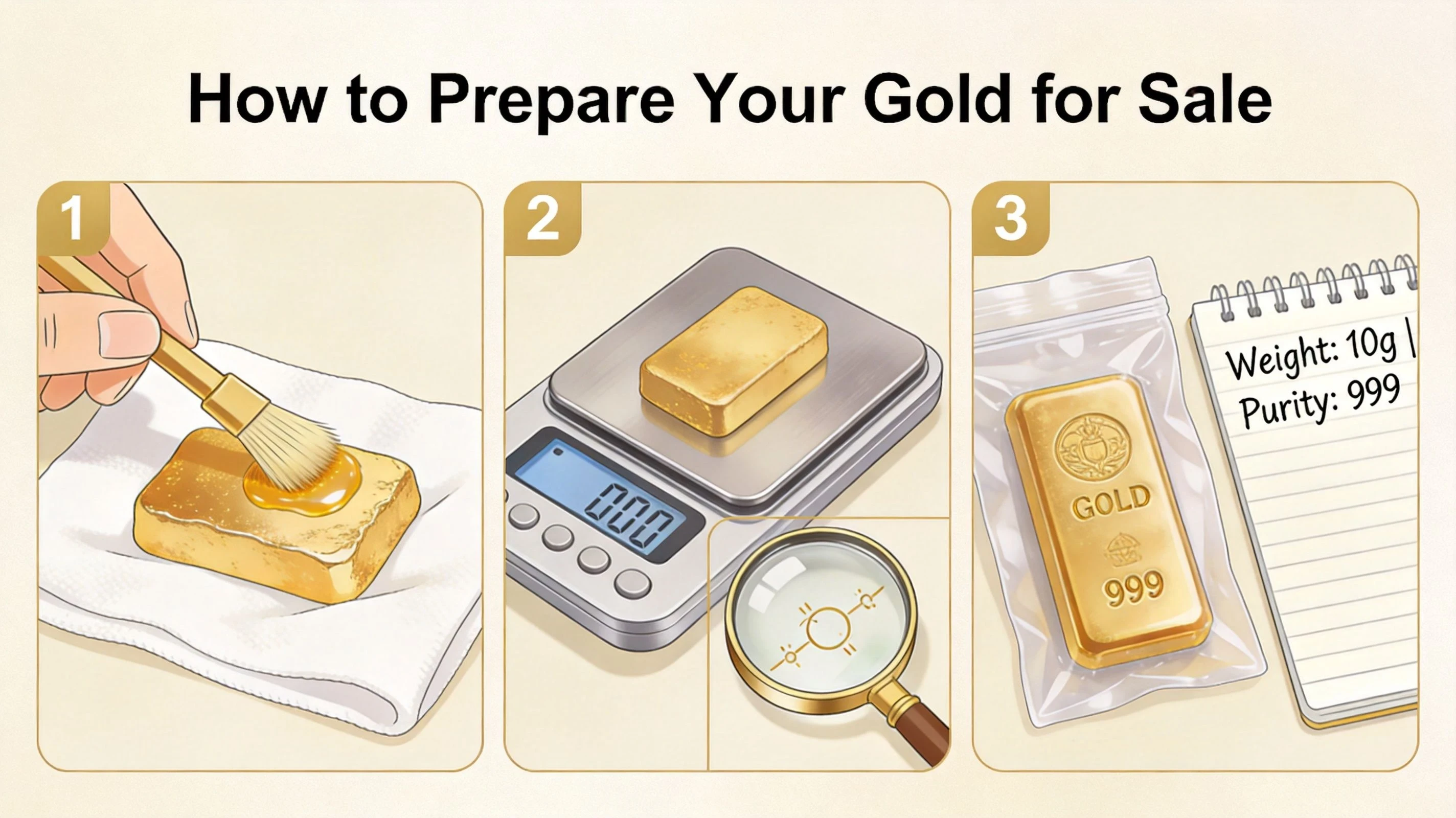
Preparing at home gives you complete control over the transaction. Follow these practical steps before visiting any buyer:
Check Hallmark Stamps: Use a magnifying glass to check the inside of rings, earring posts, or necklace clasps for stamps such as 10K, 14K, 18K, 417 (10K), 585 (14K), or 750 (18K). Watch out for stamps like GP, GEP, or HGE, which mean "gold plated" or "gold electroplated"—these pieces contain negligible gold and hold no scrap value.
Pre-Weigh Your Pieces: Use a digital kitchen scale set to grams. Group your jewelry by karat before weighing them so you have clear numbers ready.
Understand Buyer Testing Methods: Professional buyers evaluate purity using several tools. Touchstone acid testing involves rubbing a tiny bit of metal onto a slate stone and applying nitric acid to verify purity. Advanced dealers use X-Ray Fluorescence (XRF) analyzers, which instantly measure exact precious metal percentages without scratching or harming the metal.
If you are unsure how to evaluate high-end items or pieces with gemstones, review our detailed resource on How to Appraise Jewelry.
Finding the Best Place to Trade in Gold Jewelry: Local vs. Online Options
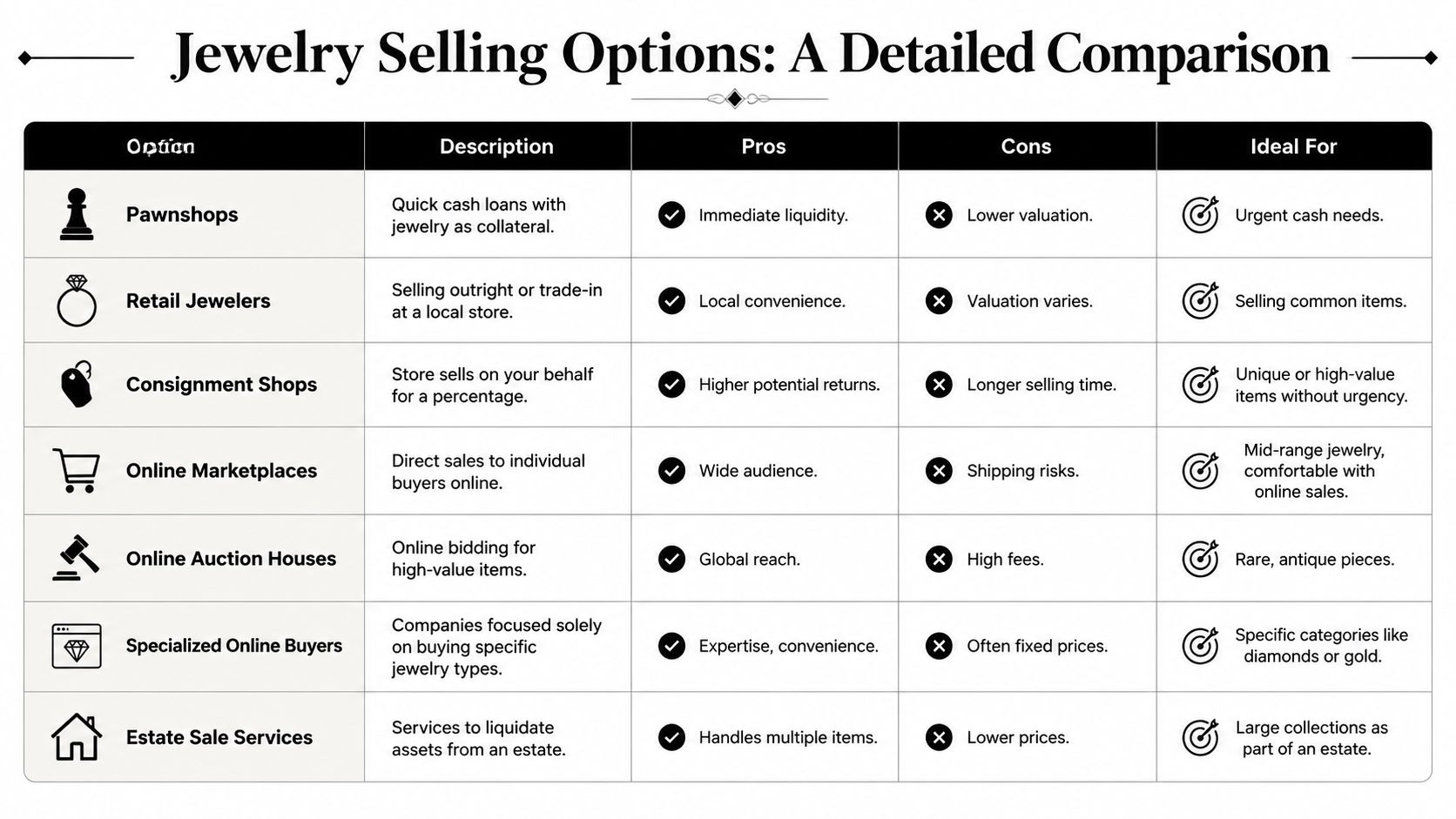
Choosing the best place to trade in gold jewelry depends on whether you prefer fast cash, higher payouts for rare items, or the convenience of selling from home. Here is a breakdown comparing local gold buyers, pawn shops, and online buyers:
Buyer Type | Typical Scrap Payout | Transaction Speed | Key Advantages | Best Used For |
|---|---|---|---|---|
Specialized Gold Dealers | 70% – 90%+ | Immediate (15–30 mins) | High transparency, live spot calculations, instant cash/wire | Scrap gold, broken jewelry, coins, fine estate pieces |
Pawn Shops | 50% – 65% | Immediate | Fast cash, no appointment needed | Quick liquidity when local options are limited |
Local Retail Jewelers | Varies widely | Immediate or trade credit | May offer higher trade-in credit toward new purchases | Upgrading fine jewelry, resalable pieces |
Online Gold Buyers | 70% – 90% | 2 to 5 business days | Convenient home pickup, insured mailers | Non-urgent sales, remote sellers |
For more tips on choosing a reliable partner, consult our overview of the Best Place to Sell Gold and search for vetted Gold Buyers Near Me.
Navigating Local Gold Buyers in Key Regional Markets
Local gold and coin specialty shops are often the superior physical option over standard pawn shops. Pawn shops prioritize collateralized loan risks, which causes their cash purchase offers on scrap metal to lean lower (often 50% to 65% of melt value). In contrast, specialized precious metal buyers work directly with refineries or high-end resale channels, allowing them to offer substantially higher percentages of melt value.
If you are looking to sell precious metals in the Southeast, our specialized team provides private consultations for Gold Buyers Atlanta, giving you immediate access to transparent evaluations. If you are located on the Gulf Coast, you can also explore local trade solutions through our guide to Sell Gold Tampa.
What Makes an Online Service the Best Place to Trade in Gold Jewelry?
Online buyers offer a convenient alternative if you do not have reputable physical buyers nearby. When selling precious metals by mail, look for buyers offering:
Free Prepaid Insured Shipping: Look for services offering evaluation kits with shipping insurance up to $1,000 or even $100,000 for high-value items.
Lab Video Unboxing: Top services record the unboxing and XRF testing of your package in a lab setting for complete proof.
Clear Return Policies: Ensure the buyer offers free, no-obligation returns if you decline their cash offer.
Flexible Cancellation Windows: Some gold exchanges give you a 30-day window to return funds and retrieve your items if you change your mind.
If you want to trade silver coins or platinum alongside gold pieces, explore our guide on Where to Sell Gold and Silver.
Scrap vs. Resale: Should You Melt or Sell Your Gold Jewelry Intact?
One of the biggest mistakes sellers make is treating all gold jewelry as scrap. Broken chains, single mismatched earrings, and bent rings are ideal for the melting pot because their value lies entirely in their weight and gold purity. However, fine jewelry from recognized luxury houses (like Cartier or Tiffany & Co.), high-grade vintage/antique pieces, and items featuring valuable diamonds often carry significant craftsmanship value that exceeds their raw gold content.
Factors determining whether your jewelry should be sold intact vs. melted down:
Brand & Designer Provenance: Signed pieces from major luxury brands carry a heavy resale premium far above melt value.
Historical or Antique Significance: Victorian, Edwardian, or Art Deco gold jewelry in original condition appeals directly to collectors.
Large, High-Quality Gemstones: Scrap buyers often weigh items together with small stones or discard accent gems. If your piece features a large diamond, it should be appraised separately.
Condition & Resalability: If an item is in pristine condition and features a timeless style, local estate jewelers can resell it whole rather than sending it to a refinery smelter.
Before agreeing to let a buyer throw your intact designer bracelet onto a scale for melt weight, seek a luxury buyer who evaluates aesthetic design, diamond quality, and brand power.
How to Evaluate Buyers, Compare Offers, and Avoid Common Scams

Finding a fair offer requires watching how buyers conduct their business. A trustworthy gold buyer will perform all testing and weighing directly in front of you on state-certified, calibrated scales.
Watch out for these red flags and key best practices:
Demand Written Quotes: Never accept vague verbal estimates. Ask for a written breakdown showing exact gram weight, identified karat purity, the spot price baseline used, and the final payout offer.
Beware of High-Pressure Tactics: Scammers often claim an offer is only good for the next 10 minutes or try to rush you into signing papers. Honest buyers encourage you to shop around.
Avoid "Gold Parties": Social gold-buying parties present high-pressure social environments where host commissions often result in payouts lower than standard dealer rates.
Verify Licensing & Reviews: Check Better Business Bureau (BBB) ratings, online customer feedback, and confirm that the buyer holds state licenses to buy precious metals.
Understand Documentation and Taxes: State and federal laws require licensed buyers to collect a government-issued ID to prevent stolen property traffic. Additionally, the IRS classifies precious metals as collectibles, meaning profits from gold sales can be subject to capital gains tax up to 28%. Keep all purchase and sale receipts for accurate tax reporting.
Frequently Asked Questions About Trading in Gold Jewelry
Do I have to pay taxes when I trade in or sell gold jewelry?
Yes. The IRS classifies physical precious metals, including gold jewelry, as collectibles. If you sell your gold for more than your original purchase price (or inherited cost basis), the profit is considered a capital gain and may be subject to collectible capital gains tax rates up to 28%. Consult a qualified tax professional regarding your personal sales tax reporting requirements.
Should I remove gemstones before trading in gold jewelry?
If you are selling jewelry strictly for scrap melt value, small accent gemstones are usually weighed along with the metal or removed and discarded by refiners. However, if your piece contains a high-value center diamond or precious gemstone (like a sapphire or ruby), you should have it evaluated separately by a qualified appraiser or removed prior to selling the metal.
Can I trade in broken or un-hallmarked gold jewelry?
Absolutely! Broken chains, damaged rings, dental gold (crowns and bridges), and pieces missing hallmark stamps retain 100% of their intrinsic gold value. Reputable buyers use XRF analyzers or acid testing to verify exact gold purity even when markings are worn or absent.
Conclusion
Trading in gold jewelry does not have to be intimidating. By measuring your items' karat purity, weighing them in grams at home, and calculating their melt value against live spot prices, you put yourself in full control of the transaction. The best place to trade in gold jewelry is always a buyer that prioritizes transparent, in-person testing, gives written quote breakdowns, and evaluates luxury or designer craftsmanship beyond raw melt weight.
At Antwerp Diamond Store in Atlanta, GA, we offer private, appointment-only consultations that guarantee complete discretion, transparent market-based appraisals, and immediate payouts without hidden fees. Whether you are liquidating scrap gold, luxury watches, or fine gemstone jewelry, visit our detailed guide on the Best Way to Sell Gold Jewelry or schedule your private valuation with us today.


