The best place to sell gold depends on what you own. For scrap gold and jewelry, reputable online buyers can deliver 90 to 95% of spot price, while local jewelers and pawnshops often pay 70 to 80%, and pawn shops can sometimes come in at 50 cents on the dollar.
If you're reading this, you're probably holding a tangle of old chains, a few broken earrings, maybe a gold coin, or a branded piece you suspect is worth more than the last offer you got. The mistake I see most often is simple: sellers treat every gold item like scrap. That's how people leave serious money on the table.
A generic 14k bracelet, a bullion coin, and a Cartier bracelet should not go to the same kind of buyer. The right move is to match the item to the buyer, then test that buyer with the right questions before you agree to anything.
Table of Contents
Finding the Best Place to Sell Your Gold
How to Prepare Your Gold for Sale
Sort by category before you ask for a quote
Check markings and gather anything that supports value
Where to Sell Gold A Detailed Comparison
Gold Buyer Comparison At a Glance
How to judge each option
How to Get the Most Money for Your Gold
Know what actually changes the payout
Ask questions that force a real valuation
Sort your gold before you sell it
Common Scams and Red Flags to Avoid When Selling Gold
Warning signs that should stop the transaction
A good process should feel boring
Why Selling Luxury Gold Items Is Different
Luxury gold should not be priced as melt only
What serious buyers look for in branded pieces
Frequently Asked Questions About Selling Gold
Is it better to sell gold online or in person
How do buyers test gold
Should I clean my gold before selling it
Do coins and bullion sell the same way as jewelry
Is branded jewelry worth more than melt value
Should I accept the first offer
What should I bring to a gold selling appointment
Finding the Best Place to Sell Your Gold
The short answer is this: specialized buyers beat pawn shops for most gold sellers. That applies whether you're in Atlanta, Buckhead, Sandy Springs, Alpharetta, Roswell, Brookhaven, Midtown Atlanta, or anywhere else in the Georgia market.
You have three main lanes. First, local precious metal buyers and jewelry experts. Second, online mail-in gold buyers. Third, pawn shops. They do not evaluate your item the same way, and they do not pay the same way.
Local certified precious metals dealers generally offer much better pricing than pawn shops, and AARP notes that pawn shops can offer as little as 50 cents on the dollar for gold items in some cases, while local dealers often provide transparent, on-site testing and same-day payment when you accept the offer (AARP guidance on selling gold and silver).
Practical rule: If the buyer can't clearly explain how they tested, weighed, and valued your gold, you shouldn't sell there.
Deciding where to sell isn't just local versus online. It's scrap versus collectible versus luxury resale. If your item has brand value, design value, or secondary market demand, a melt-only offer is the wrong offer.
How to Prepare Your Gold for Sale
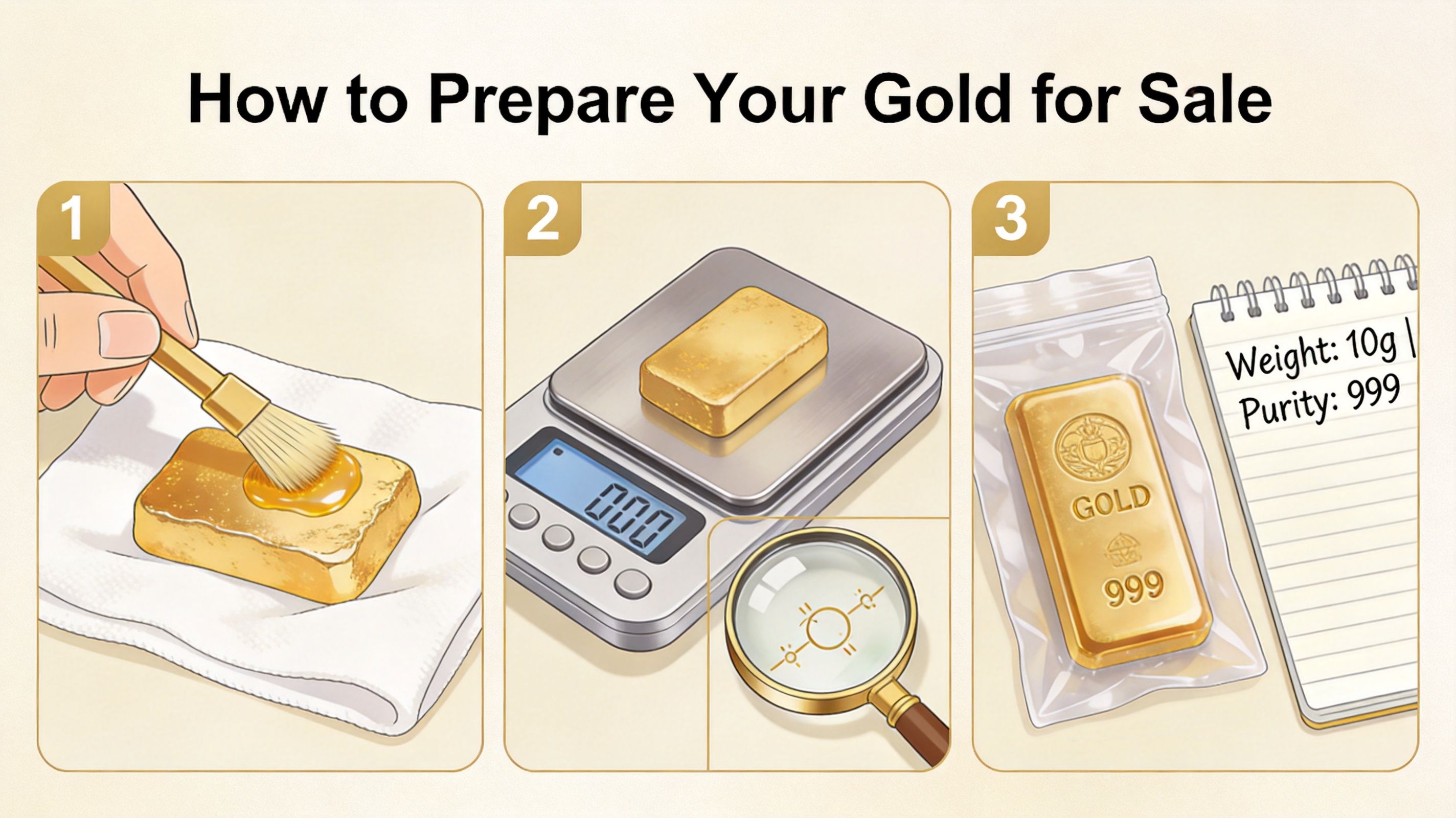
Most sellers start shopping offers too early. First, get organized. A clean, sorted presentation helps the buyer evaluate faster, and it helps you avoid mixing high-value pieces with ordinary scrap.
Sort by category before you ask for a quote
Don't walk in with one pouch and ask, "What will you give me for all of it?" That's how branded and well-made pieces get flattened into a scrap number.
Separate your items into groups:
Scrap gold: Broken chains, single earrings, damaged rings, dental gold, and mismatched pieces.
Bullion and coins: Bars, rounds, and government-issued coins should be evaluated differently from jewelry.
Fine jewelry: Rings, bracelets, necklaces, and earrings with craftsmanship value.
Designer or signed jewelry: Cartier, Tiffany & Co., Van Cleef & Arpels, and similar items may deserve resale pricing, not just metal pricing.
If you also have silver in the same estate or jewelry box, keep it separate from your gold and review this guide on selling silver flatware so you don't bundle unlike items into one weak negotiation.
Check markings and gather anything that supports value
Look for stamps like 10k, 14k, 18k, 22k, 24k, 585, 750, or 916. Those markings are only the starting point. An experienced buyer will still test the metal, but the marks help you sort your pieces in advance.
Then gather:
Original boxes and papers: Especially for signed or branded jewelry.
Receipts or service records: Helpful for premium pieces.
Gemstone reports or old appraisals: Not because they dictate the offer, but because they provide context.
Loose components: A detached charm, extra bracelet link, or original clasp can affect resale appeal.
Clean gently. Don't polish aggressively, don't file test a piece yourself, and don't remove links or parts. Sellers damage value when they try to "help" the appraisal.
For more complex pieces, especially items with diamonds, colored stones, or designer hallmarks, professional jewelry appraisal services can help you understand whether you're dealing with melt value, market value, or both.
Where to Sell Gold A Detailed Comparison
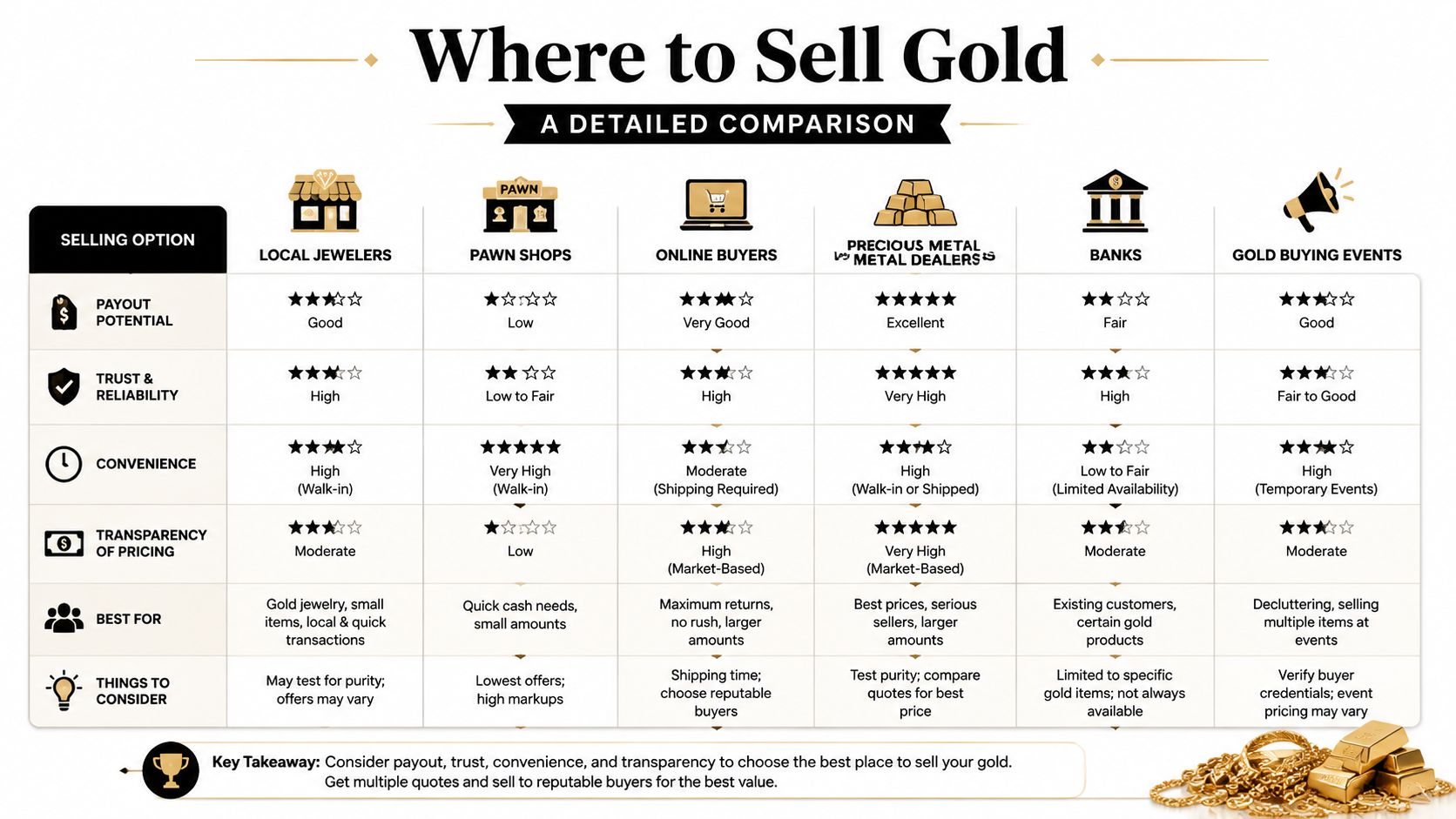
You walk into a shop with a 14k chain, a Cartier bracelet, and a broken gold ring. If the buyer treats all three the same, leave. The best place to sell gold is the place that prices your item by the right standard. Melt value for scrap. Resale value for signed luxury pieces. Market demand for fine jewelry.
Gold Buyer Comparison At a Glance
Buyer Type | How They Usually Price Gold | Payment Speed | Best For |
|---|---|---|---|
Reputable online gold buyer | Strong on scrap payouts tied closely to spot price | Delayed until the package is received, evaluated, and accepted | Broken chains, single earrings, plain gold jewelry, bulk scrap |
Local jeweler or gold expert | Varies by expertise. Better buyers separate scrap from resale-quality jewelry | Often same day | Fine jewelry, branded pieces, in-person review, immediate payment |
Pawn shop | Usually conservative, with heavy margin built into the offer | Fast | Urgent cash needs, lower-value items, simple transactions |
Luxury resale buyer | Prices by brand, condition, craftsmanship, and secondary-market demand | Slower than a scrap deal in some cases | Cartier, Tiffany & Co., Van Cleef & Arpels, Rolex, and collectible gold pieces |
How to judge each option
Online gold buyers work well for straightforward scrap. Their advantage is efficiency. Their weakness is distance. Before you ship anything, ask how they test purity, whether offers are locked to the market price on the day of receipt, who pays return shipping if you decline, and how long you have to accept or reject the offer. Check the current real-time 99.9% pure gold sell rates before you compare any quote.
Local jewelers and gold specialists are the best choice if you want to see the evaluation happen in front of you. Ask direct questions. Are you buying this for melt, resale, or both? How are you testing purity? Are you removing stones before weighing? Will you write the weight, karat, and offer breakdown on paper? Serious buyers answer clearly and do not rush you.
Pawn shops solve one problem. Speed. They are rarely the right venue for maximizing value, especially for fine jewelry or signed pieces. If you use a pawn shop, get competing offers first and treat the transaction as a convenience decision, not a pricing benchmark.
Luxury resale buyers matter more than many sellers realize. A branded gold piece can be worth far more than its metal content, but only if the buyer has the client base and product knowledge to resell it properly. If the conversation starts and ends with gram weight, that buyer is not equipped to value luxury.
A practical local route for Georgia sellers is to compare in-person offers from precious metal buyers and luxury jewelry specialists. If your estate includes multiple metals, this guide on where to sell platinum jewelry and mixed precious metal pieces will help you avoid getting one flat offer for items that belong in separate categories.
Use this framework before you sell:
Ask what market the buyer serves. Scrap refining, retail resale, estate jewelry, watches, and branded luxury all produce different offers.
Ask how the offer is calculated. You want weight, purity, stone handling, and buyer margin explained plainly.
Ask whether branded pieces are valued above melt. If the answer is vague, move on.
Ask what documentation you receive. A professional buyer can show the numbers behind the offer.
Ask what happens if you decline. This matters most for shipped items and high-value goods.
One local option in the Atlanta market is Antwerp Diamond Store, which evaluates fine jewelry, gold items, watches, and other luxury assets through in-person appointments and remote submissions. For sellers in Buckhead, Roswell, and nearby areas, that kind of review can help separate branded resale value from simple melt value.
How to Get the Most Money for Your Gold
A seller walks into the first shop they find with a 14k chain, a signed bracelet, and a vintage ring. Thirty minutes later, everything has been grouped into one pile and priced as scrap. That is how money gets left on the table.
The highest offer usually goes to the seller who separates items by value type before asking for quotes. Broken chains, plain wedding bands, collectible coins, diamond jewelry, and luxury branded pieces do not belong in the same pricing bucket. If a buyer treats them that way, the offer is built for the buyer's profit, not yours.
Know what actually changes the payout
Gold value starts with purity and weight, then shifts based on whether the item should be sold for melt, estate resale, or branded resale. A plain 18k bracelet may trade close to scrap logic. A Cartier, Tiffany, or Bulgari piece should be evaluated as a finished luxury item first.
Check real-time 99.9% pure gold sell rates before you request offers. That number is not your payout, but it gives you a hard reference point. It also makes it easier to spot a buyer who is hiding behind vague language.
Timing matters, but classification matters more. Sellers often focus on the daily gold price and ignore the bigger issue: whether the buyer is using the right market for the item in front of them.
Ask questions that force a real valuation
Do not ask, "What's your best price?" Ask questions that expose how the price was built.
Are you buying this for refining, estate resale, or luxury resale?
You need the buyer to state the market clearly. If they cannot, they are guessing or defaulting to melt.What parts of this offer come from gold content, and what parts come from brand, design, or resale demand?
This question separates knowledgeable jewelry buyers from simple scrap desks.How are stones, settings, and maker's marks handled in the valuation?
A serious buyer will address each one directly.Can you write the offer out by item instead of grouping everything together?
Bundle pricing hides weak numbers.If I remove one item from the deal, does the rest of the offer change?
That answer tells you whether the buyer is pricing carefully or averaging everything in their favor.
A good comparison process also means comparing buyer types, not just buyer names. A scrap buyer competes on one set of economics. A luxury reseller competes on another. The same discipline used when comparing platforms for selling handbags, including authentication fees, payout speed, and security steps applies here. Fees, expertise, holding period, and resale channel all affect what you take home.
Sort your gold before you sell it
Create three groups before any appointment.
Scrap gold: broken chains, single earrings, damaged basics, and items with no design premium
Jewelry with resale potential: wearable pieces with diamonds, craftsmanship, or vintage appeal
Luxury branded items: signed pieces from recognized houses, especially with boxes, papers, receipts, or service records
This step sounds simple because it is. It also changes the outcome. A buyer who pays fairly for scrap may still be the wrong buyer for a signed bracelet or a heavy designer necklace.
Get multiple quotes on the same day when possible. Then compare the method, not just the dollar amount. The strongest offer is the one that explains where the money comes from and does not collapse when you ask precise questions.
Common Scams and Red Flags to Avoid When Selling Gold
A weak offer is annoying. A dishonest process is worse. Most bad gold transactions follow the same pattern: confusion, pressure, and missing detail.
Warning signs that should stop the transaction
Walk away if you see any of these:
The buyer won't test or weigh in front of you: You should be able to see how they reached the number.
The scale or process feels opaque: If nothing is explained, assume the process benefits the buyer, not you.
The buyer pushes urgency: "Sell now before the market drops" is pressure, not advice.
Everything gets treated as melt only: Signed jewelry, coin premiums, and collectible value can disappear in seconds under a lazy appraisal.
You can't get your item back easily: If the return process is unclear, don't hand it over.
Fraud isn't limited to precious metals. The broader lesson is the same in any asset sale: verify the process, verify the counterparty, and protect yourself before money changes hands. This overview of tactics to safeguard personal assets is useful background if you want a sharper eye for manipulation and misrepresentation.
A good process should feel boring
A legitimate gold transaction is not dramatic. It should be methodical.
Look for this sequence:
Identification of the item
Testing and explanation
Visible weighing
Clear offer
Freedom to decline
If you're also comparing categories like timepieces, many of the same red flags apply. This guide to online watch buyers is worth reading because luxury sellers often face the same pressure tactics across different asset classes.
If a buyer acts offended because you asked questions, that's your answer.
The safest sellers stay detached. They don't negotiate from emotion, guilt, or urgency. They decide from evidence.
Why Selling Luxury Gold Items Is Different
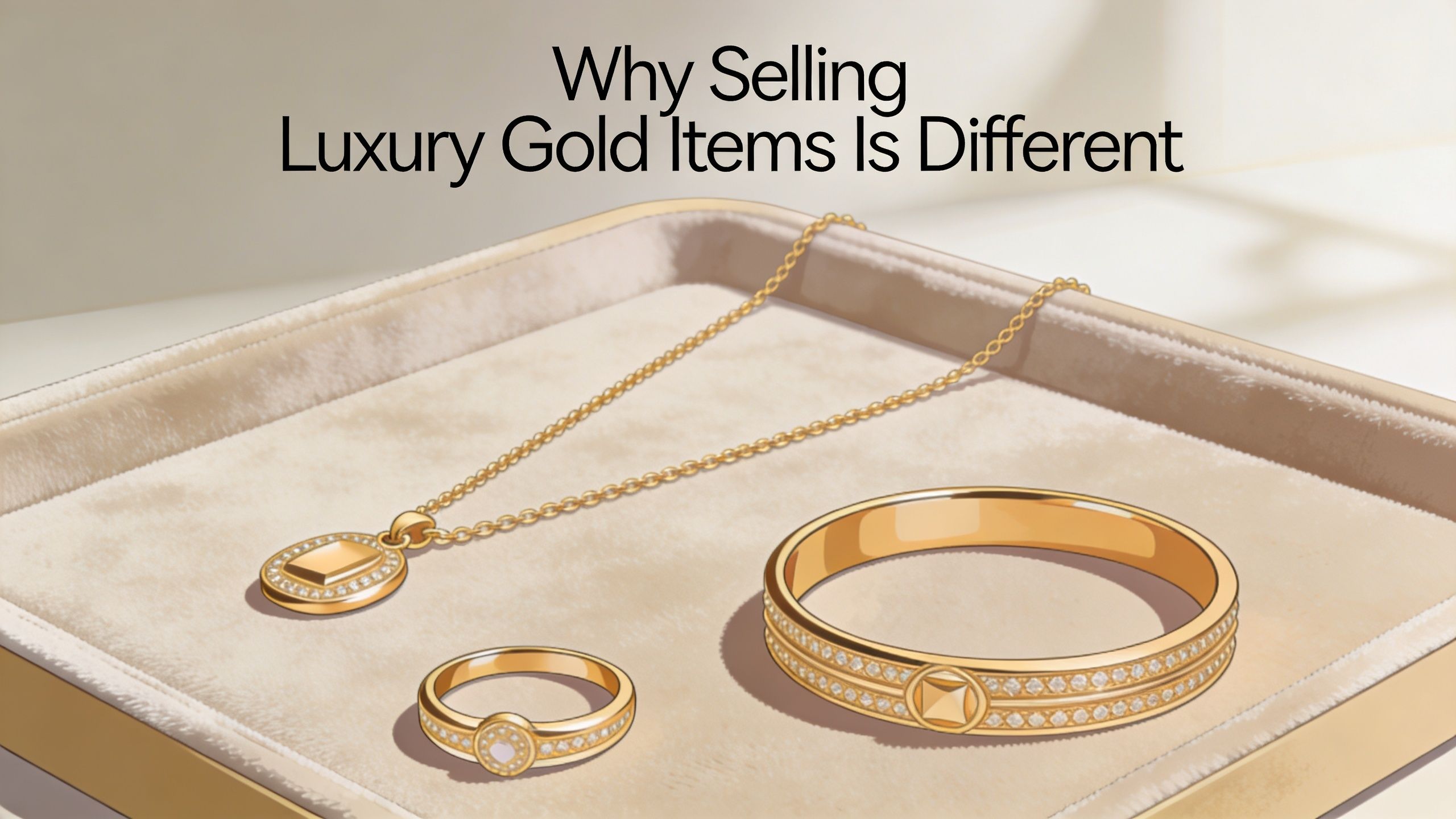
Generic advice fails in this scenario. Luxury gold isn't just metal. It's brand, design, condition, originality, and buyer confidence.
Luxury gold should not be priced as melt only
A Cartier bracelet, Tiffany & Co. necklace, or gold Rolex component should never be evaluated on weight alone unless the piece is damaged beyond practical resale. Buyers in this part of the market care about desirability, model, finish, serials, packaging, and whether the item can be authenticated with confidence.
The precious metals market now includes multiple channels, including online dealers, local coin shops, and specialized exchanges, and market analysis notes that the right choice depends on the situation. Local options offer same-day payment and transparency, while online channels offer convenience but add shipping risk and payment delay, which matters more for high-value items (market channel comparison).
That tradeoff becomes sharper with luxury goods. A scrap chain can be mailed with relatively little emotional friction. A signed bracelet or heirloom watch usually shouldn't be handled that casually.
What serious buyers look for in branded pieces
For luxury gold, buyers usually focus on a set of value drivers:
Brand and model recognition: Cartier, Tiffany & Co., Rolex, and other well-known names attract stronger buyer interest.
Condition: Deep scratches, stretched links, replaced parts, and poor repairs can weaken resale appeal.
Original accessories: Boxes, certificates, service paperwork, and receipts can support buyer confidence.
Authentication markers: Hallmarks, serial numbers, signatures, and construction details matter.
Market demand: Some branded items sell quickly, others don't.
If your item crosses categories, such as a gold watch rather than jewelry alone, this guide on how to sell high-end watches is useful because watch buyers evaluate originality and service history very differently from scrap gold buyers.
A luxury seller should expect a more nuanced conversation. The buyer should discuss not just karat and weight, but also whether the item belongs in a resale case, an auction pipeline, or a refining lot. If they can't make that distinction, they probably shouldn't be pricing your piece.
Frequently Asked Questions About Selling Gold
Is it better to sell gold online or in person
It depends on the item. Online buyers can be strong for ordinary scrap gold. In-person selling is often better for luxury jewelry, pieces with stones, and anything you don't want to ship.
How do buyers test gold
Most legitimate buyers use a combination of hallmark review, metal testing, and weighing. The important part isn't the exact tool. It's whether they explain the process clearly and do it in front of you when appropriate.
Should I clean my gold before selling it
Light cleaning is fine. Aggressive polishing is not. Dirt can be removed, but original finish and condition shouldn't be altered.
Do coins and bullion sell the same way as jewelry
No. Coins and bullion may follow a different pricing logic than wearable jewelry. A buyer who specializes in scrap may not be the right buyer for collectible or investment-grade pieces.
Is branded jewelry worth more than melt value
Often, yes. Brand, craftsmanship, condition, and documentation can all matter. That's especially true for Cartier, Tiffany & Co., Van Cleef & Arpels, and similar names.
Should I accept the first offer
Usually not. Compare offers, especially if the item might have resale value beyond metal content.
What should I bring to a gold selling appointment
Bring the item itself, your ID, any original boxes or papers, old appraisals, receipts, and service records if you have them. More context usually leads to a better evaluation.
If you want a professional review before you decide where to sell, contact Antwerp Diamond. You can start with an online evaluation or arrange an in-person appointment if you're in Atlanta, Buckhead, Roswell, or the broader Georgia market.