

A diamond resale value calculator gives you a rough estimate, typically 30% to 50% of the current retail price for a similar stone, not what you originally paid. It's a starting point, not a guaranteed offer, and the final cash value often changes once a buyer evaluates the diamond, the setting, the paperwork, and how easily that exact item can be resold.
If you're looking at a ring box, a GIA report, or an old appraisal and trying to answer one question, “What is this worth if I sell it today?”, that gap matters. Online calculators are useful because they strip away some of the mystery. They are not enough on their own because real offers are made on physical items, not on abstract specs entered into a form.
Table of Contents
Introduction: What Is Your Diamond Really Worth?
A resale calculator is most helpful when you treat it as a screening tool. It can tell you whether your expectations are in the right range before you spend time visiting buyers, comparing offers, or deciding whether to sell the stone loose or as jewelry.
That matters because the resale market behaves very differently from the retail market. CaratX reports that in 2024 secondhand diamond sales grew 22%, while average resale values remained only 30% to 50% of retail. In plain English, there is active demand, but there is still a large spread between a jewelry store price tag and an actual secondary market cash offer.
What to gather before you even estimate
Before using any diamond resale value calculator, collect the facts that drive the estimate:
The grading report: Start with a current GIA or IGI report if you have one. This report provides the calculator with its basic input data.
The report number: You'll usually find it near the top of the report. Buyers use it to match the stone to its grading record.
Shape and cutting style: Round brilliant, princess, oval, cushion, and others trade differently.
Exact carat weight: Use the report's stated weight, not an estimate from a receipt or memory.
Color and clarity grades: These appear in the core grading section.
Cut grade, polish, symmetry, and fluorescence: These details often sit lower on a standard report and are easy for sellers to overlook.
Measurements: Length, width, and depth can help explain why two diamonds with the same carat weight don't sell the same way.
Photos of the whole piece: If the diamond is mounted, buyers need to see the ring or jewelry item, not just the paper.
Practical rule: If you're guessing on the inputs, the output won't help much.
A seller in Atlanta, Buckhead, Sandy Springs, Alpharetta, Roswell, Brookhaven, or Midtown Atlanta usually gets the clearest path forward by bringing both the paperwork and the jewelry itself. The report tells part of the story. The physical piece tells the rest.
Gathering the Inputs for a Diamond Value Calculator
The first mistake is often made here: opening a calculator before understanding the necessary inputs. A diamond resale value calculator can only be as good as the inputs you feed it.
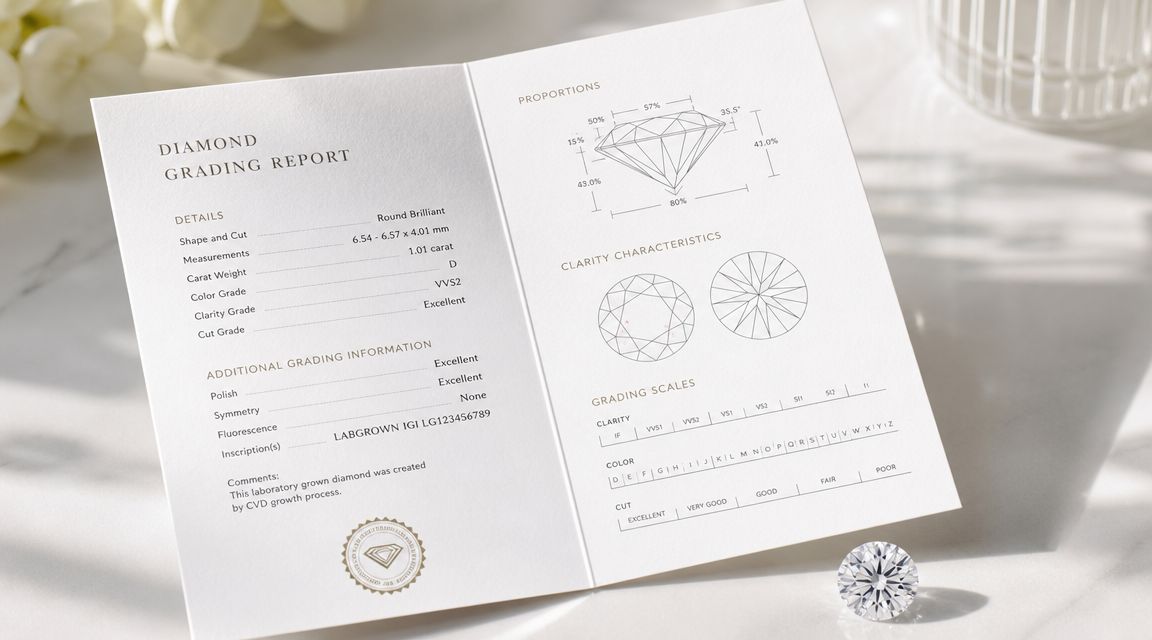
What to pull from your grading report
On a standard grading report, focus first on the stone's identity and quality grades. For a round diamond, that means the carat weight, color, clarity, and cut grade. Then move to the details calculators often hide in smaller text, including polish, symmetry, fluorescence, and measurements.
If the diamond is mounted and you don't have a report, don't try to reverse engineer the 4 Cs from an old insurance appraisal. Insurance documents often serve a replacement purpose, not a resale purpose. That makes them useful for reference, but weak as calculator inputs.
A good starting point is understanding how much a diamond is worth in the current market before you focus on your own piece.
What to gather before you estimate
Use this short checklist before entering anything online:
Grading report in hand. If you have more than one report, use the most credible and most current one.
Clear photos in neutral lighting. Include top view, side view, and any visible inclusions, chips, or wear on the mounting.
Jewelry details. Note whether the stone is loose, in a solitaire ring, halo ring, pendant, or another setting.
Brand information. If the ring is from a known house, that can matter in a way a stone-only calculator won't capture.
Condition notes. Prongs, shank wear, surface damage, and missing accent stones affect what buyers can offer.
Here's a simple manual way to think about the estimate. First, identify a comparable new diamond in the market using the report details. Then narrow that comparison by shape and certification quality. Finally, ask whether your item is really a loose diamond transaction or a whole-jewelry transaction.
A seller with a loose round brilliant and a seller with the same diamond in a worn ring do not necessarily have the same resale outcome.
That difference becomes even more important in the Georgia market, where many sellers bring inherited rings, reset engagement rings, and branded pieces rather than loose certified stones.
Using the Resale Value Formula A Worked Example
A lot of online tools follow a simple internal logic. They try to identify the current retail price for a comparable new diamond, then discount that number to approximate resale. That's useful, but only if you understand what the math is trying to represent.
How the basic formula works
That benchmark helps because it separates three values that sellers often blend together:
original purchase price
current retail asking price for a comparable new diamond
probable resale value in today's secondary market
Only the second number belongs in the formula.
Worked example table
Suppose you have a 1.01 carat round brilliant, G color, VS2 clarity, Excellent cut diamond with a reputable grading report. You search for a comparable new certified stone and find the lowest available retail price for a similar listing.
Metric | Value/Calculation | Notes |
|---|---|---|
Diamond specs | 1.01ct round brilliant, G, VS2, Excellent | Start with report data, not memory |
Comparable market price | Lowest available retail price for a similar new stone | Use like-for-like comparisons |
Resale benchmark | Retail price × 0.5 | Based on the benchmark method described above |
Estimated output | A rough resale estimate | Not a guaranteed cash offer |
This is the right way to think about a diamond resale value calculator. It is not “What did this cost?” It is “What is the market likely to pay for a comparable item now, after resale discounts?”
A ring owner should also understand the difference between valuing a loose diamond and valuing mounted jewelry. If you want a more ring-specific context, this guide on how much to value a diamond ring is a useful companion.
What the formula gets wrong
The formula is clean. The market isn't.
A calculator usually assumes the comparable diamond is exactly comparable. In practice, one stone can look equal on paper and still trade differently because of fluorescence, cut precision, inclusions near the table, a weak report, or the fact that the diamond sits in a ring a buyer would need to repair, unset, or scrap.
The output is a direction, not a commitment.
That's why experienced buyers use calculators as a first pass, then adjust based on what they can resell with confidence.
Factors Online Calculators Miss That Impact Your Offer
The biggest blind spot in most calculator content is simple: sellers rarely own a spreadsheet. They own a ring, an earring, a pendant, or an inherited jewelry piece with wear, style, and market friction attached to it.
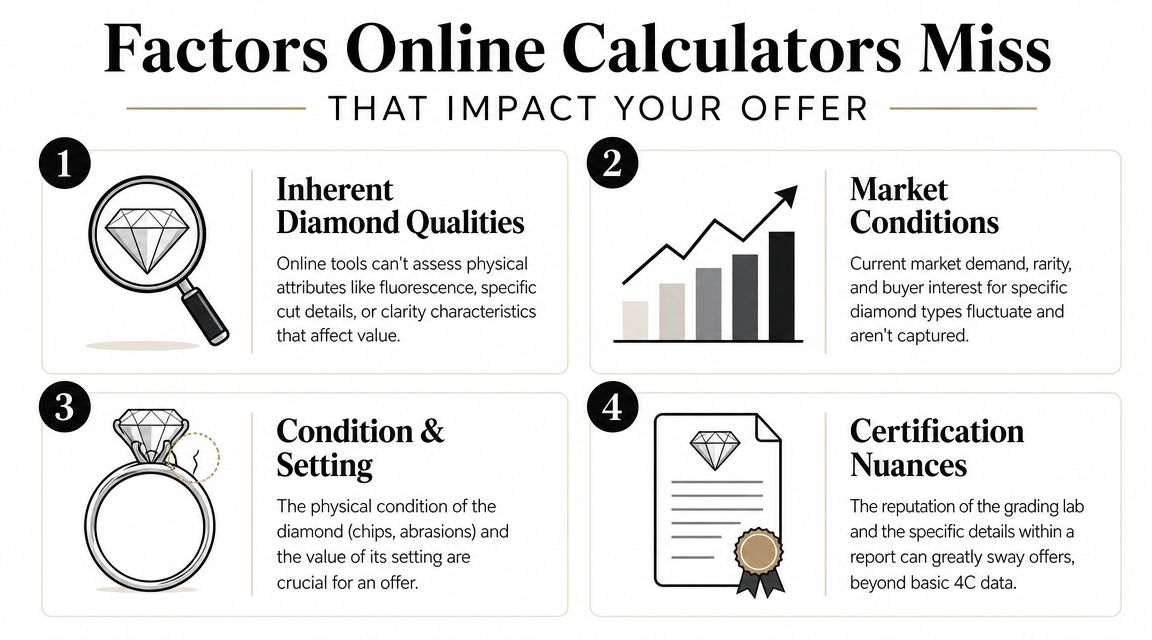
Why stone level math misses real world resale
Calculators tend to focus on the 4 Cs plus a few drop-down details. Real offers go further. The buyer is asking different questions: Is the grading report trusted? Is the stone salable in today's market? Is the ring attractive as-is, or does it need to be dismantled? Is there damage? Is there brand value in the mounting?
One major failure point is weight thresholds. This valuation guide notes that a 0.95-carat diamond can trade 10% to 20% below a comparable 1.00-carat stone, which is why “magic sizes” can break simple calculator logic. A linear model can miss that kind of discontinuity, especially around common thresholds.
Another issue is nuance in the report itself. Fluorescence, polish, symmetry, and cut precision can influence buyer confidence. A form with only carat, color, and clarity fields often smooths over details that matter at the offer stage.
A broader primer on what buyers look for can help if you're still sorting out stone quality and identity. This explanation of genuine diamond meaning is useful for understanding the difference between having a real diamond and having a diamond that sells well.
How to prepare before asking for offers
You can improve the process before anyone names a price:
Bring the actual report. A photocopy or a phone note with grades is weaker than the original documentation.
Check for recent damage. Chips, abrasions, and prong issues can change an offer even if the old report looks strong.
Photograph the piece accurately. Include profile shots and wear on the mounting.
Know whether the setting helps or hurts. Some settings add value. Others only add metal weight and labor costs to remove the stone.
Don't anchor to the old retail receipt. Buyers are pricing current resale demand, not yesterday's store markup.
Some diamonds are easy to price on paper and hard to sell in reality. That's where professional evaluation matters most.
Sellers in greater Atlanta often save time by getting an in-person review instead of chasing multiple online estimates that all rely on simplified assumptions.
Tips to Maximize Your Diamond's Resale Value
Preparation doesn't create value out of thin air, but it can reduce buyer uncertainty. Lower uncertainty usually leads to a cleaner, faster offer process.
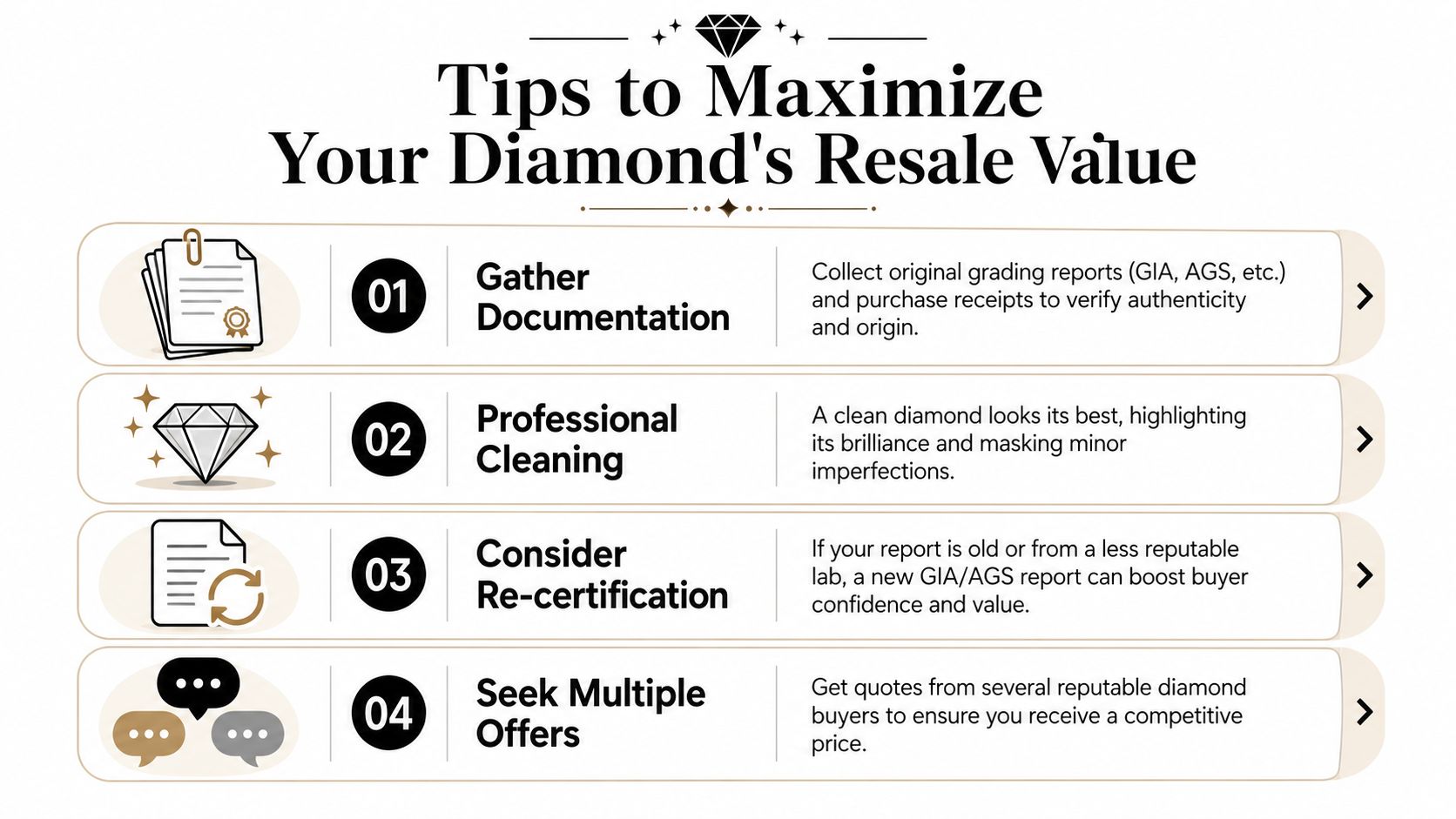
What actually improves buyer confidence
Start with paperwork. The grading report matters most, but receipts, branded boxes, and any service history can help support the story of the piece. If you have a branded ring from Tiffany & Co., Cartier, or Van Cleef & Arpels, the branding can affect buyer interest in a way a stone-only calculator won't see.
Clean presentation also matters. A ring that's covered in lotion residue or everyday grime is harder to judge fairly at first glance. If you want to clean jewelry safely at home before showing it, this guide to Evo Dyne's jewelry cleaning methods gives practical tips on using an ultrasonic cleaner and when to be cautious.
This video offers a useful visual perspective before you start comparing offers:
The other major issue is that many sellers are not selling a loose diamond at all. Diamond Banc notes that many sellers own diamonds in settings, where brand and condition affect value, and that calculators focus on the stone while a full jewelry offer considers the complete piece. That helps explain why resale recovery is often about 20% to 50% of retail.
Appraisal, resale, and loan value are not the same
At this point, confusion usually begins.
Appraisal value: Often used for insurance replacement. It is not a cash offer.
Resale value: What a buyer may pay in the secondary market.
Loan value: A separate risk-based figure if you're borrowing against the item.
A few practical moves help:
Keep the report with the piece. Separated paperwork slows the process.
Ask whether the buyer is valuing the stone alone or the whole ring. That answer changes the discussion immediately.
Get more than one serious evaluation. Not every buyer serves the same market.
Be realistic about generic mountings. Some add design value, others are mainly metal value.
If your report is outdated, or if the diamond has changed condition since it was last evaluated, a fresh professional review can prevent disappointment later.
Frequently Asked Questions About Diamond Resale Value
A calculator helps you frame expectations. It does not replace a real inspection. That's the thread running through almost every question sellers ask.
Can a calculator tell me what a buyer will pay today
No. It can suggest a range based on market comparisons, but it can't promise a live offer because it can't inspect the diamond, verify the report, or judge the setting and condition in person.
Does a ring setting matter
Yes. Some settings add value because of brand, craftsmanship, or resale appeal. Others contribute mainly precious metal value, or they may even reduce the convenience of resale if the buyer expects to remove the stone.
Should I sell locally or online
It depends on your comfort level, paperwork, and the type of piece you own. Many sellers prefer local evaluation because they can ask direct questions, compare explanations, and see how the buyer is assessing the item. That's often especially useful in Atlanta area neighborhoods like Buckhead, Midtown Atlanta, Roswell, and Sandy Springs where in-person luxury evaluations are common.
Is a GIA report worth having
Usually, yes, if you're dealing with a significant diamond and want a stronger basis for comparison. Buyer confidence generally improves when the stone is backed by a respected grading report. If you're shopping, selling, or comparing documentation, this overview of a GIA certified engagement ring gives helpful context.
Why is my old appraisal so much higher than resale
Because appraisals often reflect replacement assumptions, not immediate secondary market liquidity. A buyer is pricing what they can realistically resell after accounting for risk, margin, and demand.
Conclusion: From Online Estimate to a Confident Sale
A diamond resale value calculator is useful because it gives you a disciplined place to start. It can help you avoid unrealistic expectations and understand that resale value is based on today's market for a comparable diamond, not the sentimental value of the piece and not the original store price.
The part most calculators miss is the part that usually decides the offer. Buyers evaluate the whole transaction, not just the 4 Cs. They look at the report, the condition, the setting, the brand, and how liquid that exact item is in the current secondary market.
If you're preparing to sell, borrow against, or understand what you have, move from calculator math to a professional review as early as possible. That's how you find out whether your piece should be valued as a loose stone, a finished jewelry item, or a branded luxury asset.
If you're comparing options in Georgia, this guide on where to sell fine jewelry for maximum value in 2026 is a practical next read.
If you want a clear, confidential opinion on your diamond or jewelry, Antwerp Diamond offers professional evaluations for sellers in Buckhead, Atlanta, Roswell, and beyond. You can start with a low-pressure online review or schedule an in-person appointment to understand your item's current market value and what a realistic offer looks like.