A one-carat diamond can cost about $1,300 to $16,500, and top-quality one-carat stones can reach $20,000 or more, so there isn't one simple answer to how much is a diamond. If you're looking at a ring you own, inherited jewelry, or a loose stone you may want to sell, the more useful question is usually not just what it cost at retail, but what the current market will pay for it.
That gap is where confusion often arises. A receipt, an appraisal, or a memory of what was paid years ago may lead to the assumption that figure reflects resale value today. In practice, diamond pricing depends on quality, size, certification, shape, market demand, and whether you're talking about a retail purchase, an insurance appraisal, or a real buy offer in the secondary market.
Table of Contents
What Factors Determine a Diamond's Price
A diamond's price starts with the 4Cs: cut, color, clarity, and carat weight. Market guides note that for a one-carat diamond, retail pricing can range from about $1,300 to $16,500 depending on those quality characteristics and shape, which is why carat alone doesn't tell you much about value (Diamonds.pro diamond price guide).
The 4Cs are the starting point
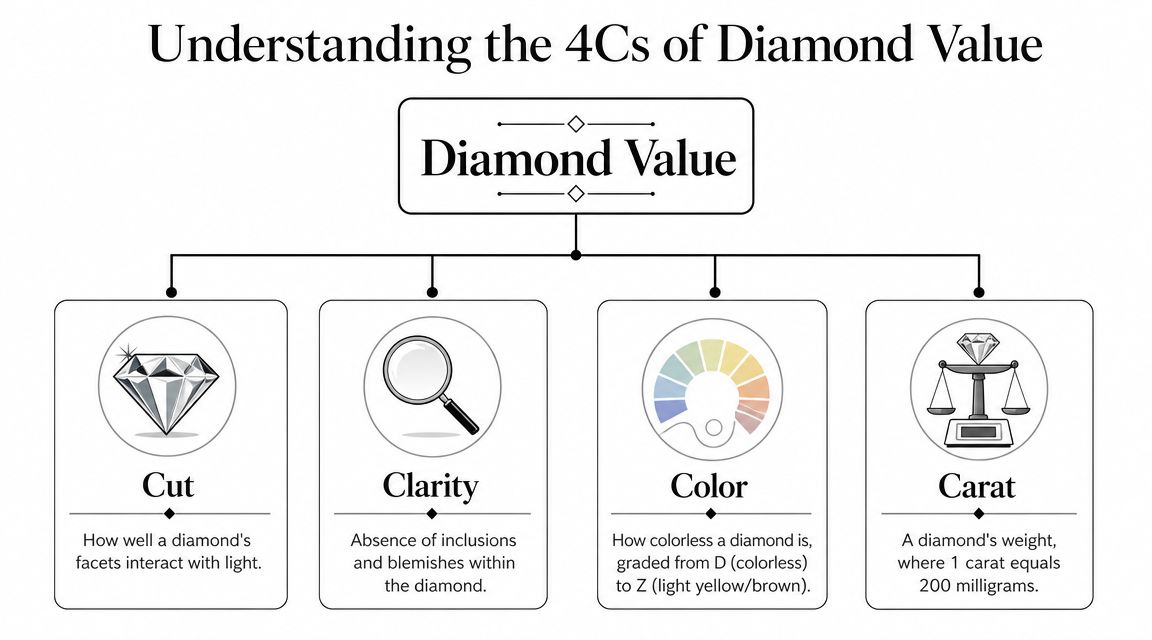
Cut is the most misunderstood factor. Many people think it means shape, but cut really describes how well the diamond handles light. A well-cut stone returns light to the eye and looks lively. A poorly cut stone can look dull even if its color and clarity grades are strong.
Color measures how colorless a diamond is. In plain terms, the less body color visible in a white diamond, the more desirable it often is in the market. Small changes in color grade can create noticeable price differences, especially in popular sizes.
Clarity describes internal inclusions and surface blemishes. Most inclusions are tiny and natural, but they still affect grading and buyer confidence. Two diamonds can look similar face-up and still trade very differently because one has a cleaner clarity grade.
Carat weight is just weight, not visual beauty. People often assume doubling the carat doubles the price, but diamond pricing doesn't work in a straight line.
Practical rule: If two diamonds have the same carat weight, don't assume they're worth anything close to the same amount.
Shape, fluorescence, and certification also matter
Shape affects both demand and cutting yield. Round brilliant diamonds often carry different pricing than oval, pear, marquise, radiant, asscher, or heart shapes because buyers don't value all shapes equally, and cutters don't recover rough material the same way from each crystal.
Fluorescence can also influence market perception. In some diamonds it makes little practical difference. In others, it can affect desirability depending on strength, appearance, and how the trade views that specific stone.
A grading report is often the closest thing a diamond has to a blueprint. A respected lab report helps a buyer verify the stone's measurable qualities and compare it against similar diamonds more confidently. If you're trying to understand why certified stones are easier to price, this overview of a GIA certified engagement ring is useful background.
For readers who want to see how different rough material can look before it ever becomes a polished stone, a specimen like this rough black diamond is a helpful visual contrast. It reminds you that the finished diamond market depends on what the cutter can produce from the original crystal.
Diamond Price Examples and Per Carat Rates
A seller often sees the first surprise here. Two diamonds can look close in size across a jewelry counter, yet their prices can be far apart once one crosses into a heavier weight bracket.
Retail market reporting shows that a 1.00 to 1.49 carat diamond averages about USD 4,448 per carat, a 2.00 to 2.99 carat diamond averages about USD 8,918 per carat, and a 4.00 to 4.99 carat diamond averages about USD 16,587 per carat (retail-market diamond statistics). The pattern matters more than the exact average. Price per carat does not rise in a straight, even progression.
Why price per carat rises as diamonds get larger
Carat weight works a bit like real estate. A small increase in square footage does not always change value much, but crossing into a more desirable category can move pricing sharply because the pool of available options gets thinner. That same category effect appears in diamonds.
A larger polished diamond is harder to produce from rough, and fine rough large enough to yield a high-quality finished stone is less common. Rapaport's consumer overview explains that a 2-carat diamond does not cost twice as much as a 1-carat diamond because rarity and demand increase with size (RapNet diamond pricing guide).
The same logic helps explain why lab-grown diamonds are priced differently. For a current consumer-facing comparison of natural and lab-created stones, Blue Nile notes that lab-grown diamonds generally sell for less than natural diamonds with similar stated grades (Blue Nile lab grown vs natural diamonds guide).
A simple example of how sellers get misled
Suppose an owner has a 1.05 ct diamond and remembers seeing 2 ct stones listed online at much higher prices per carat. It is easy to assume the value curve keeps climbing in a predictable way and that any larger stone must translate into a proportionally stronger resale offer.
That is not how the secondary market works.
Retail asking prices show what buyers pay to acquire comparable diamonds through a store or online seller. Resale buyers price a different problem. They look at how easily the stone can be verified, how quickly it can be resold, and how much margin is needed to cover risk. If you have ever compared consumer-facing buying channels with specialist secondary buyers in another luxury category, the process is similar to how online watch buyers evaluate resale inventory.
Here is a useful side-by-side view:
Carat Weight | Avg. Retail Price / Carat | What a Seller Should Understand |
|---|---|---|
1.00 to 1.49 ct | USD 4,448 | Retail averages describe replacement shopping, not a standing cash offer |
2.00 to 2.99 ct | USD 8,918 | Higher per-carat pricing reflects rarity, but resale still depends on cut quality, lab report, and buyer demand |
4.00 to 4.99 ct | USD 16,587 | Large stones can attract strong interest, yet offers still reflect current marketability rather than retail list price |
That gap is the blind spot.
A diamond owner may hold an appraisal or remember a store price and expect the resale market to anchor to that figure. In practice, resale buyers anchor to current comparables and the risk of putting capital into that specific stone. The same fair-market-value principle shows up in other asset categories, including probate sales, where pricing depends on what the market will pay now rather than on a paper estimate. That broader concept is explained well in this guide to understanding Texas probate property valuation.
This distinction highlights the two different meanings of the question, "How much is a diamond?" For a retail buyer, it means purchase price. For a seller, it means current market value in a resale setting.
Why an Appraisal Value Is Not a Market Offer
Many diamond owners often get blindsided. A paper appraisal may look authoritative, but it usually answers a different question than the one a seller is asking.
What an appraisal is designed to do
Consumer pricing guides commonly quote broad retail ranges. For example, a 2-carat natural diamond can retail from about $3,500 to $46,000 depending on quality, but those same guides rarely explain the resale gap, even though sellers care about what a buyer will pay today (Brilliant Earth diamond price buying guide).
Most jewelry appraisals are prepared for insurance replacement. That means the number is often tied to the cost of replacing the item through a retail channel, not what a dealer or private buyer would pay to acquire it.
An appraisal can still be useful. It may describe the ring, list the metal, identify accent stones, and summarize the center diamond's qualities. But if the document is old, generic, or based on broad replacement assumptions, it won't function as a current market offer.
What a buyer is actually pricing
A buyer looks at things an appraisal usually doesn't solve for in a resale setting:
Current demand: Is this size, shape, and quality easy to place now?
Certainty: Is there a reputable lab report, or does the buyer need to verify everything from scratch?
Condition: Is the setting worn, altered, chipped, or missing side stones?
Liquidity: Can the diamond be resold quickly, or will it sit in inventory?
The same logic shows up in other asset categories. If you've ever looked at estate assets, this article on understanding Texas probate property valuation is a useful comparison because it highlights the difference between a formal value on paper and what a real market participant may pay.
If you're familiar with luxury resale outside jewelry, the principle is similar to what happens in watches. A paper estimate and a live offer can be very different, which is part of why guides on online watch buyers often stress market comps and buyer verification rather than old appraisals.
How to Get an Accurate Diamond Valuation to Sell
The best valuation process starts with documentation, then moves to physical verification, then ends with a live offer based on current market conditions. That's important because rough-diamond market data shows volatility: the world average value per carat rose from USD 108.83 in 2021 to USD 132.30 in 2022, then fell to USD 88.35 in 2024, a decline of about 33.2% from 2022 to 2024 (Statista diamond pricing data referenced in market summary).
Start with the facts you already have
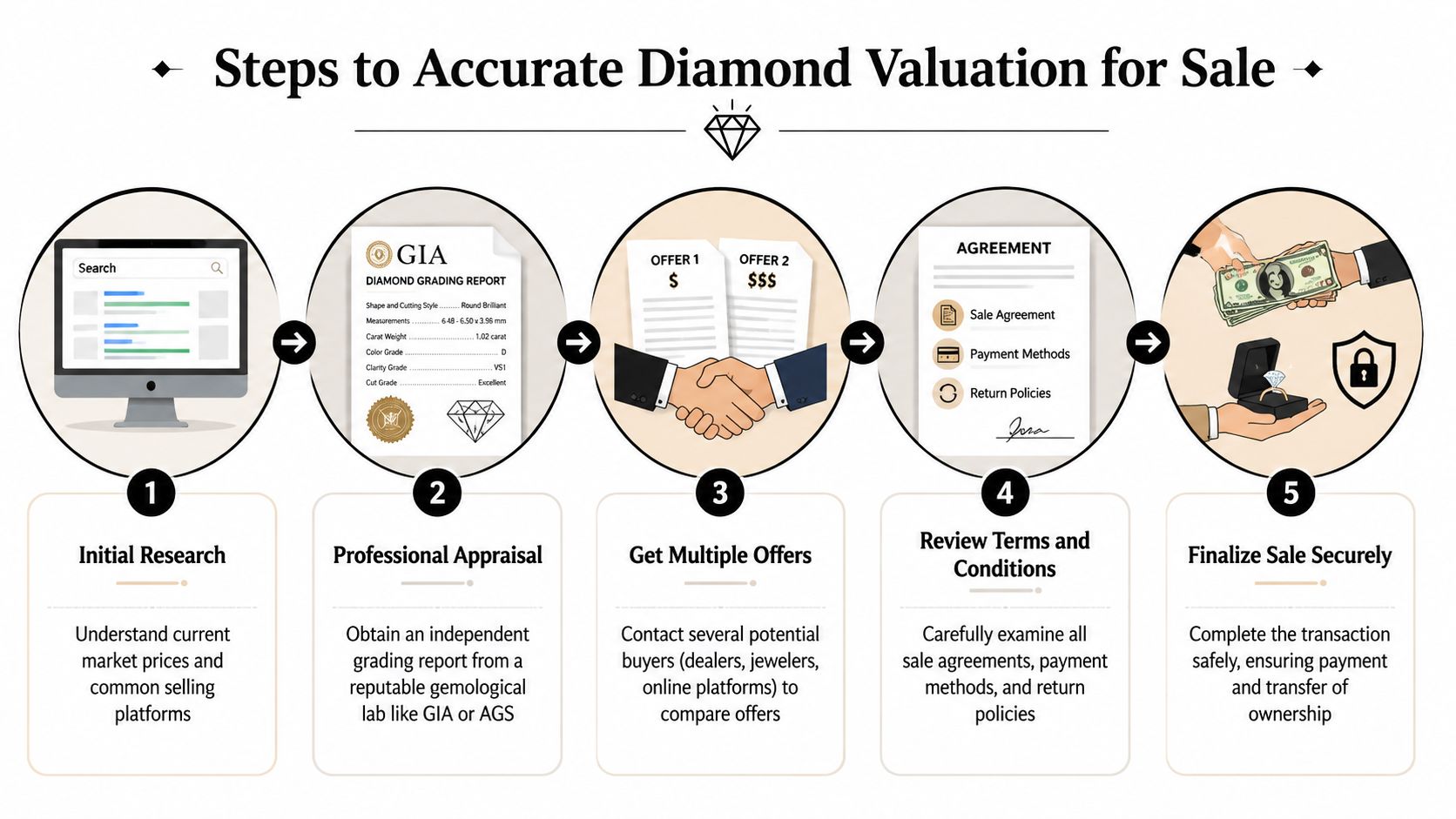
Gather the items that reduce uncertainty for a buyer:
Lab report: GIA and other recognized reports help define what is being valued.
Purchase paperwork: Old receipts don't establish resale value, but they can identify origin and specifications.
Recent photos: Clear images of the loose stone or ring help a buyer screen the piece before a full review.
Setting details: Metal type, brand, hallmarks, and any side stones can matter.
For people selling in Georgia, that first pass can happen online or in person. Some firms, including sell my diamond ring near me resources from local buyers, explain how to begin with photos and documentation before scheduling a physical review.
Confirm the stone in person or through a secure remote process
A serious buyer still needs to verify the diamond. That means checking whether the stone matches the paperwork, reviewing condition, measuring the mounting if it's set, and assessing what part of the piece carries the value.
For local clients in Atlanta, Buckhead, Sandy Springs, Alpharetta, Roswell, Brookhaven, Midtown Atlanta, and the greater Georgia market, an in-person appointment is often the clearest route. The diamond can be examined under proper lighting and magnification, and the owner can ask direct questions about how the offer was formed.
For remote clients, insured shipping and chain-of-custody procedures matter. The goal is simple: protect the item, document receipt, and make sure the owner understands the evaluation path before any sale decision.
A short overview can help if you're new to the process:
One practical option in Atlanta is Antwerp Diamond Store, which offers online preliminary evaluations, insured shipping for remote submissions, and private in-person appointments in Buckhead. That doesn't replace comparison shopping, but it gives sellers one more current-market reference point when they want a transparent review.
Bring the diamond exactly as it is. Don't guess on grades, don't clean aggressively at home, and don't rely on a decade-old appraisal to anchor your expectations.
Tips to Maximize Your Diamond's Resale Value
A common selling mistake starts at the kitchen table. The owner lays out the ring box, an old appraisal, and a firm idea of what the diamond "should" bring. Then the offers arrive far below that number.
The gap usually comes from uncertainty. Buyers pay more when they can identify the diamond quickly, confirm what it is, and estimate how easily they can resell it. If your appraisal says $12,000 and the live resale market sees a much lower number, the practical question becomes: what can you do to narrow the discount tied to risk?
What helps a seller immediately
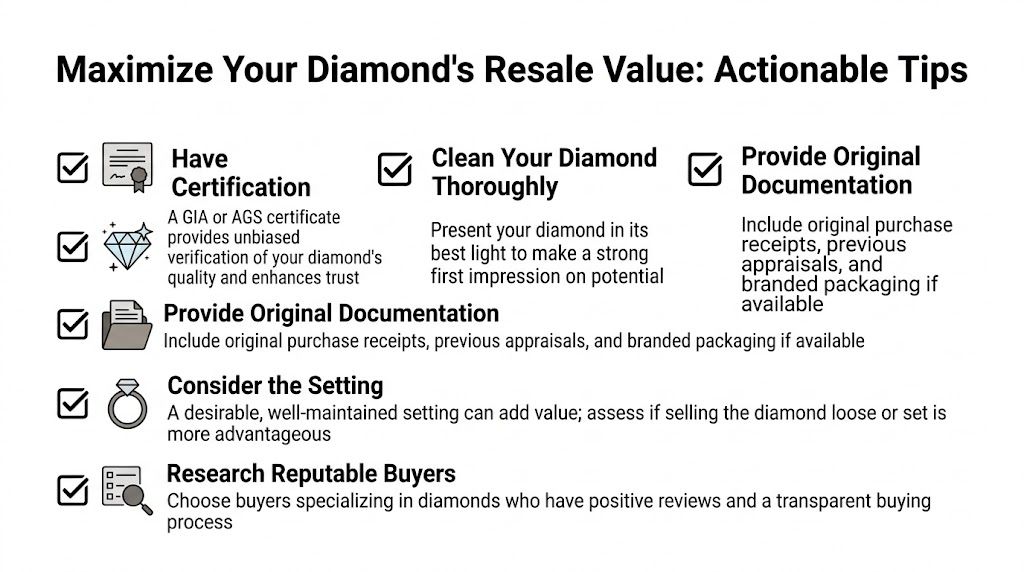
Start with the items that reduce guesswork:
Find the grading report: A respected lab report gives the buyer a starting point for color, clarity, cut, and measurements.
Gather original paperwork: Receipts, prior appraisals, branded boxes, and service records help connect the piece to its history.
Clean the piece gently: A diamond should look bright, but harsh home cleaning can loosen stones or damage older settings.
Ask whether the ring should be sold whole or separated: Some rings are valued mainly for the center stone. Others get support from the mounting, brand, or design.
Confirm whether the diamond is natural or lab-grown: Origin changes resale demand and pricing expectations right away.
That last point often surprises owners. Natural and lab-grown diamonds may look the same to the eye, but they do not trade the same way in resale. If origin is unclear, a buyer will usually protect against that risk by offering less until the stone is verified.
Small details that change buyer confidence
Condition matters, but resale value is really a confidence equation. A chipped girdle, worn prongs, a missing report, or an inscription that does not match the paperwork all slow the transaction and increase the buyer's cost to verify the piece.
The setting can matter too. A plain mounting may be priced mainly for metal and labor. A signed Tiffany & Co., Cartier, or well-made vintage ring can carry separate value if the branding is authentic and the design still has demand. In those cases, selling the piece through a buyer who handles signed jewelry, not just loose stones, can make a real difference. If you are weighing your options, this guide on where to sell fine jewelry explains how different buyer types evaluate documentation, brand, and condition.
One more point helps sellers avoid disappointment. Strong paperwork does not raise the inherent quality of the diamond. It shortens the distance between what the diamond is and what a buyer feels safe paying for it.
A resale offer is partly about the stone itself and partly about how much uncertainty surrounds it. Reduce the uncertainty, and you give the buyer fewer reasons to discount the price.
Frequently Asked Questions About Selling Diamonds
Will an older diamond ring still have value
Yes, often it will. Age alone doesn't eliminate value. Buyers usually focus on the center diamond's qualities, certification status, condition of the setting, and whether the style has current demand.
Is it better to sell a diamond loose or in a ring
It depends on what carries the value. If the center diamond is the main asset, a buyer may mostly price the stone and treat the setting separately. If the mounting is branded, well made, or desirable on its own, the complete ring may be more attractive.
Do branded rings resell better
Sometimes. A branded ring from a known luxury house can increase buyer confidence if the piece is authentic and in good condition. Branding doesn't override weak diamond quality, but it can support value in the right piece.
Can I use my appraisal to set an asking price
You can use it as background, but not as a market answer. Appraisals are often prepared for insurance replacement and may not reflect live resale demand.
Does platinum in the setting matter
Yes, but usually as one part of the whole valuation. The center stone often drives most of the value, while the metal and craftsmanship add context. If you want to understand how buyers separate stone value from metal value, this guide on where to sell platinum helps.
Should I get more than one offer
Usually, yes. Multiple offers help you see whether one buyer is pricing the stone aggressively, discounting for uncertainty, or placing more value on the setting or brand.
Are natural and lab-grown diamonds treated the same in resale
No. Buyers generally separate them because the market does. Origin affects pricing, demand, and how the offer is structured.
If you want a current, no-pressure opinion on what your diamond is worth on the market, Antwerp Diamond is one option for a professional evaluation. You can start with photos and documentation, or arrange a private in-person review in Atlanta if you'd rather have the diamond examined face to face.