
If you searched watch review comedy central, the direct answer is this: Review is a Comedy Central mockumentary series starring Andy Daly as Forrest MacNeil, and it ran for 22 episodes across 3 seasons from March 6, 2014, to March 30, 2017. But if you're here because you need to review a luxury watch before selling, borrowing against it, or bringing it in for an offer, the same word points to a very different skill: verifying what you have, judging condition accurately, and checking current demand before anyone names a number.
Most owners start too late. They walk in saying, "It's a Rolex" or "It's a Cartier," but they haven't pinned down the exact reference, dial variant, bracelet, service history, or whether the parts are original to the watch. That missing detail can change expectations fast.
A serious watch review isn't guesswork. It's the same disciplined process experienced buyers use online before an in-person inspection, and it's especially useful if you're comparing options in Atlanta, Buckhead, Sandy Springs, Alpharetta, Roswell, Brookhaven, Midtown Atlanta, or anywhere else in Georgia.
Table of Contents
The Review on Comedy Central vs Reviewing a Real Watch
What the TV search usually means
If your search was literal, Review is the Comedy Central series with Andy Daly playing Forrest MacNeil, a professional critic who reviews life experiences instead of movies or restaurants. The show premiered on March 6, 2014, ended on March 30, 2017, and ran for 22 episodes over 3 seasons, adapted from the Australian format Review with Myles Barlow, as summarized in the series history for Review).
That matters because the phrase watch review comedy central is ambiguous. Some people want to know where to watch the show. Others are looking for guidance on how to review a watch they own. Search engines bundle those intents together, and most pages handle only one of them.
Practical rule: If a search term can mean entertainment or asset evaluation, clarify the meaning first, then move to the financial decision.
What a real watch review actually does
A real watch review is less about taste and more about evidence. You're not asking whether the watch is "nice." You're checking whether the watch is correctly identified, whether the parts appear original, how condition compares with similar pieces, and how much buyer confidence the watch inspires.
That last point gets overlooked. A luxury watch with the right reference number, consistent wear, matching bracelet, and clean paperwork usually feels lower risk to a buyer than a shinier watch with vague details.
Use this framework before you seek an offer:
Review question | What you're trying to confirm | Why it matters |
|---|---|---|
What is it exactly | Reference, model line, metal, dial, bracelet | Small variations can change demand |
Is it original | Hands, crown, bezel, dial, clasp, movement | Replacement parts can affect buyer confidence |
What condition is it in | Case shape, polishing, crystal, dial, stretch, service wear | Condition affects resale and loan decisions |
What supports the story | Box, card, receipt, service records, links | Documentation helps prove provenance |
A casual owner might say, "I have a Cartier Tank." A prepared seller says, "I have a Tank Must on steel with its bracelet, recent service paperwork, and the original card." The second description gets taken more seriously before the watch is even opened.
How to Use Online Resources to Verify Your Watch Model
Start with the watch itself
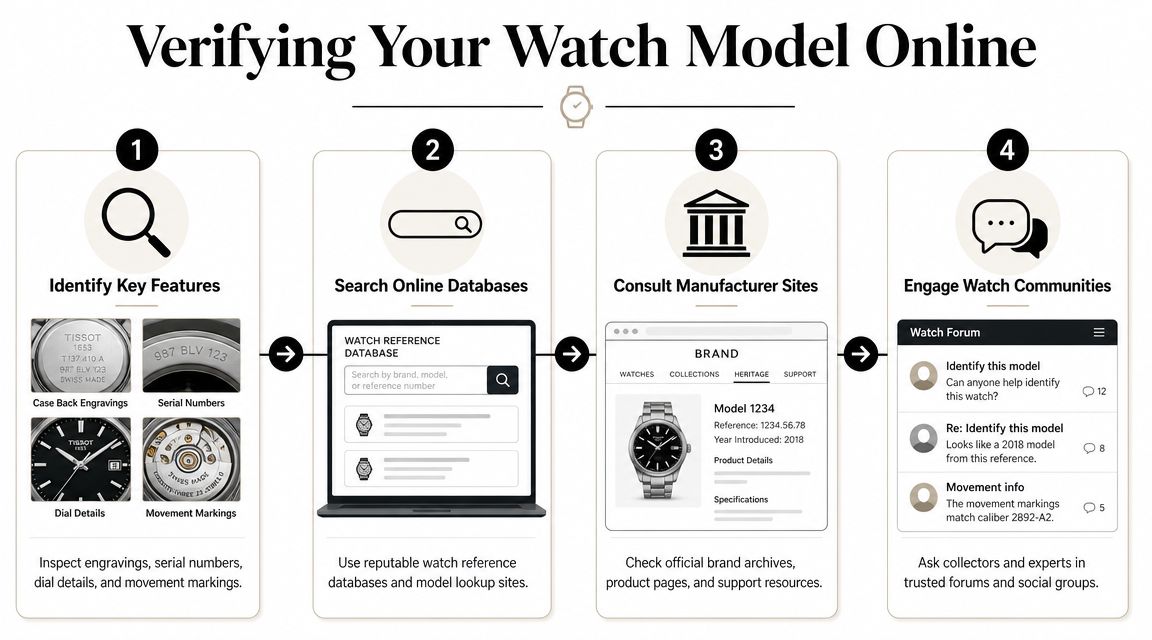
Before you open marketplace tabs, inspect the watch in good light. Note the brand name, dial text, case material, bracelet style, clasp engraving, case back markings, and any visible reference or serial number. On some models, the critical identifiers are obvious. On others, they're tucked between the lugs, inside paperwork, or on the movement and should only be checked by someone qualified.
Take clear photos of the dial, case front, both case sides, case back, clasp, bracelet end links, and any papers. If the watch has complications, photograph them in operation. Buyers compare details fast, and your own images help you slow down and verify what you have.
Cross-check with multiple sources
One weak habit I see often is relying on a single listing title. Marketplace sellers mislabel watches all the time. A better process is to compare the watch against official brand pages, archived catalog images, enthusiast forums, and completed market listings.
The same search ambiguity that affects watch review comedy central affects watches too. People often think online search will give one clean answer, but fragmented results often show clips, commentary, and partial information rather than a clean access path for the TV show, as noted in this discussion of the show's current discoverability and fragmented search results on YouTube coverage of Review availability. Watch research works the same way. Search results are noisy, and identification takes cross-checking.
Use a sequence like this:
Search the exact text on the watch. Include dial wording, bracelet code, and any reference number.
Check official brand materials. Current product pages, archives, press images, and service documentation can confirm baseline specs.
Use collector forums carefully. Forums can be excellent for edge cases, but don't treat the first reply as final.
Compare multiple sale listings. Look for repeated traits, not one seller's description.
Save your evidence. Keep screenshots and notes so you can explain why you believe the watch is a specific reference.
A buyer trusts a seller more when the seller can show their work.
If you're valuing an older piece, this kind of groundwork is especially useful alongside a focused guide on vintage watch valuation, because older references often carry more variation in dial, bracelet, and service history than newer models.
Spotting Condition Cues from Photos and Listings
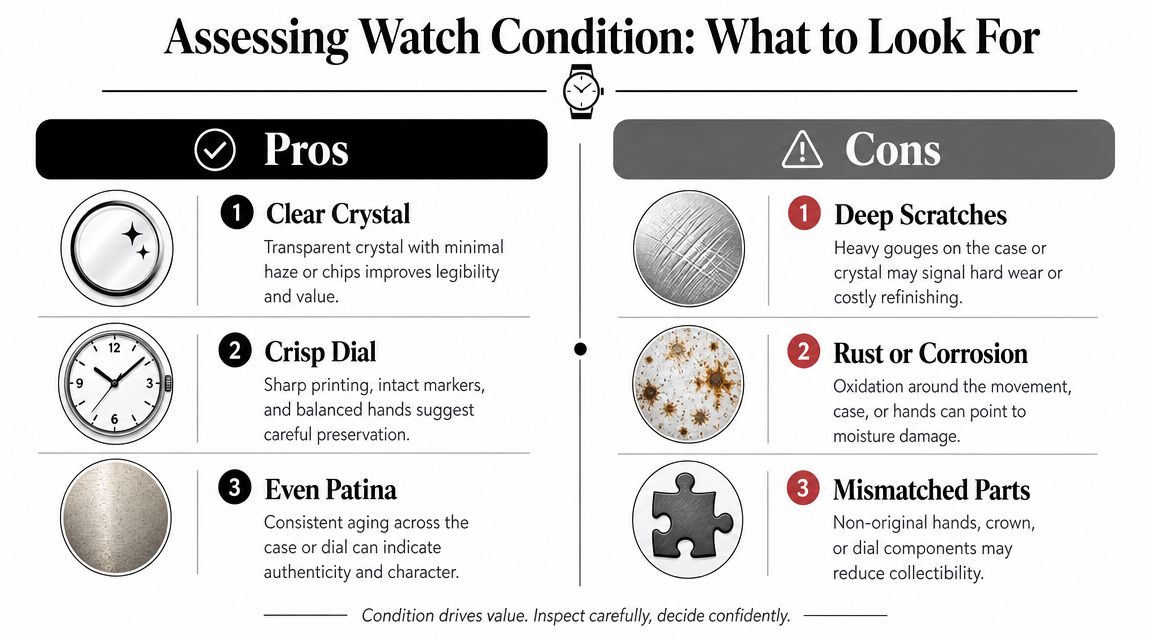
The hardest part of reviewing a watch isn't naming it. It's seeing condition the way a buyer sees it. Owners focus on whether the watch looks clean. Buyers focus on whether the watch looks honest.
That distinction matters because a polished case, relumed dial, replacement bezel insert, or aftermarket diamond setting can change the entire conversation. The Comedy Central series built its identity on extreme, unusually specific experiences, with Forrest reviewing "the most intense experiences that life has to offer," a concept described on Apple TV's Review show page. Luxury watch review is specific in a different way. Tiny physical details carry outsized weight.
What strong listing photos reveal
Good photos let you judge shape, not just cleanliness. On a sports Rolex, for example, you want to see whether the lugs still look full and even, whether chamfers are intact where they should be, and whether the bezel teeth remain sharp. On Cartier, symmetry and dial condition often matter more than raw ruggedness. On Audemars Piguet, edge definition and bracelet integrity are hard to fake in close photos.
Look for these positive signs:
Crisp case geometry. Edges look defined rather than melted down by repeated polishing.
Consistent aging. Hands, dial, lume, and case wear make sense together.
Matching components. Bracelet, clasp, crown, and buckle fit the model and period.
Straightforward seller language. Strong listings usually disclose service, replaced parts, and flaws.
What usually hurts value
Some problems are obvious, such as chips, corrosion, or moisture damage. Others are subtler. A refinished dial can look glossy and attractive in poor lighting but still reduce collectability. A bracelet with heavy stretch may still photograph well face-on. A crown from the wrong generation can pass unnoticed by a casual owner.
Condition isn't just "good" or "bad." It's a stack of small signals that either support originality or raise questions.
If you're reviewing listing photos online, it's also smart to remember that image manipulation has become more common. Basic awareness of trust and safety workflows in 2026 is useful because polished marketing images can hide edges, soften scratches, or flatten dial texture in ways that don't match the watch in hand.
For sellers who want a stronger sense of how buyers read listings before making contact, this breakdown on how to sell high-end watches is a useful companion.
Gauging Market Demand and Setting Realistic Expectations
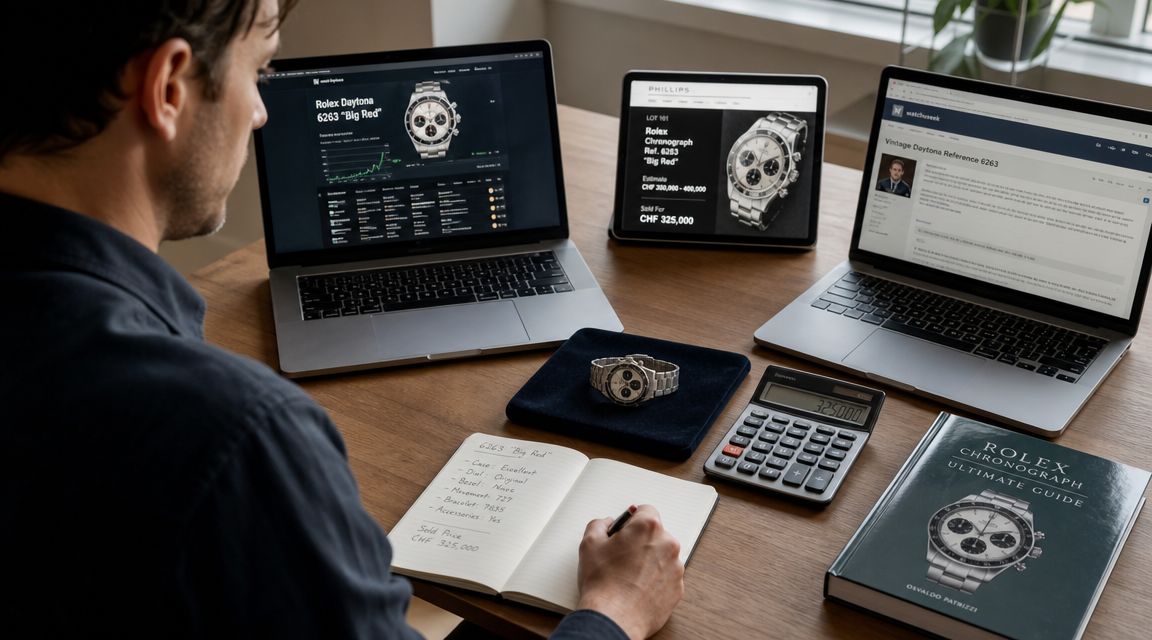
Many owners jump from identification straight to a dream number. That's where disappointment starts. A watch can be authentic, attractive, and from a strong brand, yet still trade below what asking-price listings suggest.
The better approach is to separate interest, asking prices, and actual buyer behavior. That same kind of audience-fit problem appears in commentary around Review, which is often described as unconventional and a cult favorite rather than a universal crowd-pleaser, as discussed in Paste Magazine's writing on the show's audience fit. Watches behave similarly. Not every respected watch has the same depth of buyer pool at the moment you want to sell.
Asking price is not market value
Chrono24 listings, dealer websites, and social media posts show what sellers hope to get. They don't automatically show what someone paid. Auction results can be more useful because they reflect a public sale event, but auction houses also represent a particular segment of the market and often favor especially strong examples.
Use at least three categories of evidence:
Source type | What it helps you see | Common mistake |
|---|---|---|
Dealer listings | Retail positioning and feature language | Treating list price as sale price |
Auction results | Public transaction evidence for notable pieces | Comparing your average watch to an exceptional example |
Forum and market commentary | Sentiment, demand shifts, known issues | Confusing enthusiasm with liquidity |
Build a realistic range
Start broad, then narrow. Compare your watch only against pieces with the same reference, similar metal, same bracelet or strap format, comparable dial, and close condition. Then apply common-sense adjustments for missing box, missing links, replaced parts, overdue service, or obvious wear.
A short market review should answer these questions:
How often does this model appear. Scarcity alone doesn't guarantee demand.
Who buys it. Collectors, first-time luxury buyers, fashion-driven buyers, or brand loyalists all behave differently.
What version gets the most attention. Dial color, bracelet type, and original accessories can shift buyer interest.
How easy is it to explain. A watch with a simple, desirable configuration usually moves more smoothly than one that needs a long story.
Here is a useful visual reference before you compare live listings and auction pages:
If your priority is speed as much as price, it also helps to understand how an efficient local process works compared with marketplace selling. This overview of options for selling a watch with instant payment gives a practical benchmark.
How to Prepare Your Watch for a Professional Appraisal
A good appraisal appointment starts before the watch leaves your house. The strongest sellers arrive organized, realistic, and careful not to "improve" the watch in ways that erase value.
For most luxury watches, what you bring matters almost as much as what you wear on your wrist. Original box, warranty card, receipts, service paperwork, extra links, spare strap, buckle, travel pouch, and even old appraisal paperwork can all help establish a cleaner ownership story.
Bring the right supporting items
Use this checklist before the appointment:
Original box and warranty card. These help support provenance and buyer confidence.
Service records. Especially important if the movement was recently serviced or pressure tested.
Extra links or alternate straps. A short bracelet can limit resale if the next owner can't wear it.
Purchase receipt or gift documentation. Helpful when available, even if it's old.
Your own notes. If you know a part was replaced, say so early.
The cleanest transaction usually starts with the cleanest file, not the cleanest polish.
If you're unsure what online buyers usually request before making an offer, this article on how online watch buyers evaluate pieces is a useful reality check.
What not to do before the appointment
Don't rush to polish the case. Don't replace parts casually. Don't scrub the watch with aggressive chemicals. Buyers would rather inspect an honest watch with visible wear than a freshly altered one that raises questions.
Light cleaning is fine. If the bracelet is dirty, use conservative methods and avoid turning a home cleaning into damage. For owners who want a practical baseline, this pro-grade metal strap cleaning guide is a sensible starting point for stainless steel bracelets.
If you're in Atlanta, Buckhead, Sandy Springs, Alpharetta, Roswell, Brookhaven, Midtown Atlanta, or elsewhere in Georgia, in-person evaluation has one major advantage: the buyer can inspect bracelet stretch, case shape, movement function, and authenticity cues directly instead of guessing from photos alone.
Frequently Asked Questions About Selling Your Watch
What documents add the most value to a luxury watch
The most helpful documents are the original warranty card, purchase receipt, and service records. Box, booklets, extra links, hang tags, and brand service paperwork also help. They don't create value by themselves, but they can improve buyer confidence and make the watch easier to resell.
Is it better to sell my watch locally in Atlanta or online
It depends on your priorities. A local in-person sale can be faster, more private, and easier for higher-touch review of condition and authenticity. An online sale may widen your audience, but it usually requires stronger photos, more back-and-forth, shipping risk management, and patience.
For Georgia owners who want to compare those paths, this guide to selling a luxury watch near me gives a practical local perspective.
How is a final offer for a watch determined
A final offer usually reflects a combination of model, reference, condition, originality, service history, documentation, and current resale demand. The buyer also considers how easily the watch can be authenticated, serviced, and placed with the next customer. A strong brand name helps, but it never overrides obvious condition or originality issues.
Should I service my watch before trying to sell it
Usually, don't assume a pre-sale service will pay you back. Some services help. Others cost money without increasing what a buyer will offer. If the watch runs, presents well, and has no urgent issue, it's often smarter to let the buyer evaluate it in its current state.
Can aftermarket changes affect value
Yes. Aftermarket diamonds, refinished dials, custom bezels, non-original bracelets, and replacement hands can all affect value and liquidity. Some retail buyers may like them, but many secondary-market buyers prefer original configuration.
What should I photograph before requesting an offer
At minimum, photograph the dial, front case, side profile, case back, bracelet, clasp, and any paperwork. Add close-ups of reference markings, damage, and included accessories. Honest, complete photos save time and reduce surprises later.
If you're ready for a serious watch review that goes beyond internet guesswork, Antwerp Diamond offers a professional, low-pressure way to evaluate luxury watches in Atlanta and beyond. You can start with an online inquiry or schedule a private in-person review, which is often the fastest way to verify details, assess condition accurately, and understand what your watch is likely to command in the current market.