

Fine jewelry is jewelry made from solid precious metals such as 10K to 24K gold, platinum, or sterling silver, usually set with genuine gemstones rather than plated base metals or imitation stones. It differs from fashion jewelry because its value comes from real materials, stronger craftsmanship, and the fact that it can hold meaningful resale value in a global jewelry market estimated at USD 381.54 billion in 2025, with one projection reaching USD 578.45 billion by 2033 and another forecast placing worldwide jewelry revenue at US$408.64 billion in 2026.
If you're asking this question, you're probably looking at a ring, bracelet, necklace, or pair of earrings and wondering whether it's just pretty, or actually valuable. That's the right question to ask, because in the jewelry world, the difference between "fine" and "fashion" affects everything that follows: how the piece wears, how it's insured, how it's appraised, and what a buyer may pay for it.
Table of Contents
What Is Fine Jewelry The Defining Qualities
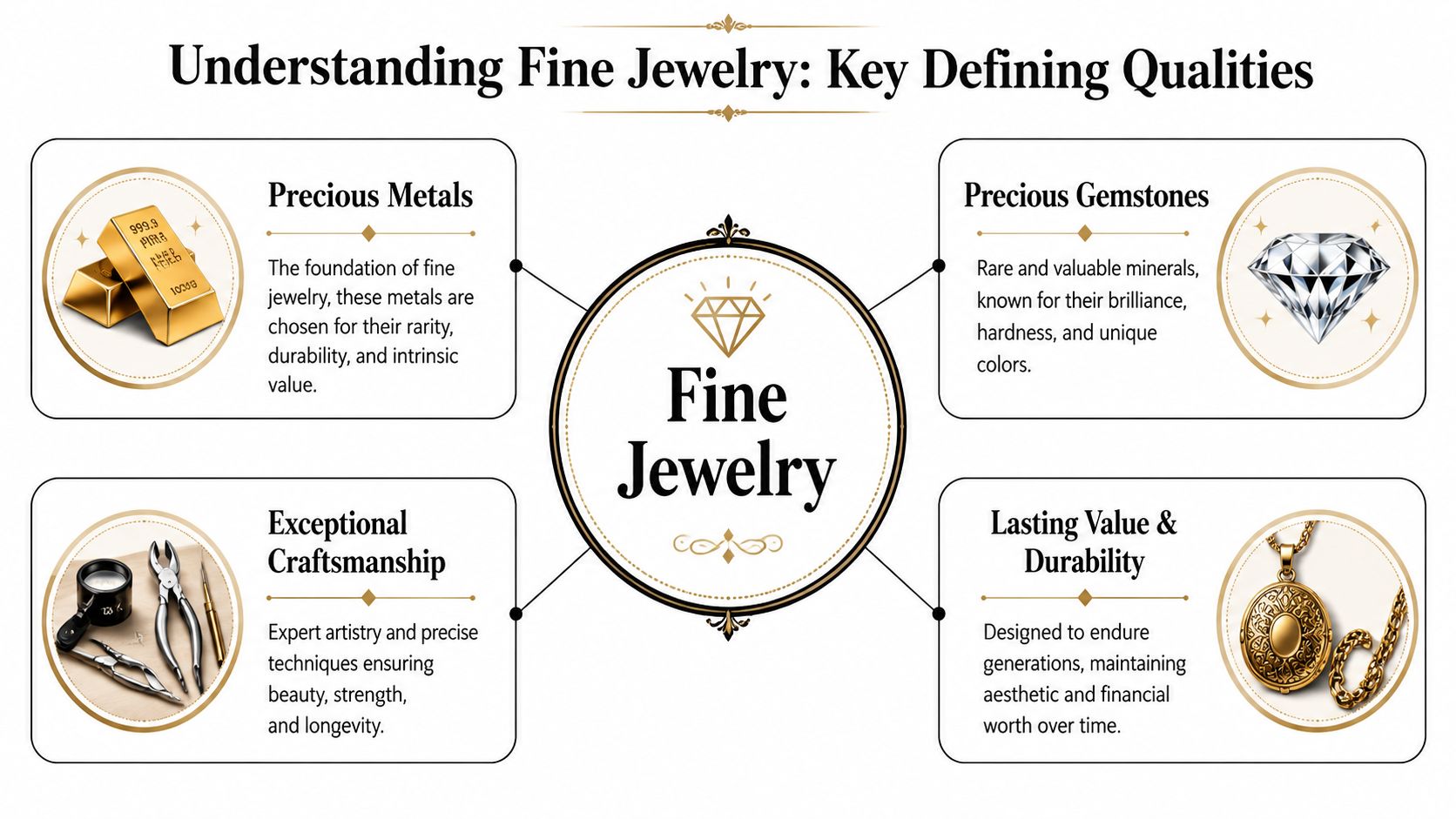
Fine jewelry is defined first by what it's made of. Pieces in this category are typically made from solid precious metals such as 10K to 24K gold, platinum, or sterling silver, and they use genuine gemstones rather than imitation stones or thin plating over base metal, as explained in this overview of fine jewelry terms and hallmark meanings.
The materials come first
When a jeweler calls something fine jewelry, they're not mainly talking about style. They're talking about intrinsic material value.
A plain 14K gold wedding band with no stones is still fine jewelry because the metal itself has recognized value. A platinum ring with a small natural sapphire is fine jewelry even if the design is simple. By contrast, a large dramatic necklace made from brass with glass stones may look luxurious, but it isn't fine jewelry.
Hallmarks help you identify this. Common examples include 14K, 18K, PLAT, 925, and sometimes 950. These marks indicate metal purity or metal type, not beauty or designer status.
If gold markings confuse you, this guide on the difference between 14K and 18K gold is a useful next step.
Practical rule: If the core value of the piece comes from solid precious metal and genuine stones, you're usually in fine jewelry territory.
Craftsmanship is part of the definition
Material alone isn't the whole story. A fine jewelry piece is also expected to be well made, durable, and suitable for long-term wear.
Professional jewelry design guidance points to details that affect longevity, such as avoiding fragile thin areas, softening sharp corners, and checking for symmetry, smooth edges, even polishing, and secure stone setting under magnification, as described in these basic jewelry design and finishing guidelines. That's why two rings made from the same metal can feel very different in hand. One may be balanced, sturdy, and cleanly finished. The other may have weak prongs, uneven seams, or poor polish.
Here are the defining qualities I tell clients to remember:
Precious metal body: Solid gold, platinum, or sterling silver, not just surface plating.
Real gemstone content: Natural diamonds, sapphires, rubies, emeralds, or other genuine stones.
Reliable construction: Secure settings, smooth finishing, and wearable structure.
Long-term usefulness: Meant to last through regular wear, repair, and resale evaluation.
That last point matters more than people think. Fine jewelry sits inside a large and established market, not a niche hobby category. Grand View Research estimated the global jewelry market at USD 381.54 billion in 2025, projected USD 578.45 billion by 2033 with a 5.5% compound annual growth rate from 2026 to 2033, and also noted another forecast of US$408.64 billion in 2026. The same source estimated U.S. jewelry-related revenue at $60.42 billion in 2023, which helps explain why authentic fine jewelry is treated as a meaningful asset class rather than an ordinary accessory in many resale situations, according to Grand View Research's jewelry market analysis.
Fine Jewelry vs Fashion Jewelry A Clear Comparison
A lot of confusion starts when people use "real jewelry" to mean anything that isn't plastic. In practice, the cleaner distinction is fine jewelry versus fashion jewelry.
Fashion jewelry can be attractive, stylish, and fun to wear. But it usually uses base metals and simulated stones, so its value is based mostly on appearance, not underlying materials.
A side by side comparison
Characteristic | Fine Jewelry | Fashion Jewelry |
|---|---|---|
Materials | Solid precious metals like gold, platinum, or sterling silver | Base metals such as brass, copper, or alloy, often plated |
Stones | Genuine gemstones | Glass, crystal, plastic, cubic zirconia, or imitation stones |
Hallmarks | Often stamped with purity marks such as karat or silver marks | May have brand marks, but usually no precious metal purity marks |
Durability | Built for long-term wear and repair | Often made for short to medium-term wear |
Value basis | Material content, gemstone quality, brand, craftsmanship, condition | Mostly style, trend, and retail presentation |
Resale potential | Can have meaningful resale value | Usually limited resale value |
One fast clue is wear pattern. When plating rubs off and another color shows underneath, that usually tells you the piece isn't solid gold. Another clue is weight. Fine jewelry often feels denser and more substantial because precious metals have more mass than many low-cost alloys.
If you're unsure about the stone itself, this article on what "genuine diamond" means helps sort out a common source of misunderstanding.
Why this matters when you sell
This distinction matters most when someone wants an appraisal, a resale quote, or a loan against jewelry. Sellers often focus on what they paid at retail. Buyers focus on what the item is, how it's made, and whether the current market wants it.
A fashion piece can look expensive and still have little secondary-market value. A simple fine jewelry piece can look understated and still be worth serious attention.
That gap between appearance and value is why professional evaluation starts with materials, not sentiment. A rhinestone cocktail ring may have dramatic visual impact. A plain platinum band may have far greater underlying value.
What Determines the Value of Fine Jewelry
A client walks in with two rings that look equally impressive from across the counter. One receives a strong offer. The other is valued mainly for scrap metal. The difference usually comes down to what the piece is made of, how well it was built, how much work it needs, and whether buyers want that style right now.
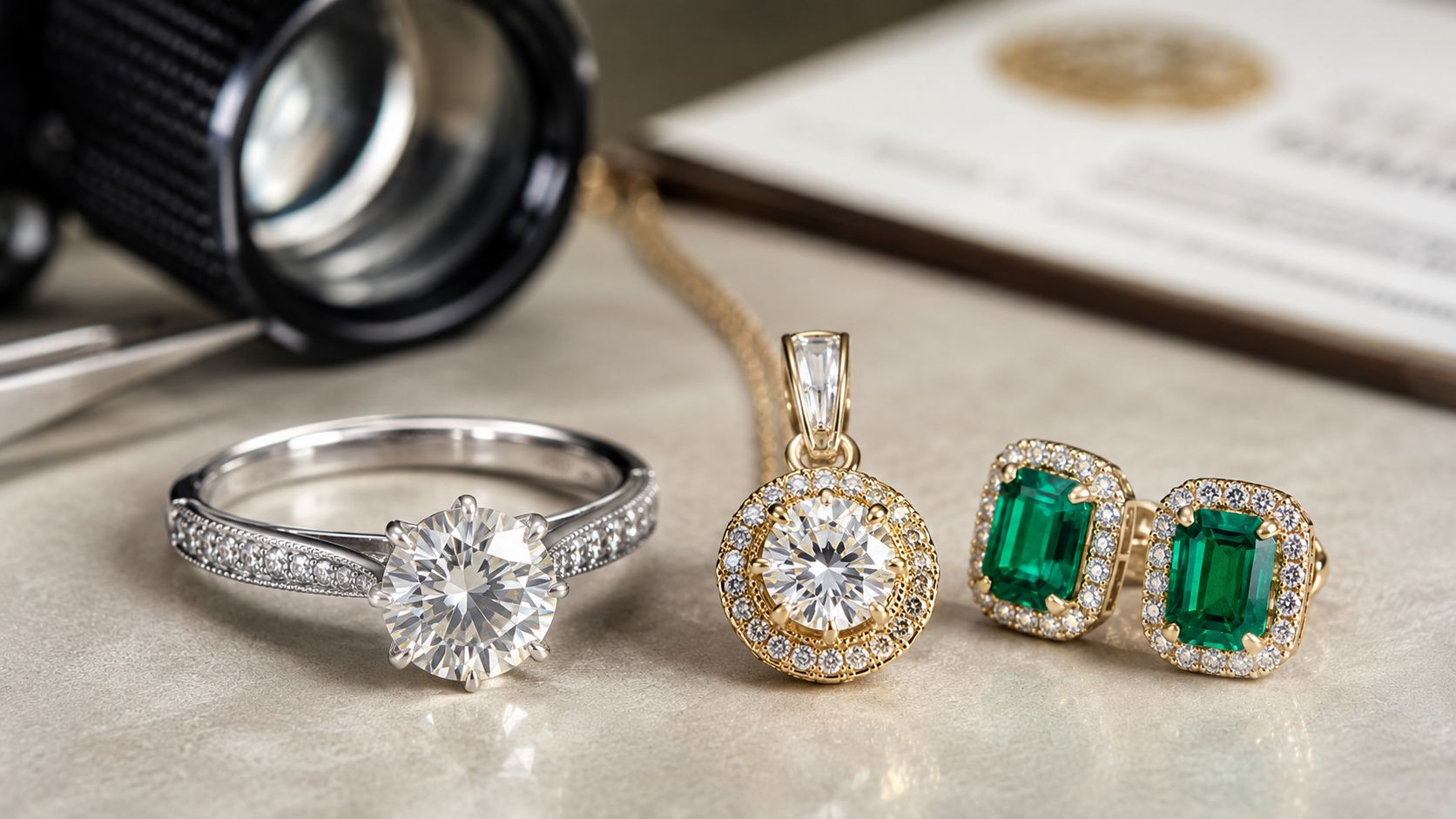
Professional buyers such as Antwerp Diamond do not price jewelry by appearance alone. They evaluate it the way a contractor evaluates a house. The visible finish matters, but so do the foundation, materials, structural soundness, and what the current market is willing to pay. In jewelry, that usually means materials, workmanship, condition, brand, and resale demand.
The five factors buyers check first
Metal purity and weight
Precious metal has a measurable base value. A heavy 18K gold bracelet usually carries more underlying worth than a similar bracelet in 10K gold because it contains more pure gold. Platinum also trades differently from gold, and silver usually sits in a lower value range. For resale, this is the floor of the conversation. Even if the design is dated, metal content still matters.Gemstone quality
Stones can move a piece from modest value to significant value very quickly. For diamonds, buyers look at cut, color, clarity, and carat weight, then ask a second question: how easy will this stone be to resell in the current market? That is why two diamonds of the same size can bring very different offers. If you want a practical baseline, this guide on how much a diamond is worth explains how those grading factors affect price.Craftsmanship and construction
Fine jewelry should be made to last, and buyers can usually tell when it was built with care. Clean solder joints, symmetrical settings, even stone placement, well-finished prongs, and secure clasps all support value. Poor construction creates risk. A ring with thin, worn prongs may need repair before it can be resold, and that repair cost affects the offer.Condition
Condition changes value faster than many sellers expect. Chipped stones, abraded facet edges, deep scratches, bent shanks, missing accent diamonds, and over-polishing all lower buyer confidence. A piece in good condition is easier to authenticate, easier to present, and easier to place in the secondary market.Brand and current demand
Brand can act like a shortcut in the resale market. Cartier, Tiffany & Co., Van Cleef & Arpels, and other recognized houses often bring stronger offers because buyers know the design language, trust the workmanship, and actively search for those names. Demand matters just as much. A well-made piece from an unfashionable period may sell slowly, while a classic design in a popular category can move quickly.
These factors work together. A designer ring with average diamonds may outperform an unbranded ring with similar raw materials. A heavy gold bracelet with no brand may still hold strong value because of metal content alone. A beautiful ring with a damaged center stone may look expensive but trade lower because the next buyer sees repair cost and resale risk.
That is why authenticity is only the starting point. Real gold, real platinum, and real gemstones do not guarantee a high offer. Buyers are asking a more practical question: what can this specific item reasonably command on the resale market?
There is also a broad resale infrastructure behind these evaluations. IBISWorld's U.S. jewelry stores industry summary reported 73,980 jewelry-store businesses in the United States in 2026, with an industry market size of $60.3 billion. A market of that size supports established pricing habits, repair networks, branded resale channels, and comparable sales data that professional buyers use during evaluation.
How to Identify Fine Jewelry at Home
You can't perform a full professional appraisal at your kitchen table, but you can do a careful first pass. That helps you separate likely fine jewelry from pieces that are mostly sentimental or decorative.
Start with marks and materials
Begin with a bright light and a simple magnifier or jeweler's loupe if you have one. Check the inside of rings, the back of pendants, the clasp area on bracelets, and earring posts or backs.
Look for these signs:
Purity marks: 10K, 14K, 18K, 22K, PLAT, 925, or 950 are promising signs.
Consistent color: Fine jewelry usually has a consistent metal color in hidden and exposed areas.
No flaking surface: If the finish is peeling or wearing through, it's often plated.
Solid feel: Precious metals typically feel denser than costume jewelry.
A simple magnet can help, but use it carefully. Precious metals themselves are generally not magnetic, so a strong magnetic reaction can be a warning sign. Still, this isn't a final test because some clasps, springs, or mixed components may react even on genuine pieces.
For a more formal process after your own first inspection, this overview of how to appraise jewelry explains what professionals test and document.
What to look for under magnification
Once you've checked the stamp, examine the workmanship. In the workmanship, many people spot the difference between fine and fashion jewelry.
Focus on:
Stone settings: Are prongs even and secure, or rough and irregular?
Edges and seams: Fine jewelry should feel smooth, not sharp or unfinished.
Backs of settings: Openings should look intentional and clean, not crudely punched out.
Wear points: Check ring shanks, bracelet links, and chain connectors for thinning or damage.
If you want to see how jewelers inspect pieces visually, this short video is a useful reference point.
Don't clean aggressively before inspection. Dirt can hide details, but harsh scrubbing can also scratch soft metals or loosen vulnerable stones.
A few things to avoid at home:
Don't scratch-test metal: You can damage the piece.
Don't assume all clear stones are diamonds: Many simulants look convincing at first glance.
Don't judge by age alone: Older doesn't automatically mean valuable.
Don't rely on boxes or tags: Packaging can be switched or lost.
Home inspection is useful for sorting. It's not enough for a buying, selling, loan, or insurance decision. When a piece may have meaningful value, you want someone to verify metal purity, inspect stones properly, and assess current resale demand.
Preserving Value Through Proper Care and Maintenance
Fine jewelry lasts because someone cares for it correctly. Poor storage, harsh cleaning, and ignored repairs can reduce both beauty and resale potential.
Simple habits that protect value
Store pieces separately when possible. Diamonds can scratch gold, platinum, and even other gemstones, so one tangled pouch or crowded tray can create avoidable wear.
For routine home cleaning, keep it gentle:
Use mild soap and warm water: This is usually appropriate for many gold and diamond pieces.
Choose a soft brush: A baby toothbrush or other soft-bristled brush works better than anything abrasive.
Dry with a soft cloth: Pat dry instead of rubbing hard.
Rinse carefully: Soap film can dull the look of a stone and make it appear less lively.
Avoid bleach, abrasive powders, ultrasonic cleaning without knowing the stone type, and rough paper towels. Those shortcuts can create scratches, loosen settings, or harm certain gems.
When professional service makes sense
Some maintenance should happen at a bench, not at home. If you notice a loose stone, bent prong, thinning ring shank, stretched chain link, or clasp that doesn't close securely, stop wearing the piece until it's checked.
Small repairs often protect larger value. A tightened prong costs far less than replacing a lost center stone.
Professional cleaning and inspection are also useful before resale. Buyers notice condition immediately, and a piece that presents well is easier to evaluate with confidence.
Keep documentation too. Original receipts, diamond grading reports, service history, designer boxes, and repair records don't create value on their own, but they can support authenticity and buyer confidence.
Selling Your Fine Jewelry The Evaluation Process
When you bring fine jewelry to a professional buyer, the review is usually methodical and non-destructive. The goal is to identify exactly what the item is, verify its components, and judge how sellable it is in the current market.
What happens during a professional review
The process often begins with a visual inspection. The buyer checks hallmarks, overall condition, construction quality, and whether the design appears branded, custom, antique, or mass produced.
Then the evaluator typically looks more closely at:
Metal verification: Testing confirms whether a piece is gold, platinum, silver, or something else.
Stone identification: Diamonds and colored stones are checked for authenticity and overall quality.
Condition assessment: Missing stones, worn settings, altered sizing, and repairs all matter.
Brand signals: Signed pieces from recognized houses may follow a different resale path than unsigned jewelry.
In Atlanta and nearby areas such as Buckhead, Sandy Springs, Alpharetta, Roswell, Brookhaven, and Midtown Atlanta, many sellers prefer a private in-person review because they can ask questions while the item is examined. For clients who want a local option, Antwerp Diamond's guide on where to sell fine jewelry outlines what to compare when choosing a buyer.
Security matters during this process, especially if you're transporting multiple pieces, inherited jewelry, or branded items. If you're preparing a store, office, or appointment-based business environment around valuable goods, these proactive retail loss prevention tips offer practical ways to think about handling, access, and risk reduction.
What helps support a stronger offer
Documentation can make the review cleaner and faster. If you have a GIA grading report for a diamond, original purchase paperwork, branded packaging, or prior repair invoices, bring them.
A buyer may place more confidence in a piece when the supporting information matches the item in front of them. Useful items include:
Diamond reports: Especially for important center stones
Designer paperwork: Helpful for signed jewelry
Original boxes or pouches: Not essential, but supportive
Repair records: Useful when they show what was done and when
One point many sellers miss is that the evaluation isn't only about material recovery. A buyer also considers whether the piece can be resold intact, whether it appeals to current clients, and whether the brand or design increases liquidity. That's why two rings with similar metal content can receive different offers.
Frequently Asked Questions About Fine Jewelry
A client often walks in with a simple question that turns out to be several questions at once: "It's real gold, so it's fine jewelry, right. And does that mean it will sell for a lot?" The first answer may be yes. The second depends on more moving parts.
Is all real gold jewelry considered fine jewelry
Solid gold jewelry usually falls into the fine jewelry category, especially when it is made from precious metal rather than plated base metal. A hollow 10K chain, a heavy 18K bracelet, and a signed 14K ring can all qualify.
Resale value is a separate question. A buyer looks at gold purity, total weight, condition, workmanship, and whether the piece has appeal beyond scrap. In other words, "real gold" establishes the floor of value, not the ceiling.
Is fine jewelry a good investment
Fine jewelry can hold value well, but it should not be treated like a guaranteed appreciating asset. Precious metals and natural gemstones give it underlying worth, yet resale prices still rise or fall based on brand recognition, design, wear, condition, and current buyer demand.
A useful way to frame it is this. Some pieces trade mainly for material value. Others carry added resale strength because they are from a known maker, contain well-documented stones, or match what buyers are actively seeking. That difference matters during evaluation.
What's the difference between fine jewelry and high jewelry
Fine jewelry is the broader category. It includes pieces made with precious metals and genuine gemstones, whether simple or elaborate.
High jewelry is a narrower tier within that world. It usually involves exceptional gemstones, more labor-intensive construction, stronger design identity, and often a major maison or one-of-a-kind presentation. In resale, high jewelry may command more attention, but only if the workmanship, provenance, and market demand support it.
Is antique jewelry always fine jewelry
Age does not determine category by itself. Many antique pieces are fine jewelry because they were made in gold, platinum, or silver and set with genuine stones. Some older pieces, however, use lower-value materials, replacement parts, or construction that limits buyer interest.
For resale, antique status can help, but only when it comes with quality materials, intact period details, and a style collectors still want.
Can sterling silver be fine jewelry
Yes. Sterling silver is a precious metal, so it can be used in fine jewelry.
That said, silver usually trades differently from gold or platinum. A professional buyer may place more weight on brand, craftsmanship, gemstone content, and design because the metal itself contributes less to total value. A signed sterling piece from a recognized maker can be more marketable than an unsigned silver item of similar weight.
What should I do before getting my jewelry evaluated
Bring the piece clean enough to inspect, but do not polish it aggressively or try home repairs. Over-polishing can soften details, remove patina, or affect the finish on branded and antique items.
Gather any paperwork that travels with the piece. Diamond grading reports, receipts, prior appraisals, repair records, and original branded packaging all help a buyer connect the item in hand to its history. That does not create value on its own, but it can support stronger confidence in authenticity, quality, and resale potential.
It also helps to know what kind of value you are asking about. Insurance value, replacement value, estate value, and resale value are not the same number.
Fine jewelry makes the most sense when you look at it as a package. Materials matter. Construction matters. Brand matters. Market demand matters too. That is also how a professional buyer like Antwerp Diamond evaluates a piece, by asking not only what it is made of, but how easily and confidently it can be resold.
If you'd like a professional, no-pressure review of your jewelry, Antwerp Diamond offers confidential evaluations for clients in Atlanta and beyond. You can bring in a piece for in-person assessment or start by gathering your documentation and requesting an evaluation when you're ready.


