

A solid gold Cuban chain is a piece of jewelry defined by its tightly interlocking oval links, valued based on its gold purity, karat, total weight in grams, and craftsmanship. Its resale value is primarily determined by those factors combined with the current market price of gold.
If you're holding one now, maybe from a purchase years ago, a gift, or an estate, the biggest question usually isn't what it looked like at retail. It's what a buyer will pay today. That's where most online guides fall short. They explain style, width, and celebrity appeal, but they don't explain how a real offer gets built.
For sellers in Atlanta, Buckhead, Sandy Springs, Alpharetta, Roswell, Brookhaven, Midtown Atlanta, and across Georgia, that gap matters. A solid gold Cuban chain can carry fashion appeal and real precious metal value at the same time, but those aren't priced the same way in a resale setting.
Table of Contents
What Is a Solid Gold Cuban Chain
A solid gold Cuban chain is known for its tightly interlocking oval links that create a thick, flat, rope-like profile. The style became widely popular in U.S. cities such as Miami and New York in the late 1970s and early 1980s as hip-hop rose, and it later became a major status symbol in music and fashion culture.
What makes the design distinct
The look is easy to recognize. The links sit close together, lie relatively flat, and create a continuous visual line rather than a loose or airy chain pattern.
That design matters for resale because buyers don't just see style. They see structure. A chain with dense link construction usually carries more metal, more weight, and better long-term durability than a chain that only looks substantial from the front.

Solid, hollow, and plated are not the same item
Many first-time sellers often get surprised. Three chains can look similar in photos and wear very differently in the market.
Consider three doors made to the same size. One is solid wood, one is hollow-core, and one is a thin surface layer over cheaper material. From across the room they may look close. In hand, they are not close at all.
According to this Cuban link weight guide, the structural design of a Cuban link chain, specifically link thickness, width, and whether the chain is solid or hollow, has a direct impact on both weight and durability. That same source notes that a 9mm solid Cuban link in 18K gold may reach 140 to 150 grams for a 24 to 27 inch length, while a hollow chain of similar dimensions might weigh less than half.
Practical rule: If two chains look similar but one feels dramatically lighter, don't assume they hold similar resale value.
Here's how the categories break down in real-world selling:
Solid gold: The chain's value is tied directly to gold content, weight, purity, and workmanship.
Hollow or semi-hollow: It may still be real gold, but there is less gold in the piece and more structural vulnerability.
Gold plated: It has appearance, not meaningful intrinsic gold value in the same sense.
If you're trying to get a rough sense of where your chain fits before an appraisal, compare its weight and feel against known solid examples, then review a practical guide on buying gold chains. It's not a substitute for testing, but it helps you avoid obvious misclassification.
Decoding Karat Purity and Hallmarks
Most sellers know their chain is "real gold" or "14K," but they don't always know what that means financially. Karat tells you how much of the chain is gold by weight, and that matters because buyers calculate intrinsic value from metal content, not just appearance.
What 10K, 14K, and 18K actually mean
In solid gold Cuban links, the most common purities are 10K, 14K, and 18K. According to this Miami Cuban link guide, those correspond to 41.7%, 58.3%, and 75% pure gold by weight.
The rest is made up of alloy metals such as copper, silver, or zinc. Those alloys are there for a reason. They improve durability and affect color, which is why higher purity doesn't automatically mean better for daily wear.
In practice, the trade-off looks like this:
Purity | Gold content | Seller takeaway |
|---|---|---|
10K | 41.7% | Better wear resistance, lower gold content per gram |
14K | 58.3% | Common balance between durability and gold value |
18K | 75% | Higher intrinsic gold content, softer under wear |
That same guide notes that 14K solid Cuban links are the most common balance between wearability and gold-content value in major Western markets. That's one reason they appear so often in resale and pawn channels.
Where to find hallmarks and how to read them
Hallmarks are usually small stamps on the clasp, near the clasp, or on a terminal end link. On U.S. pieces you may see 10K, 14K, or 18K. On European-marked pieces you may see 417, 585, or 750.
A hallmark is useful, but it isn't the entire answer. Stamps can wear down, and chains can be repaired over time. A clasp might even be replaced with a part marked differently from the body of the chain.
Hallmarks start the conversation. They don't finish it.
Simple at-home checks can help you spot obvious issues:
Magnet test: Gold isn't magnetic, so strong attraction is a warning sign. It isn't proof by itself.
Visual inspection: Look for fading, exposed base metal, or color differences near high-friction points.
Weight feel: Real solid chains usually feel denser than new sellers expect.
For a more detailed breakdown of how purity changes value and wear, see the difference between 14K and 18K gold. It's one of the most important distinctions in any gold valuation.
How to Estimate Your Chain's Market Value
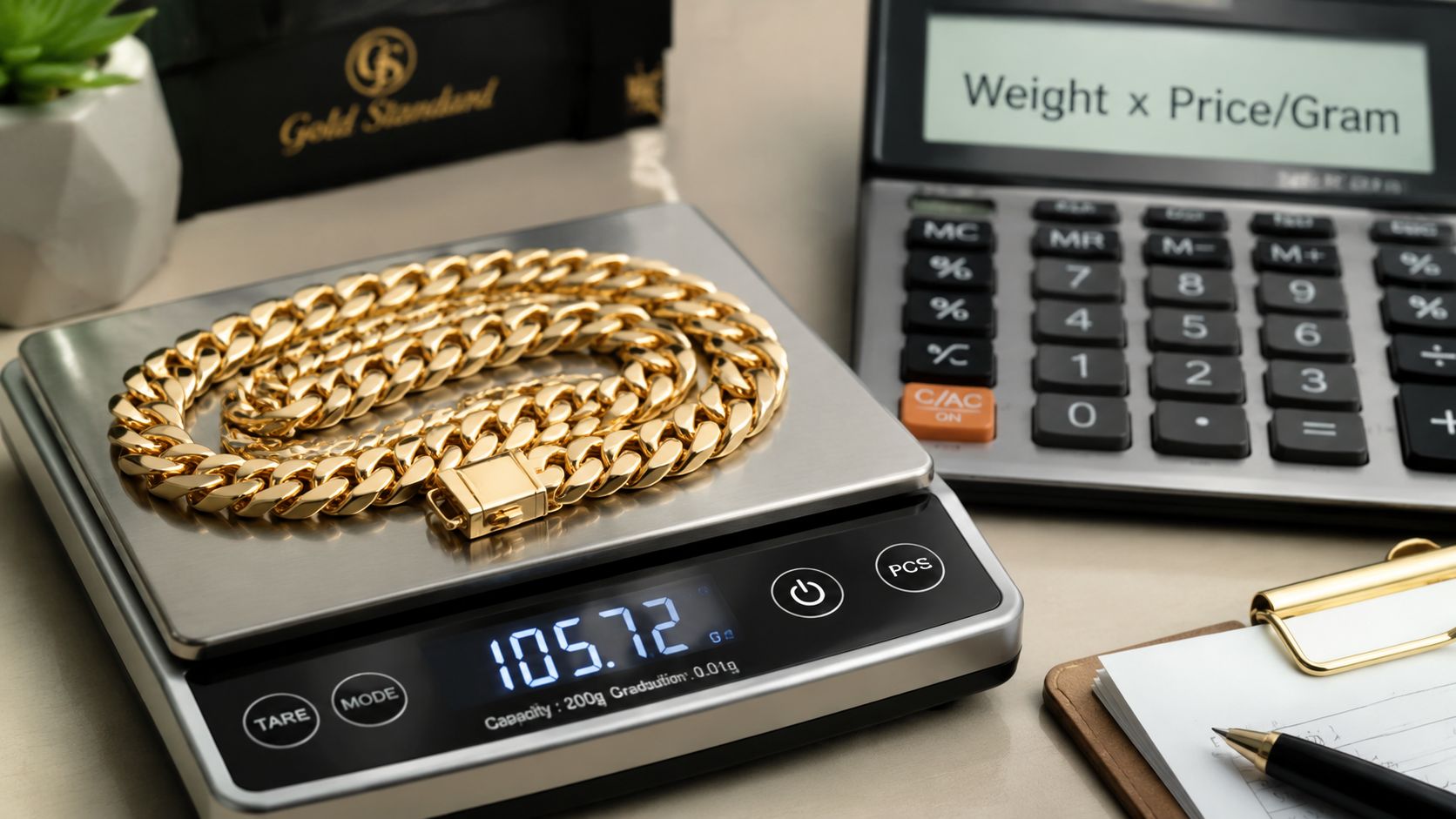
A seller doesn't need to become a refiner to understand the math. You just need to know the baseline formula buyers use before they adjust for condition, construction, and marketability.
The baseline formula buyers use
The basic framework is:
Weigh the chain in grams
Apply the purity factor
Compare the pure gold content to the current spot price of gold
Adjust for workmanship, style demand, and condition
That baseline matters because gold has moved sharply over time. According to the verified gold-price data provided for this topic, gold rose from roughly $400 per ounce in 2004 to over $2,000 per ounce in 2011 and again to about $2,400 per ounce in 2023, which represents an increase of more than 500% over two decades. For sellers, that means an older heavy chain may be worth materially more today than expected because its metal content is worth more.
What doesn't work is pricing a chain from memory, retail receipt, or social media comps. Retail includes margin, and internet asking prices are not the same as completed resale offers.
A practical example using a 14K 50 gram chain
A verified benchmark makes this easier. A typical 14K solid gold Cuban link chain weighing 50 grams contains roughly 29 grams of pure gold, because 14K is 58.3% gold content. If gold trades at $2,000 per ounce, or about $64.30 per gram, that chain holds roughly $1,865 in intrinsic metal value alone, not counting a premium for design or craftsmanship.
That example shows why serious buyers stay close to daily spot pricing. Even before any style premium is considered, the numbers move with the gold market.
Here's the same calculation in a simple table:
Step | Example |
|---|---|
Total chain weight | 50 grams |
Purity | 14K = 58.3% |
Pure gold equivalent | Roughly 29 grams |
Gold price benchmark | About $64.30 per gram |
Intrinsic metal value | Roughly $1,865 |
A professional appraisal goes beyond this baseline. Buyers also verify whether the piece is solid or hollow, whether links are handmade or machine-produced, and whether the chain carries desirable construction details. According to this Cuban link pricing guide, handmade chains can cost 20 to 40% more than comparable machine-made versions because of tighter link construction and higher labor input. In resale, that doesn't always transfer dollar for dollar, but it can affect demand.
If you want to understand how a buyer moves from raw metal value to a live market offer, review this guide on how to appraise jewelry.
A short visual explanation can also help if you're new to the process.
Condition Issues That Affect Resale Value
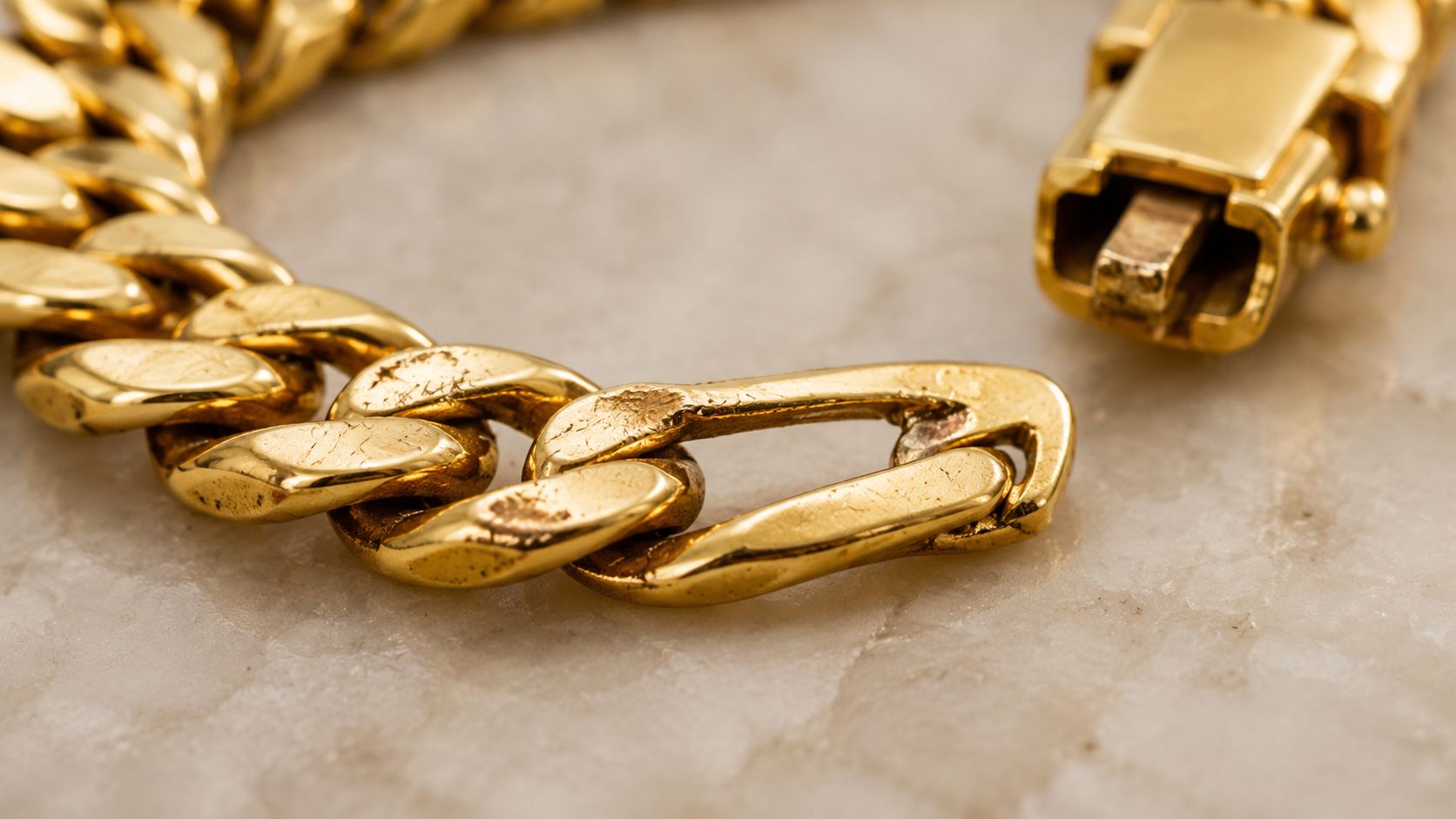
Once the baseline value is clear, condition becomes the next major variable. A chain can be real, heavy, and properly marked, then still receive a lower offer because repair risk sits with the buyer.
What appraisers inspect first
On a Cuban link, the usual pressure points are predictable. Buyers look closely at the clasp, solder points, link symmetry, stretch, and whether the chain still lays correctly.
Problems tend to fall into a few categories:
Worn clasps: If the lock feels loose or unreliable, the chain may need repair before resale.
Stretched links: A chain that has loosened over time can lose that tight, clean Cuban profile.
Dents and flattening: Damage is more common in lighter or hollow construction, but any chain can show it.
Past repairs: Uneven solder, mismatched color, or altered links can change how the piece is valued.
A clean, solid chain with crisp structure is easier to place in the secondary market. A damaged one may still sell, but the buyer has to account for labor, risk, and whether the item is best resold as jewelry or evaluated more conservatively.
When style still matters
Condition isn't the only adjustment. Demand matters too. Solid gold Cuban link chains have been major status symbols since the late 1970s, and their value isn't just in the metal. Their cultural cachet still affects marketability, especially for heavier, well-made pieces.
A chain can be worth one thing as scrap gold and another thing as a finished wearable piece.
That distinction matters more in active luxury markets like Atlanta and Buckhead, where buyers often see both fashion-driven and estate-driven jewelry. A chain with strong structure, good wearability, and recognizable craftsmanship usually gets more attention than a damaged piece that only has melt logic behind it.
Red Flags to Watch for When Selling Gold
Selling gold should feel measurable. If the process feels vague, rushed, or hard to follow, step back.
Much of the online content around Cuban links focuses on buying and style, but not on what happens when an owner sells. As noted in this discussion of the underserved selling angle, the important question is how a chain's characteristics turn into a real third-party offer after wear, demand, and resale practicality are factored in.
Signs the process is not transparent
A few warning signs come up again and again in gold transactions:
They won't weigh the chain in front of you: Weight is a core input. You should see it.
They avoid explaining purity assumptions: If they say "it's probably this" without testing or examining marks, that's weak process.
They use confusing pricing language: If you can't tell how the offer connects to grams, purity, and market conditions, ask for clarity.
They push for an immediate yes: Pressure usually benefits the buyer, not the seller.
Some sellers also get distracted by retail replacement value. That's a different number for a different purpose. A resale offer reflects what a buyer can confidently verify and resell now.
What a fair evaluation should look like
A professional gold evaluation should be straightforward:
What you should expect | Why it matters |
|---|---|
Visible weighing | Confirms one of the main value drivers |
Hallmark review | Supports the purity assessment |
Construction check | Distinguishes solid, hollow, and repaired pieces |
Condition review | Explains deductions tied to wear or repair |
Clear offer explanation | Lets you decide with real context |
If you're comparing buyers, it can also help to look at adjacent jewelry categories and how transparency affects resale confidence. A good example is this piece on the iced out cross chain, where material, condition, and workmanship all influence resale differently than retail presentation.
The Professional Selling Process Step by Step
A good selling experience is orderly, not theatrical. Whether you're in Midtown Atlanta, Roswell, Alpharetta, Brookhaven, Sandy Springs, or elsewhere in Georgia, the same basic process should apply.
Before you visit or ship
Start by gathering what you have. That may include the chain itself, any receipt, box, prior appraisal, repair documentation, or provenance tied to an estate.
Don't polish aggressively before a sale. Light cleaning is fine, but over-cleaning can hide wear patterns or leave residue around links and clasps.
If you're meeting in person, schedule enough time for a proper review. If you're selling remotely, make sure the buyer explains the insured shipping and intake process clearly before you send anything.
What happens during the evaluation
The actual review should be methodical. A buyer typically examines hallmarks, checks the clasp and link integrity, weighs the chain, and determines whether the piece is solid, hollow, or altered.
Experience is paramount. A skilled evaluator doesn't just read a stamp. They compare the stamp, weight, construction, and wear pattern to see whether the whole piece makes sense.
If a chain's dimensions and its weight don't line up, a careful buyer will investigate before making an offer.
In local markets like Buckhead and greater Atlanta, in-person evaluations are often the easiest route because sellers can see the inspection happen in real time. For remote owners, the standard should still be the same: secure handling, documented intake, clear communication, and a no-obligation offer.
How the offer is presented
A credible offer should connect back to objective factors. You should be able to understand whether the number is being driven mostly by gold content, by finished-jewelry resale potential, or by a combination of both.
That doesn't mean every buyer will use identical language. It does mean the logic should be visible. If a chain is very wearable and marketable, the offer may reflect more than pure melt logic. If the piece is heavily worn or altered, the offer may sit closer to intrinsic metal value.
For sellers who want a better sense of what a professional outlet should look like before making contact, this guide on where to sell fine jewelry offers a practical frame for comparing options.
Payment method and timing should also be stated plainly. Whether someone chooses a direct sale or wants to ask about collateral-based options, clarity matters. Just remember that loan decisions, repayment terms, and ownership consequences vary by business and jurisdiction, so read the terms carefully before agreeing to anything.
Frequently Asked Questions About Selling Gold Chains
Is a solid gold Cuban chain valued mostly for style or gold weight
For most resale transactions, the starting point is gold content. Style, craftsmanship, and wearability can improve the offer, but buyers usually begin with weight, purity, and current gold pricing.
Can I sell a damaged Cuban chain
Yes. Damage doesn't automatically make the chain unsellable. It usually changes whether the piece is evaluated more as wearable jewelry or more conservatively based on metal value and repair burden.
Does brand matter if the chain isn't from Cartier or Tiffany and Co.
Yes, but less than many sellers expect. In non-branded gold chains, construction quality, purity, total weight, and condition usually matter more than an unverified retail story.
Is 14K the most common purity for resale
In many Western markets, yes. Verified guidance on Miami Cuban links notes that 14K is a common balance between wearability and gold-content value, which is why it appears so often in secondary-market trade.
Should I clean the chain before an appraisal
Light cleaning is fine. Avoid harsh polishing, abrasive cloths, or do-it-yourself repair attempts. Buyers want to see the actual condition.
Will a hollow Cuban chain sell for less than a solid one
Usually, yes. If external size is similar, hollow construction means less gold content and generally less durability, which affects both intrinsic value and buyer confidence.
Is a pawn shop the same as a jewelry buyer
Not always. Some pawn operators know gold well, and some jewelry buyers know finished resale better. The important difference is transparency. You want a buyer who can explain weight, purity, condition, and how the final offer was reached.
Can I get value from an inherited chain even if I don't know its history
Yes. History is helpful, but not required. A professional can still assess hallmarking, gold content, construction, and condition without a full backstory.
Is it better to sell locally in Atlanta or ship to a buyer
That depends on your comfort level and the buyer's process. Local sellers in Atlanta, Buckhead, Roswell, Sandy Springs, Alpharetta, Brookhaven, and Midtown Atlanta often prefer in-person review because they can watch the evaluation. Remote selling can also work well if the process is insured, documented, and clearly explained.
If you're ready to understand what your chain is worth in the current market, Antwerp Diamond is a practical place to start. You can request an evaluation, visit for a private in-person review in the Atlanta area, or ask about secure mail-in options if you're selling from elsewhere in Georgia or across the U.S.


