

Selling an iced out cross chain for top dollar starts with authenticating the diamonds and precious metal, documenting condition and paperwork, and getting a professional valuation based on the piece's components and craftsmanship. If your cross pendant is the kind of piece that might carry 7 carats of VVS natural diamonds and weigh 28 grams, the buyer shouldn't price it on style alone. They should price what's present.
If you're reading this, you're probably in one of two situations. You either want to sell an iced out cross chain now, or you want to know whether what you own is a fashion piece, a fine jewelry piece, or something in between. That distinction matters because sellers often lose money when a buyer focuses on the look and ignores the underlying materials. The right process fixes that.
Table of Contents
Introduction
An iced out cross chain can be worth far more, or far less, than most owners expect. The mistake I see most often is treating it as a trend item when the core question is simpler: what are the stones, what is the metal, how well is it built, and how easily can another buyer verify all of that?
That's why the strongest offers usually go to sellers who present the piece like fine jewelry, not just streetwear-inspired jewelry. Clear photos, metal stamps, receipts, prior appraisals, and an honest condition summary all help a buyer separate surface sparkle from actual value. If you need a broader starting point on resale process, Antwerp Diamond's guide on where to sell fine jewelry is a useful companion.
Practical rule: Don't ask, “What do iced out cross chains sell for?” Ask, “What can a buyer verify in mine?”
Your First Step Documenting Your Iced Out Cross
Before anyone appraises your chain, you need a clean record of what you have. This is not the same as a formal appraisal. It's your own evidence file.
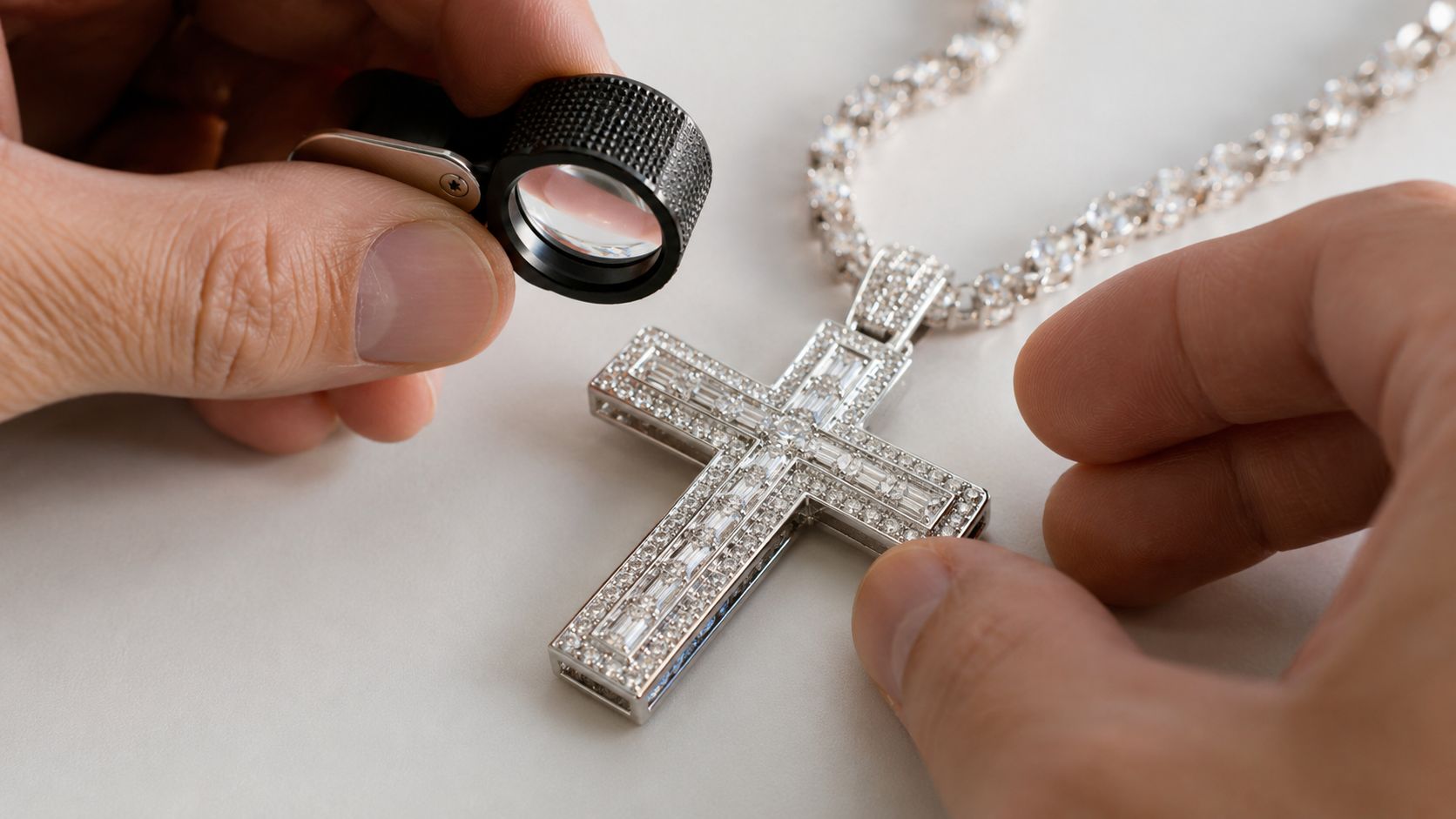
What to record before you ask for an offer
Start with the basic identifiers on the piece itself. Look for hallmark stamps such as gold purity marks or sterling silver marks, and note any maker's mark on the clasp, pendant back, or bail. If the chain and pendant are from different makers, write that down too. Mixed-origin sets often matter in resale.
Then document condition in plain language. Don't oversell it. A buyer wants to know whether the clasp closes securely, whether the chain lies flat, whether the pendant hangs straight, and whether any stones appear loose or missing.
Use this checklist:
Metal marks: Record every visible purity stamp and any maker's mark.
Piece format: Note whether it's a pendant with chain, pendant only, or a matched set sold together.
Weight: If you have a jewelry scale, weigh the chain and pendant together, then separately if possible.
Stone coverage: Describe where stones are set, front only or front and sides.
Condition points: List scratches, dents, bent links, worn rhodium or plating, loose prongs, or replaced parts.
Paperwork: Gather receipt, appraisal, certificate, warranty card, box, and any repair invoices.
Photos: Take straight-on, side, back, clasp, bail, and close-up stone-setting images.
For the photos, use bright indirect light and a neutral background. The point isn't to make the piece look dramatic. The point is to make it easy to verify construction details. Antwerp Diamond's article on how to photograph jewelry is useful if you're preparing an online submission.
Why this category can be misunderstood
“Iced out” describes a look, not a guaranteed level of value. The category generally refers to jewelry heavily covered with stones, often diamonds but sometimes cubic zirconia or other gemstones, and it commonly includes styles such as Cuban link and tennis chains in sterling silver or gold with diamond or rhinestone settings, as noted in this overview of what defines iced out jewelry.
That broad definition is exactly why documentation matters. One cross chain may be primarily fashion jewelry. Another may be built and evaluated like fine jewelry.
Historically, iced out jewelry is tied to hip-hop culture, where fully diamond-set pieces became visible status symbols. The style later moved into mainstream e-commerce and luxury retail, which helps explain why these pieces can carry both cultural appeal and measurable jewelry value, as discussed in this article on the legacy of iced out jewellery.
A buyer can only pay for what they can identify and defend. If your paperwork and photos are weak, the offer usually gets more conservative.
How Experts Determine the Value of Your Chain
A seller walks in with an iced out cross that gets attention across the room. The buyer still starts with quieter questions. What is the metal, what are the stones, how well is the piece built, and what can be verified well enough to support an offer.

Material value comes first
Professionals separate fashion value from asset value at the start. Fashion value comes from the look, the size, the style reference, and whether the piece feels current. Asset value comes from components that can be identified and defended, usually precious metal content and genuine stones with a resale path.
That distinction matters because style rarely carries a weak piece in the secondary market. Verified gold and verified diamonds do.
A trained buyer usually breaks the review into a few parts:
Component | What the buyer checks | Why it matters |
|---|---|---|
Metal | Purity stamp, color consistency, wear pattern, finish | Precious metal content sets a baseline value |
Diamonds or other stones | Whether they appear natural, lab-grown, moissanite, or simulants, plus uniformity and setting quality | Stone identity changes how the piece can be resold |
Total build | Pendant weight, chain strength, bail size, clasp security | Structural problems reduce confidence and price |
Marketability | Whether the piece is easy to resell as-is | Liquidity affects the offer |
If you want a clearer view of the process buyers use, this guide on how to appraise jewelry explains the evaluation standards in broader terms.
Craftsmanship changes the outcome
Two cross chains can contain similar gold weight and still produce very different offers. The difference is often workmanship.
On a well-made piece, the pendant hangs straight, the bail is proportionate to the chain, the clasp matches the overall weight, and the pavé work is consistent across the face and edges. On a weaker piece, stones may be unevenly seated, prongs can be thin or poorly finished, and the back may show shortcuts that affect durability. Buyers notice those details quickly because repair risk comes out of resale value.
Heavy stone coverage also creates a trade-off. More surface sparkle can help retail appeal, but dense pavé increases the chances of maintenance issues if the setting work is mediocre. From a buyer's side, a flashy look does not offset loose stones, worn tips, soft solder points, or a chain that cannot safely support the pendant over time.
What a professional is trying to answer
The core question is simple. If this piece changes hands again, which part of the price will still hold up under inspection?
That is why good documentation improves outcomes. If you can present clear photos of hallmarks, exact gram weight, stone paperwork if available, and any prior invoices or repairs, the buyer has more support for valuing the chain on its material content instead of treating it as style-driven jewelry with uncertain components.
For diamond-set jewelry, trade references such as the GIA Diamond Quality Factors are useful because they show the kind of grading framework professionals rely on when separating appearance from measurable quality.
Strong offers come from what can be verified. In an iced out cross chain, that usually means gold content, stone identity, total weight, and condition.
Preparing Your Jewelry for a Successful Sale
A buyer opens your file and sees a clean set of photos, readable hallmarks, a weight record, and matching paperwork. That file gets treated very differently from a chain dropped on the counter with no history attached. With an iced out cross chain, presentation matters because it helps the buyer separate fashion appeal from recoverable material value.

Presentation affects confidence
Start with careful cleaning. Use a soft cloth and leave heavy polishing, ultrasonic cleaning, and steam work to a jeweler if the setting condition is unknown. Small pavé stones can loosen under pressure, and residue packed around beads or prongs can hide issues that matter during intake.
This short video gives a helpful visual reference before you handle the piece:
Then build a file that supports the piece on its components, not just its look. Gather the original receipt, any prior appraisal, repair invoices, diamond papers if they exist, and a recent gram weight if you have one. If the chain or pendant is stamped 14K or 18K, understanding the difference between 14k and 18k gold helps you read those marks correctly and discuss value in the right terms.
Good photos do part of the valuation work before the buyer even replies. Use neutral lighting, keep the piece flat, and shoot close enough to show setting quality and wear. A dark, filtered photo may make the chain look dramatic, but it usually lowers confidence because the buyer cannot judge metal color, stone matching, or repair history.
Use a simple submission format:
Overview photo: Full chain and pendant laid flat.
Detail photo: Front of cross close-up.
Back photo: Pendant back and bail.
Chain photo: Clasp, end links, and any stamps.
Condition note: Short written summary of any issues.
Document set: Receipt, appraisal, and certificates in one batch.
What not to do before an evaluation
Do not swap in unknown replacement stones to make the piece look finished. Mixed melee is easy to spot under magnification, and it creates questions about the rest of the item. Do not buff over hallmarks or plating transitions. Those details help confirm metal content and construction.
Keep the paperwork clean as well. A certificate from another pendant, an old appraisal with unclear descriptions, or a repair ticket that does not match the item slows the process and can reduce the offer.
Buyers also look past surface flash. They check whether the setting work is secure, whether the finish shows excessive wear, whether the bail and chain are structurally sound, and whether the piece can be valued for gold and stones if style demand is weak. That is the difference between a fashion piece that photographs well and a piece that can be bought with confidence for its underlying materials.
Choosing the Right Way to Sell Your Iced Out Chain
Where you sell matters almost as much as what you sell. An iced out cross chain sits in a tricky lane because it can be custom, unbranded, and hard for a general buyer to authenticate.
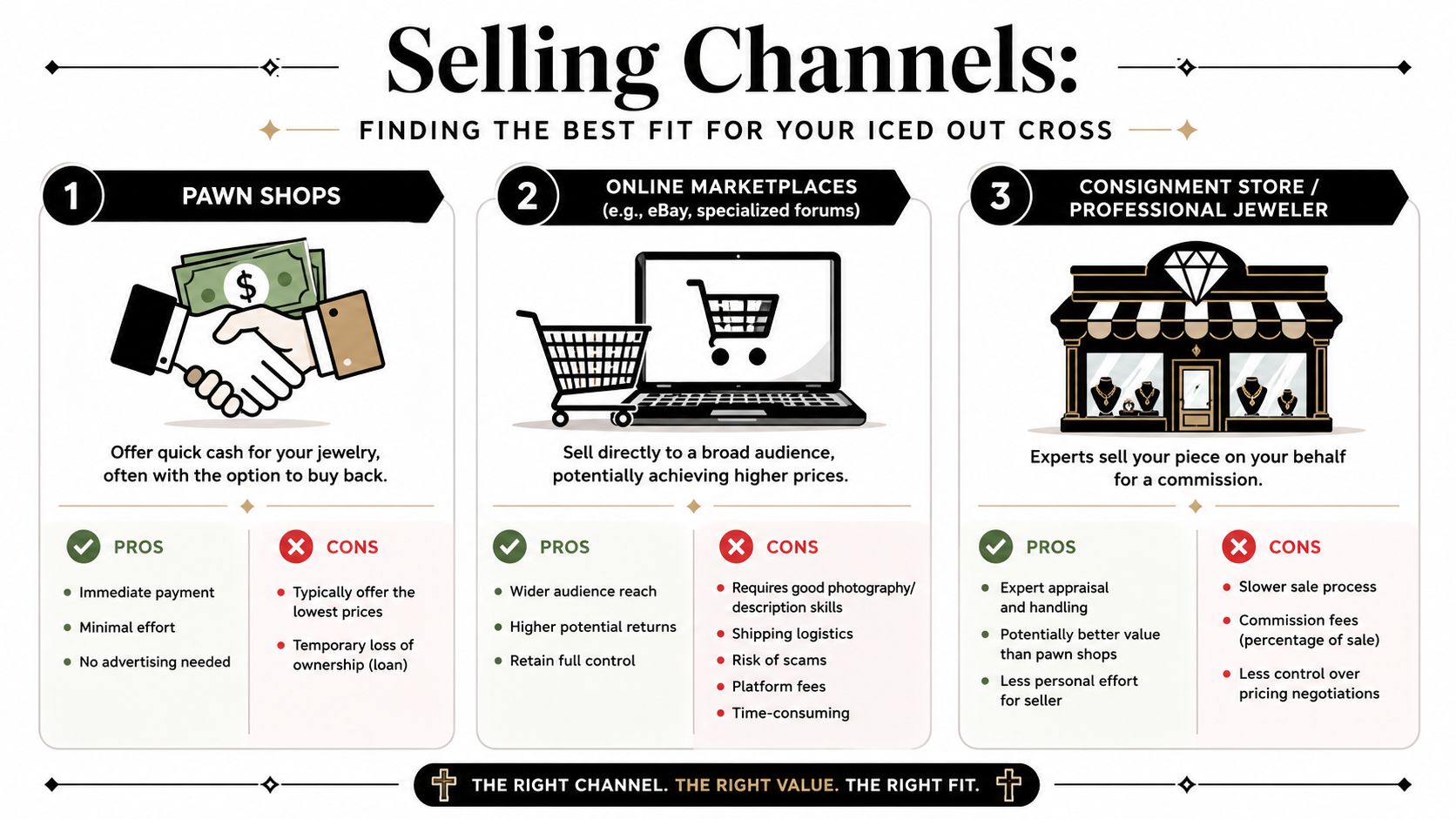
Three common selling channels
Here's the practical comparison:
Selling channel | Works well for | Main drawback |
|---|---|---|
Pawn shop | Speed and convenience | Offers may lean toward a fast-exit number |
Online marketplace | Sellers comfortable with photos, messaging, and shipping | More effort, more risk, and more buyer skepticism |
Professional jewelry buyer or consignment specialist | Pieces with meaningful material value or custom workmanship | Process may require deeper review |
The biggest issue in the secondary market is authentication. With custom or unbranded pieces, value depends heavily on expert verification of materials and craftsmanship, which makes buyer selection critical, as noted in this discussion of authentication risk for iced-out cross chains.
When a specialist buyer makes more sense
If your cross chain may have real diamond and gold value, a specialist buyer is usually better equipped to separate decorative appeal from component worth. That matters in Atlanta, Buckhead, Sandy Springs, Alpharetta, Roswell, Brookhaven, Midtown Atlanta, and across the Georgia market, where sellers often want a private evaluation instead of listing a high-value custom piece publicly.
One option is where to sell jewelry online, especially if you want to compare remote selling routes before committing. Antwerp Diamond is one example of a buyer that offers online evaluations, insured shipping for remote clients, and private in-person appointments in Buckhead. That kind of process can make sense when the piece needs material verification rather than a quick style-based bid.
If the chain is custom, the buyer's expertise matters more than the buyer's advertising.
Frequently Asked Questions About Selling Jewelry
Is an iced out cross chain with lab-grown diamonds valuable
It can be valuable, but the valuation path is different from a piece with natural diamonds. A buyer will still examine metal content, workmanship, condition, and how easily the stones can be verified and resold.
What's the difference between fashion value and asset value
Fashion value comes from look, style, and current demand. Asset value comes from verifiable precious metal, verifiable stones, and craftsmanship that another buyer can confidently assess.
Does customization help or hurt resale
It depends on the quality and taste level of the work. Strong custom work can help if the setting is clean, symmetrical, wearable, and made from desirable materials. Weak aftermarket work often hurts because buyers worry about repairs, mixed parts, or inconsistent stones.
Do I need paperwork to sell an iced out cross chain
No, but paperwork helps. Receipts, appraisals, repair records, and certificates reduce uncertainty and make it easier for a buyer to defend a stronger offer.
What is melt value versus resale value
Melt value is tied to the recoverable precious metal content. Resale value can be higher if the piece is attractive, well made, and marketable as finished jewelry. In weak-condition or hard-to-authenticate pieces, resale value may move closer to component value.
Should I sell the chain and pendant together
Usually, yes, if they were made as a balanced set and look coherent together. If one part is clearly stronger than the other, a buyer may still evaluate them separately.
Get a Professional Offer for Your Cross Chain
To sell an iced out cross chain well, treat it like a fine jewelry asset first and a fashion item second. Document the metal, stones, weight, condition, and paperwork. Present the piece clearly, and choose a buyer who can evaluate material quality, construction, and resale risk instead of pricing it on appearance alone.
If you're in Atlanta or nearby areas such as Buckhead, Sandy Springs, Alpharetta, Roswell, Brookhaven, or Midtown Atlanta, an in-person review can be especially useful. For sellers elsewhere in Georgia or across the U.S., remote evaluation may still work if your photos and documentation are strong.
If you want a professional, no-pressure review of your cross chain, you can contact Antwerp Diamond for an evaluation online or arrange a private in-person appointment. Bring the piece, any paperwork you have, and clear photos if you're starting remotely.


