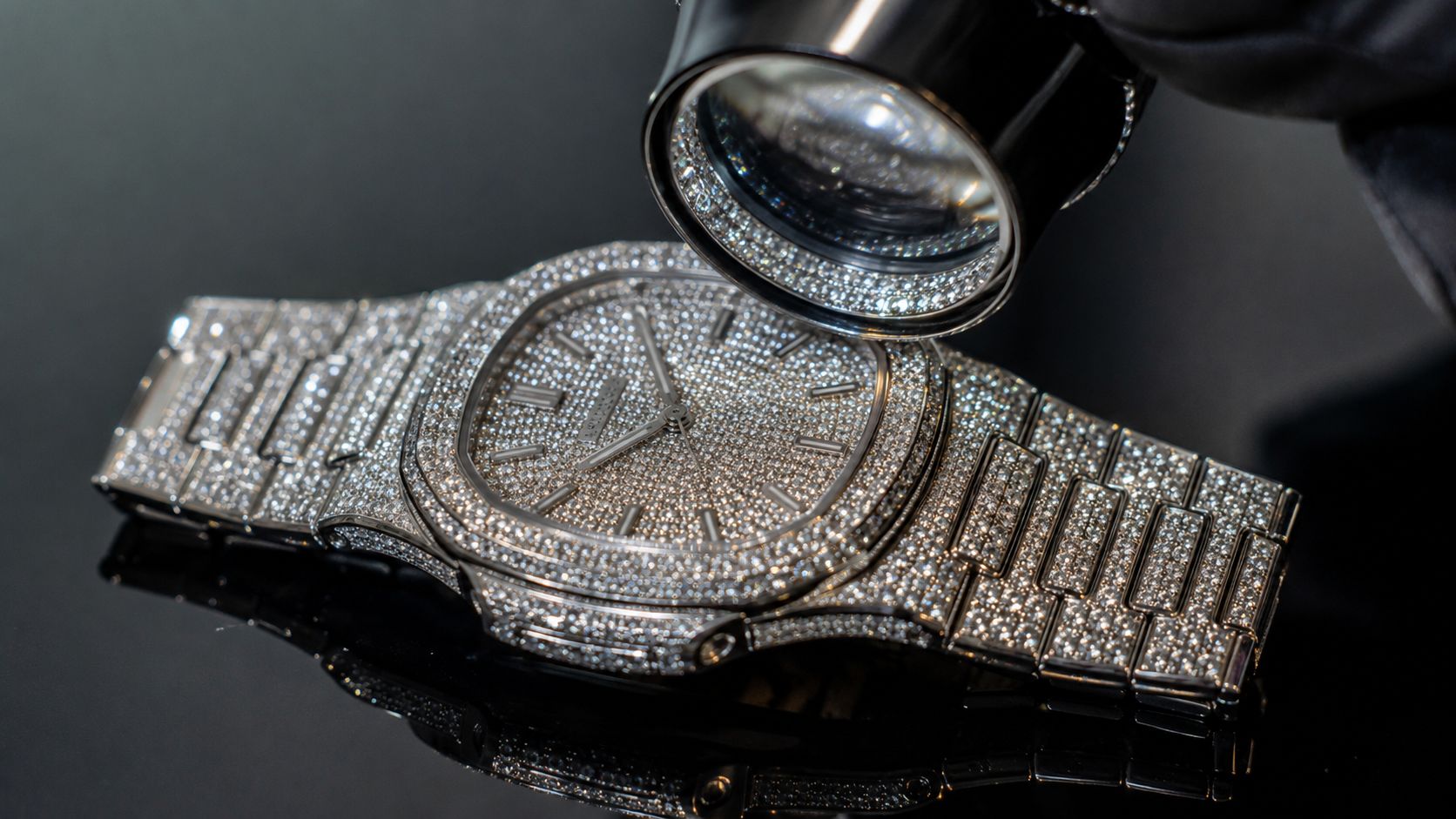
VVS diamonds on a watch are Very Very Slightly Included stones, a top-tier clarity grade where inclusions are only detectable under 10x magnification, not by the naked eye. They matter because that level of clarity can raise a watch's desirability and value, but in real resale conditions the premium is justified only when the stones, setting, documentation, and watch itself all hold up under expert inspection.
Most articles stop at the definition. That misses a crucial question buyers and sellers ask: if a watch is covered in VVS diamonds, does that indeed change what it's worth, or is it mostly marketing once the stones are mounted? In practice, the answer depends on where the diamonds came from, how they were set, whether the watch was factory-set or aftermarket, and how the secondary market views the whole piece.
For owners in Atlanta, Buckhead, Sandy Springs, Alpharetta, Roswell, Brookhaven, Midtown Atlanta, and across Georgia, that distinction matters whether you're buying, appraising, borrowing against, or selling a diamond watch. With VVS diamond watches, clarity is only one part of the story. The rest is authenticity, workmanship, and resale reality.
Table of Contents
What Are VVS Diamonds on a Watch
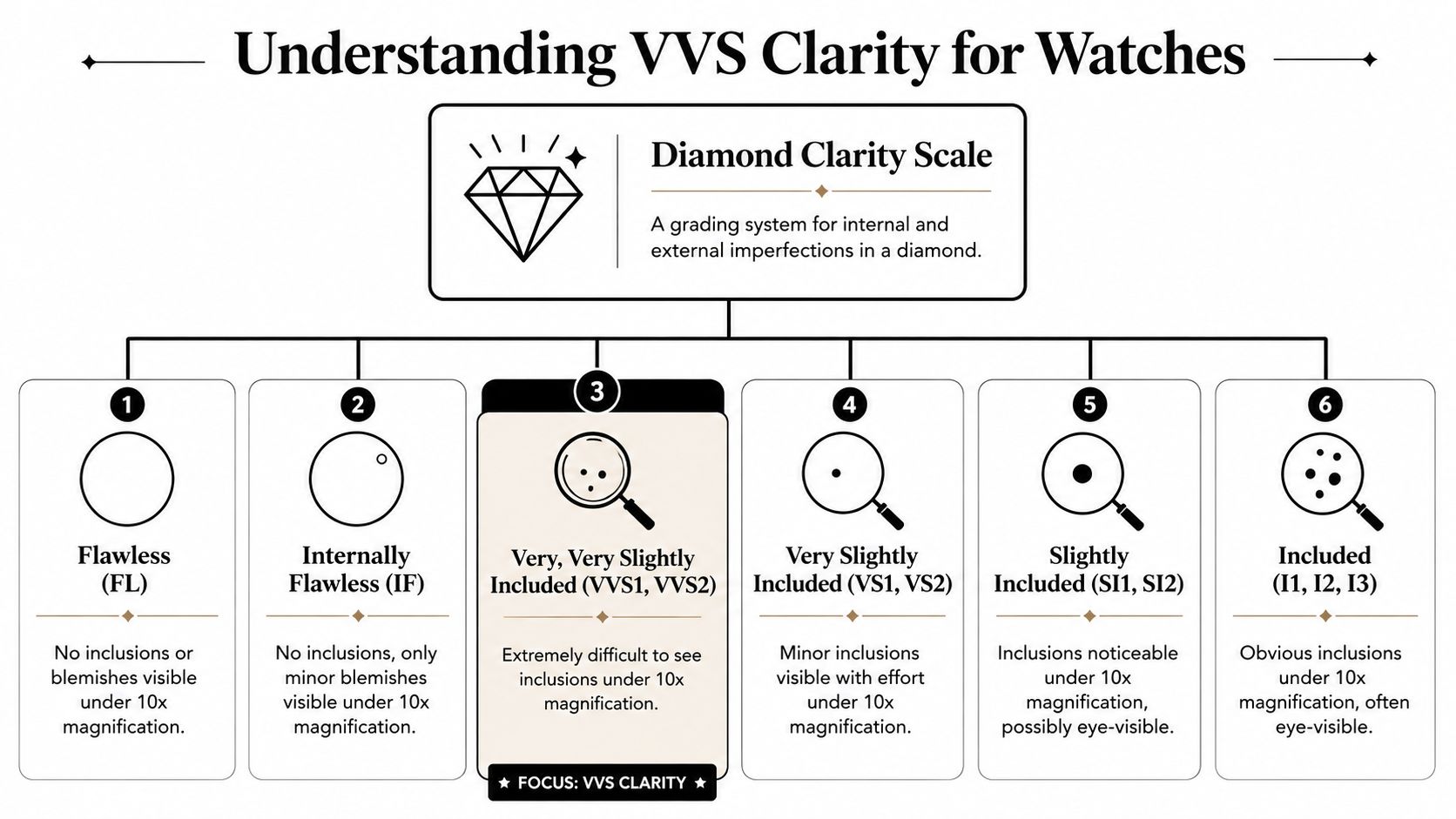
VVS stands for Very, Very Slightly Included. In diamond grading, that means the inclusions are only detectable under 10x magnification, not with the naked eye, and that's one reason VVS sits just below Flawless and Internally Flawless in the clarity scale, as explained in this overview of diamond clarity grades and in trade descriptions of watch-set diamonds.
Why VVS works so well on pavé watches
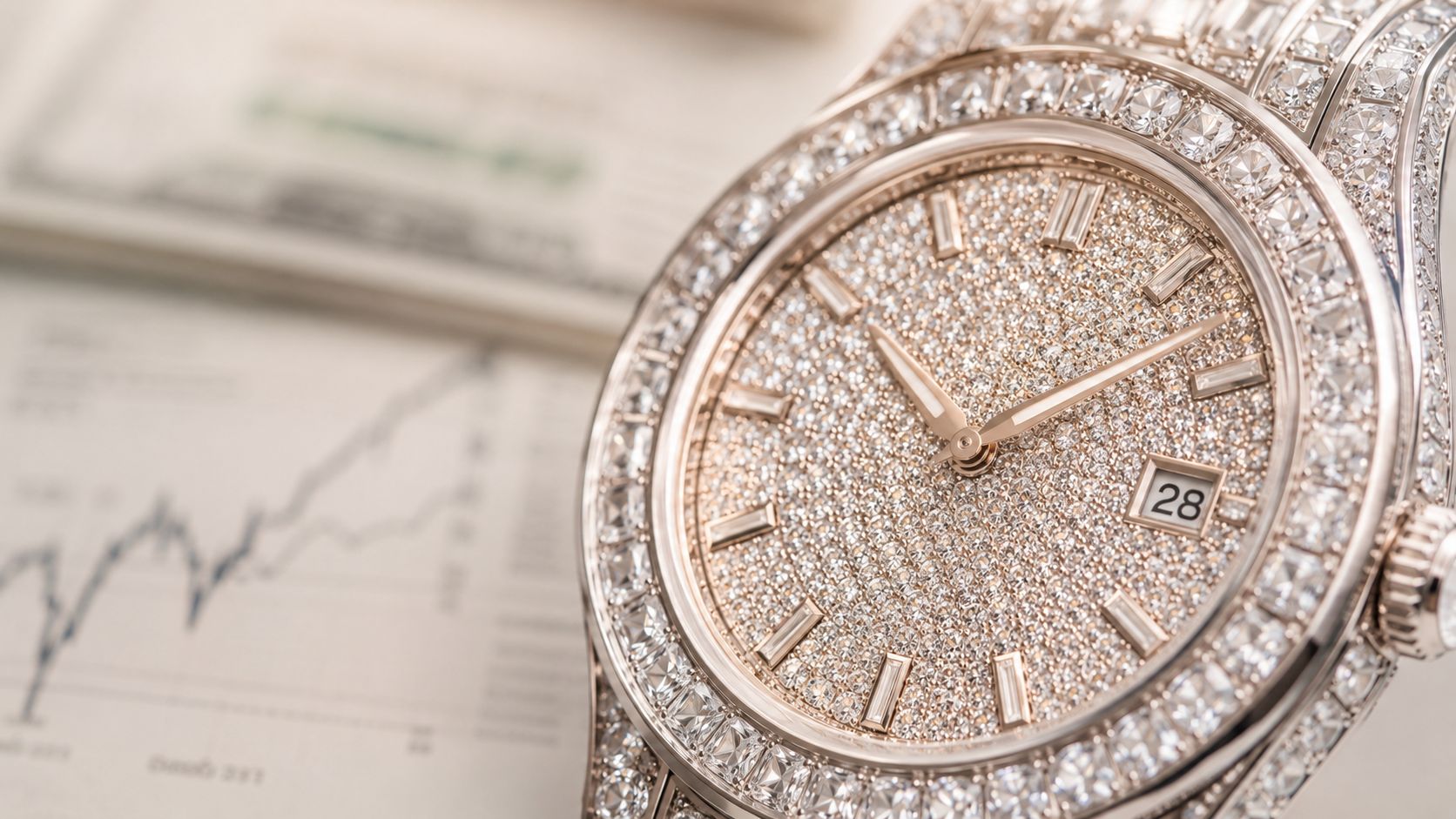
On a ring with one center stone, buyers focus on that single diamond. On a watch, the visual effect comes from many small stones working together across the bezel, dial, case, lugs, and bracelet. According to Asorock Watches' explanation of VVS diamonds in watchmaking, pavé settings rely on very small, tightly matched stones, and cleaner clarity helps create more uniform optical return.
That's the practical reason VVS became such a strong marketing term in iced-out watches. If one or two stones are visibly weaker than the rest, the eye catches the break in the pattern. Uniformity is the point.
Practical rule: On a diamond watch, consistency usually matters more than the headline grade printed in a sales listing.
Consider a tiled wall. If every tile is aligned and the finish matches, the surface looks clean and expensive. If a few tiles are off, the whole wall looks cheaper even if the material itself is good. Diamond watches behave the same way under direct light.
Where buyers get confused
Many shoppers treat “VVS” as if it answers every quality question. It doesn't. It tells you about clarity, but not whether the diamonds are natural, lab-grown, or a simulant, and not whether the watch was originally produced that way.
It also doesn't guarantee that the setting work is clean. A watch can use strong stones and still show uneven spacing, weak prongs, poor line symmetry, or over-polished surfaces around the setting. Those details matter when the watch comes in for appraisal or resale.
If you're trying to separate real quality from hype, it also helps to understand what sellers mean when they say a stone is genuine. This guide on what “genuine diamond” means is a useful starting point before you judge a VVS diamond watch listing.
A seasoned buyer looks at three levels at once:
The diamonds themselves: Are they matched well, and is the stated clarity believable?
The watch platform: Is the underlying watch desirable on its own?
The workmanship: Does the setting improve the watch, or does it compromise it?
That's the difference between a watch that photographs well online and one that still holds scrutiny on the bench.
The Real Impact of VVS Clarity on Watch Value
VVS clarity does affect value, but not in a straight line. Buyers often assume the label alone creates a major premium. In the trade, value comes from a combination of diamond scarcity, watch brand, quality of setting, and whether the market trusts the piece.
Scarcity supports the premium
VVS diamonds are positioned as premium partly because they're not common. One jewelry source estimates that VVS stones make up only about 5% to 7% of all diamonds in the market, while Flawless or Internally Flawless stones are cited at roughly 2%, which helps explain why VVS appears so often in high-end watch listings and why buyers pay close attention to grading and certification when evaluating iced-out pieces, as noted by Gabriel & Co..
That scarcity matters most when the diamonds are part of a credible, well-executed watch. It matters less when the stones are mounted in a piece with weak overall demand or questionable modification history.
What actually adds value in the market
A VVS label can support price. It doesn't automatically support resale.
Here's what tends to carry weight when the watch is evaluated:
Value factor | Why it matters |
|---|---|
Brand and model | Rolex, Cartier, Patek Philippe, and Audemars Piguet don't trade the same way in the secondary market. The underlying watch still drives demand. |
Factory origin | A factory diamond piece is generally easier to authenticate and easier to place with serious buyers. |
Stone matching | Buyers notice spread, color consistency, and overall finish more than they notice a seller's verbal claim. |
Documentation | Original box, papers, service history, and any supporting diamond documentation help reduce uncertainty. |
Condition | Stretch, dents, over-polishing, missing stones, and movement issues can offset any clarity premium. |
A VVS diamond watch is worth more when the whole watch is convincing, not just the wording in the listing.
Many owners often misread the market. They focus on what the stones cost to install, not on what a buyer can confidently resell. Those aren't the same thing.
For resale planning, it helps to compare the watch's diamond component with the broader resale logic for gemstones. Antwerp Diamond Store's diamond resale value calculator guide gives a useful framework for thinking about how quality, demand, and buyer confidence shape offers.
In real transactions, VVS clarity works best as a supporting factor. It helps a strong watch become more desirable. It rarely rescues a weak watch, a poor setting job, or a heavily altered piece with uncertain origin.
How to Verify and Authenticate VVS Diamond Watches
If a seller says a watch has VVS diamonds, treat that as a claim that needs verification. In watch settings, especially with many small stones, buyers shouldn't rely on verbal descriptions alone.
Start with paperwork, but don't stop there
Begin with whatever documentation exists. That may include brand paperwork, original sales receipts, independent appraisals, service records, or invoices from the jeweler who performed aftermarket work.
But paperwork has limits. Small melee diamonds on watches usually aren't individually certified. That means a document may describe the watch generally without proving every stone to be VVS.
A practical checklist looks like this:
Match the watch identity: Confirm reference numbers, serial information, and model details line up with the watch itself.
Review any diamond paperwork carefully: Look for what the document states about the stones, not what the seller says it means.
Check for modification disclosure: If the diamonds were added later, the paperwork should reflect that clearly.
Inspect the overall condition: Missing stones, uneven rows, and damage around drilled surfaces can tell you a lot before magnification even starts.
What an expert checks in person
A proper authentication combines gem knowledge and watch knowledge. Looking at only one side of that equation causes mistakes.
An experienced evaluator will usually examine:
Stone quality under magnification
VVS is a clarity statement. The evaluator uses magnification to judge whether the stated grade is plausible across the set, not just on a few visible stones.Setting quality
Good setting work keeps the visual pattern clean and the stones secure. Poor work often shows uneven seat depth, inconsistent bead work, or damage to case geometry.Watch authenticity
The diamonds may be real while the watch is altered, over-restored, or assembled from mixed parts. That can hurt value fast.
If the watch and the diamonds are evaluated separately, the owner can get a misleading answer. The resale market buys the finished object, not isolated components.
For Rolex owners especially, the underlying watch must be authenticated before any diamond premium is taken seriously. This guide on how to know if your Rolex is real shows the kind of baseline checks that matter before anyone starts discussing diamond clarity.
In the Atlanta market, in-person inspection is still the cleanest path when the numbers matter. Photos can help with a preliminary opinion, but they won't replace bench review for high-value diamond-set watches.
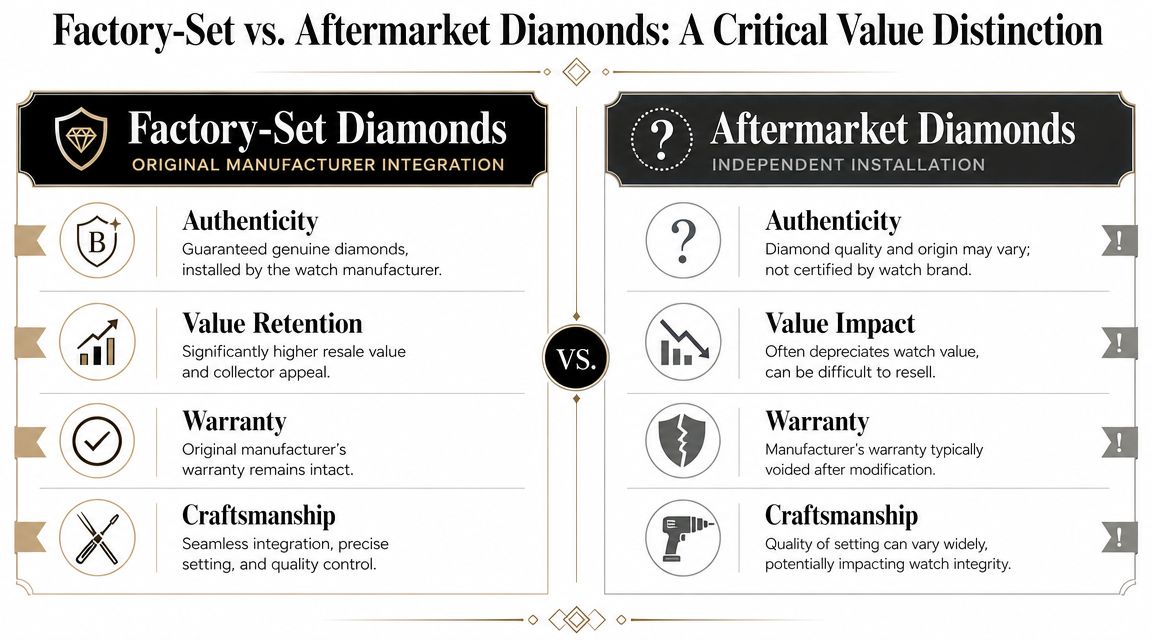
Factory-Set vs Aftermarket A Critical Value Distinction
This is the divide that changes everything. Two watches can both be described as VVS diamond watches, yet trade very differently because one left the manufacturer with diamonds and the other was modified later.
Why factory-set usually trades stronger
A factory-set watch benefits from original design intent, factory finishing, and cleaner buyer confidence. Collectors and dealers know what they're looking at, and the watch usually fits established market expectations better.
Aftermarket diamond watches can still be valuable, but they carry more questions. Was the case drilled correctly? Were parts replaced? Was the bracelet weakened? Was the diamond quality overstated? Did the modification hurt future serviceability?
The technical side of diamond watch construction also matters here. Listings for VVS-set pieces show how these watches are often built around larger pavé surfaces, including examples such as a 39.8 mm Santos de Cartier-style watch and a separate 41 mm watch with automatic movement and 25–30 carats of stones, all of which point to the labor and engineering involved in full coverage settings, as shown in this diamond watch product listing.
That same complexity is why poor aftermarket work creates problems. The more surface area that gets set, the more room there is for uneven execution and future service headaches.
Side-by-side comparison
Feature | Factory-set diamond watch | Aftermarket diamond watch |
|---|---|---|
Origin | Produced by the brand in that form | Modified by a third party after sale |
Buyer confidence | Usually stronger because the watch matches known factory specifications | More variable because the quality depends on the jeweler's work |
Resale audience | Broader, especially among collectors and cautious buyers | Narrower, often limited to buyers focused on look over originality |
Service considerations | Typically more straightforward from a provenance standpoint | Can be harder if the setting interferes with normal watch work |
Value behavior | Usually steadier if condition and documents are strong | Can swing widely based on execution and demand |
Factory-set commands trust. Aftermarket has to earn it.
If you need to understand the financial side before selling, pledging, or insuring a piece, this article on how to appraise jewelry helps explain how experts separate intrinsic material value from brand and market value.
In practice, aftermarket VVS diamonds don't erase the discount that many modified watches face. Clean work helps. Strong stones help. Originality still matters.
Selling Your VVS Diamond Watch What to Expect
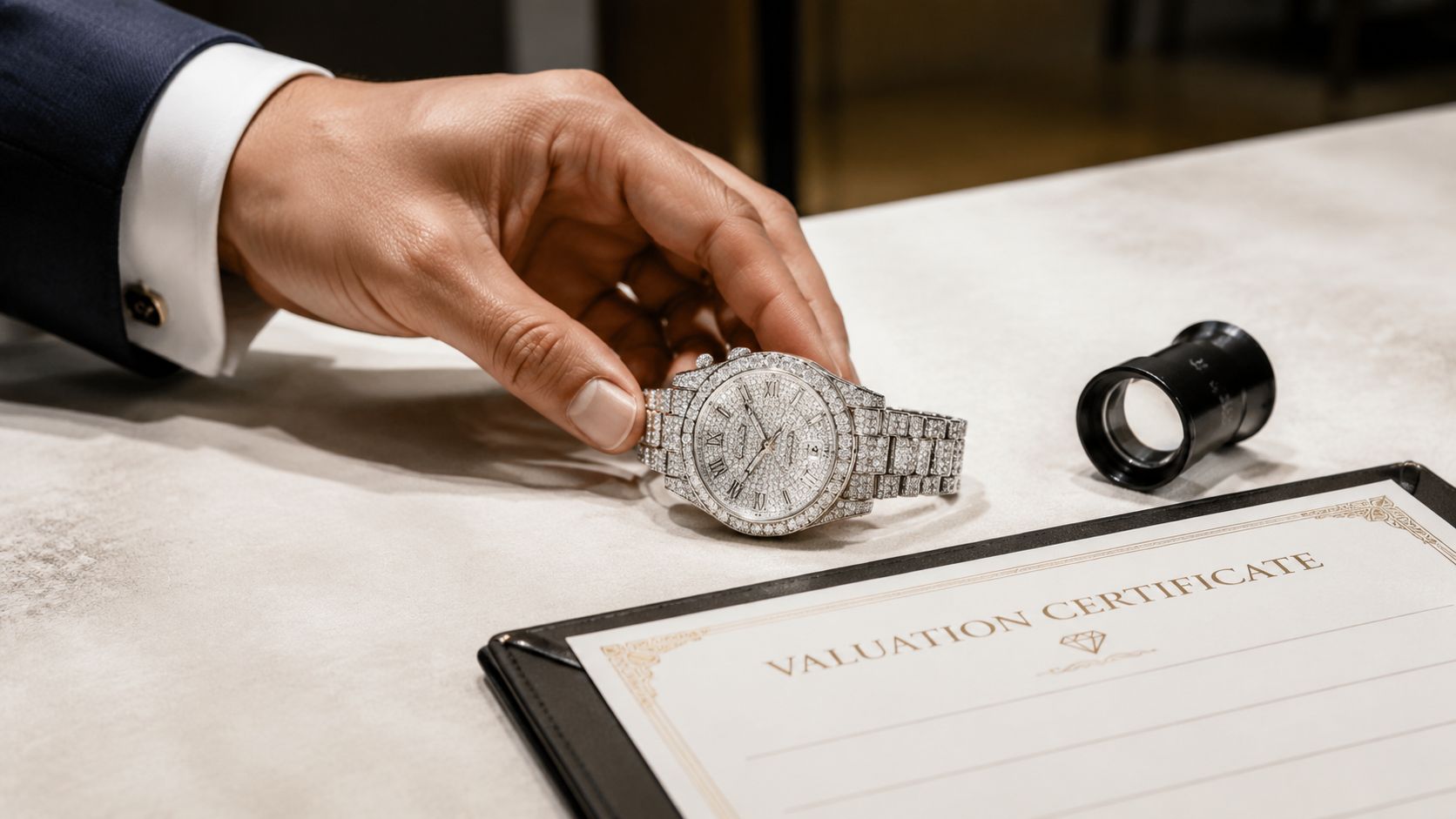
When owners sell a VVS diamond watch, they often expect the clarity grade to drive the entire offer. It usually doesn't. The offer is built from the watch first, the diamond work second, and the credibility of the package throughout.
How offers are really built
A serious buyer will generally look at several layers at once:
The base watch: Brand, reference, movement, originality, and current market demand.
The diamond execution: Whether the stones appear natural or otherwise, how well they match, and how clean the setting looks.
The condition profile: Missing stones, loose stones, bracelet wear, dial issues, polishing, and service needs.
The documents: Box, papers, receipts, prior appraisals, and proof of origin all reduce friction.
The resale path: How easy the piece will be to place with the next buyer.
One of the biggest realities in this category is that the market doesn't always reward VVS the way owners expect once the stones are mounted. An industry source notes that many buyers ask for VVS quality, yet many aftermarket diamond watches use lower clarity stones such as VS or SI1 because the visible difference is often minimal once set, and setting quality can matter more than the grade alone, as discussed in this industry video on VVS diamond watches.
That's the point many sellers need to hear. You may have paid for VVS, but the buyer will ask whether that premium remains visible, credible, and commercially relevant today.
What sellers can do before the appointment
Owners can improve the process by coming prepared, not by trying to oversell the piece.
Use this pre-sale checklist:
Gather original materials: Box, papers, receipts, and service documents help answer questions early.
Don't replace missing stones casually: A rushed repair can create matching problems that experienced buyers spot immediately.
Be honest about aftermarket work: Disclosure doesn't kill a deal. Hidden modification often does.
Clean the watch carefully: Remove surface dirt, but don't over-polish or attempt cosmetic work at home.
Ask for a market-based evaluation: The best offers come from buyers who understand watches and diamond setting together.
For owners comparing options, Antwerp Diamond offers guidance on selling high-end watches, including what evaluators look for in luxury timepieces. That can be useful whether you're in Buckhead, Roswell, Sandy Springs, Alpharetta, Brookhaven, Midtown Atlanta, or elsewhere in Georgia.
A well-made VVS diamond watch can sell well. A weak aftermarket watch with a strong clarity claim often won't. In the resale market, trust converts to value faster than marketing language does.
FAQs About VVS Diamonds and Watches
Is VVS better than VS on a diamond watch
Yes, in clarity terms VVS is higher than VS. But on a watch, especially with many small mounted stones, the visible difference may be limited unless the setting is large, the matching is weak, or the workmanship is poor.
Does VVS always mean the watch is worth more
No. VVS can support value, but it doesn't override the importance of brand, originality, setting quality, condition, and documentation.
Are all VVS diamond watches natural diamond watches
No. “VVS” is a clarity term, not a statement about origin by itself. A seller still needs to identify whether the stones are natural diamonds, lab-grown diamonds, or something else entirely.
Is a factory diamond watch always better than an aftermarket one
For resale and buyer confidence, factory-set usually has the advantage. Aftermarket can still be attractive, but it needs stronger verification and often faces more questions in the secondary market.
Can moissanite be sold as VVS on a watch
Sellers may use VVS-style language in moissanite marketing, which is one reason buyers get confused. That's why the stone type must be identified separately from the clarity claim.
Should you pay extra for VVS on an iced-out watch
Sometimes yes, sometimes no. If the watch is well-made, the stones are properly matched, and the piece has a clear resale audience, VVS may be worth paying for. If the setting is mediocre or the watch is heavily modified, the premium may not come back to you later.
Quick Clarity Comparison VVS vs VS
Feature | VVS (Very, Very Slightly Included) | VS (Very Slightly Included) |
|---|---|---|
Clarity position | Higher clarity tier | Slightly lower clarity tier |
Inclusions | Extremely difficult to detect under magnification | Minor inclusions are easier to find under magnification |
Naked-eye appearance on watches | Usually clean-looking | Often also clean-looking once mounted |
Use in marketing | Common in premium iced watch listings | Common in practical aftermarket work |
Resale effect | Helps when supported by strong watch quality and documentation | Can still perform well if the setting and watch are strong |
Do small VVS diamonds come with individual certificates
Usually not on watches. Large center stones are more likely to have separate grading reports. Diamond-set watches with many small stones are typically evaluated as a mounted group by an expert.
If you want a realistic opinion on a VVS diamond watch, bring the watch, its paperwork, and any service or purchase records for review. Antwerp Diamond can help assess authenticity, condition, setting quality, and resale potential so you can make an informed decision without guessing.