To know if your Rolex is real, start with three concrete checks: the seconds hand should move with a smooth sweep, a date model should show 2.5x magnification through the Cyclops lens, and the dial, case, and bracelet should show crisp, high-quality finishing. Those checks can screen out many obvious fakes, but if you need a real answer for a sale, appraisal, loan, or purchase, professional authentication is still the only reliable final step.
That's the position many owners find themselves in. The watch looks right, the papers may even look right, and online advice keeps repeating the same surface-level checklist. The problem is that modern counterfeits often copy the easy tells well enough to pass a casual inspection.
The better way to approach how to know if your Rolex is real is to think in layers. Some checks are useful screening tools. Others carry much more weight. The strongest answer comes from a hierarchy of evidence, starting with what you can see and feel, then moving to identifiers, provenance, and finally expert internal inspection.
Table of Contents
Verifying Key Rolex Identifiers Serial Numbers and Hallmarks
Quick Visual and Sensory Checks You Can Do Now
A watch comes across the counter. The seller says it is a Rolex, the photos looked convincing, and the price is just low enough to create urgency. Before anyone starts talking about serials, papers, or resale value, the watch itself usually gives the first honest answer.
These opening checks sit at the bottom of the evidence ladder. They are useful because they are immediate, and because poor counterfeits often fail them within seconds. They are still screening checks. A convincing fake can pass some of them.
Start with movement, weight, and feel
Begin with what the watch does in your hand. A genuine mechanical Rolex should have a flowing seconds hand rather than a one-second quartz tick, and Rolex calibres such as the 3235 beat at 28,800 vibrations per hour, which helps create that visual sweep. The same Rolex spotting guide also notes that authentic models tend to have substantial mass, with stainless-steel, gold, and platinum references feeling noticeably denser than many replicas because of their case construction and bracelet quality, according to this Rolex spotting guide.
Then pay attention to resistance and balance. The case should feel dense, the bracelet should articulate with control, and the crown should wind with a refined, deliberate feel. Counterfeits often miss one of these tactile cues even when the dial looks respectable in a listing photo.
Here is the first-pass screen I use at the counter:
Watch the seconds hand in motion: It should sweep with fine increments, not jump once per second like a basic quartz movement.
Lift the watch before studying the dial: Rolex cases and bracelets usually feel solid and well balanced, not hollow or top-heavy.
Move the bracelet through your fingers: Links should feel substantial and orderly, without excessive rattle or a cheap stamped feel.
Wind and set the crown carefully: The threading and action should feel precise, not gritty, loose, or uneven.
One bad sign does not prove a fake. Several small inconsistencies at once deserve caution.
Sellers who plan ahead often start here because this is what buyers notice first in person. If you are preparing a watch for review or resale, this guide on how to prepare high-end watches before a resale evaluation is useful.
What these checks can and cannot tell you
These cues help sort obvious problems from watches that deserve closer examination. They do not prove authenticity.
A counterfeit can get the weight close and still miss the crown action. It can mimic a smooth seconds sweep and still have weak dial printing, poor date presentation, or incorrect finishing once inspected under magnification. That hierarchy matters. Feel and motion are fast filters. They are not final evidence.
What separates a genuine Rolex from a strong counterfeit is consistency. The case, bracelet, dial furniture, crystal, crown operation, and overall finishing should agree with each other. Real watches tend to hold together as complete objects. Fakes often start to contradict themselves once you slow down and examine each component with intent.
Model context matters too. Buyers scrutinize sport models with unusual intensity, especially Daytonas, which is one reason collectors still study the story of Rolex Daytona alongside the physical traits of the watch in front of them.
A Closer Look at the Details Magnification Reveals
A watch can feel convincing in the hand and still come apart under a loupe. That is why magnification sits higher in the evidence chain than weight, sweep, or general finish. It does not prove authenticity by itself, but it exposes the kind of fine manufacturing errors that strong counterfeits still struggle to hide.
Use a loupe on the date, dial, and crystal
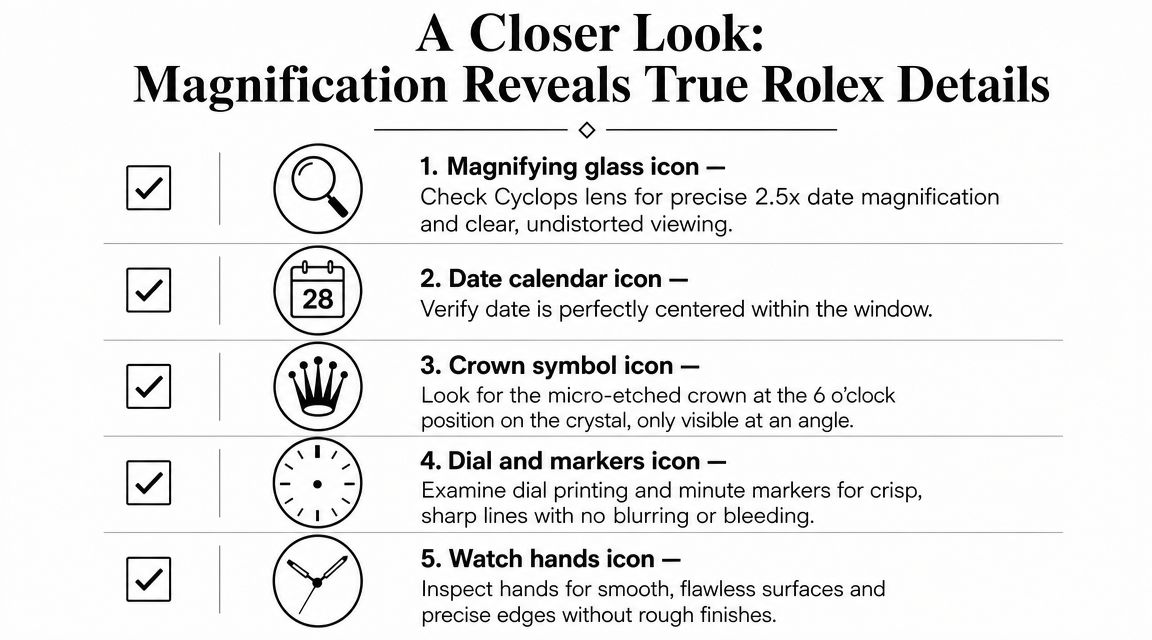
Start with the parts counterfeiters most often get close, but not right. On a genuine Rolex date model, the Cyclops should enlarge the date enough that it reads clearly and fills the window with confidence. The magnification standard often cited for this check is 2.5x, as noted earlier in the article.
Under magnification, inspect the watch as a set of related details rather than isolated parts:
Cyclops date view: The numeral should appear bold, centered, and easy to read.
Date alignment: The date should sit properly in the aperture, without riding high, low, or off to one side.
Dial printing: Lettering should be crisp, with clean edges and consistent thickness.
Minute track and markers: Spacing should be even, with markers placed cleanly against the track.
Crystal etching: The tiny crown at 6 o'clock should appear faint but precise under angled light, not coarse or obvious.
Experience proves valuable. A counterfeit rarely fails in only one place. The date may look decent, but the coronet on the dial is slightly soft. The text may be sharp, but the marker spacing is inconsistent. Genuine Rolex watches tend to show discipline across all of these surfaces at once.
If you want context on how model-specific details evolved over time, especially on an icon collectors scrutinize closely, the story of Rolex Daytona is worth reading because it helps explain why small details matter so much in vintage and modern comparisons.
Owners preparing for a sale often learn this the hard way. A buyer may say the watch “looks good,” then lose confidence the moment a loupe comes out and the printing or date alignment starts to drift. That is one reason informed sellers review the same points a dealer will examine before listing or meeting a buyer. Antwerp Diamond has a useful guide on selling a luxury watch near you.
Where precision usually breaks down on a fake
High-quality counterfeits usually copy broad design cues well enough to survive casual viewing. Magnification shifts the test from style to execution.
Look closely at the hands. Check whether the edges are clean and uniform or slightly ragged. Study applied markers from more than one angle. They should sit securely and evenly, without glue residue, tilt, or inconsistent polishing. On the dial, poor counterfeits often show printing that looks thick, grainy, or unsettled once enlarged.
The key trade-off is time. Quick checks help screen a watch fast. Loupe work slows the process down, but it gives better evidence because it tests manufacturing precision rather than first impressions.
Rolex does not rely on “close enough” tolerances in visible details. If the watch only holds up from normal viewing distance, the inspection has already told you something important.
Verifying Key Rolex Identifiers Serial Numbers and Hallmarks
The next layer of evidence is identity. Not the style of the watch, but the watch's actual engraved identifiers and whether they appear where they should for that production era.
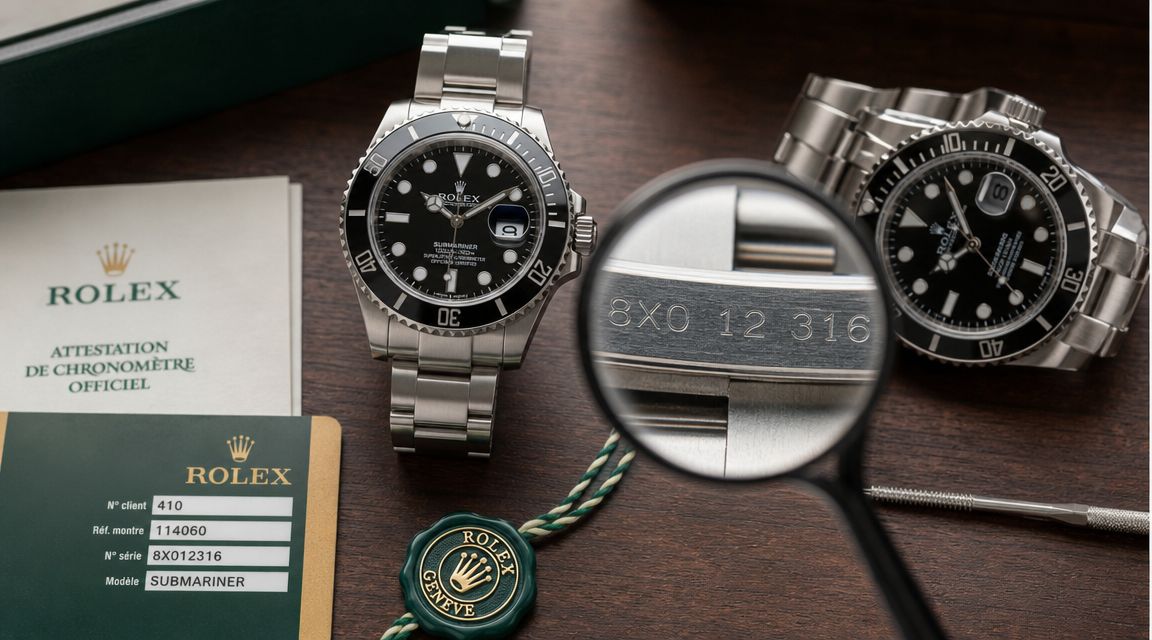
Where the serial should be based on age
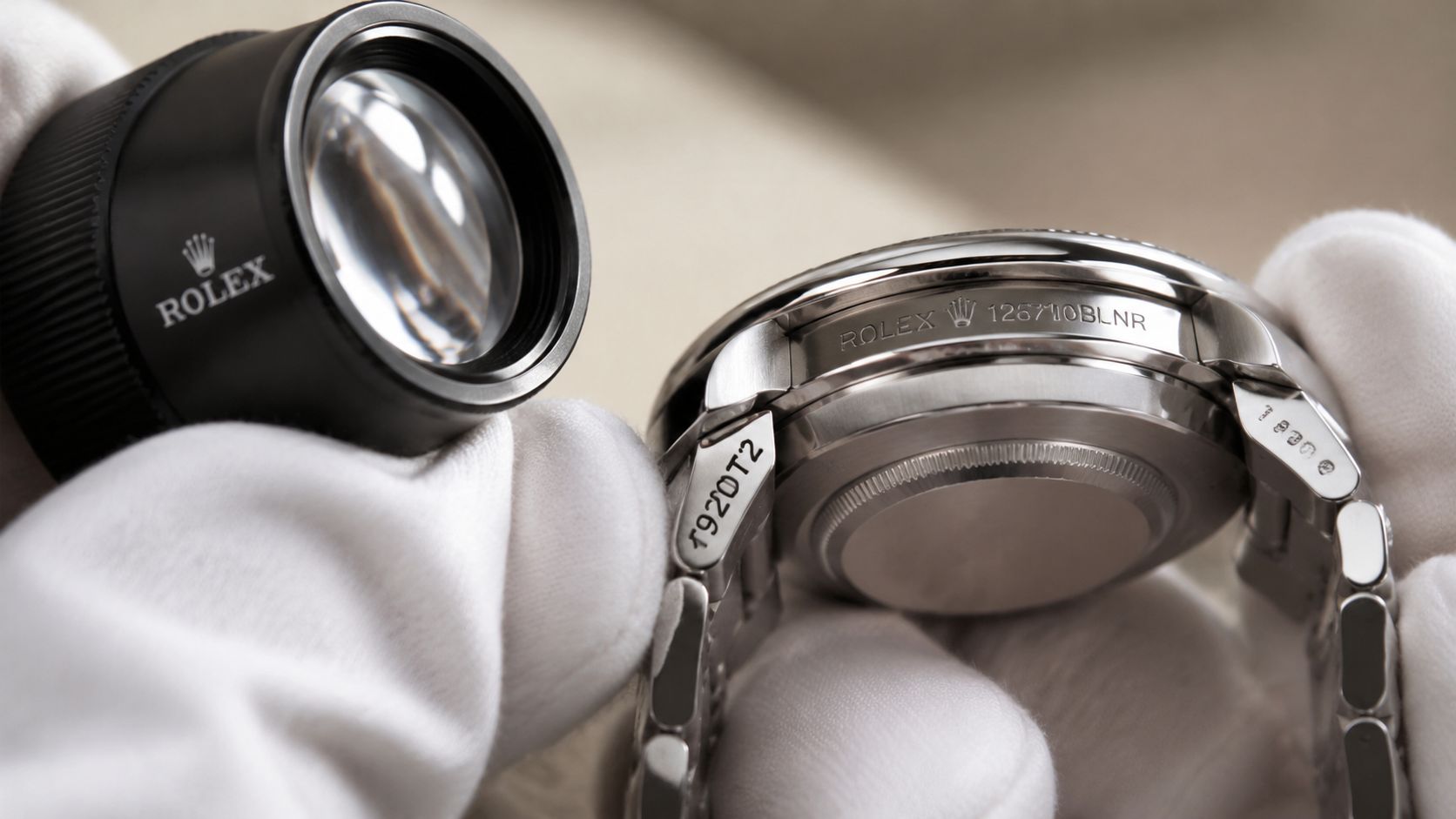
A key Rolex authentication marker is the 2005-era shift in serial-number placement. On watches made before 2005, the serial is typically engraved between the lugs at the 6 o'clock side, which usually means removing the bracelet to inspect it. On models from 2005 or newer, the serial may be engraved on the rehaut, the inner rim between the dial and crystal, according to Bob's Watches on Rolex serial numbers.
Searching in the wrong place often leads people to conclude the watch is suspicious. The location depends on the age of the watch. You need to identify the production era before you decide where to inspect.
For vintage pieces especially, the question isn't just whether a number exists. It's whether the watch's reference, age, and engraving style all line up. If you deal with older Rolex models, Antwerp Diamond's article on vintage watch valuation is a helpful companion because originality and production-era consistency strongly affect value.
What genuine engraving looks like
Rolex engravings should be clean, sharp, and precisely cut, not shallow or rough. That's one of the clearest tells in serial and model verification.
Use angled light and magnification. Genuine engraving should look deliberate and crisp, with edges that catch light cleanly. Counterfeit engraving often looks soft, sandy, or etched rather than cut.
Consider this practical approach:
Check | What you want to see on a genuine Rolex | Common counterfeit issue |
|---|---|---|
Serial location | Matches the watch's production era | Number placed where it shouldn't be |
Depth and edges | Crisp, precise cut | Shallow, fuzzy, or rough |
Letter and number spacing | Even and controlled | Irregular spacing |
Consistency with paperwork | Reference and watch details align | Mismatch or suspicious formatting |
This walk-through video can help you visualize where these identifiers sit and how collectors inspect them:
A matching serial by itself still doesn't prove authenticity. Modern replicas can copy visible numbers. What matters is whether the engraving quality, placement, model details, and overall watch all support the same story.
The Importance of Documentation and Provenance
A Rolex is authenticated physically, but it's judged commercially as a package. That means the watch, its documents, its service trail, and the ownership story all matter together.
What to review beyond box and papers
The most useful documents are the ones that help build continuity. Warranty card. Sales receipt. Service records. Previous appraisals. Any record that ties the watch to a believable timeline.
That doesn't mean every real Rolex will have a complete set. Many authentic watches have been separated from boxes and documents over time. But when paperwork is present, it should support the watch rather than complicate it.
Review the package with these questions in mind:
Do the watch details and documents align: The model, serial, and general configuration should make sense together.
Is there service history: Service records can help establish continuity and maintenance.
Does the ownership trail feel coherent: A watch with a plausible chain of custody inspires more confidence.
Are you relying too heavily on packaging: Box and booklet alone don't carry much weight without the watch itself checking out.
Why paperwork supports but does not prove authenticity
One of the biggest mistakes I see is treating papers as conclusive proof. They're not.
As Luxury Watches USA explains in its discussion of provenance and watch history, modern counterfeiters can create convincing papers, so the key question is not merely whether the documents look correct. It's whether the complete package of watch, service history, and ownership trail makes sense.
Good paperwork adds confidence. It does not override physical contradictions on the watch itself.
That matters a great deal if you want to sell your Rolex. Buyers and appraisers don't just ask whether papers exist. They ask whether the watch and the paper trail support each other. If you're preparing for resale, Antwerp Diamond has a useful guide on what sellers should know before they sell a Rolex watch.
In practice, provenance is higher on the evidence ladder than casual visual impressions, but lower than a skilled movement inspection. It supports the case. It doesn't close it.
When and How to Get Professional Rolex Authentication
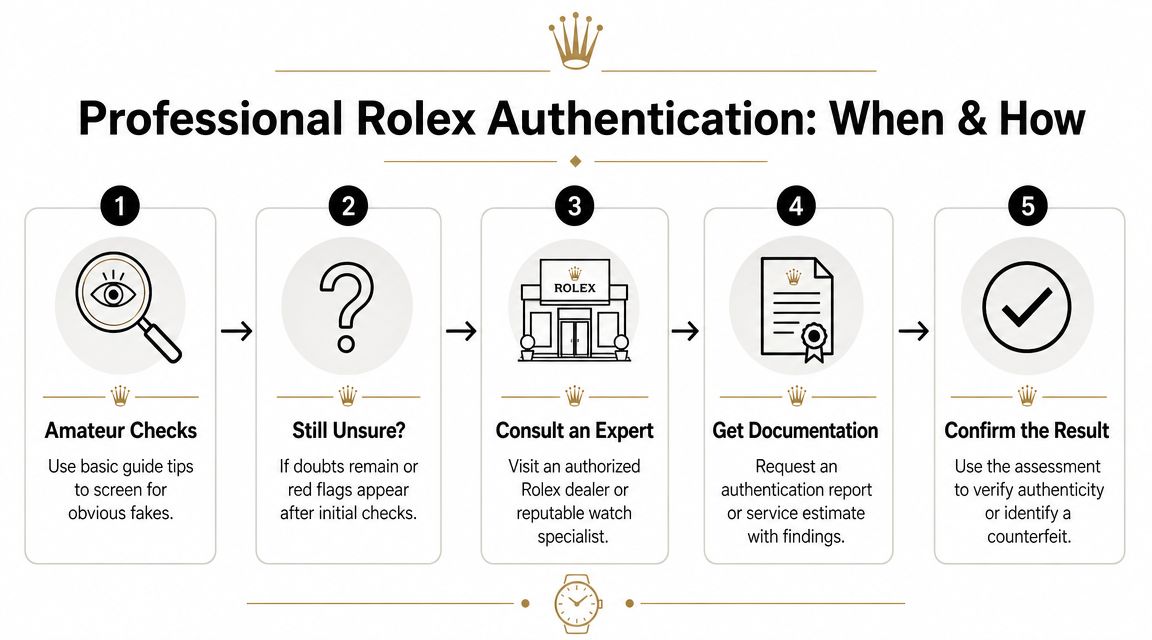
A watch comes across the counter with a clean dial, the right weight, a convincing bracelet, and paperwork that appears consistent. That is exactly the point where owner-level checks stop being enough. The watches that cause trouble are rarely the obvious fakes. They are the ones that pass the first screen and still leave unanswered questions.
When screening checks are no longer enough
Professional authentication makes sense when the watch sits in the middle ground. It does not show an obvious flaw, but it also does not earn full confidence from visual inspection alone.
That happens often with private-party purchases, inherited pieces, estate watches, and secondary-market Rolexes described as all original. It also happens with watches that have one or two details that do not line up cleanly with the reference, production period, or service history.
Get a qualified expert involved when any of these conditions apply:
You plan to sell the watch: Serious buyers want evidence that holds up under scrutiny.
You plan to borrow against it: Lenders care about authenticity, condition, and how readily the watch can be sold.
The watch presents mixed signals: Strong exterior quality can coexist with incorrect parts or an inconsistent movement.
There are known replacement or aftermarket parts: That shifts the question from simple authenticity to authenticity, originality, and value.
The source is uncertain: If the chain of custody is thin, the inspection matters more.
What an expert examines, and what counts as proof
The hierarchy of evidence matters here. A clean rehaut, sharp printing, and the right case proportions are screening tools. They help identify weak counterfeits. They do not settle difficult cases.
Conclusive work usually requires opening the watch and inspecting the movement, case construction, and inside markings with the proper tools. That is where a trained watchmaker or appraiser can confirm whether the calibre architecture matches the reference, whether the finishing and engravings are consistent with Rolex production, and whether the watch shows signs of being assembled from mixed parts.
A serious authentication is not based on one tell. It is a layered assessment of the whole watch:
External construction: Case lines, bezel action, crown operation, bracelet fit, clasp quality, dial execution, and crystal details.
Reference consistency: Whether the visible configuration makes sense for that model and production period.
Internal authenticity: Whether the movement, case interior, and technical construction match what should be inside that reference.
Originality and service history: Whether parts are factory-correct, later service replacements, or non-Rolex substitutes.
Market usability: Whether the watch can be represented confidently for resale, appraisal, insurance, or collateral purposes.
The difference matters. A watch can be authentic Rolex and still have replacement hands, an aftermarket bezel, or a service dial that changes its value. A proper examination separates “real” from “all original,” and those are not the same conclusion.
The right question is whether the entire watch remains consistent under expert inspection, inside and out.
Opening the case yourself is still a bad gamble. The risks are simple. Scratched case backs, damaged gaskets, slipped tools, compromised water resistance, and avoidable doubt about condition.
How to choose the right authentication path
Start with the purpose. If you need confidence before a purchase, use an independent watchmaker or appraiser with Rolex experience. If you need documentation for resale, lending, estate work, or insurance, choose someone who can examine the watch in person and explain both authenticity and originality in plain terms.
Ask direct questions before handing over the watch. Will they inspect the movement if needed? Can they identify service versus aftermarket parts? Will they give a written appraisal or authentication record if the situation calls for it? A vague opinion is worth much less than a documented inspection.
If you are comparing options, a local watch appraisal service in NYC shows the kind of authentication framework that matters in any market. The city changes. The process does not. A credible review ties the physical watch to its reference, condition, originality, and commercial reality.
Why this matters in Atlanta and the Georgia resale market
In Atlanta, including Buckhead, Midtown Atlanta, Sandy Springs, Brookhaven, Roswell, Alpharetta, and the broader Georgia market, many Rolex deals happen outside authorized retail channels. That increases the importance of independent authentication.
A seller asking for a strong price needs more than confidence. A buyer putting up serious money needs more than a reassuring story. Professional review gives both sides a basis for decision, especially when the watch is expensive, older, recently serviced, or described as untouched.
Home checks help screen out obvious problems. Professional authentication is what turns a plausible Rolex into a supported conclusion.
Frequently Asked Questions About Rolex Authenticity
Does missing box and papers mean a Rolex is fake
No. A real Rolex can exist without its original box and papers.
Missing accessories may affect buyer confidence and resale value, but they don't automatically say anything final about authenticity. The watch itself still has to be judged on its physical characteristics, identifiers, and overall credibility.
Can a real Rolex have non-original parts
Yes. A Rolex can be genuine and still contain replacement or aftermarket parts.
That doesn't necessarily make the entire watch fake, but it can affect value, collectibility, serviceability, and how comfortable a buyer feels. In the trade, these watches often require more careful explanation because originality matters almost as much as authenticity in many resale situations.
Should you open the case yourself
No. That's not a safe shortcut.
Rolex cases require the right tools and handling. If you open one without proper equipment and experience, you risk scratching the case, damaging the gasket, compromising water resistance, or harming the movement. If the goal is certainty, self-opening usually creates more problems than it solves.
What matters most if you plan to sell or borrow against a Rolex
The strongest package is a watch that checks out physically, has believable provenance, and has been reviewed by a qualified expert.
If you're selling, the buyer wants confidence. If you're using the watch as collateral, the evaluator wants marketable authenticity and condition. In both cases, the hierarchy of evidence matters. Surface checks are the first step. Identifiers and provenance add support. Expert authentication carries the most weight.
Is a smooth seconds hand enough to prove a Rolex is real
No. It's helpful, but it isn't conclusive.
A smooth sweep is a good sign because a genuine mechanical Rolex should not behave like a cheap quartz watch. But modern counterfeits can imitate that look well enough to fool non-specialists. Treat it as a screening result, not a final verdict.
If the serial number matches the paperwork, is that enough
No. Matching numbers help, but they don't close the case.
The serial still needs to be in the correct location for the watch's era, engraved with the right quality, and supported by the rest of the watch. A fake can carry copied or reused visible identifiers. The quality and context of those identifiers matter as much as the numbers themselves.
What is the most useful owner-level tool for checking a Rolex
A loupe or strong magnifier is probably the most useful simple tool because it lets you inspect the date magnification, dial printing, engraving quality, and alignment details that a casual glance misses.
That said, even a good loupe has limits. It can help you screen. It can't replace internal movement inspection by a qualified professional.
If you want an experienced, low-pressure opinion on a Rolex before you sell, appraise, or borrow against it, Antwerp Diamond offers confidential evaluations for luxury watches and other high-value assets. You can start with an online review or arrange an in-person appointment if you're in Atlanta, Buckhead, Roswell, or the wider Georgia market.