
Finding used luxury watches for sale is an excellent way to acquire iconic timepieces, and the market is large enough to support serious buying and selling activity: the global pre-owned luxury watches market was valued at USD 28.77 billion in 2024 and is projected to reach USD 69.22 billion by 2032. Success, however, depends on three things buyers often underestimate: authentication, trusted sourcing, and disciplined condition assessment.
That matters because pre-owned watches aren't a side category anymore. They sit inside a substantial, expanding market where buyers pursue Rolex, Cartier, Patek Philippe, and Audemars Piguet for different reasons, including access to discontinued references, lower entry cost than buying new, and stronger resale logic on the right models. If you're shopping in Atlanta, Buckhead, Sandy Springs, Alpharetta, Roswell, Brookhaven, Midtown Atlanta, or elsewhere in Georgia, the same rules apply locally as they do globally: buy the watch, the condition, and the paper trail.
Table of Contents
Understanding the Pre-Owned Luxury Watch Market
The pre-owned watch market works because certain watches don't behave like ordinary consumer goods. Buyers aren't just replacing a used item. They're often chasing a known reference, a discontinued dial, a production era, or a brand with established resale demand.
The scale confirms that this isn't a fringe space. The global pre-owned luxury watches market was valued at USD 28.77 billion in 2024 and is projected to reach USD 69.22 billion by 2032, with an 11.6% CAGR, according to Data Bridge market research on pre-owned luxury watches.
Why this market behaves differently from ordinary resale
A used luxury watch can be rational to buy for reasons that have nothing to do with bargain hunting.
Some buyers want a model that's no longer made. Others want to avoid the uncertainty of boutique availability. Many want a watch whose market value is easier to understand because the same references trade repeatedly in public and dealer channels.
Practical rule: A healthy pre-owned market needs repeatable references, informed buyers, and enough transactions for price discovery. Watches from established maisons usually check those boxes better than fashion-driven pieces.
That also explains why insurance and risk management matter once values rise. For owners reviewing protection concerns around collectible timepieces, this overview of high-value watches offers a useful starting point on the category itself.
Why certain brands stay liquid
Not every luxury watch is equally easy to resell. Brand recognition, reference consistency, serviceability, and collector familiarity all affect how quickly buyers understand what they're looking at.
Rolex is the clearest example. In one market analysis of pre-owned platforms, Rolex accounted for 36% of all sales on Bezel, a reminder that strong brand recognition usually brings faster turnover and clearer pricing than less-established names in resale. If you're weighing the ownership side as well as the buying side, Antwerp Diamond's article on whether watches are good investments is a useful companion read.
A practical takeaway follows from that dominance. If two watches have similar retail positioning, the one with broader global recognition usually has the easier resale path. That's especially true for iconic families such as the Rolex Submariner and Datejust, Cartier Santos, Patek Philippe Nautilus, or Audemars Piguet Royal Oak.
Where to Find Reputable Used Luxury Watches
The source changes the risk. The watch may be identical on paper, but the buying experience can differ sharply depending on whether you're purchasing through a certified program, an independent dealer, a marketplace, or an auction house.

How the main buying channels compare
Here's the short version.
Buying channel | Usually works best for | Main advantage | Main trade-off |
|---|---|---|---|
Official certified pre-owned | Buyers who want the most controlled process | Authentication, inspection, warranty structure | Typically less pricing flexibility |
Independent dealers and jewelers | Buyers who want guidance and inventory access | Human review, reputation, in-person assessment | Quality varies by dealer |
Online marketplaces | Buyers hunting for specific references | Broad selection | You must control the verification process |
Auction houses | Buyers seeking unusual or collector-driven pieces | Access to uncommon inventory | Final price and condition expectations can be less predictable |
Certified pre-owned programs appeal to buyers who want process discipline. That's especially useful on expensive references where service history, parts originality, and post-sale support matter as much as cosmetics.
Independent dealers can be the best middle ground when the dealer knows watches, not just luxury goods broadly. A knowledgeable local jeweler or watch buyer can walk you through condition, prior polishing, bracelet stretch, replacement parts, and whether the asking price makes sense for that exact example. For readers comparing remote versus local selling channels, Antwerp Diamond's guide to where to sell jewelry online covers some of the same trust questions from the transaction side.
When local inspection matters
In Atlanta and nearby areas such as Buckhead, Roswell, Alpharetta, Sandy Springs, and Brookhaven, in-person inspection still has real value. You can check case lines, clasp wear, bracelet feel, dial quality, and whether the watch sits correctly on the wrist. Those things don't always show up in listing photos.
Marketplace listings can still be useful, but they demand more discipline from the buyer. A polished listing isn't authentication. Strong demand for household names also attracts more aggressive sellers, especially on highly recognizable Rolex references.
Buy the seller before you buy the watch. A reputable source should be willing to discuss condition in plain language, disclose service work, and explain what is and isn't original.
Auction houses sit in a different category. They're often useful when you're looking for vintage or unusual inventory, but they suit buyers who already understand reference risk, restoration risk, and how bidding psychology can push a watch beyond sensible pricing.
How to Verify Authenticity and Condition
A serious watch inspection starts with what you can see, then moves to what only a trained eye or a bench inspection can confirm. That sequence matters because many problems show up before the caseback ever comes off.
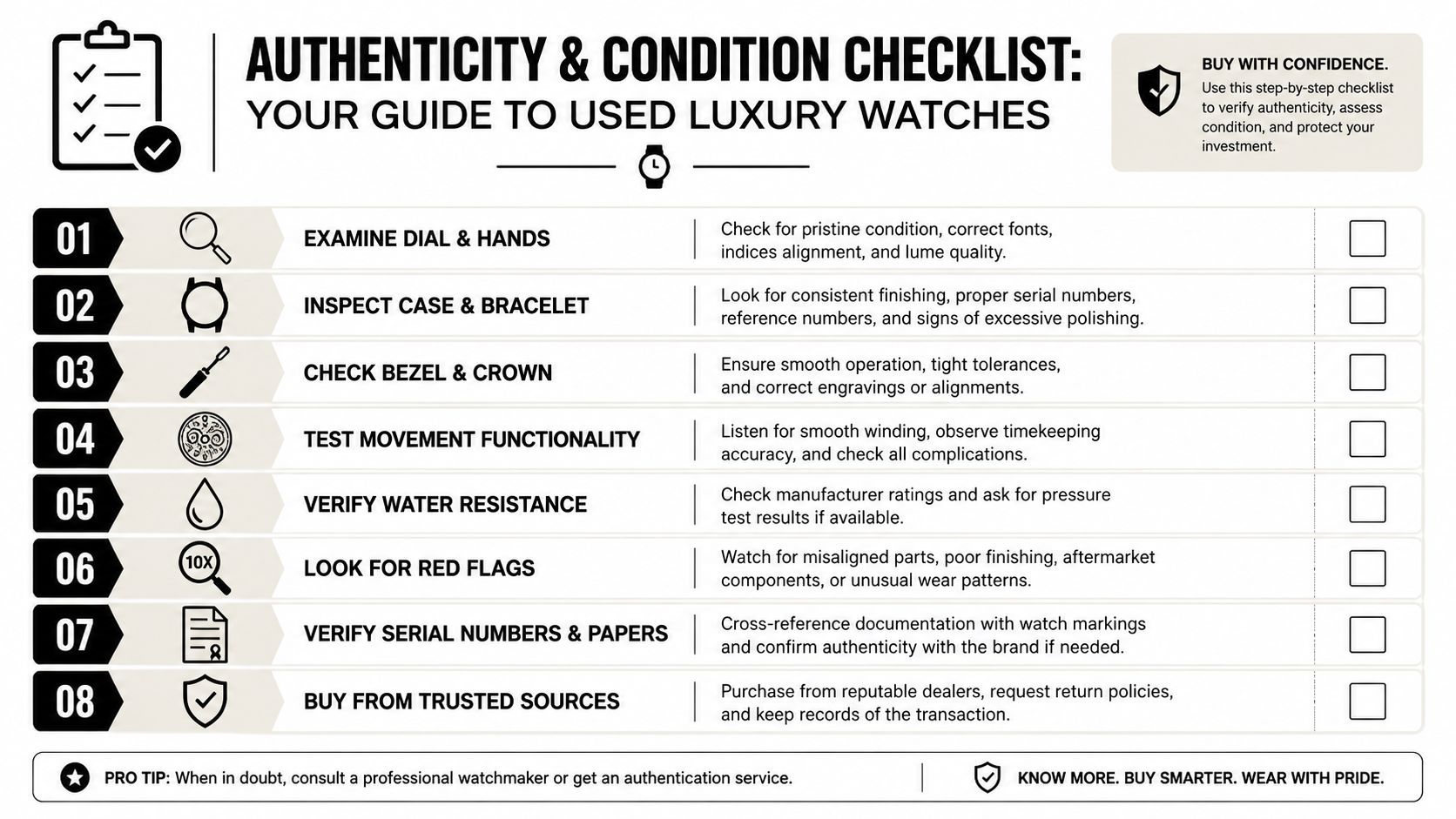
Early in your review, use this checklist graphic as a practical guide.
What you can inspect yourself
Start with the dial and hands. Printing should be sharp, consistent, and clean under magnification. Markers should align properly, and lume should make sense for the model and age.
Then move to the case and bracelet.
Check case geometry: Over-polishing softens edges, rounds bevels, and can erase the character that collectors pay for.
Inspect the bracelet: Excessive stretch, mismatched links, or a loose clasp can point to heavy wear or incomplete originality.
Read the details closely: Reference and serial engravings should appear crisp and appropriate for the brand and era.
Test the functions: Date change, chronograph reset, bezel action, crown threading, and winding feel all tell you something.
This video gives a useful visual framework for what experienced buyers look for during inspection.
What needs professional verification
Some issues can't be settled from photos or a countertop look. Movement condition, moisture damage, non-original components inside the case, and improper servicing often require tools and experience.
Reputable resellers emphasize warranty-backed inspection and genuine-part servicing because improper servicing or replacement of key components can lower value and compromise long-term reliability. Certified pre-owned programs reflect that with multi-point inspections, as outlined by Tourneau's certified pre-owned watch process.
A buyer should also separate authenticity from originality. A watch can be genuine but still contain service parts, refinished surfaces, or swapped components that affect value. That's one reason many buyers look up guidance on how to know if your Rolex is real before committing to a purchase.
If the watch is expensive enough that a mistake will bother you for years, pay for professional verification before the deal closes.
What Determines the Price of a Used Luxury Watch
A used watch isn't priced by brand alone. Two examples of the same reference can trade very differently because the market prices condition, completeness, originality, and buyer confidence, not just the name on the dial.

The value drivers that actually move price
These factors usually matter most:
Factor | Why it affects price |
|---|---|
Brand and reference | Some models have deeper buyer pools and more transparent resale pricing |
Physical condition | Case shape, dial quality, bracelet wear, and movement health influence desirability |
Originality | Correct dial, hands, bezel, bracelet, and parts matter, especially on collectible references |
Completeness | Box, warranty card, manuals, tags, and receipts can reduce buyer hesitation |
Service history | Good servicing can support confidence, but poor servicing can hurt value |
One of the most misunderstood price drivers is box and papers. The completeness of a full set materially affects resale value because original documents help prove provenance and reduce authentication uncertainty. Guides on pre-owned watches note that full sets can increase price significantly, as explained in this overview of pre-owned luxury watch documentation and provenance.
How buyers and sellers should read a listing
A listing price isn't the same as a market-clearing price. Buyers should ask what supports the number. Sellers should ask what weakens it.
Look for these signals:
Full set versus watch only: Missing papers don't automatically mean a fake, but they do change buyer psychology and resale ease.
Unpolished versus heavily polished: Sharp lugs and original lines usually bring more confidence than shiny refinished metal.
Recent service with genuine parts: Useful when documented. Less useful when described vaguely.
Model-specific demand: A popular steel sports model behaves differently from a less-followed dress reference.
If you're valuing an older piece, especially one with age-related wear or uncertain accessories, Antwerp Diamond's guide to vintage watch valuation helps frame how collectors think about originality versus presentation.
A fair price sits where evidence supports the ask. If the seller can't explain the evidence, the price is just a wish.
Spotting Red Flags and Common Scams
The watch itself can be authentic and the transaction can still be unsafe. That's where many buyers slip. They focus on fonts, serials, and bracelets, but ignore seller behavior and payment structure.

Seller behavior that should make you pause
The secondary luxury market is growing faster than the new market, and resale value has become a key purchase criterion. That strong demand also attracts scammers, which is why transaction safety matters as much as product knowledge, as noted in this discussion of the secondhand luxury market and resale risk.
Common red flags include:
Stock or recycled photos: Ask for fresh images with the current date or a specific pose of the watch.
Artificial urgency: "Several buyers are waiting" is often used to stop you from checking details.
Refusal to discuss service or provenance: Honest sellers usually know what they have and what they don't.
Push for irreversible payment methods: That's a transaction warning, not a minor inconvenience.
How to structure a safer transaction
Safer deals usually share a few habits.
Keep communication documented: Messages inside a platform or by email create a record.
Use protected payment channels: Choose methods with clear dispute procedures when possible.
Insist on inspection rights: For expensive pieces, an escrow-style process or dealer-mediated verification can be worth the extra effort.
Meet in controlled settings: If buying locally in Midtown Atlanta, Buckhead, or Sandy Springs, use a professional office, jewelry store, or other secure commercial location.
A low price doesn't compensate for a bad process. If the transaction feels rushed, opaque, or oddly complicated, walk away.
For Sellers Considering Trade-In or Consignment
Selling privately can work, but it also means you handle pricing, photos, buyer screening, payment risk, and post-sale disputes. For many owners, especially with Rolex, Cartier, Patek Philippe, or Audemars Piguet, that's more exposure than they want.
When a direct sale makes more sense
A direct sale to a professional buyer fits sellers who value speed, privacy, and a clean transaction. You get an evaluation, a market-based offer, and a defined handoff instead of weeks of messages from unqualified buyers.
That can be particularly useful in Atlanta-area neighborhoods where convenience matters. A seller in Buckhead, Alpharetta, Roswell, or Brookhaven may prefer a private appointment over meeting strangers or shipping a watch to an unknown buyer. Antwerp Diamond Store is one local option for in-person evaluations and remote submissions, alongside other established dealer channels, and its guide to online watch buyers is helpful if you're comparing routes.
When consignment may be worth the wait
Consignment can make sense when the watch is niche, collectible, or likely to benefit from patient marketing. The trade-off is time. You'll usually wait longer, and final proceeds depend on when the right buyer appears.
For sellers trying to understand broader online resale dynamics before choosing a path, Suby's jewelry selling guide is a useful general read on listing strategy, buyer trust, and channel selection. The watch-specific version of that decision is simple: if you want certainty and discretion, direct sale often wins. If maximizing upside matters more than speed, consignment may be worth considering.
Frequently Asked Questions About Buying Used Watches
Short answers buyers usually need
Is it safe to buy a luxury watch without box and papers?
Yes, sometimes. Missing box and papers don't automatically mean the watch is fake. But you should treat the lack of documentation as a value and risk issue, then tighten your inspection standards.
What is a Frankenwatch?
It's a watch assembled from parts that didn't originally belong together for that exact configuration. It may contain genuine brand parts and still be undesirable because originality affects collectibility and resale.
Is water-resistant the same as waterproof?
No. Buyers should assume a pre-owned watch needs testing before relying on any stated water resistance, especially if service history is unclear or the watch is older.
Should I budget for service after purchase?
Possibly. If the service record is vague, incomplete, or old, assume the watch may need attention sooner than the seller suggests.
Are local dealers better than online sellers?
Not always, but local inspection gives you more control. Being able to handle the watch in person in Atlanta, Roswell, or Sandy Springs can reveal issues that photos miss.
What should I ask before sending a watch by mail?
Ask about insurance, signature handling, documentation, packing expectations, and what happens if the offer changes after inspection. If you're comparing shipping methods for a high-value item, this express courier intl guide is a practical reference for understanding shipping logistics more broadly.
What's the smartest first step if I'm undecided between buying, trading, or selling?
Get an informed evaluation of the specific watch. Most bad decisions in this market start with assumptions about value rather than facts about the actual piece.
If you're in Atlanta or anywhere in Georgia and want a clear, professional opinion on a pre-owned watch, Antwerp Diamond is a practical place to start. Bring in the watch, its box and papers if you have them, and any service records, and get a no-pressure evaluation that helps you decide whether to buy, sell, trade in, or understand what you own.