

14K Gold Price per Gram Today: Start With Melt Value
The 14K gold price per gram today is about $72.62, based on a quoted rate for October 31, 2026. That is an estimated melt value, not a guaranteed cash offer. Check the latest spot price before you sell, since gold rates can change throughout the day.
To estimate your jewelry's melt value, multiply its gold-only weight in grams by the current 14K price per gram. For example, a 10-gram 14K chain would have an estimated melt value of $726.20 at this rate. A buyer's offer may differ after the item's weight and purity are verified.

Live 14K Gold Price per Gram Today and Current Market Rates
To evaluate any piece of scrap gold, estate jewelry, or bullion, understanding how the underlying commodity market functions is essential. Gold trades virtually 24 hours a day across major international exchanges in New York, London, Tokyo, and Zurich. When trading desks quote the spot price of gold, they are referencing raw, pure 24K gold bullion.
Because 14K jewelry contains pure gold alloyed with other metals to boost durability, its value is calculated as a direct percentage of that pure spot price. In late October 2026, spot prices for pure gold hovered between $3,874 and $4,045 per troy ounce. Tracking a Live 24-Hour Spot Gold Chart helps you see these movements in real time.
Below is an overview of how live prices translate across different purities per gram:
Karat Purity | Gold Content (%) | Millesimal Fineness | Estimated Price per Gram (USD) |
|---|---|---|---|
10K | 41.67% | 417 | $51.88 |
14K | 58.33% | 585 | $72.62 |
18K | 75.00% | 750 | $93.37 |
22K | 91.67% | 916 | $114.12 |
24K (Pure) | 99.99% | 999 | $124.50 |
Tracking the specific 14k gold cost per gram gives you a reliable baseline to evaluate your pieces accurately.
What Is the 14K Gold Price per Gram Today?
The baseline spot melt rate for 14K gold per gram fluctuates within the $72.00 to $76.20 range depending on the specific trading session in late October 2026. For instance, rates logged at $76.10 on October 28, $76.19 on October 27, and settled around $72.62 to $72.68 toward the end of the month.
Because 14K contains 14 parts pure gold out of 24 total parts, it possesses an exact pure gold purity of 58.33%. When you evaluate your pieces against market updates like our 14k Gold Price Guide 2026, you can easily determine whether current rates favor holding or selling your items.
How Troy Ounces Define Gram Pricing
If you put a gold necklace on a standard kitchen scale, you might encounter a confusing discrepancy. Everyday items like flour or postal packages are weighed in avoirdupois ounces, where one ounce equals approximately 28.35 grams.
Precious metals, however, are traded exclusively using the troy ounce, an ancient standard originating in Troyes, France.
1 Troy Ounce = 31.1035 Grams
1 Avoirdupois Ounce = 28.3495 Grams
A troy ounce is roughly 9.7% heavier than a standard grocery store ounce. When global commodity exchanges report that pure gold is $3,874.40 per troy ounce, financial systems calculate the per-gram price by dividing the spot price by 31.1035:
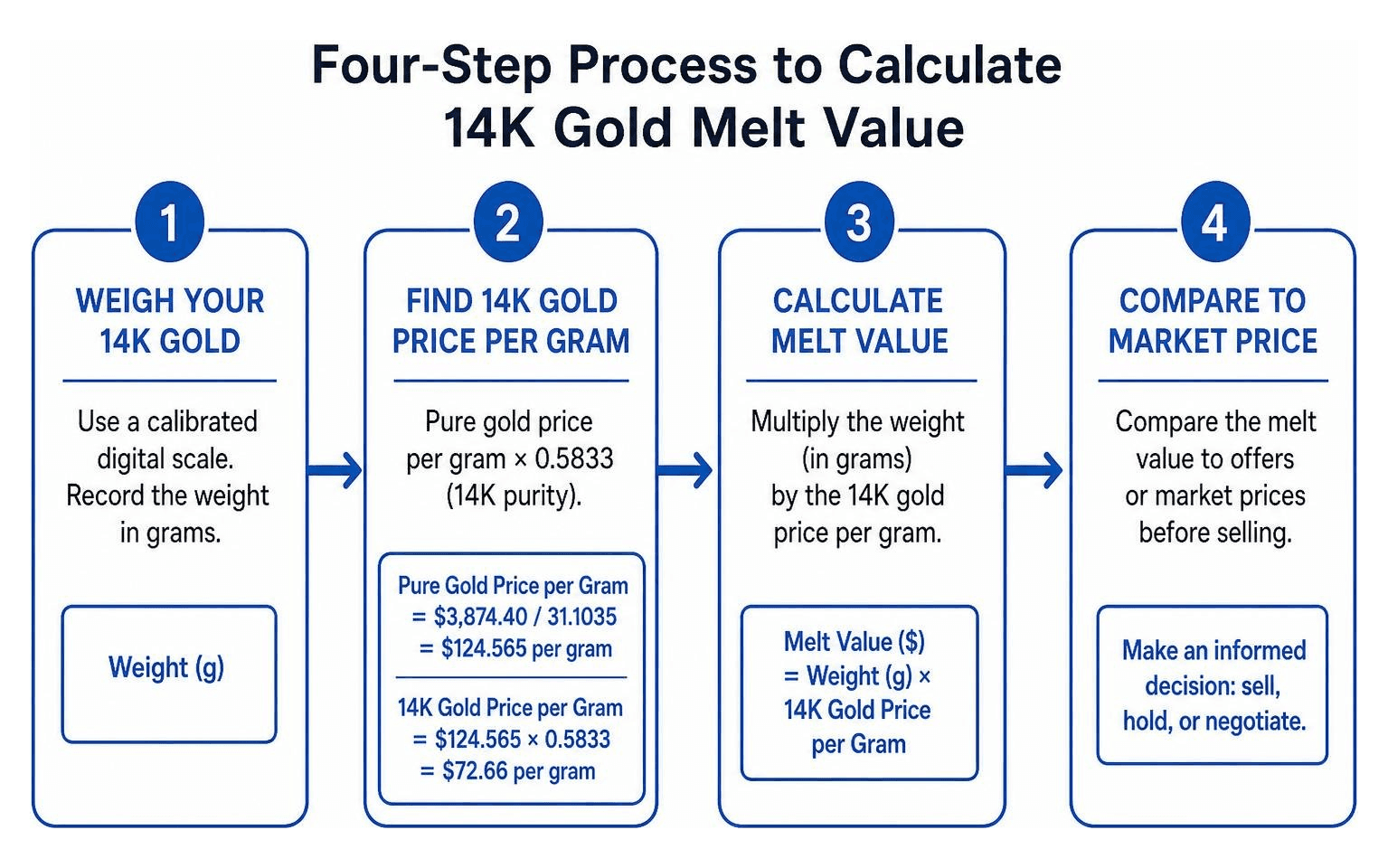
Pure Gold Price per Gram = $3,874.40 / 31.1035 = $124.565 per gram
14K Gold Price per Gram = $124.565 × 0.5833 = $72.66 per gram
Understanding this distinction ensures you never accidentally shortchange yourself by using the wrong conversion factor.
How to Calculate 14K Gold Melt Value Step-by-Step
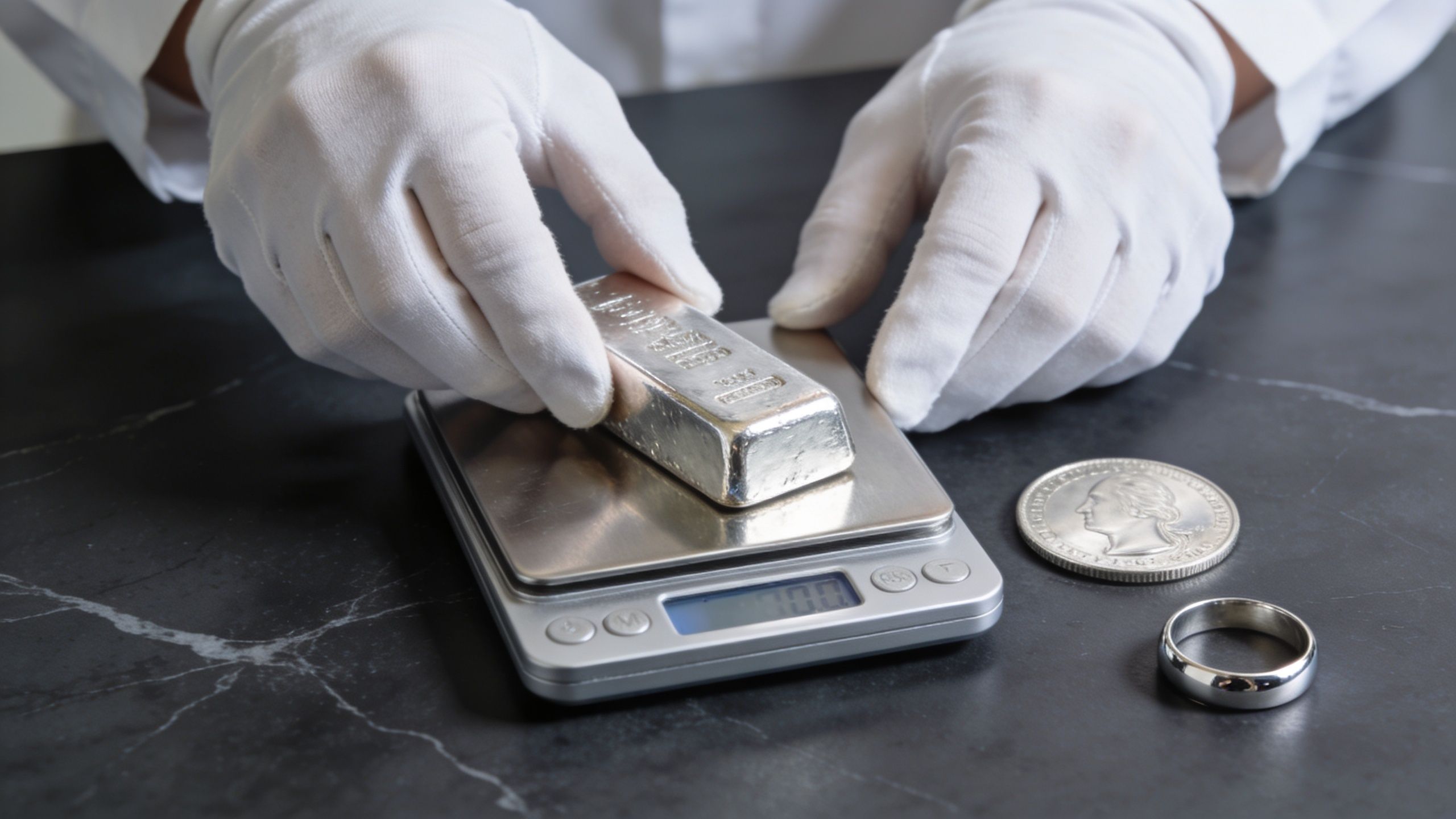
Calculating the melt value of your 14K jewelry at home is straightforward once you have the right tools. All you need is a calibrated digital jewelry scale that measures in grams (or pennyweights) and the current gold spot price. Learning how to determine gold purity ensures that your calculations rest on verified metal grades rather than guesswork.
Understanding 14K Purity and the 585 Hallmark
Pure 24K gold is exceptionally soft, malleable, and prone to bending or scratching. To make gold suitable for daily wear in engagement rings, bracelets, and chains, jewelers melt pure gold alongside strengthening alloy metals such as copper, silver, nickel, or zinc.
14K gold represents 14 parts pure gold and 10 parts alloyed metals (14 divided by 24), yielding 58.33% purity. In European jewelry manufacturing and modern hallmarking, this is expressed in millesimal fineness as 585 (representing 585 parts per thousand, or 58.5%).
Whether stamped "14K", "14Kt", or "585", the intrinsic gold content remains the same. When deciding between different jewelry purities, reviewing the difference between 14k and 18k gold can help you weigh durability against metal value.
The Formula for 14K Gold Scrap Valuation
To find the intrinsic scrap melt value of any 14K item, use this plain formula:
Melt Value = Total Gold Weight in Grams × Purity Factor (0.5833) × Live 24K Gold Price per Gram
Alternatively, if you already know the live 14K per-gram rate:
Melt Value = Total Gold Weight in Grams × Live 14K Gold Price per Gram
Let's walk through three practical examples:
Simple 14K Wedding Band (5 grams): 5 grams × $72.62 = $363.10 melt value
Heavy 14K Cuban Link Chain (45 grams): 45 grams × $72.62 = $3,267.90 melt value
Estate 14K Diamond Ring: If a ring weighs 7.5 grams in total on the scale, but contains 1.5 grams of diamonds and center stones, you must subtract the non-gold elements first. The actual gold weight is 6.0 grams: 6.0 grams × $72.62 = $435.72 gold melt value
When evaluating gemstone-heavy jewelry, calculating your 14 karat gold ring with diamonds value requires appraising the stones and the gold mount separately to capture total resale worth.
Understanding Daily Market Drivers and Price Fluctuations

Gold rates are dynamic, responding continuously to macroeconomic data, central bank activity, and international currency shifts. Tracking International Gold Rates in VND or European spot tables highlights how currency values impact the cost of precious metals across the globe.
Factors That Influence the 14K Gold Price per Gram Today
Several core economic forces dictate why the 14k gold price gram today can shift higher or lower throughout any given trading week:
Federal Reserve Monetary Policy & Interest Rates: Gold yields no dividend or interest. When interest rates rise, yields on cash and bonds increase, often applying downward pressure on precious metals. Conversely, falling rates or anticipated rate cuts tend to drive investors toward physical gold.
US Dollar Index (DXY) Strength: Gold is universally dollar-denominated. When the dollar weakens against foreign currencies, buying gold becomes less expensive for international investors, driving global demand and pushing the spot price upward.
Safe-Haven and Geopolitical Demand: During periods of economic uncertainty, banking sector volatility, or geopolitical conflict, institutional funds and private investors allocate capital into gold as an enduring store of wealth.
Central Bank Reserves: Major central banks worldwide actively accumulate bullion reserves to diversify away from fiat currency risks, providing steady institutional support for baseline market pricing.
Karat Comparison: 10K vs 14K vs 18K Price Shifts
Because each karat grade contains a distinct proportion of pure gold, price changes impact each metal tier proportionally.
10K Gold (41.7% Pure): Highly durable and resistant to scratching due to its higher copper and silver content, making it popular for class rings and budget-conscious jewelry. If pure gold rises by $10 per gram, 10K gains $4.17 per gram. Our 10k gold diamond ring guide explores how this alloy performs over decades of wear.
14K Gold (58.3% Pure): The industry standard for fine jewelry in North America, striking the ideal equilibrium between rich gold color and structural strength.
18K Gold (75.0% Pure): Features a deeper, warmer yellow hue favored by luxury fashion houses. While significantly more valuable per gram, it is softer and more prone to surface scuffs under heavy daily use.
Spot Price vs. Real Resale Value: What Sellers Actually Receive
One of the most common surprises sellers face is discovering that no buyer pays 100% of the live spot melt price for scrap jewelry. Spot price is the theoretical wholesale valuation for raw, refined metal on commodity trading floors.
Turning an old gold ring back into a pure investment-grade bullion bar involves real-world logistical steps:
Assaying & Testing: Verifying exact elemental composition.
Refining & Smelting: Burning off alloy metals and chemical separation.
Smelting Loss: Accounting for minor metal evaporation during high-heat processing.
Buyer Margins: Covering business overhead, testing equipment, and resale carrying costs.
Learning the best way to sell gold jewelry helps you identify buyers who offer transparent pricing close to true market value rather than steep discounts.
What Is a Fair Scrap Payout from Gold Buyers?
Payouts vary depending on where you bring your items:
Fair Gold Buyer Payouts: Reputable high-end estate buyers, refiners, and professional gold specialists typically offer between 70% and 90% of full melt value for scrap metal. If 14K spot melt is $72.62 per gram, a fair cash payout generally lands between $50.80 and $65.35 per gram.
Pawn Shops and Generalist Buyers: Because pawn operations carry higher overhead and retail carrying costs, offers often drop to 40% to 60% of melt value (roughly $29.00 to $43.50 per gram).
When you choose to sell gold jewelry for cash, asking for an itemized breakdown of weight, verified purity, and payout percentage ensures total transparency.
Maximizing Cash Payouts Before You Sell
To secure the highest possible payout for your 14K gold, follow these practical steps before scheduling an evaluation:
Sort Your Jewelry by Hallmark: Keep your 10K, 14K, and 18K items separated. If mixed scrap is weighed together, unscrupulous buyers may calculate the entire lot at the lowest karat grade.
Weigh Your Items in Grams at Home: Record the baseline weight of your pieces before walking into an appointment so you know your baseline expectations.
Remove Non-Gold Components When Feasible: If an old chain has a heavy steel safety pin or magnetic clasp, remove it so it does not distort your precious metal weight.
Identify Fine Designer Brands: If your 14K piece comes from a notable luxury designer or features certified natural diamonds, sell it on its aesthetic and brand merits rather than melting it down as scrap.
Select Private Luxury Specialists: Searching for reputable gold buyers near me that operate by appointment ensures a secure, private, and professional appraisal process.
Frequently Asked Questions About 14K Gold Prices
Why is gold weighed in troy ounces instead of standard ounces?
The troy ounce (31.1035 grams) has been the standardized unit of measurement across international precious metals markets for centuries. Established during medieval European trade fairs, this standard creates uniform trading terms across global exchanges in London, New York, and Hong Kong, preventing the confusion that would arise from regional variations in commercial avoirdupois ounces.
What does 585 mean on my 14K gold jewelry?
The number 585 stamped on a piece of jewelry indicates its millesimal fineness. It signifies that the item consists of 58.5% pure gold (585 parts per 1,000) and 41.5% alloy metals. This is the official European stamping standard equivalent to the North American 14K (14 karat) designation.
How much will a gold buyer pay for 14K gold per gram?
A professional gold buyer will typically pay between 70% and 90% of the live melt value for 14K gold scrap. At a spot melt rate of $72.62 per gram, you can expect a competitive payout ranging between $50.80 and $65.35 per gram, depending on the total volume, testing methods, and whether the item can be resold as finished estate jewelry rather than refined as scrap.
Conclusion
Understanding the 14K gold melt value per gram allows you to navigate the precious metals market with complete confidence. Whether you are liquidating broken chains, appraising estate jewelry, or monitoring your personal portfolio, knowing how to convert troy ounces, identify purity stamps, and calculate melt formulas ensures you always receive true value for your assets.
At Antwerp Diamonds, we provide private, appointment-only evaluations for your fine jewelry, luxury watches, and designer goods in our Atlanta, GA offices. We believe in complete transparency, providing free appraisals based on real-time market data with immediate cash payouts and zero hidden fees. If you are ready to evaluate your estate pieces, consult live 14k gold pricing rates and book your private consultation with our appraisal team today.