10K Gold Diamond Ring Price: A Quick 2026 Guide
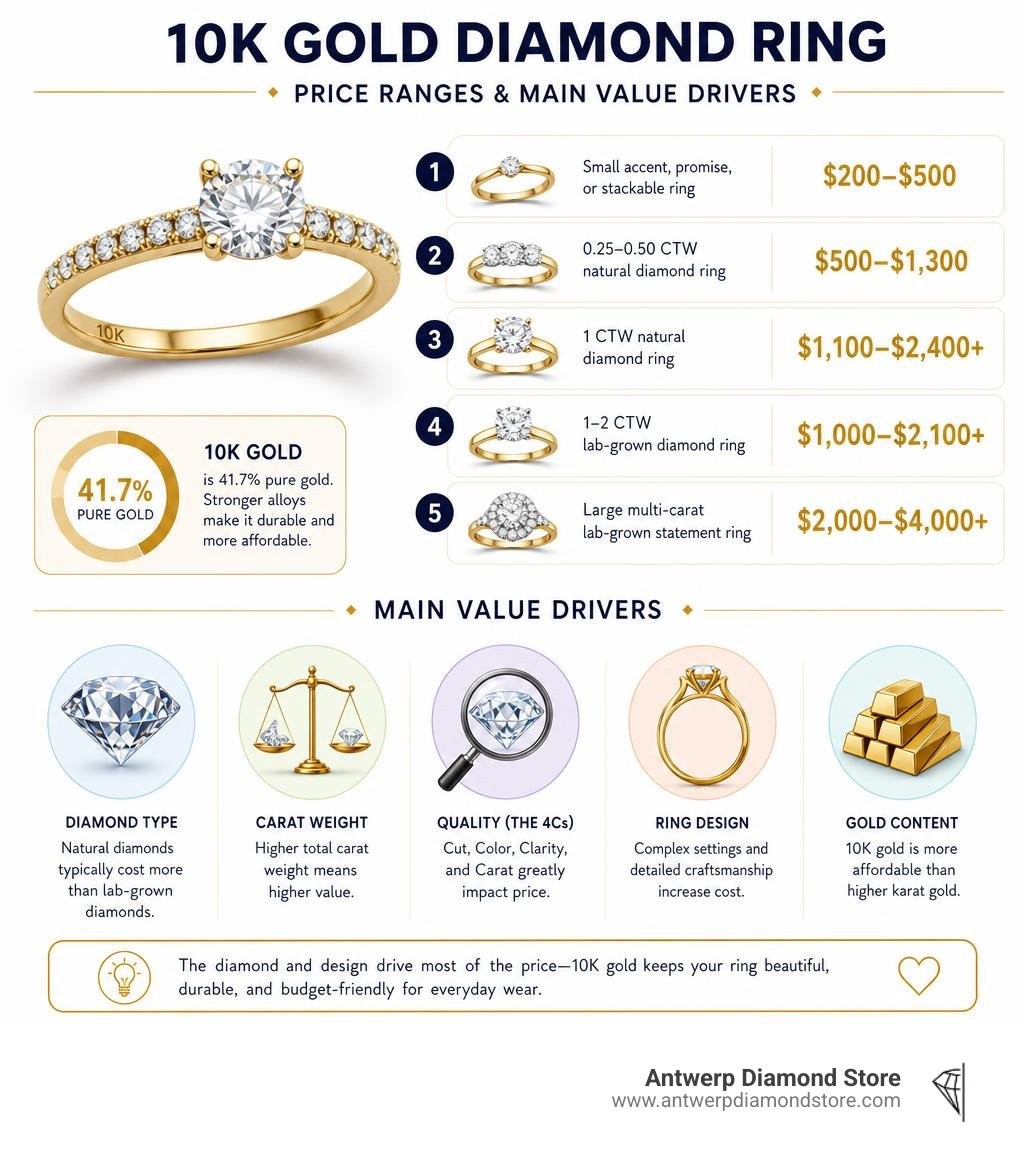
A 10k gold diamond ring price usually ranges from about $200 for a small diamond or lab-grown diamond band to $2,000 or more for larger diamond rings. The biggest price drivers are the diamond's type, total carat weight, quality, and the ring's design - not just the gold.
Type of 10K gold diamond ring | Typical retail price range |
|---|---|
Small accent, promise, or stackable ring | $200-$500 |
0.25-0.50 CTW natural diamond ring | $500-$1,300 |
1 CTW natural diamond ring | $1,100-$2,400+ |
1-2 CTW lab-grown diamond ring | $1,000-$2,100+ |
Large multi-carat lab-grown statement ring | $2,000-$4,000+ |
10K gold is 41.7% pure gold, with stronger alloy metals making up the rest. That lower gold content helps keep the upfront price down and makes the metal a practical choice for daily wear. Still, it also means the ring's resale value may be much lower than its retail ticket price, especially when the diamonds are small, lower quality, or lab-grown.
For buyers who care about value, the key is to separate the retail asking price from what the metal and diamonds may be worth on the secondary market. A discounted price can be useful, but diamond quality, certification, condition, and total gold weight matter more than a large "percent off" label.
Primary Factors Influencing Ring Costs
When evaluating the 10k gold diamond ring price, it helps to understand what goes into the tag on a jewelry display. Although the metal setting sets the baseline budget, the chosen diamonds and craftsmanship make up the majority of the final cost.
10K gold is defined by its gold metal purity: exactly 41.7% pure gold blended with 58.3% base metal alloys such as copper, silver, zinc, and nickel. In the United States, 10k is the legal minimum purity threshold recognized by the Federal Trade Commission that can still be advertised and sold as genuine gold. Because pure gold currently trades at historic highs, replacing 58.3% of the metal weight with inexpensive alloy metals keeps setting manufacturing costs relatively low. A typical 10k gold ring setting weighing 3 to 5 grams contains only around 1.25 to 2.1 grams of pure fine gold.
Beyond the gold alloy, the price of any diamond ring hinges on several critical components:
The Diamond 4Cs: Cut, color, clarity, and carat weight—standards established by the Gemological Institute of America—dictate the value of natural stones.
Diamond Origin: Natural earth-mined diamonds command a premium due to scarcity, whereas lab-grown diamonds offer much higher carat weight at lower retail price points.
Ring Design Complexity: Intricate settings, milgrain detailing, custom filigree, or multi-stone pave settings require extra bench jeweler labor, increasing overhead.
Retail Brand & Distribution Channel: Large retail chains and department stores price rings with promotional markups, while estate markets reflect pure spot metal and wholesale diamond liquidation values.
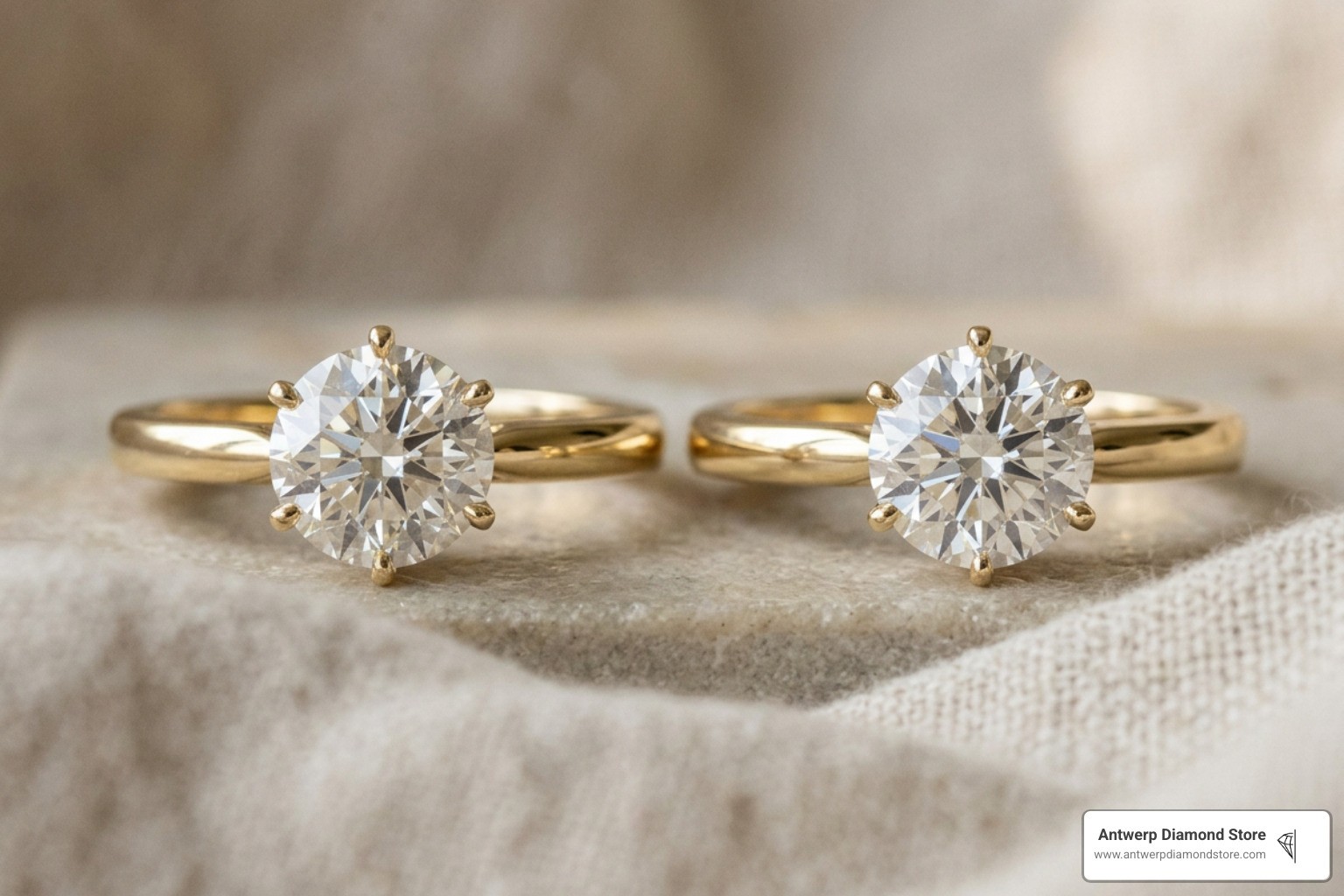
Natural vs. Lab-Grown Impact on 10k Gold Diamond Ring Price
The choice between natural earth-mined diamonds and lab-grown stones is the single biggest factor determining how far your budget stretches when shopping for 10k gold settings.
Natural diamonds carry significant mining, sorting, and wholesale supply chain costs. When set in 10k gold, natural diamonds are often selected in commercial quality tiers (such as HI color and I1-I2 clarity) to keep total retail prices accessible. For example, a 0.25 carat natural diamond solitaire set in a 10k gold band typically retails between $1,200 and $1,800 full price, though promotional sales frequently drop this to around $800 to $1,200. Higher quality natural center stones (such as G-H color with VS2-SI1 clarity) set in 10k gold can quickly drive prices into the $2,500 to $5,000 range.
Conversely, lab-grown diamonds have transformed entry-level fine jewelry pricing. Because lab-grown diamonds share identical optical and chemical properties with natural diamonds at a fraction of the creation cost, manufacturers frequently pair high-grade lab-grown diamonds with durable 10k gold mountings.
It is very common to find lab-grown diamond rings in 10k gold featuring impressive F color and VS2 clarity ratings priced significantly lower than inferior natural diamond counterparts:
A 1.00 CTTW lab-grown diamond 10k gold ring regularly sells for $800 to $1,200.
A 2.62 CTTW lab-grown statement ring with EF color and VS clarity set in 10k gold retails around $1,100 to $2,200.
Multi-carat lab-grown wedding sets (3 to 5 CTTW) in 10k white or yellow gold range from $1,700 to $3,500.
While lab-grown stones provide maximum size and visual brilliance for your immediate retail dollar, buyers should remain aware that lab-grown diamonds carry virtually zero secondary market resale value compared to high-grade natural diamonds.
Diamond Carat Weight and Quality Tiers
Carat total weight (CTTW) reflects the combined weight of all diamonds in a piece, which significantly alters overall pricing. Single center stones (solitaires) carry a much higher price per carat than a ring made up of multiple smaller stones adding up to the same total weight.
Retailers utilize clever setting techniques to maximize visual impact on budget-friendly 10k gold rings:
Solitaire Settings: Featuring one main diamond, solitaire rings reflect pure single-stone value. A 0.10 CTTW natural diamond solitaire in 10k white gold serves as an entry-level piece starting around $200 to $600, while a 0.50 CTTW natural solitaire usually ranges between $900 and $1,600.
Composite and Halo Settings: By clustering several smaller diamonds tightly together inside a 10k gold frame, jewelry designers create the illusion of a massive single center diamond at a much lower cost. A 1.00 CTTW composite diamond engagement ring in 10k gold often retails for $1,100 to $1,400, whereas a single 1.00 carat natural solitaire would cost several thousand dollars.
Multi-Row Pavé and Anniversary Bands: Channels or rows of micro-set accent diamonds distributed across 10k yellow or white gold bands provide high brilliance across wider surfaces. Entry-level 1/10 CTTW bands start around $200, while 1.00 CTTW to 1.50 CTTW natural diamond bands retail between $1,000 and $2,400 depending on diamond clarity grades (ranging from commercial I2-I3 grades up to clean SI1-SI2 grades).
Average 10k Gold Diamond Ring Price Comparison Across Styles and Metals
To contextualize the 10k gold diamond ring price, it helps to compare 10k gold directly against higher-purity metal options like 14k and 18k gold. Understanding how gold karat levels affect both price and physical characteristics ensures you pick the right alloy for your lifestyle.
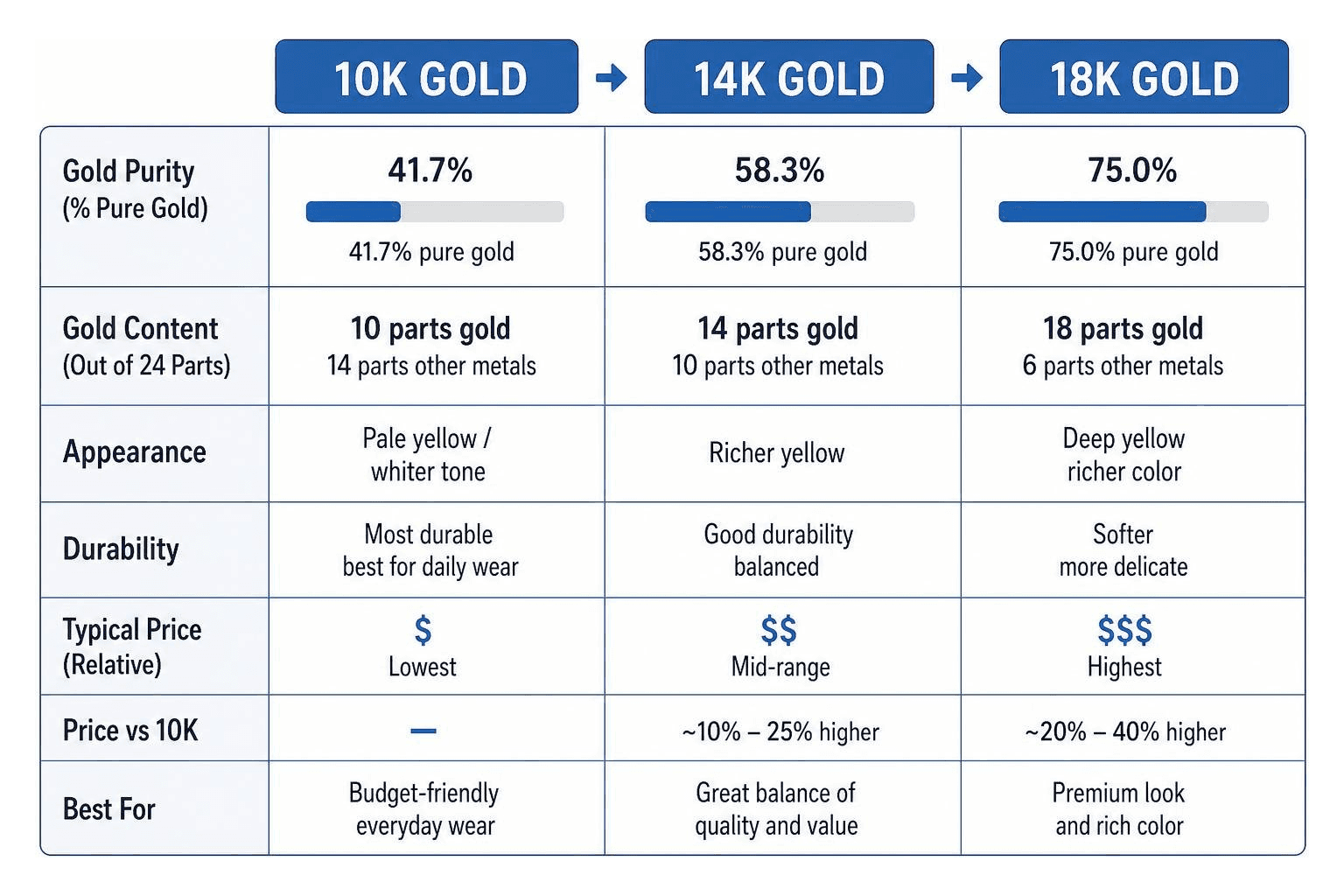
The table below breaks down general retail price expectations for similar diamond ring styles across different gold karats:
Ring Style & Diamond Specs | 10K Gold Price | 14K Gold Price | 18K Gold Price |
|---|---|---|---|
1/10 CTTW Diamond Accent / Promise Ring | $200 – $450 | $350 – $650 | $550 – $900 |
1/2 CTTW Natural Diamond Band (I1-I2 / HI) | $600 – $1,100 | $850 – $1,500 | $1,250 – $2,100 |
1.00 CTTW Lab-Grown Diamond Ring (F/VS2) | $800 – $1,400 | $1,100 – $1,800 | $1,600 – $2,500 |
1.00 CTTW Natural Diamond Ring (I1 / GH) | $1,100 – $2,400 | $1,800 – $3,200 | $2,600 – $4,500 |
1.50 CTTW Natural Princess-Cut Ring (I2 / GH) | $2,500 – $3,500 | $3,500 – $5,200 | $5,000 – $7,500+ |
If you are comparing different metal purities for an engagement ring or custom band, explore our detailed guides on What Is the Difference Between 14k and 18k Gold and current market rates for the Price Gold 14k.
Durability vs. Gold Purity
Is 10k gold better or worse than 14k or 18k gold? The answer depends entirely on whether you prioritize physical durability or metal richness.
Scratch Resistance & Alloy Hardness: Pure 24k gold is extremely soft and easily bent or scratched. Because 10k gold contains 58.3% non-gold metals (a combination of silver, copper, nickel, and zinc), it is noticeably harder and more scratch-resistant than 14k (58.5% pure gold) or 18k (75% pure gold). This physical toughness makes 10k gold an excellent candidate for heavy-duty daily wear, work rings, or budget-friendly stackable bands.
Color and Aesthetic Nuance: The higher non-gold metal content impacts visual appearance. 10K yellow gold tends to have a lighter, slightly paler tone compared to the warm, rich yellow of 14k or 18k gold. In fact, 10k yellow gold actually contains more silver (approx. 52%) than pure gold (41.7%)! 10K white gold uses silver, nickel, or palladium alloys and is routinely plated with rhodium to achieve a bright mirror finish, making it virtually indistinguishable from 14k white gold visually until the rhodium wears off over time.
Tarnish and Skin Reactivity: Higher alloy content means 10k gold can tarnish or oxidize faster than 14k or 18k gold when exposed to harsh chemicals, sweat, or environmental moisture. Additionally, individuals with nickel allergies may experience skin irritation from 10k gold alloys.
Retail Pricing Ranges by Ring Style
Retailers categorize 10k gold diamond rings into distinct design styles catering to specific gift occasions and budget tiers:
Promise Rings & Accent Bands ($199 – $450): Featuring modest diamond weights (1/20 CTTW to 1/4 CTTW) or lab-created gemstone accents, these pieces serve as popular entry-level fine jewelry gifts.
Anniversary Bands & Stackers ($350 – $999): Multi-stone designs, milgrain contour bands, and scalloped eternity bands featuring 1/4 CTTW to 1/2 CTTW natural or lab diamonds fall squarely in this mid-tier bracket.
Bridal Sets & Engagement Rings ($600 – $2,200): Solitaires, halos, three-stone rings, and multi-row composite bridal sets in 10k gold offer full engagement style options under $2,000, particularly when utilizing promotional retail codes or lab-grown diamonds.
High-Carat Statement Ensembles ($2,000 – $4,000+): Multi-carat natural diamond rings (1.5 CTTW to 2 CTTW) or massive multi-row lab-grown diamond bands (3 CTTW to 5 CTTW) represent the top tier of 10k gold jewelry pricing.
Retail vs. Secondary Market: Pre-Owned Pricing and Resale Value
There is a significant difference between new retail prices and secondary market liquidation value when evaluating a 10k gold diamond ring price. Understanding how retail markups function prevents unrealistic resale expectations down the road.
When you purchase a brand-new 10k gold ring from a traditional storefront or online mall retailer, the ticket price includes multiple layers of overhead: manufacturing labor, wholesale distributor margins, marketing expenses, retail store rent, staff commissions, and vendor profit margins. Consequently, new retail jewelry is routinely priced at a 100% to 300% markup over its raw intrinsic material value.
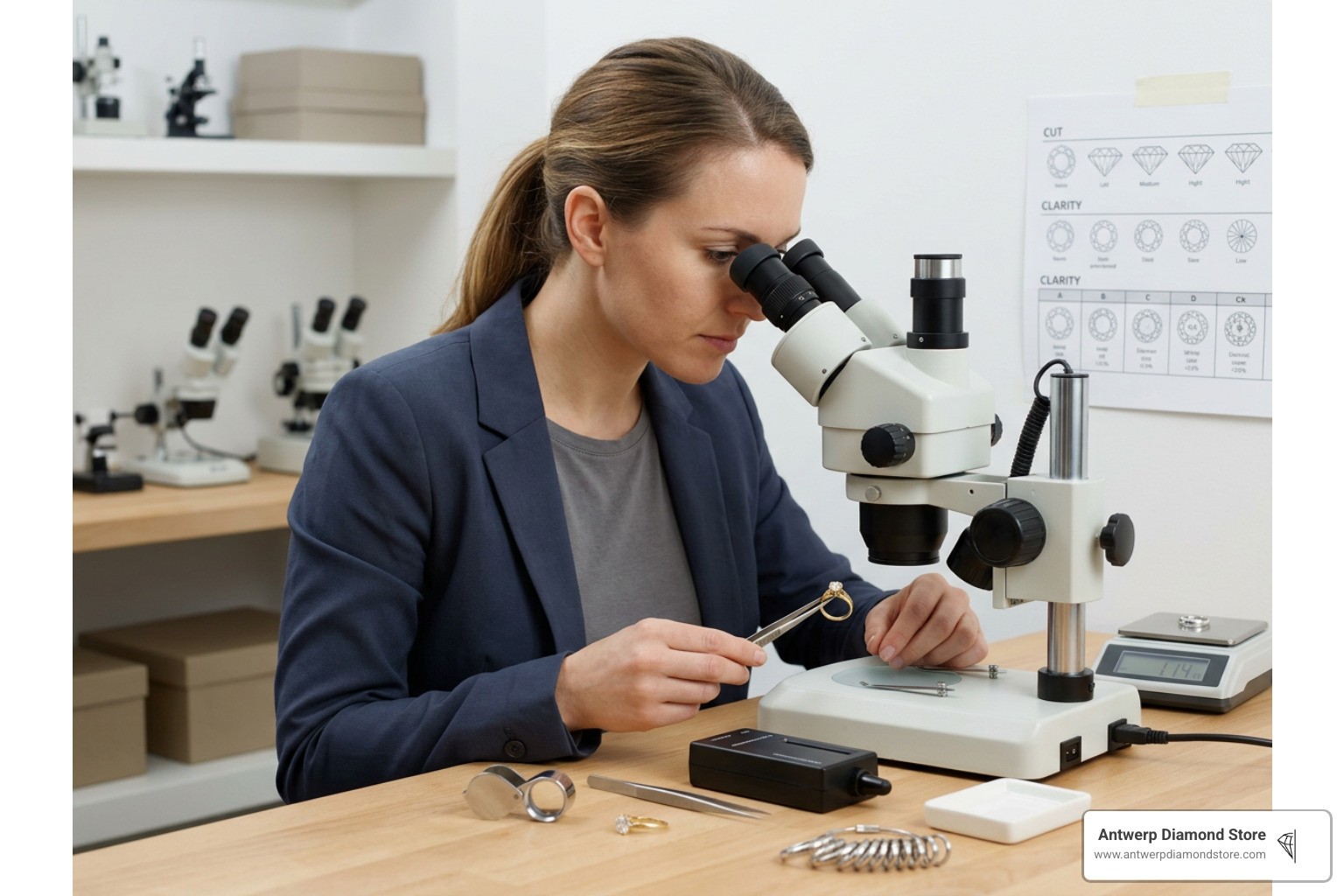
When selling a pre-owned 10k gold ring back into the estate or resale market, retail markup disappears entirely. Secondary market values are governed almost exclusively by two factors:
The spot melt value of the 10k gold alloy.
The wholesale cash liquidity value of the center diamond (if natural and of significant size/quality).
To understand how professional jewelry appraisers assess intrinsic diamond value, read our guide on How Much Is a Diamond or utilize our interactive Diamond Resale Value Calculator.
Understanding Resale Value and Scrap Gold Content
Calculating the raw scrap gold value of a 10k gold ring is straightforward financial math based on current spot gold market pricing.
Because 10k gold contains exactly 41.7% pure fine gold, the melt value is calculated by multiplying the ring's overall weight in grams (minus the weight of any stones) by 41.7% of the live gold spot price per gram.
For instance, assuming a baseline spot market value where 10k scrap gold yields approximately $25 per gram:
A light 2.0-gram 10k white gold solitaire setting contains roughly $50 in scrap gold value.
A heavier 5.0-gram 10k yellow gold band contains roughly $125 in scrap gold value.
Small accent diamonds (often called "melee" diamonds weighing under 0.10 carats each) and commercial-grade natural diamonds (I1-I3 clarity) carry very minimal secondary market repurchase value because re-cutting or re-setting them is labor-intensive for estate buyers. Lab-grown diamonds, regardless of original retail cost, have negligible cash liquidation value on the secondary scrap market due to unlimited supply production.
How Retail Markup Affects the 10k Gold Diamond Ring Price
Retailers frequently advertise major sales—such as "50% off" or "60% off original retail list price"—on 10k gold diamond rings. While these promotional discounts bring prices down closer to fair retail market value, buyers should recognize that original list prices (like an MSRP of $2,500 marked down to $999) are often inflated baseline figures.
A typical price lifecycle for a 0.50 CTTW natural diamond ring in 10k gold demonstrates this spread:
Original Retail List Price: $1,800 – $2,400
Promotional Retail Sale Price: $800 – $1,200
Secondary Market Cash Liquidation / Scrap Value: $150 – $350
This markup dynamic is precisely why buying pre-owned 10k gold diamond rings can offer extraordinary savings for budget-conscious shoppers, provided the piece is inspected and verified by a trusted jewelry specialist.
Additional Costs and Buying Considerations
The sticker price on a 10k gold diamond ring price tag is rarely the final amount you will spend. Several post-purchase fees and maintenance requirements should be factored into your total ownership budget.
Ring Resizing Fees and Sizing Restrictions
Standard display ring sizes for women in retail environments are typically size 6.5. If your finger size differs, resizing expenses may apply:
Simple Sizing: Adjusting a plain 10k gold band up or down by 1 to 2 sizes generally costs $40 to $90 through an independent bench jeweler, though some retailers include initial sizing free with purchase.
Complex Sizing Limitations: Rings featuring full eternity pave bands, intricate filigree, or invisible-set princess diamonds often cannot be resized without destabilizing the diamond mountings. Ordering a custom size directly from a manufacturer may take 6 to 8 weeks and often renders the ring non-refundable under standard store return policies.
Jewelry Appraisals and Insurance
If your 10k gold diamond ring has a retail replacement value exceeding $500–$1,000, adding it to a home insurance policy or personal jewelry float requires an official appraisal document.
Independent appraisal certificates generally cost between $50 and $150.
Appraisals detail the metal karat verification, gram weight, diamond color, clarity, cut specifications, and estimated replacement cost. Learn more about professional valuation steps in our guide on How to Appraise Jewelry.
Maintenance, Cleaning, and Care Expenses
While 10k gold is remarkably durable against bending and denting, maintaining its luster requires routine care:
Rhodium Re-Plating for White Gold: 10K white gold settings are electroplated with rhodium to achieve a bright silver appearance. As daily wear rubs off this outer layer over 12 to 24 months, the pale yellowish warm base metal becomes visible. Re-plating a white gold ring costs approximately $50 to $100 per application.
Prong Inspections and Tightening: Because 10k gold is hard, prongs can occasionally snag or loosen. Having a professional jeweler inspect stone stability annually costs roughly $30 to $60, or may be included under retail warranty plans.
At-Home Cleaning Routine: Keep your diamond ring sparkling at home by soaking it in warm water mixed with mild dishwashing liquid. Gently scrub away oils and skin lotion buildup behind the setting using a soft-bristled toothbrush, then dry thoroughly with a lint-free cloth. Always remove gold jewelry before entering chlorinated pools or hot tubs, as chlorine chemically weakens gold alloy bonds over time.
Alternative Gemstones vs. Diamond Costs
If you love the strength of a solid 10k gold setting but want to optimize your budget, pairing 10k gold with alternative gemstones offers striking aesthetic variety at lower price points:
Sapphires and Emeralds: Natural or lab-created precious gemstones set with diamond accents in 10k gold regularly retail between $300 and $800.
Opal and Topaz Rings: Vibrant semi-precious stones (such as London Blue Topaz, Rhodolite Garnet, or Australian Opals) framed by micro-diamond accents in 10k yellow gold offer bohemian elegance starting around $250 to $500.
Moissanite: High-brilliance lab-created moissanite paired with a 10k gold mounting provides diamond-like dispersion at a fraction of natural diamond pricing.
Frequently Asked Questions About 10K Gold Diamond Rings
Are 10k gold diamond rings a good value for the money?
Yes, 10k gold diamond rings offer exceptional practical value for everyday, budget-conscious buyers. Because 10k gold contains 58.3% non-gold alloys, it is significantly harder and more scratch-resistant than 14k or 18k gold, making it ideal for active wearers. Paired with certified lab-grown diamonds or commercial natural diamonds, 10k gold allows consumers to enjoy genuine solid gold and real diamonds at entry-level price points ranging from $200 to $1,200.
How much is a 10k gold ring with diamonds worth in scrap value?
The scrap cash value of a 10k gold ring depends on its total weight in grams and the live spot price of gold. Because 10k gold is 41.7% pure fine gold, its scrap metal baseline value averages approximately $25 per gram under standard wholesale scrap rates. A typical 3-gram 10k gold band yields around $75 in raw scrap gold value. Small accent diamonds usually add minimal secondary cash value unless the center natural diamond is of significant weight (0.50 carats or larger) and high quality.
What additional costs should be expected after purchasing a ring?
Potential additional costs include ring resizing fees ($40–$90 if non-standard sizes are required), official insurance appraisal fees ($50–$150), and periodic maintenance costs. For 10k white gold rings, rhodium re-plating every 1 to 2 years costs around $50–$100 to restore bright white shine. Optional 5-year extended protection warranties offered by retailers generally add $60–$120 to the initial purchase price.
Conclusion
Understanding the 10k gold diamond ring price comes down to balancing immediate retail affordability against material composition. With its 41.7% pure gold content reinforced by durable alloy metals, 10k gold offers a tough, highly budget-friendly metal framework for beautiful natural and lab-grown diamond designs.
Whether you are shopping for a simple 1/10 CTTW anniversary stacker under $300, a classic natural diamond solitaire, or an impressive multi-carat lab-grown statement band, separating retail markup from intrinsic metal and gem value ensures you make an informed purchase.
When you are ready to evaluate, buy, or liquidate pre-owned fine jewelry, estate gold, or loose diamonds, work with trusted luxury specialists. At Antwerp Diamond Store, we offer expert evaluations, complete transaction transparency, and immediate market-based cash offers for high-end watches, fine gold, and certified diamond jewelry in a private, discreet setting.