

What an Engagement Ring Valuation Really Tells You
An engagement ring valuation can mean very different things depending on whether you need insurance paperwork, a fair-market figure, or a fast cash offer. The number on an old receipt or insurance appraisal is rarely the amount a buyer will pay today.
Value type | What it means | Best use |
|---|---|---|
Retail replacement value | The cost to buy a comparable new ring from a retailer | Insurance coverage |
Appraised value | A documented value for a stated purpose, often replacement or estate planning | Insurance, legal, probate |
Resale value | What the ring may sell for in the current pre-owned market | Selling privately or through a buyer |
Cash offer | What a buyer can pay now, after allowing for risk, resale costs, and margin | Fast, discreet sale |
For most diamond rings, the center stone drives the result. Its carat weight, cut, color, clarity, certification, natural or lab-grown origin, condition, setting metal, and brand all matter. As a broad benchmark, a diamond's cash resale value is often around 50% of the lowest available retail price for a comparable stone, though exceptional diamonds and sought-after designer rings can behave differently.
Market conditions also change. In the past month, prices for 1-carat natural diamonds rose 0.52%, while comparable lab-grown diamond prices fell 2.34%. That is why a current valuation matters more than the price paid years ago.
This guide explains how to separate a useful insurance appraisal from a realistic resale figure, so you can make a clear decision before you sell, insure, divide, or replace your ring.
Retail, Resale, and Appraisal Value: Essential Definitions
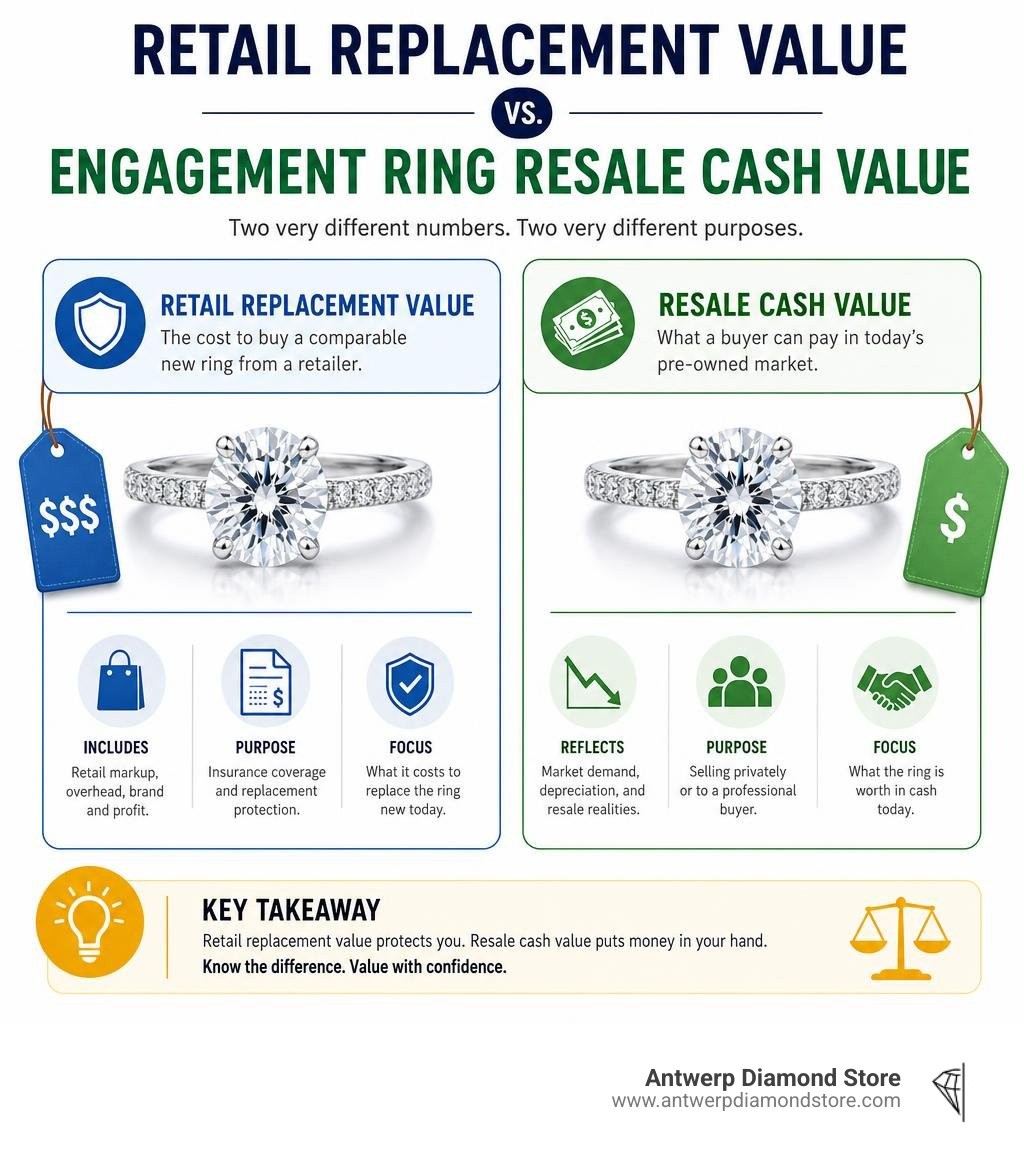
When navigating an engagement ring valuation, the single biggest point of confusion is why three different experts can look at the exact same ring and give three wildly different dollar amounts. To understand your ring's true worth, you have to look at the three distinct valuation benchmarks used in the jewelry industry:
Retail Replacement Value: This is the figure printed on most formal appraisals provided by retail jewelers at the time of purchase. It estimates what it would cost to purchase an identical ring brand new at full retail price, including original manufacturing labor, designer markup, store overhead, and sales margins. It is typically intentionally set at the high end of the market to ensure your insurance policy covers complete replacement in case of loss.
Fair Market (Appraised) Value: Used primarily for legal, estate, tax assessment, or divorce proceedings, this represents a fair price that a willing buyer and a willing seller would agree upon in an open market, neither being under pressure to complete the transaction.
Cash Resale Value: This is the immediate liquid dollar amount you receive when selling your pre-owned ring to a professional buyer, jeweler, or secondary market specialist. This price reflects raw material values, secondary market demand, and wholesale diamond benchmarks rather than retail overhead.
Valuation Benchmark | Purpose & Context | Key Components Included | Relative Dollar Level |
|---|---|---|---|
Retail Replacement Value | Insurance policies and full loss replacement | Diamond retail price + full labor + retail profit margin + overhead | Highest (100% baseline) |
Fair Market Value | Probate tax, estate division, divorce settlements | Secondary retail market pricing without forced liquidation pressure | Medium (50% to 70% of retail) |
Cash Resale Value | Immediate sale to pre-owned luxury buyers or jewelers | Wholesale diamond baseline + metal scrap value - buyer holding risk | Realistic Cash (30% to 50% of retail) |
To quickly estimate your diamond stone's secondary market standing, tools like a Diamond Resale Value Calculator provide a clear starting point before you seek an official offer.
Understanding the Retail-to-Resale Price Gap
It can feel like a cold splash of water when you take a ring with a $10,000 insurance appraisal to a jeweler and receive a cash offer around $3,500 to $4,000. It is easy to assume someone is trying to take advantage of you, but this price difference is driven by standard retail mechanics.
Retail fine jewelry usually carries a traditional markup of roughly 100% over wholesale costs. When a boutique sells an engagement ring, that retail price must cover expensive brick-and-mortar rent, sales commissions, insurance, marketing campaigns, customer warranties, and profit.

When you return to the market to sell that ring, you are operating in the secondary wholesale or pre-owned ecosystem. Pre-owned buyers are not paying for the retail store's past marketing campaigns or store window displays. Instead, professional buyers calculate their cash offer based on immediate wholesale market value.
Because professional buyers must assume holding risks, refinish worn metal settings, and re-certify or recut loose gems, the immediate secondary cash market generally anchors diamond offers at roughly 50% of the lowest online retail price for an equivalent unmounted diamond.
Key Factors in Engagement Ring Valuation
Every engagement ring valuation rests on specific physical and market variables. An expert valuer breaks down a piece into its individual core components to establish an accurate number.
Primary Gemological Components of Engagement Ring Valuation
The center stone typically accounts for 70% to 90% of the ring's overall financial value. Evaluating a diamond requires looking closely at the traditional 4Cs established by the Gemological Institute of America (GIA):
Carat Weight: Diamond pricing is calculated per carat, but price scales do not increase in a straight line. They jump dramatically at critical weight thresholds such as 0.50, 1.00, 1.50, and 2.00 carats. For instance, a 0.99-carat diamond might look visually identical to a 1.01-carat diamond, but the 1.01-carat stone commands a significantly higher price per carat simply because it crosses the 1.00-carat mark.
Cut Quality: Cut dictates how brightly light bounces through the diamond. A stone with an Excellent or Ideal cut reflects light efficiently and commands maximum market value. Poorly cut stones appear dull or dark and suffer steep value deductions on the resale market, regardless of their size.
Color Grade: Graded on an alphabetical scale from D (completely colorless) down to Z (noticeably yellow or brown). D, E, and F colorless stones carry clear market premiums, while lower grades like J or K are priced more accessibly.
Clarity Grade: Ranges from Flawless (FL) to Included (I1-I3). The commercial sweet spot for resale value rests in the "eye-clean" range—typically VS1 through SI1—where inclusions are invisible to the naked eye without microscopic magnification.
Certification Status: Paperwork matters immensely. Independent lab certification acts as a diamond's official passport. A stone backed by a recognized GIA grading report commands a 10% to 30% price premium over uncertified stones or stones certified by softer, less strict laboratories. If you hold a GIA Certified Engagement Ring, its grading report number is often micro-laser inscribed on the stone's girdle, allowing instant verification against online databases.
Metal, Brand, and Diamond Origin Impacts
Beyond the center diamond's 4Cs, several structural elements heavily influence the outcome of an engagement ring valuation:
Precious Metal Content: Rings crafted in platinum, 18K gold, or 14K gold are valued based on their net metal weight and current spot market metal prices. When unbranded rings are evaluated for scrap or remounting, metal settings are weighed after subtracting stone weights.
Designer Brand Premiums: Standard, unbranded engagement rings typically resell for 30% to 50% of their original retail price. However, recognized premier luxury designer houses carry exceptional brand retention, often reselling for 50% to 70% of original retail prices provided you have the original boxes and paperwork.
Natural vs. Lab-Grown Diamonds: Origin plays a huge role in secondary market retention. Natural diamonds, formed over billions of years, maintain structural rarity and established secondary market trade channels. In contrast, lab-grown diamonds can be produced efficiently in industrial facilities. Driven by surging production capacity, lab-grown prices have dropped steadily (falling another -2.34% over the past month alone). Consequently, pre-owned lab-grown diamonds carry minimal cash resale value compared to their natural counterparts.
In-Person vs. Online Options for Appraisal

When seeking an engagement ring valuation, modern ring owners can choose between instant digital tools and traditional, in-person gemological inspections. Knowing when to use each approach saves both time and money.
Choosing the Right Appraisal Method
Digital appraisal calculators and modern AI tools offer fast, accessible estimates. By uploading clear photos from multiple angles—capturing the center stone, setting profile, and internal band hallmarks—users can access an instant market check in under 60 seconds.
These online estimates aggregate millions of recent market sales, comparing your ring's style against historical secondary listings. They provide a quick, low-friction way to check ballpark ranges before booking an appointment or listing an item.
However, visual digital tools have clear physical limitations:
They cannot physically test metal purity or distinguish 10K gold from 18K gold.
They cannot view subsurface inclusions, pinpoint internal feathers, or detect diamond fluorescence under ultraviolet light.
They cannot verify microscopic laser girdle inscriptions or confirm physical wear and micro-cracks on gem facets.
Because of these boundaries, insurance underwriters and court officers do not accept digital or automated appraisals for official claims or legal filings. If you want an entry-level estimate, you can explore services like an Appraise My Ring Online tool or browse detailed market breakdown platforms such as the Engagement Ring Value Guide | AI-Powered Ring Appraisal | Value Identifier .
For formal legal needs, high-value insurance scheduling, or executing a final cash sale, an in-person physical appraisal by a qualified gemologist remains indispensable.
Professional Valuation Reports, Fees, and Standards

A professional in-person engagement ring valuation produces a formal legal document detailing the physical attributes, replacement costs, and origin verification of your fine jewelry.
According to National Association of Jewellers (NAJ) standards, a complete professional jewelry appraisal document incorporates 12 mandatory cataloguing points for each item:
Detailed transmittal letter and declared purpose of valuation.
Complete physical description of setting design and craftsmanship.
Precious metal identification and tested purity hallmark analysis.
Exact metal weight in grams or pennyweights.
Individual stone counts, shapes, and dimensions.
Detailed 4Cs diamond grading parameters (Cut, Color, Clarity, Carat).
Laboratory grading report numbers and laser inscription checks.
High-resolution macro photography of the piece.
Verification of stone mounting security and physical wear condition.
Explicit statement of valuation methodology and market level used.
Appraiser signature, accredited credentials, and date.
Limiting conditions and formal notice of 6-year research record retention.
To review an in-depth breakdown of how certified appraisals evaluate center gems, read our guide on obtaining a formal GIA Ring Appraisal.
Selecting a Qualified Appraiser
When hiring a professional, pay close attention to credentials and fee structures. Traditional in-person jewelry appraisals typically cost between $50 and $200 per item, depending on setting complexity and stone count.
Fee Structure Warning: A reputable, ethical appraiser charges a flat fee or an hourly rate ($50 to $150/hr). Never hire an appraiser who charges a percentage fee based on the ring's final assessed value. Percentage-based fees create an obvious conflict of interest, encouraging the valuer to artificially inflate figures.
Credentials to Look For: Look for independent appraisers holding recognized gemmological credentials, such as GIA Graduate Gemologist (GG) diplomas or membership in accredited appraisal organizations. Registered valuers with major industry bodies typically possess at least five years of direct trade experience, formal diamond grading qualifications, and rigorous appraisal practice training.
Maintaining an Updated Engagement Ring Valuation
An engagement ring valuation is not a set-it-and-forget-it document. Because precious metal spot markets fluctuate and diamond index benchmarks shift over time, valuation documents naturally age out of accuracy.
The National Association of Jewellers (NAJ) recommends having fine jewelry revalued at least every three to five years. Updating your appraisal ensures your insurance policy keeps pace with inflation, gold price spikes, and exchange rate swings.
Regular revaluations protect you from two frustrating scenarios:
Under-insurance: If metal prices surge and your ring is lost or stolen, an outdated 10-year-old policy limit may leave you thousands of dollars short of the funds needed to remake your ring.
Over-insurance: If market diamond prices drop, paying insurance premiums based on an inflated, outdated valuation means you are overpaying annual premiums without receiving any additional payout protection.
Professional appraisers are required by industry standards to retain all research notes, testing records, and calculation documentation for at least six years following an appraisal, giving you a solid paper trail if an insurance claim ever arises. To learn more about updating historical figures, consult our practical overview on How Much to Value a Diamond Ring.
Post-Loss Assessments and Insurance Requirements
If your engagement ring is lost or stolen without a recent appraisal on file, insurance providers require a post-loss assessment.
In a post-loss evaluation, an independent gemologist works backward using secondary evidence:
Historical retail purchase receipts and bank statements.
Original laboratory certificates (such as GIA or AGS reports).
High-resolution family photographs showing the ring on your hand from multiple angles.
Providing clear historical paperwork allows the loss adjuster to recreate exact ring specs and reimburse an accurate replacement value rather than defaulting to a basic, lower-tier replacement ring.
Frequently Asked Questions About Ring Valuation
Can an online appraisal be used for insurance or legal purposes?
No. Online appraisals and photo-based digital estimates serve purely as entry-level informational tools to help you understand general market benchmarks. Insurance companies and court proceedings (such as estate probate or divorce asset divisions) require a physical, in-person appraisal completed by a certified gemologist.
Physical inspection is mandatory to test metal alloys, verify diamond laser girdle inscriptions, check for hidden chips or stress fractures under magnification, and confirm stone authenticity.
Why is the cash resale offer so much lower than the insurance appraisal?
Insurance appraisals reflect full Retail Replacement Value, which calculates what it costs to recreate a ring brand new at full retail prices—including retail profit margins, custom bench labor, store overhead, and marketing.
When you sell a pre-owned ring, a cash buyer pays Wholesale Cash Resale Value. Professional buyers evaluate the ring based on raw material values: loose diamond market demand and scrap metal weight. Because pre-owned buyers take on holding risks, refinishing costs, and resale expenses, cash offers land closer to wholesale levels—typically around 30% to 50% of original retail prices.
How much does a professional ring appraisal cost?
A formal, in-person jewelry appraisal from a certified gemologist typically costs $50 to $200 for a standard engagement ring. Simple solitaire rings rest at the lower end of that scale ($50 to $100), while complex multi-stone vintage settings requiring individual measurement of dozens of accent diamonds cost more due to the additional bench time required. Always ensure your appraiser charges a flat fee or hourly rate rather than a percentage of the ring's assessed value.
Conclusion
Understanding an engagement ring valuation comes down to recognizing the clear line between insurance replacement estimates and actual cash resale values. While a retail appraisal gives you the upper-bound figure needed to insure your ring against loss, secondary cash offers reflect real-world market demand, raw metal weight, and wholesale diamond values.
When you are ready to transition from estimates to immediate liquid cash, working with a discreet, established pre-owned luxury specialist makes all the difference.
At Antwerp Diamond Store, we simplify the liquidation process for fine jewelry, luxury watches, and designer pieces. Operating out of Atlanta, GA, we provide free evaluations, transparent market-based offers, and instant payouts in a private, appointment-only setting. Whether you hold a certified natural diamond solitaire or a signed designer engagement ring, we deliver immediate payment without hidden fees or high-pressure tactics. Reach out to our expert team today to schedule your private valuation.


