

What a GIA Ring Appraisal Really Means
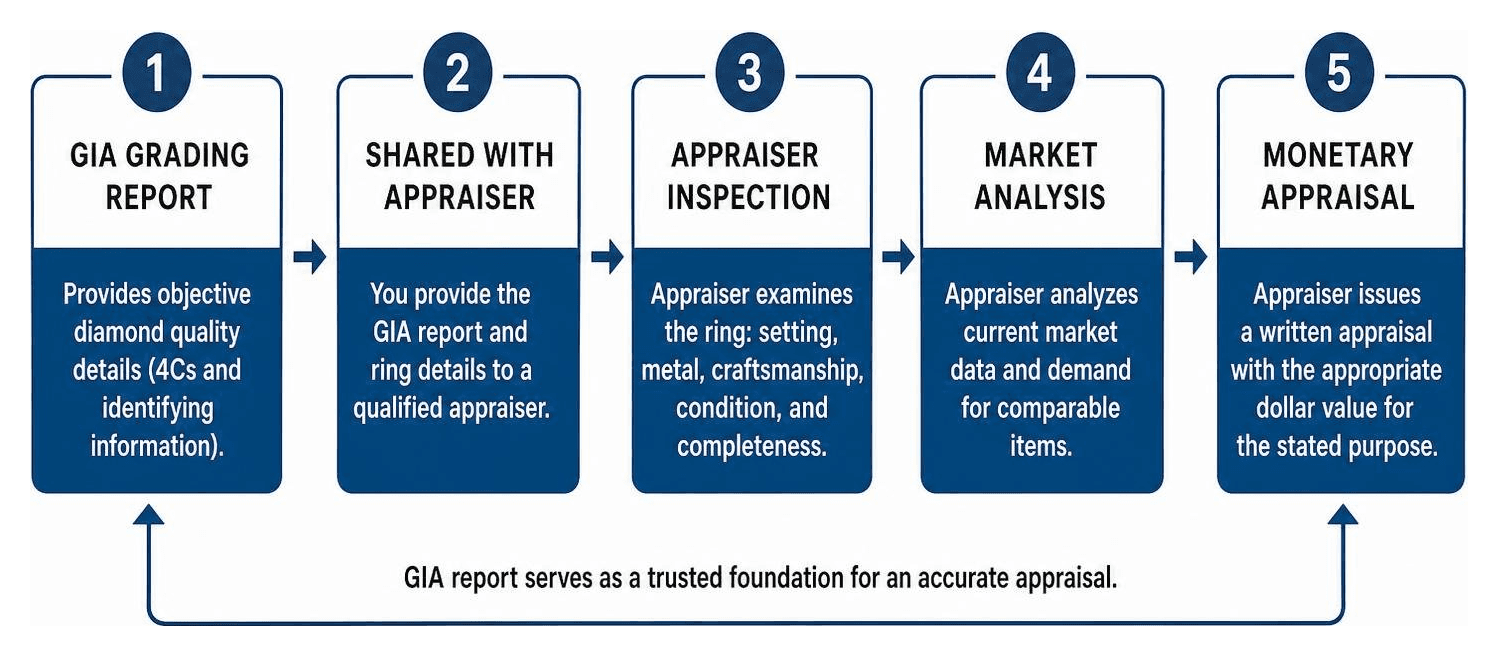
A gia ring appraisal usually refers to two separate services: a GIA grading report for the diamond and a professional appraisal that assigns a current dollar value to the complete ring.
Document | What it tells you | Who provides it |
|---|---|---|
GIA grading report | The diamond's quality, including carat weight, color, clarity, cut, and other identifying details | GIA |
Ring appraisal | The ring's value for insurance, estate planning, resale, or another stated purpose | An independent qualified jewelry appraiser |
GIA does not issue monetary appraisals for rings, diamonds, or other jewelry. Its reports are objective quality records, not price estimates. A professional appraiser can use a GIA report as a reliable starting point, then inspect the setting, metal, craftsmanship, condition, and current market demand to determine the right type of value.
That distinction matters, especially when you need a realistic figure. An insurance replacement value can be much higher than the amount a buyer would pay in a fast cash sale. The purpose of the appraisal determines which number is useful.
This guide explains what GIA documentation does and does not provide, how to obtain an independent ring appraisal, and how to check that both your report and valuation are legitimate.

Understanding GIA Ring Appraisal vs. GIA Grading Report
When people search for a gia ring appraisal, they are often caught in a web of industry jargon. It is completely understandable—after all, when you receive a sleek, laminated document from the world's premier gemological authority with scientific diagrams and official stamps, it sure looks like an appraisal!
However, the Gemological Institute of America (GIA) is a non-profit educational and research organization established in 1931. GIA created the International Diamond Grading System in the 1950s, giving the world a standardized language for evaluating diamond quality through the famous 4Cs (Carat Weight, Color, Clarity, and Cut).
GIA’s core mission is scientific objectivity and consumer protection. Because GIA acts as an unbiased third party, it strictly refrains from putting dollar signs on any piece of paper. An appraisal, by definition, is an opinion of monetary value formulated for a specific financial purpose (such as insurance, probate estate settlement, or resale).
If you own a GIA Certified Engagement Ring, you hold the gold standard of quality documentation. But to turn those quality metrics into a dollar figure, you must bridge the gap between scientific evaluation and commercial market values.
Feature | GIA Diamond Grading Report | Professional Jewelry Appraisal Report |
|---|---|---|
Primary Goal | Scientific analysis of diamond quality | Establishing a monetary dollar value |
Monetary Values | Never included | Always included (based on report scope) |
Issuer | Gemological Institute of America (GIA) | Independent Qualified Appraiser / Gemologist |
Scope of Inspection | Unmounted loose natural diamonds | Entire ring (center stone, side stones, mounting metal, brand) |
Time Sensitivity | Unchanging "birth certificate" (diamond physical properties stay identical) | Time-sensitive market snapshot (fluctuates with metal and diamond markets) |
Primary Purpose | Verifying authenticity and quality parameters | Insurance coverage, estate settlement, tax, or resale valuation |
Does GIA Provide Monetary Valuations?
The short answer is a definitive no. GIA strictly enforces a policy of commercial neutrality. If GIA were to issue dollar amounts, its impartial standing in the global gem trade would be compromised.
Furthermore, there is a physical limitation: GIA only issues full grading reports for loose, unmounted natural diamonds weighing 0.15 carats or more. Metal mountings hide parts of the stone, distort color perceptions under gemological lamps, and prevent exact scale weights. To get a GIA report, a stone must be removed from its mounting.
Because GIA never places a financial estimate on gems or settings, searching for an official "GIA appraisal" leads directly to independent third-party appraisers who use GIA data to formulate pricing. For a deeper breakdown of how GIA reports interact with commercial valuations, read this comprehensive GIA Diamond Appraisal Guide.
Key Information Included in a GIA Grading Document
While a GIA grading dossier contains zero dollar signs, it provides the essential evidence an appraiser needs to calculate an accurate valuation. Without a GIA report, an appraiser inspecting a mounted diamond has to estimate grades—which can leave your appraisal open to significant error margins.
A standard GIA grading report provides:
Carat Weight: Measured precisely to the hundredth of a carat (e.g., 1.01 ct).
Color Grade: Graded on an alphabetical scale from D (Colorless) to Z (Light Yellow or Brown).
Clarity Grade: Evaluated from Flawless (FL) down to Included ($I_3$) under 10x magnification.
Cut Grade: Rated on a scale from Excellent to Poor (available for standard round brilliants), analyzing how light interacts with the stone's facets.
Proportion Diagram & Table/Depth Percentages: Detailed measurements of crown angles, pavilion depths, and table percentages that govern light performance and brilliance.
Clarity Plot: A visual map charting internal features (inclusions) and surface traits (blemishes). This acts as a unique fingerprint—no two diamonds have identical clarity plots!
Laser Inscription: Most GIA-graded diamonds feature the report number micro-inscribed on the girdle, linking the physical stone directly to its digital record.
Fluorescence: Evaluates whether the stone glows under ultraviolet light (e.g., None, Faint, Medium Blue, Strong Blue), which can impact pricing.
How Professional Jewelry Appraisals Work
If GIA does not calculate monetary values, how does an actual appraisal happen?
A professional appraisal is a comprehensive evaluation of the entire item as a complete piece of finished fine jewelry. When you take your ring to a qualified appraiser, they perform a thorough physical inspection. If the diamond has a GIA report, they verify the girdle laser inscription against the paperwork using a microscopic loupe.
Next, they examine the mounting itself. They evaluate the precious metal composition (such as 14K gold, 18K gold, or platinum), calculate total metal weight, inspect accent stones (like pavé diamonds or halos), and judge the overall manufacturing craftsmanship (e.g., cast, hand-fabricated, or designer branded).
Finally, the appraiser factors in current spot market metal prices (gold and platinum spot rates on that exact day) and current wholesale/retail market conditions for diamonds. The resulting document is a legal appraisal that meets standard protocols like the Uniform Standards of Professional Appraisal Practice (USPAP). To explore the step-by-step mechanics of this process, see our guide on How to Appraise Jewelry.

Who Performs Ring Appraisals and Appraiser Credentials
Not all appraisals are created equal. Walking into a mall jewelry store where a salesperson writes a retail figure on an index card is not a formal appraisal. In fact, many insurance companies will reject informal receipts during a claim process.
To ensure your gia ring appraisal is legally sound and accepted by insurers, banks, and probate courts, you should work with an Independent Jewelry Appraiser. Look for professionals holding credentials from recognized industry organizations:
GIA Graduate Gemologist (GG): Indicates rigorous formal education in identifying and grading gemstones and diamonds.
American Society of Appraisers (ASA): Requires testing, ethics training, and adherence to USPAP methodology.
American Gem Society (AGS): Offers titles such as Certified Gemologist Appraiser (CGA).
National Association of Jewelry Appraisers (NAJA): Focused exclusively on personal property gem and jewelry valuations.
International Society of Appraisers (ISA): Offers rigorous training in valuation principles and legal appraisal standards.
An independent appraiser who does not sell jewelry has no financial stake in inflating or deflating your ring's value. This eliminates conflicts of interest, providing you with a clean, unbiased valuation.
How to Obtain an Accurate GIA Ring Appraisal
Getting your ring appraised using your GIA report is straightforward if you take a few simple preparation steps:
Gather Your Documents: Bring your original GIA report (or GIA Diamond Dossier), original purchase receipts, prior appraisals, and any repair or custom alteration records.
Clean the Ring: Ultrasonic cleaning ensures the appraiser can clearly inspect metal hallmarks, prongs, and accent stones without dirt hiding flaws.
Choose the Right Valuation Type: Specify why you need the appraisal upfront. Are you trying to schedule an insurance policy? Settling an estate? Splitting assets? Or preparing for a fast cash liquidation?
Confirm In-House Inspection: Choose a specialist who conducts while-you-watch or secure on-site inspections so your ring never leaves the building or gets shipped off to third parties.
Review the Final Report: Ensure the written document includes photographic documentation, detailed stone descriptions, precise metal weights, and the appraiser's official seal and signature.
If you are evaluating an inherited heirloom or settling family assets, our guide on Estate Jewelry Appraisal outlines the legal and valuation nuances involved in probate settlements. For a detailed breakdown of the appraisal submission process, review this Engagement Ring Appraisal Guide.
Valuation Factors, Costs, and Market Realities
Understanding appraisal pricing structures saves you money and prevents costly misunderstandings. In 2026, a standard written appraisal for an engagement ring typically costs between $100 and $250 as a flat fee per item. For complex multi-stone pieces or estate collections, appraisers may charge an hourly rate ranging from $50 to $150 per hour.
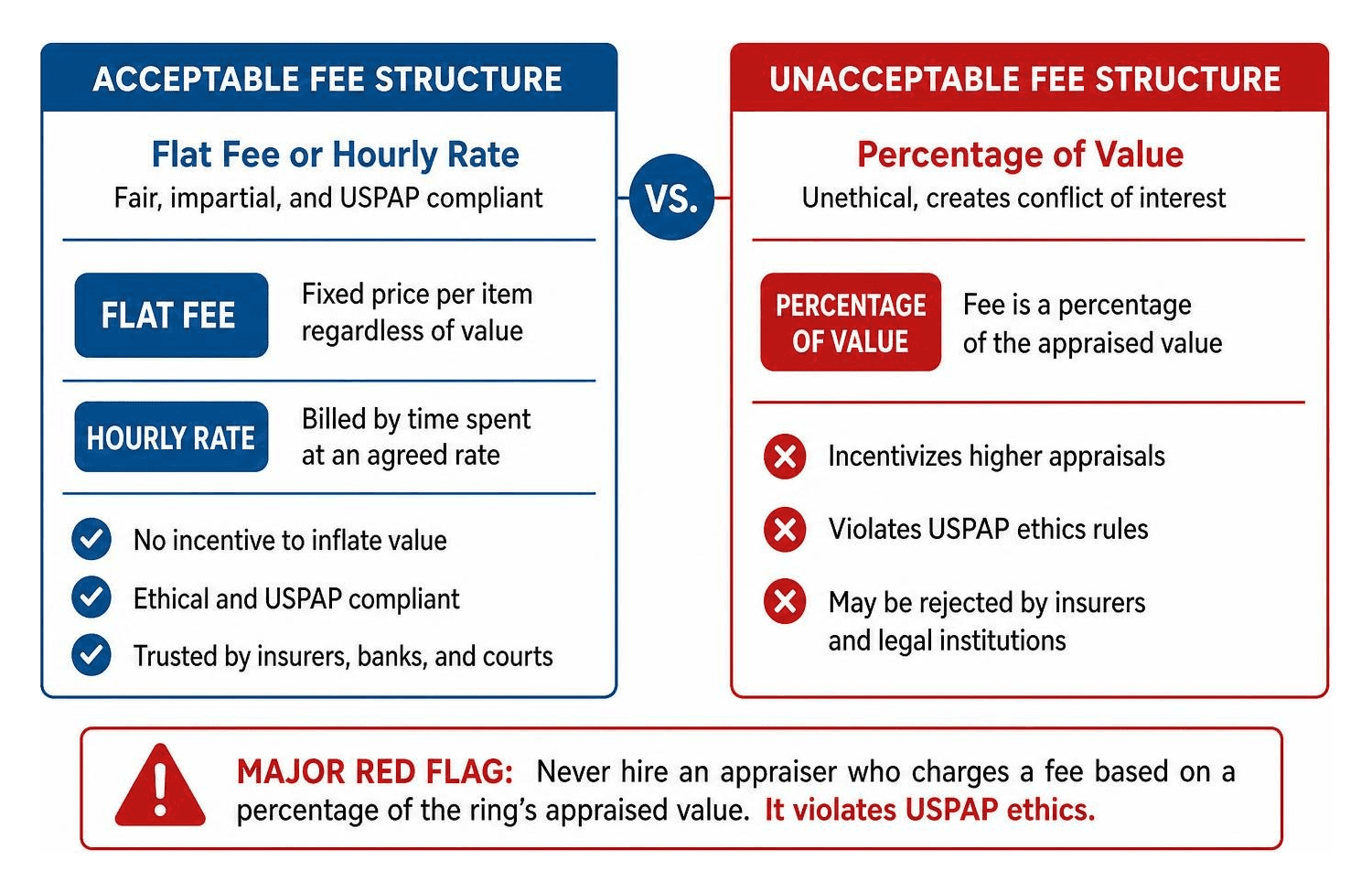
A major red flag: Never hire an appraiser who charges a fee based on a percentage of the ring's appraised value! Percentage-based pricing violates USPAP ethics because it incentivizes the appraiser to artificially inflate the dollar figure just to collect a higher fee.
For more details on determining costs and values, check out our resource on How Much to Value a Diamond Ring.
Factors That Influence Your GIA Ring Appraisal Value
While your GIA report establishes the baseline diamond quality, many additional variables dictate the final dollar value on an appraisal report:
Precious Metal Content and Spot Prices: Gold and platinum prices move daily. A heavy 18K gold or solid platinum ring setting holds significantly higher melt and replacement value than a thin 14K gold band.
Designer Branding and Craftsmanship: A ring setting crafted by an iconic luxury house (like Tiffany & Co. or Cartier) carries a substantial brand premium over a non-branded commercial mounting, even if the center diamonds are identical. Subtle geometric designs like the Gia Ring by Alice Pierre demonstrate how specialized design craftsmanship impacts retail value.
Accent Stones and Setting Work: Halos, pavé bands, and side stones add to overall diamond carat weight and labor costs.
Ring Condition: Is the ring brand new, or does it show worn prongs, scratched metal, or chip damage on side stones? Physical wear reduces immediate replacement value unless restored.
To see what a real, fully documented gemological valuation looks like in practice, inspect this downloadable Sample Appraisal Report.
Retail Replacement vs. Cash Resale Value
Here is where most consumers experience sticker shock. If you take an insurance appraisal listing your ring at $10,000 to a jeweler or buyer expecting a $10,000 cash payout, you will be disappointed.
Why? Because an appraisal can represent completely different "layers" of value depending on its intent!
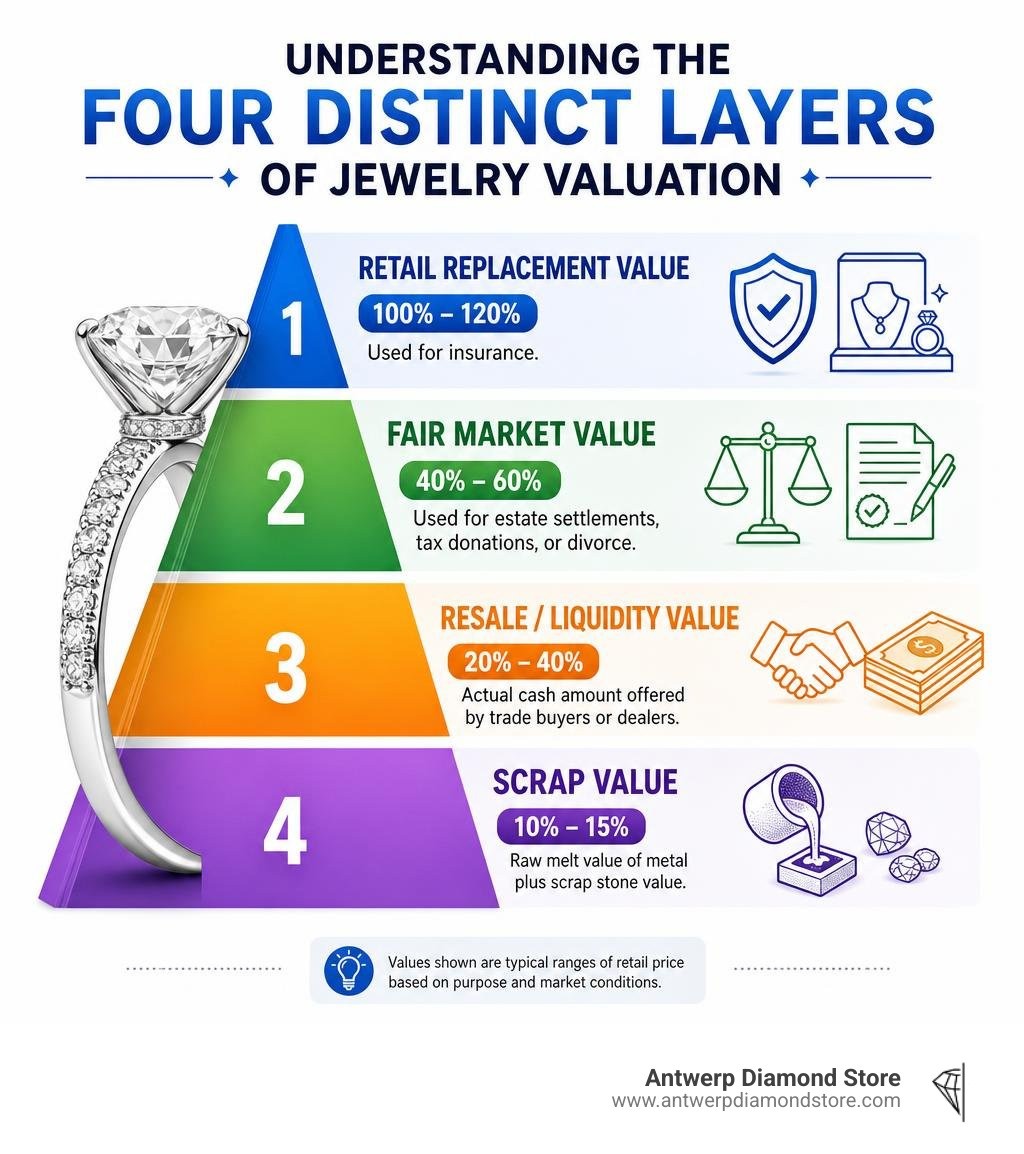
Retail Replacement Value (100% – 120% of retail price): Used for insurance policies. It estimates what a brick-and-mortar jewelry store would charge to recreate or replace the item brand-new at current retail prices, accounting for store overhead, labor, warranties, and insurance buffers.
Fair Market Value (40% – 60% of retail price): Used for estate settlements, tax donations, or divorce division. It reflects an agreed price between a willing buyer and seller in a normal market without time constraints.
Resale / Liquidity Value (20% – 40% of retail price): The actual cash amount trade buyers, estate dealers, or immediate cash buyers can offer. Secondary market buyers purchase at wholesale floor prices because they must account for holding costs, resale risks, and market fluctuations.
Scrap Value (10% – 15% of retail price): The raw melt value of the precious metal plus scrap stone value.
Understanding this gap protects you from unrealistic expectations. If you want to estimate what your diamond ring might fetch on the secondary market today, try our Diamond Resale Value Calculator. You can also run figures through this external Diamond Appraisal Calculator or consult this guide on Diamond Ring Value Realities.
When you are ready to sell, working with direct cash buyers ensures transparent, stress-free transactions. At Antwerp Diamond Store in Atlanta, GA, we purchase luxury watches, fine jewelry, and designer pieces for immediate cash. We provide private, appointment-only consultations with transparent market-based offers and instant payouts without hidden fees or guesswork.
Frequently Asked Questions About GIA Ring Appraisals
Why is my ring appraisal value higher than the purchase price?
It is common for an insurance appraisal provided by a store to be 10% to 30% higher than what you actually paid. Retailers and appraisers build in an "insurance buffer."
This buffer protects you against sudden spikes in gold spot prices or diamond market shifts over a multi-year period. It ensures that if your ring is lost or stolen three years from now, your insurance payout will still cover the full cost of crafting an exact duplicate from scratch. However, an inflated appraisal figure also leads to higher monthly insurance premiums!
How do I verify if a GIA report is authentic?
Fraudulent certificates do exist, but GIA makes verification easy:
GIA Report Check: Visit GIA's official website or scan the QR code printed on the physical report. Enter the unique GIA report number and carat weight to view the digital record directly from GIA's database.
Check the Girdle Inscription: Use a jeweler’s loupe (10x magnification) to examine the laser-inscribed GIA report number on the outer edge (girdle) of your diamond.
Security Features: Physical GIA paper reports contain high-tech security attributes, including security screens, microprint lines, and reflective holographic seals.
How often should I update a diamond ring appraisal?
You should update your ring appraisal every 2 to 3 years. Metal prices fluctuate constantly—gold and platinum markets can shift dramatically in a short period. Furthermore, diamond trade indices move over time.
Keeping an updated appraisal on file with your insurance provider guarantees you aren't underinsured (which leaves you vulnerable during a loss claim) or overinsured (which wastes money on inflated monthly premiums).
Conclusion
To recap: a gia ring appraisal involves two distinct but complementary tools. The GIA report provides an unchanging, scientifically rigorous evaluation of your diamond's quality parameters (the 4Cs). An independent jewelry appraiser then takes those verified specs, examines the mounting and metal, checks live market trends, and calculates a monetary value.
Whether you need an appraisal to schedule an insurance policy, handle an estate, or sell an inherited ring, knowing the difference between retail replacement value and cash liquidity value puts you in total control of your financial decisions.
If you are looking to monetize fine jewelry, engagement rings, or luxury timepieces, we are here to help. At Antwerp Diamond Store in Atlanta, GA, we offer free, no-obligation evaluations in a private, discreet setting. We calculate fair market values based on live secondary market data and offer instant cash payouts.
Ready to explore your options? Check out our guides on how to Calculate Diamond Price, learn How to Sell Diamonds safely, or review options to Sell Diamond Ring Online. If you are local to the Atlanta area, you can also search how to Sell My Diamond Ring Near Me and schedule a private consultation with our team today!