

If you're holding a loose diamond or a ring and trying to figure out what it's really worth, start with the seller's math, not the showroom price. To calculate diamond price the way a buyer does, you begin with price per carat, then adjust for the stone's 4Cs, weight band, and the reality of what the market will pay.
That matters because the number on a retail tag and the number on a cash offer are not the same thing. If you want a defensible figure for resale, a loan, or an appraisal discussion in Atlanta, Buckhead, Sandy Springs, Alpharetta, Roswell, Brookhaven, or Midtown Atlanta, you need a benchmark that reflects trade pricing, not marketing.
Table of Contents
What Sellers Really Need to Calculate Diamond Price
You're not trying to impress a jeweler. You're trying to walk in with a number that holds up when someone inspects the stone. That's the whole game, and it starts with a simple trade habit, price per carat multiplied by carat weight.
The same logic shows up in broader pricing strategy too. If you want a clean model for how to think about margins and market value, the framework in ways to price a product for profit is a useful reminder that price is built from benchmarks and adjustments, not wishful thinking.
Practical rule: sellers should treat the first number as a benchmark, not a final offer.
The seller's mental model
A buyer looks at the stone in layers. First comes the report, then the weight band, then the market comparison, then the condition and demand on that day. If you skip any of those, you'll get the wrong answer.
The cleanest starting point is the 4Cs, but not as a slogan. You want carat, cut, color, and clarity written down before you do anything else. From there, you convert the diamond into a per-carat benchmark and test it against current trade reality.
What you're actually trying to learn
A retail quote tells you what a store wants to charge. A seller needs to know what a dealer might pay, what a reseller might discount, and where the stone sits inside the market. Those are different numbers, and pretending they're the same is how sellers end up in a weak position.
A good self-check is simple. If you don't know the exact carat weight, the grading lab, the shape, and the clarity cell on a pricing chart, you're not ready to negotiate yet. Get those basics right first, then price the stone.
Reading the 4Cs From a Grading Report
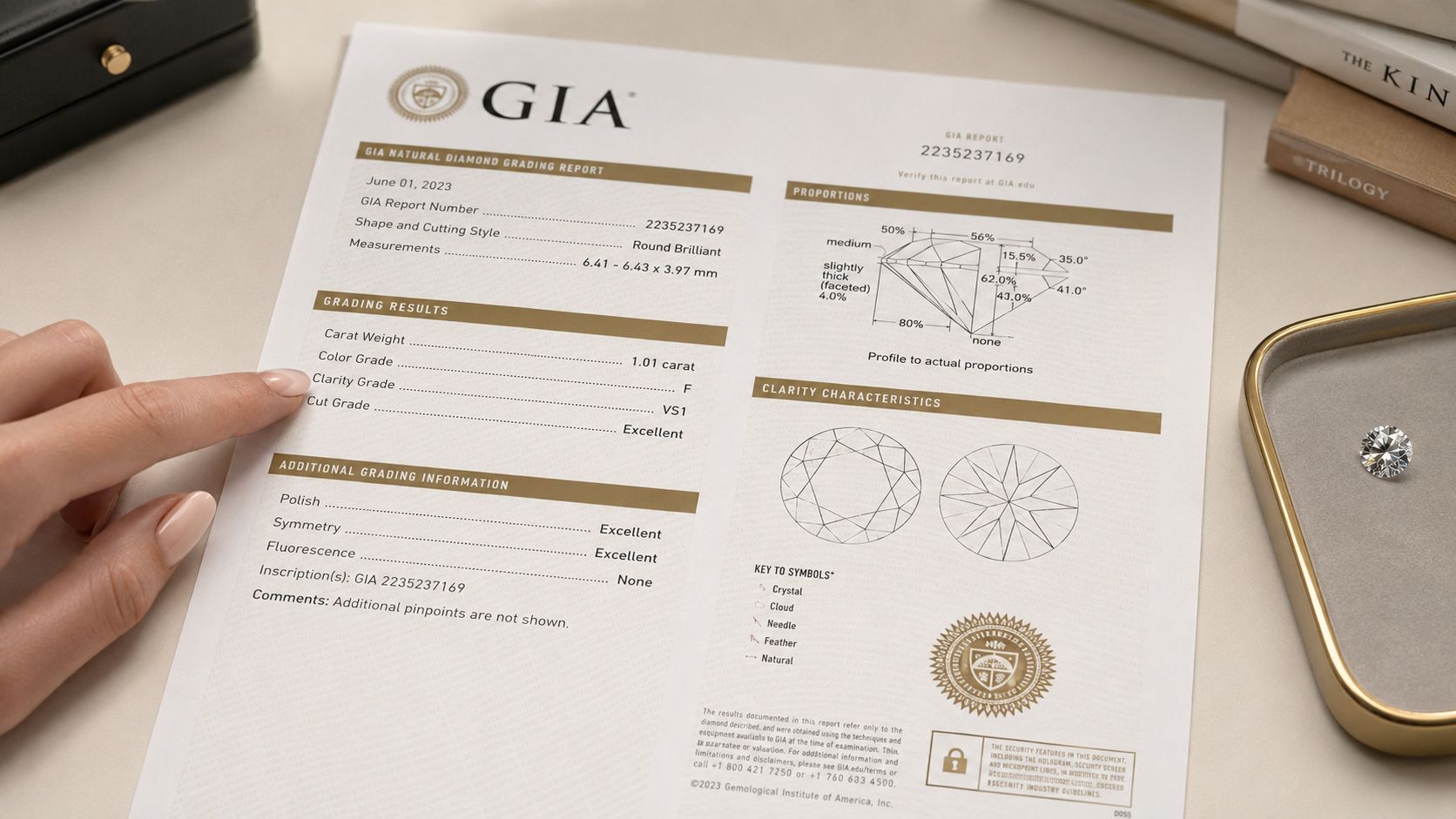
A grading report is your starting sheet, but buyers don't weigh all four Cs the same way. Carat sets the scale, color and clarity place the stone on a price chart, and cut shapes how the diamond behaves in the market. If the report is from a recognized lab, that credibility itself helps the conversation, because buyers trust standardized grading more than a seller's memory.
The key is to copy the report exactly. Write down the carat weight, shape, cut grade if the lab lists it, color, clarity, fluorescence, and the lab name. That's the data set a buyer will use, not the story around the stone.
What buyers actually penalize
Clarity is where sellers make lazy assumptions. VS1 and VS2 are not the same thing, even if the difference feels small on paper. Buyers also care whether the inclusions are easy to spot without magnification, because that affects how quickly they can move the stone.
Cut deserves respect, but don't assume every Excellent grade pays the same. A paper grade is helpful, but light performance, proportions, and shape still affect the final offer. Fluorescence can also change the number, especially if the stone has a look buyers don't love.
A strong grading report doesn't guarantee a strong offer. It just keeps the conversation grounded.
If you're comparing engagement rings or loose stones, the report should also be checked against the setting and any prior paperwork. A ring with clean documentation usually gives a buyer more confidence than a stone with missing or mismatched details.
For a seller in Georgia, that paperwork matters just as much as the diamond itself. If you need a local reference point, this guide to GIA-certified engagement rings is a helpful companion when you're sorting out what the report is really telling you.
What to copy before you ask for a price
Carat weight: Use the exact figure on the report, not a rounded guess.
Color grade: Note the letter grade exactly as listed.
Clarity grade: Record the grade and any inclusion plot details.
Cut and polish: Keep these separate if the lab lists them.
Fluorescence: Buyers often look at this more closely than sellers expect.

Pulling a Real Benchmark Price Per Carat
The clean trade method is old-school and efficient. Find the weight tier, match the color and clarity cell, read the base per-carat rate, then multiply by carat weight. That's how pricing charts are used in the trade, and it's why two stones with nearly identical specs can still land in different places.
One practical example from the market is an I-color, VVS2 stone priced at $3,000 per carat, which puts a 0.46 ct round diamond around $1,380 when you multiply the rate by weight, as shown by the Gem Society example in the source data. The logic is simple, but only if the weight band and quality cell are correct.
A seller should also respect how sharply benchmarks move with size. In the 54,000-stone study, the logged relationship between carat and price was nearly linear, with R-squared of 0.933 and a slope of 1.68, which means weight explains most of the price variation in logged terms. The same dataset showed prices from $326 to $18,823, with a mean of $3,933 and a median of $2,401. (DataBurton diamond research)
Weight bands matter more than people think
The market doesn't price diamonds like a smooth spreadsheet. It behaves in steps, especially around popular thresholds. A seller who understands those jumps can see why a stone just under a band can look cheap on paper and still be very attractive to a buyer.
Weight band | Avg price per carat (USD) | Why it matters |
|---|---|---|
Under 0.50 ct | 2,190 | Smaller stones sit in a different price zone and don't follow the same per-carat logic as larger goods. |
0.51 to 0.99 ct | 2,896 | This band often gives sellers the first meaningful jump in benchmark behavior. |
2.00 to 2.99 ct | 8,918 | Larger stones command much stronger per-carat pricing. |
4.00 to 4.99 ct | 16,587 | High-carat stones can move into a much different value class. |
Those averages show why it's a mistake to blend all diamonds into one number. The same report grade can produce very different pricing depending on where the stone sits in the size ladder. See the diamond resale value calculator if you want a seller-friendly way to frame the benchmark before you negotiate.
Applying Adjustments for Cut, Fluorescence, and Market
The chart price is not the offer. A buyer looks at the stone, then adjusts for details the chart can't fully capture. That's where many sellers get surprised, because the final number is shaped by how the diamond presents in front of someone with cash on the table.
One important reality is that price can fall even when weight loss seems modest. The University of Texas gem notes show that a 1 carat diamond recut for proper proportions can lose 28% of its weight, while a hypothetical 1 carat G, VS2 stone can drop from $3,600 to about $2,736, which is a drop of roughly 45% because price per carat is lower for lighter stones. (UT diamond pricing notes)
The adjustments buyers actually make
Cut precision matters because a diamond that performs well can move faster. A buyer will care whether the proportions support brilliance, not just whether the report says the cut is clean. That's one reason sellers should never stop at the label.
Fluorescence is another common adjustment. A stone can look great under normal light and still be discounted if the buyer thinks the fluorescence hurts its marketability. Shape also matters, because round brilliants are usually treated differently from fancy shapes in the trade.
Practical rule: if the stone has a lab report, a strong face-up look, and clean proportions, the buyer has less room to discount on feel.
The lab matters too. A recognized grading lab reduces uncertainty, while weaker paperwork gives buyers an excuse to widen their spread. Condition, especially on mounted stones, matters as well, because the buyer is thinking about what it will take to resell the piece.
For deeper reading on how internal features affect pricing, the guide to inclusions in a diamond is a solid companion. That's where a lot of seller confusion starts, because tiny internal marks can affect the trade more than is commonly expected.
A simple seller's checklist
Check cut precision: Look beyond the grade and ask how the stone faces up.
Review fluorescence: Strong fluorescence can pull a buyer down on price.
Confirm shape: Round stones and fancy shapes do not always trade the same way.
Verify the lab: Better paperwork usually narrows the buyer's discount.
Inspect condition: Chips, repairs, and setting wear all affect the offer.
Why Two Stones With the Same 4Cs Can Price Differently
Two diamonds can read the same on paper and still land in different price bands. That's not a contradiction, it's normal trade behavior. Buyers pay for how easily a stone can be moved, how it looks in person, and whether it sits on the right side of a popular weight threshold.
The weight bands matter because the market pays attention to milestones like 0.50 ct, 0.75 ct, 1.00 ct, 1.50 ct, and 2.00 ct. Industry guidance notes that those thresholds can create 10% to 25% pricing increases even when the visual difference is minimal. (Labrilliante diamond pricing guide)
The 0.99 ct versus 1.01 ct problem
A 0.99 ct and a 1.01 ct stone can look nearly identical to the eye, yet buyers may treat them as different inventory classes. The 1.01 ct stone may sit in the more desirable band, while the 0.99 ct stone stays on the lower side of the threshold.
That's why a seller should expect a spread, not a single perfect number. The smaller stone can still be very attractive, especially if it looks cleaner or faces up better, but the trade often rewards the threshold more than the eye test.
The character of the stone matters
Inclusions that sit under the table, faint color zoning, and light return all influence the final offer. A stone with the same grade but a stronger face-up look can sell more easily, so the buyer protects margin differently. Liquidity matters too, because a diamond that moves quickly is a safer purchase than one that sits.
Lab-grown stones add another wrinkle. They may share the same basic grading vocabulary, but the market doesn't treat their resale path the same way. That difference matters when a seller uses the wrong comparison set and wonders why the offer feels low.
Same 4Cs on paper doesn't mean same money in the real world.
Natural Diamonds vs Lab-Grown Pricing
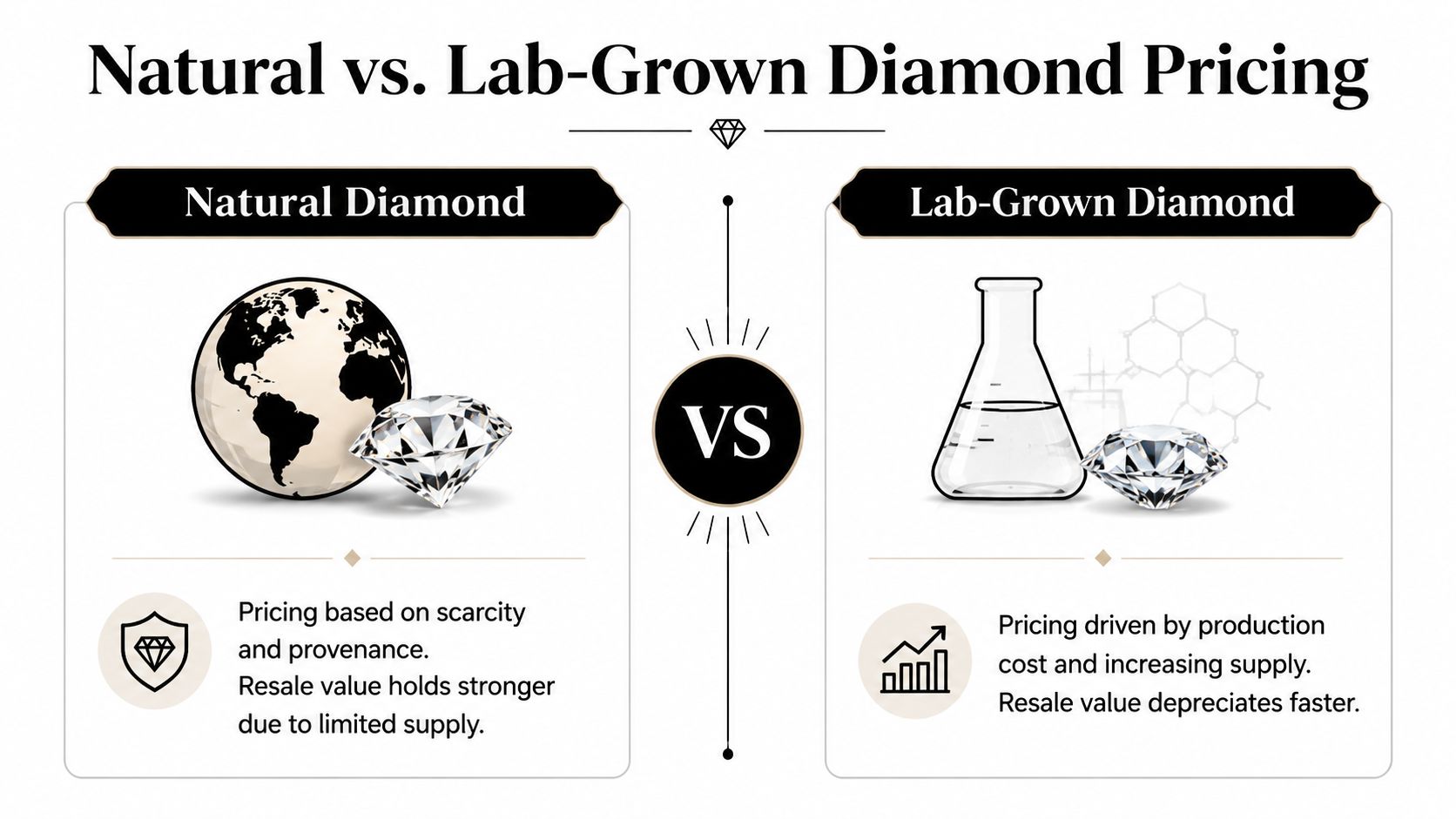
A single calculator formula doesn't fit both markets anymore. Natural diamonds and lab-grown diamonds now behave like separate pricing ecosystems, and sellers who use the wrong one end up with a fantasy number instead of a dealable number. The 4Cs still matter, but they don't mean the same thing in both markets.
Newer calculator designs reflect that split by adding valuation purpose, certification, fluorescence, market strength, and even currency. That's a sign the old one-size-fits-all model is outdated. If you're pricing a lab-grown stone, don't borrow a natural-diamond yardstick and pretend the output is comparable. The oval lab-grown diamond guide is a practical example of how shape and market category change the conversation.
How sellers should think about the difference
Natural diamonds are priced around scarcity, provenance, and trade demand. Lab-grown diamonds are priced much more like manufactured goods, where supply and replacement cost play a bigger role. That changes resale behavior, because the buyer's offer is tied more tightly to what can be sourced now.
The right benchmark also depends on purpose. Insurance, resale, and upgrade trade-in are not the same exercise. A calculator can help with all three, but the output means something different in each case.
The cleanest approach is to use the calculator as a comparable. Don't treat it as a final offer. That's especially true for lab-grown stones, where the spread between buy price and sell price can be much wider than sellers expect.

Reading a Buyer Offer and Maximizing Your Sale
An online estimate is a reference point, not a promise. Several calculator pages frame the result as an estimate, and the transaction can land 15% to 30% above or below the displayed figure depending on cut, fluorescence, certification lab, and the stone's character, according to the source data provided. That's the spread sellers need to plan for, not ignore.
A buyer's desk is where the estimate gets tested. If the stone is well documented, cleanly graded, and easy to place into current demand, the offer tends to tighten. If the paperwork is weak or the appearance doesn't match the report's promise, the buyer widens the gap.
Get ready before you ask for a quote
Gather the report: Bring the grading paperwork, not just the jewelry box.
Confirm the weight: Verify the carat weight to two decimals.
Check the stone face-up: Note inclusions under the table or anything visible without effort.
Save the supporting paperwork: Prior appraisals, setting details, and receipts help a buyer move faster.
Decide on your goal: Sale, loan discussion, or appraisal context changes the conversation.
If you want a real offer instead of a rough estimate, in-person evaluation still wins. Antwerp Diamond Store in Buckhead works as one local option for sellers who want authentication, condition review, and a clear no-obligation offer, and remote sellers can use insured mail-in service if they're not nearby. For a separate seller's guide, how to sell a diamond ring online is a useful read before you decide whether to ship or walk in.
If you want a straight answer on what your diamond can actually bring in today's market, bring it to Antwerp Diamond for a private evaluation. The team can review the grading report, confirm the weight and condition, and give you a clear offer based on real resale demand. Visit Antwerp Diamond to start with a confidential assessment in Atlanta or by secure mail-in service.


