
Oval lab grown diamonds are typically 60% to 80% cheaper than natural equivalents, and by 2025 they were no longer a niche buy, they sat inside a mainstream diamond market projected to account for 21.3% of total demand. If you're selling one, the market reality is simple, value depends on cut, proportions, documentation, and how closely the stone matches what buyers want right now.
That's the hard truth clients need before they shop, sell, or ask for an offer. An oval lab grown diamond can look larger than a round stone of the same carat, but it only brings strong money if it faces up well, has clean paperwork, and presents without obvious proportion problems.
Table of Contents
What Makes Oval Lab Grown Diamonds Different
Oval lab grown diamonds are real diamonds created in controlled environments, and they now trade in a market that has moved from niche to mainstream at speed. GIA cites an industry estimate of 6 to 7 million carats of gem-quality laboratory-grown diamond production in 2020, with China at about 3 million carats, India at about 1.5 million carats, and the United States at about 1 million carats. By 2025, Statista projected lab-grown diamonds to account for 21.3% of the total diamond market, while Fortune Business Insights valued the global lab-grown diamond market at USD 29.46 billion in 2025 and projected growth to USD 91.85 billion by 2034 at a 13.42% CAGR. GIA market summary

Why the oval shape matters
Oval is attractive because it gives buyers the look of a larger stone without the price of a comparably sized mined diamond. It also sits well on the finger, which keeps demand steady in engagement-ring markets and helps explain why oval remains one of the most searched lab-grown shapes in 2025 shape rankings. That matters for sellers because a shape with broad buyer recognition is easier to place, especially when the stone is well cut and the paperwork is clean.
Practical rule: A lab-grown oval is only “easy to sell” if it looks attractive on video and in person. Paper alone does not move the offer.
The term lab grown does not mean imitation in the costume-jewelry sense. It means the diamond was grown by HPHT or CVD, then cut and finished as a diamond, with the same core diamond properties buyers expect in mined stones. For resale, that distinction matters less as a branding point than as a pricing reality, because the market now treats lab-grown as its own category with its own supply and demand.
If you want a plain-language refresher on diamond identity, the article on genuine diamond meaning is a useful companion. It helps separate technical fact from marketing language, which is exactly what sellers need before they accept an offer.
How Oval Lab Grown Diamonds Are Made and Graded
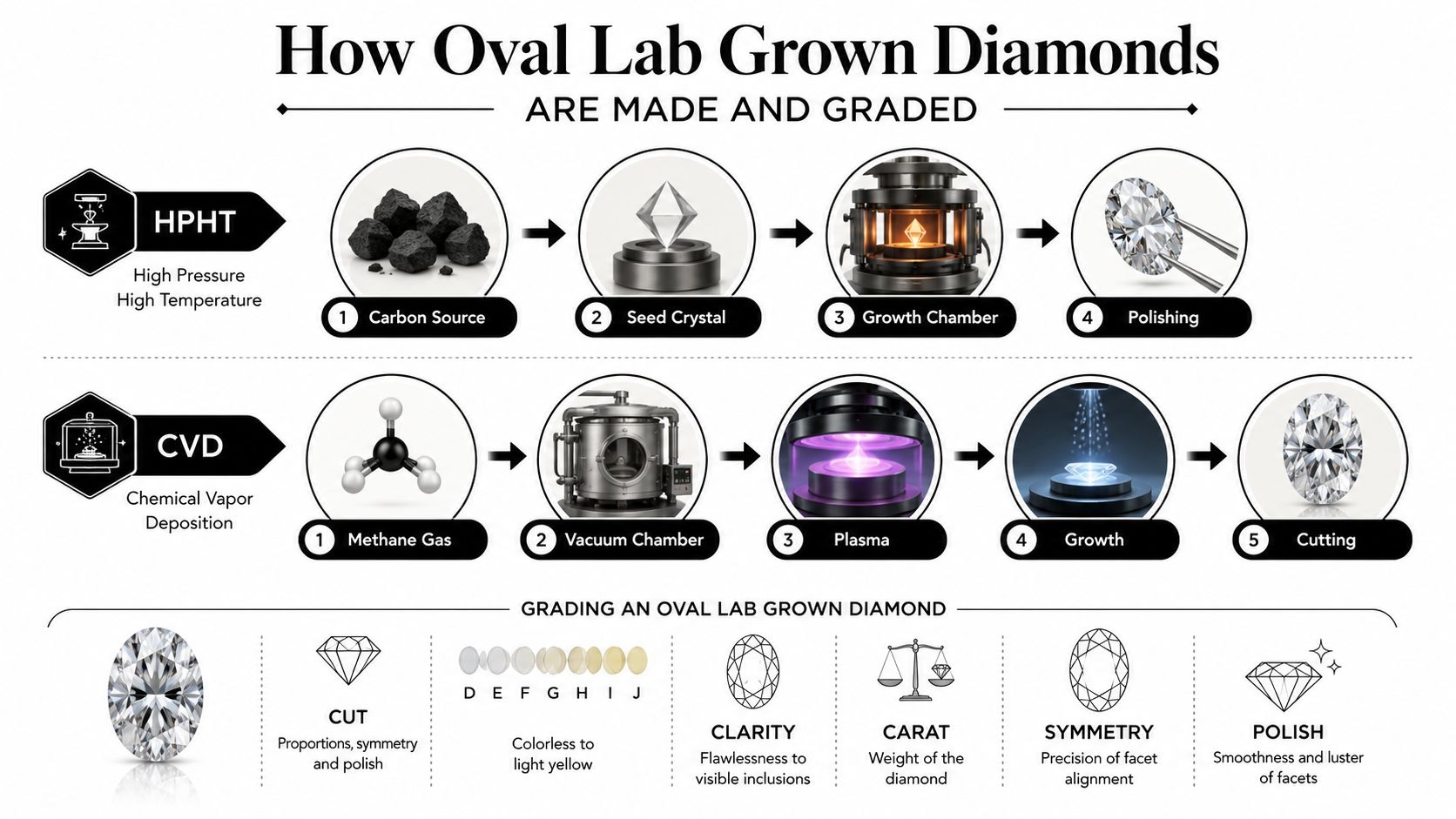
Oval lab grown diamonds are made by HPHT or CVD, and both methods produce a diamond with the same basic composition as a mined stone. The difference shows up in how the crystal grows, how the finished diamond handles light, and what a buyer notices under inspection. The growth method doesn't change the fact that it's a diamond, but it can affect how the stone is selected, priced, and compared against similar listings.
HPHT and CVD in plain English
HPHT uses high pressure and high temperature to grow diamond from a carbon source around a seed crystal. CVD uses a vacuum chamber, gas, and plasma to build diamond layer by layer. Both are legitimate diamond growth methods, and both can produce excellent stones when the cut is handled well.
Certified examples show why buyers still read the measurements closely. One 1.00 ct oval HPHT lab diamond measures 8.11 x 5.68 x 3.51 mm with 61.8% depth and 61.0% table, while a 2.54 ct oval IGI-certified stone measures 11.12 x 7.68 x 4.80 mm with 62.5% depth and 61% table. Those figures show the practical tradeoff, more depth can hide weight inside the stone, while a well-proportioned oval can show more spread for the same carat weight. Certified oval measurements
A buyer pays for what the eye sees first. Hidden weight still counts on a report, but it doesn't impress on the hand.
What grading actually influences offer levels
Lab-grown ovals are usually evaluated on color, clarity, carat, polish, symmetry, and proportion, not on a standardized oval cut grade the way round brilliants are. That means the same reported carat can produce very different market responses. Two stones with similar paper can land in very different price bands if one faces up clean and balanced, while the other looks heavy or poorly shaped.
A seller should assume that growth-related features matter most when they affect confidence. If a stone looks clean, symmetrical, and well spread, buyers are more willing to lean into the purchase. If the oval looks uneven or carries obvious visual issues, the offer will reflect that immediately.
The right takeaway is simple. A lab-grown oval's value is visual first, technical second, and paperwork third, but all three matter. That's how professionals evaluate it in the market.
Comparing Oval Lab Grown to Mined Diamonds
The price gap is the first thing most clients notice, and it's the reason many choose lab-grown in the first place. One industry source said oval lab-grown diamonds are often 60% to 80% cheaper than natural equivalents, and another market summary put typical savings around 30% to 60% depending on the comparison point. That range tells you the market is not pricing lab-grown ovals as substitutes for mined stones, it's pricing them as a separate, value-driven category. Lab-grown oval market summary
The visual upside is just as important. Buyers often choose an oval lab-grown diamond because it offers a larger-looking face-up appearance at a lower cost than a mined stone with similar visible quality. That is why the shape remains attractive in engagement jewelry, especially for buyers who want presence on the finger without paying mined-stone pricing.
Characteristic | Lab Grown Oval | Mined Oval |
|---|---|---|
Price position | Usually much lower than mined equivalents | Higher purchase cost |
Face-up appearance | Often looks larger for the carat | Can look equally elegant, usually at a higher cost |
Market category | Mainstream lab-grown segment | Traditional diamond segment |
Buyer focus | Value, size, proportion, documentation | Rarity, tradition, and natural origin |
Resale expectation | Driven by current lab-grown demand and stone quality | Driven by natural diamond demand and grading |
The comparison that matters for resale is not sentimental, it's transactional. Buyers of lab-grown stones care about how the stone presents, how efficiently it was cut, and whether the certificate supports confidence. Buyers of mined ovals still weigh the same visual issues, but they're also paying for the natural origin premium, which changes the pricing structure completely.
If you want a separate baseline on how loose diamonds are priced in the broader market, compare pricing can help you think through the difference between listing logic and actual buyer offers. Use that kind of reference as a starting point, not as a substitute for hands-on evaluation.
Evaluating Cut Quality and Proportions
Oval lab grown diamonds live or die on proportions. The cut decides whether the stone looks balanced, bright, and worth a serious offer, or whether it looks stretched, sleepy, and harder to move. A good oval can hold buyer interest. A weak one gets discounted fast.
The desirable length-to-width range commonly lands near 1.3:1 to 1.7:1, with many buyers preferring 1.5:1 to 1.6:1 for a balanced outline. A neutral 2026 reference says the most-shopped oval variable after bow-tie is the length-to-width ratio, with a preferred range of about 1.35:1 to 1.50:1 and a modal retail preference around 1.40:1 to 1.45:1. Oval ratio guidance
What a buyer checks
Professional buyers look at table, depth, symmetry, and the millimeter footprint, not just the carat number on the report. The same carat weight can look larger or smaller depending on how the stone distributes weight. A deeper stone can hide mass below the girdle, while a better-balanced oval can project more size from the top.
The practical ranges to remember are table around 53% to 63% and depth around 58% to 62.5%. Those proportions do not guarantee a beautiful stone, but they give a serious buyer a useful starting point for judging spread and light return. If a seller cannot speak to these basics, the buyer will usually assume the stone is average at best.
Direct advice: If the report looks fine but the oval seems too deep or too narrow on video, trust the video. The eye catches what the certificate cannot.
Why video matters more than paper for ovals
Oval cuts are especially prone to the bow-tie effect, that dark zone across the center that can make a stone look dull in real life. Buyers need 360° video because the same ratio can behave differently depending on how the stone was cut and polished. The shape can look elegant in one clip and awkward in another, even when the lab report looks similar.
For sellers, that means one thing. Do not rely on carat alone. Have the stone viewed in motion, under neutral lighting, with side and face-up angles included. A buyer who sees a clean, symmetrical, lively oval is far more likely to make a stronger offer than one who only sees a number on paper.
The page on GIA certified engagement ring is helpful if you want to understand why certification language matters so much during evaluation. For ovals, certification supports trust, but the visual test still decides most of the conversation.
A seller who wants a fair read should also use a realistic pricing baseline before talking numbers. A tool like compare pricing helps frame the discussion, but a buyer still prices the actual stone in front of them, not an abstract chart.
For a broader price reference, see how much a diamond is worth. That context matters, because buyers factor in proportions, video performance, and documentation together, then decide whether the stone deserves a firm offer or a cautious one.
Understanding Pricing Trends and Market Value
Oval lab grown diamonds have seen a hard reset in pricing, and buyers price them against current wholesale reality, not old retail tags. One industry pricing record reported a 1.5-carat lab-grown emerald-cut diamond at USD 10,300 in 2016, falling to USD 3,975 by 2021, while another summary said the average 1-carat lab-grown diamond was around USD 1,000 or less in 2025 versus about USD 4,200 for a similar natural diamond. That same source stated wholesale lab-grown prices dropped 37% year over year and had declined about 96% over seven years, with early-2025 per-carat pricing near USD 168. Lab-grown diamond price history

What those numbers mean for sellers
Sellers need to price against the market that exists now. Stones bought at a premium years ago rarely bring that original retail figure back, because buyers can source from a wider supply at lower price points. That does not make the stone weak. It means the offer will follow replacement economics, condition, and how cleanly the diamond presents, not the amount paid at checkout.
For oval lab-grown stones, shape still affects the offer. Ovals can trade at a discount to round brilliants at the same grade, and lab-grown ovals often sit well below natural equivalents. That is why the strongest offers go to stones with balanced proportions, clean certification, and strong visual appeal. Buyers pay for a stone that photographs well, faces up well, and comes with paperwork they trust.
Video helps sellers see where their stone sits before they ask for numbers. The footage below is worth reviewing alongside the report, because it shows how buyers assess current pricing and market position.
If you want a broader price reference for loose diamonds, a guide to diamond pricing gives useful context. Use it as a baseline only. A buyer still values the specific oval lab-grown stone in front of them, with its condition, documentation, and presentation carrying real weight in the final offer.
A seller who wants a realistic read should also use compare pricing before talking numbers. That helps frame expectations, but the market will still pay for the actual stone, not a generic chart.
Preparing to Sell Your Oval Lab Grown Diamond
Start with the documents. Bring the certificate, the original purchase receipt if you have it, and any appraisal report or service paperwork that came with the piece. Buyers use those documents to confirm identity, origin, grading language, and chain of information, and missing paperwork can slow down or weaken the first offer.
What to check before you ask for an offer
Look at the stone under bright, neutral light and be honest about condition. Chips, scratches, worn prongs, and any cloudiness should be disclosed up front. If you hide a defect, the buyer will find it during inspection, and the revised offer usually feels worse than a transparent one would have.
Certificate Match: Verify that the stone, measurements, and report number match the piece you're offering.
Condition Notes: List chips, abrasion, loose settings, or visible wear before evaluation.
Photos and Video: Capture the stone in daylight and in a clean indoor setting so the buyer can judge spread and symmetry.
Ownership Paperwork: Keep receipts and prior appraisals together, even if you think they're not critical.
Storage Care: Use a soft pouch or box so the stone doesn't pick up avoidable damage before review.
How to choose the evaluation route
An in-person evaluation usually gives the fastest read when you're nearby. Antwerp Diamond offers private appointments in Atlanta, Buckhead, Sandy Springs, Alpharetta, Roswell, Brookhaven, Midtown Atlanta, and the broader Georgia market, plus additional locations including Roswell, Las Vegas, Fort Lauderdale, and Houston by appointment. For remote sellers, insured shipping is the practical path when travel isn't realistic.
The diamond resale value calculator is a useful place to start if you want to frame expectations before you walk in. It won't replace a hands-on assessment, but it can help you think more clearly about what influences a professional buyer.
Clear disclosure helps. If the stone has an issue, naming it early usually saves time and keeps the conversation focused on real value.
Next Steps for Confident Selling
An oval lab grown diamond is not priced like a natural diamond, and it shouldn't be evaluated like one either. The offer depends on cut quality, proportions, documentation, condition, and how cleanly the stone presents in real viewing, especially on video and under neutral light. Sellers who understand that framework usually negotiate with more confidence and less frustration.
The smartest move is to put your stone in front of a buyer who looks at current market data, not old retail expectations. That's where a no-obligation review matters, because it gives you a concrete offer grounded in the way today's lab-grown market trades. If you're comparing options, the article on where to sell loose diamonds can also help you think through your next step without pressure.
Antwerp Diamond handles this kind of evaluation for clients who want a clear read on jewelry, loose diamonds, and other luxury assets. If your oval lab grown diamond is ready for review, bring it in, request a private appointment, or start with a remote evaluation so you can see what the market says before you decide.
If you're ready to move from speculation to a real offer, contact Antwerp Diamond and request an evaluation for your oval lab grown diamond. Bring the certificate, tell the full condition story, and let a professional buyer price it against today's market instead of yesterday's retail tag.


