
You can get a useful watch appraisal online without leaving home, but only if you understand what the number really is. In practice, most online tools deliver a market estimate, while a formal appraisal is a different thing and usually needs physical inspection. That distinction matters whether you're selling a Rolex, checking a Patek Philippe purchase, or deciding what to do with a Cartier you haven't worn in years.
Table of Contents
What an Online Watch Appraisal Actually Delivers
You've got the watch in a drawer, you know it has value, and you don't want to waste time driving across town just to hear a rough number. That's exactly where watch appraisal online is useful, because it gives you a fast sense of market position before you commit to a sale, insurance review, or in-person appointment. It's also where a lot of owners get tripped up, because a digital estimate is not the same thing as a formal appraisal.
Market estimate versus formal appraisal
A good online tool gives you a directional value, usually based on brand, model, condition, completeness, and recent market evidence. A formal appraisal is different, because expert guidance says it's a legal document that generally requires physical inspection, while online tools are better for rough estimates or sale-oriented screening. For that reason, many sellers use online valuation first, then move to an in-person review when the watch is rare, vintage, or incomplete.
That distinction is not just technical. It affects what you can do with the result, especially if you need a document for official use or want a number that reflects a serious condition review.
Who benefits most from the online route
Online appraisal is useful for people who want to pre-screen a sale, check whether a private offer is reasonable, or see how box, papers, and service history affect the result. It also helps owners who are updating a collection record, handling estate questions, or sanity-checking a recent purchase. If you're comparing options in Atlanta, Buckhead, Sandy Springs, Alpharetta, Roswell, Brookhaven, or Midtown Atlanta, the remote route can save time before you book a hands-on review.
A solid online estimate should leave you with three things, how the number was built, what evidence supported it, and what to do next. That usually means the appraiser looked at identity, condition, and recent market context, then translated those inputs into a market-facing figure.
Practical rule: If the result doesn't tell you what was checked and what was missing, treat it as a rough lead, not a serious valuation.
Compare local watch appraisal options in Atlanta if you want to understand how remote estimates and in-person review differ in practice.
Preparing Your Watch and Documentation Before You Submit
Most online submissions fail before the appraiser ever starts pricing them. The watch may be real, but the file is incomplete, the photos are soft, or the owner leaves out the very details that determine whether the piece is a watch-only example or a full-set watch with stronger resale appeal. If you want a better answer, your job is to show identity, originality, and completeness as clearly as possible.
The information that matters most
Start with the basics, brand, model or reference number, approximate year of manufacture, movement type, and any complications. Then add the support material that makes the submission traceable, including the box, papers, warranty card, service records, prior appraisal, and purchase receipt. A complete submission gives the appraiser enough evidence to judge the watch instead of guessing from a generic description.
For Rolex, Patek Philippe, and Cartier, that usually means listing the reference cleanly and including any known service history. If you don't know the reference, don't guess. A wrong model number can send the valuation in the wrong direction before the comparison even starts.
Photos that actually help
The photo set should be clear, straight, and honest. Shoot the dial straight-on in neutral light, then add the caseback, clasp, bracelet, crown, serial or reference engravings, and any hallmarks or movement markings that are visible. If you have a box and warranty card, photograph them together so the appraiser can see that the set is traceable.
A useful habit is to include one image that proves completeness, not just beauty. That matters because watch-only prices and full-set prices are often compared separately in the trade, and the missing papers can change how buyers react to the same reference. A Rolex Submariner with papers does not always land in the same market lane as the same reference without them, even when the watch itself looks clean.
The same logic applies to vintage pieces, especially when originality is uncertain. A Patek Philippe with a strong paper trail is easier to interpret than one with a beautiful dial and no supporting records. A Cartier can be straightforward too, but only if the photos clearly show the signature details and the condition of the case and bracelet.
A clean submission doesn't guarantee a higher number, but it does reduce the chance of a weak estimate caused by missing proof.
Review a watch serial number lookup guide if you need help gathering the identifying details before you submit.
How a Serious Online Valuation Actually Works
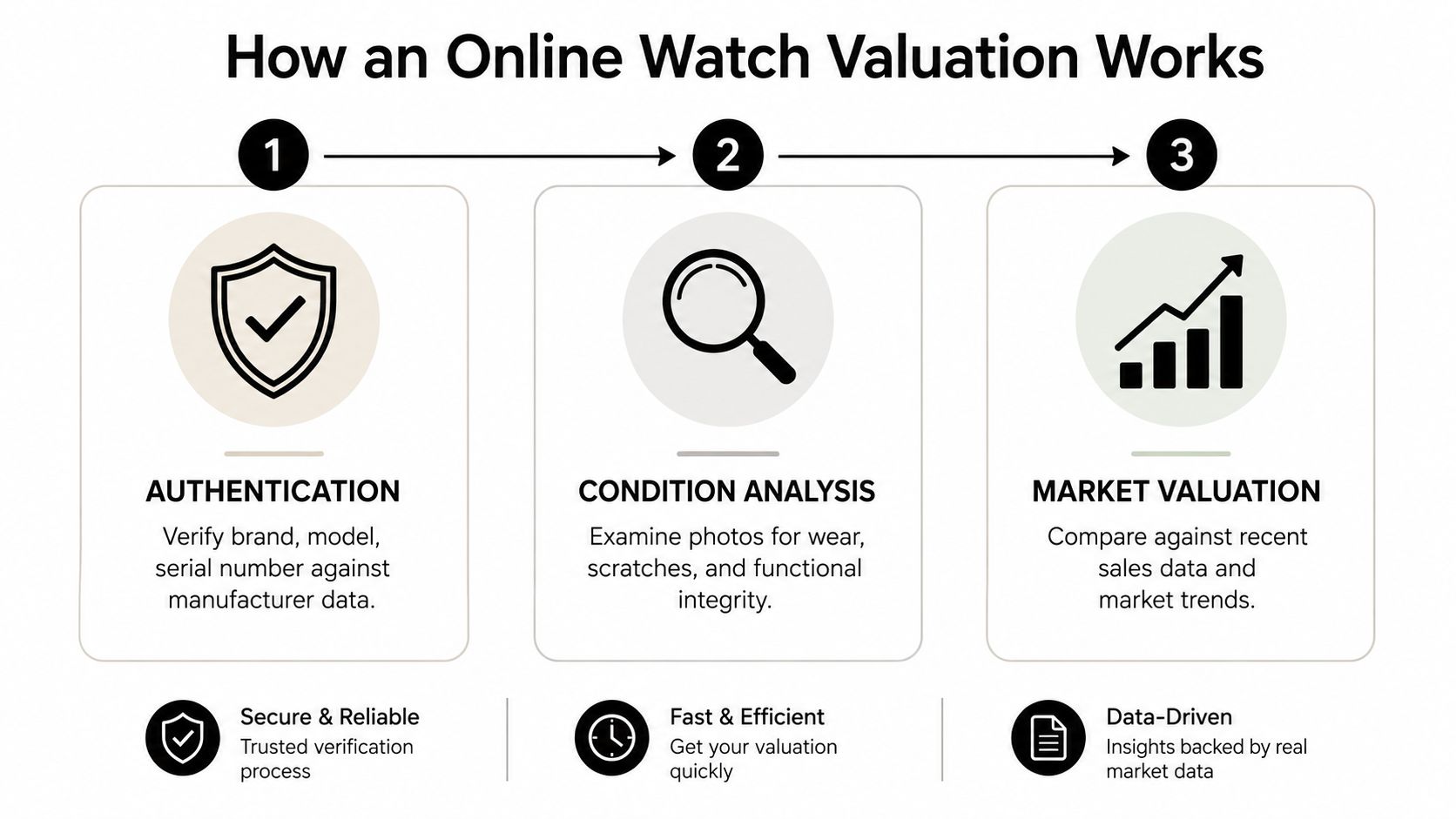
A serious online valuation is not a guess with a logo attached. It follows a three-stage workflow, authentication, condition grading, and market valuation, and each stage changes the final number for a different reason. The stronger the evidence, the more credible the estimate.
Authentication comes first
The first step is to verify the watch's identity. That means checking the brand, model, serial or reference numbers, caseback engravings, and movement markings against the images and the known configuration of the piece. If those details don't line up, the rest of the valuation becomes unstable very quickly.
Online tools do well when the owner provides good photos, and poorly when the submission is vague. A correct reference number means little if the caseback engraving, dial configuration, or movement details don't match what the model should be.
Condition and originality move the number
Condition grading looks at scratches, dial wear, bracelet integrity, service history, and originality. That last word matters more than many owners expect. A watch can be authentic and still lose ground if parts are replaced, the dial has aged unevenly, or the bracelet no longer matches the original configuration.
One industry guide notes that a fully serviced Rolex can add 30 to 50 percent to value [source], which is why service history is one of the biggest variables in a remote valuation. That doesn't mean every service receipt creates a premium, but it does mean a well-documented service record can materially change how the watch is framed by buyers.
For broader context, established valuation guides also weigh condition, originality, rarity, age, materials, and completeness. That's why the absence of box, papers, warranty card, service records, or receipts can change the number even when the watch itself looks fine.
Market valuation uses real comparables
The last stage benchmarks the piece against recent sales data, auction results, dealer transactions, and private-sale comparables. That is where a database with depth and reliability matters. Everywatch says it combines auction results dating back to 1989 from more than 250 auction houses and over 350,000 historical lots, which shows how large historical datasets widen the comparison set beyond one dealer's opinion [source].

If you want a deeper dive into how this works on older pieces, this vintage watch valuation guide is useful background. For another angle on condition assessment, the way HD Asian Art explains sculpture care tips is a good reminder that high-value objects are priced by what can be verified, not just by what looks attractive.
Choosing the Right Online Appraisal Service and Avoiding Scams
A Rolex with service papers, a Patek Philippe with mismatched parts, and a Cartier that only looks clean in photos can all push an online appraisal in different directions. That is why the first job is to identify what kind of service you are using. Some platforms are built to estimate market value from data, some buyers are really giving a preliminary quote, and some independent appraisers are producing a formal report with a paper trail.
Comparing the main service types
Service Type | Data Source | Typical Output | Best For |
|---|---|---|---|
Large data-driven platform | Auction, dealer, and private-sale data | Market estimate | Quick benchmarking and seller screening |
Specialist dealer or buyer | Internal buying experience and market demand | Preliminary offer | Owners who may sell soon |
Independent appraiser | Inspection plus comparable market evidence | Formal report | Documentation-focused needs |
Consumer tools have moved into the mainstream, but the output still depends on the business model behind the screen. WatchPatrol says its appraisal tool uses price data from tens of thousands of recent private watch sales to estimate fair market value, while a buyer-focused service can be built around a faster quote process, as outlined in how online watch buyers typically handle initial quotes. That difference matters. Remote valuation is now fast, yet speed does not tell you whether the result is a market estimate, a purchase offer, or a formal appraisal.
What to check before you upload anything
Start with the company's identity, its data sources, and a plain explanation of how the number is produced. Ask whether the result is binding, directional, or a preliminary offer, because those outputs serve different purposes and should not be read the same way. If the firm will not explain its process, treat that as a warning sign.
Red flag: Instant numbers with no explanation usually hide weak methodology, thin comparables, or a sales pitch disguised as an appraisal.
A few other warning signs stand out quickly. No company information, upfront fees before any review, and unsolicited offers that appear before the watch has even been examined all point to shortcuts that owners regret trusting. The same caution applies whether you are dealing with a vintage Submariner, a modern Nautilus, or a diamond-set Cartier, because glossy presentation can hide poor process.
For Atlanta-area owners, a practical middle path is a free online evaluation first, then an in-person appointment in Buckhead, Roswell, or another nearby office if the watch needs a closer look. That works well when you want to compare a remote estimate with a hands-on review before deciding whether to sell.
The video below is useful if you want to see how a watch appraisal conversation usually unfolds in real life.
For a broader framing of service comparison and buyer behavior, this classic auto appraisal guide from SnapClaim is a good parallel read. The object is different, but the logic is similar. A credible valuation depends on identity, condition, and evidence.
Shipping and Insuring Your Watch Without Taking a Risk
If you're using a mail-in service, the logistics matter as much as the valuation. Owners stall here because they worry about loss, damage, or whether the watch will come back in the same condition. That concern is rational, and the safest providers build the process around insured shipping, signature confirmation, and documented receipt.
How reputable shipping usually works
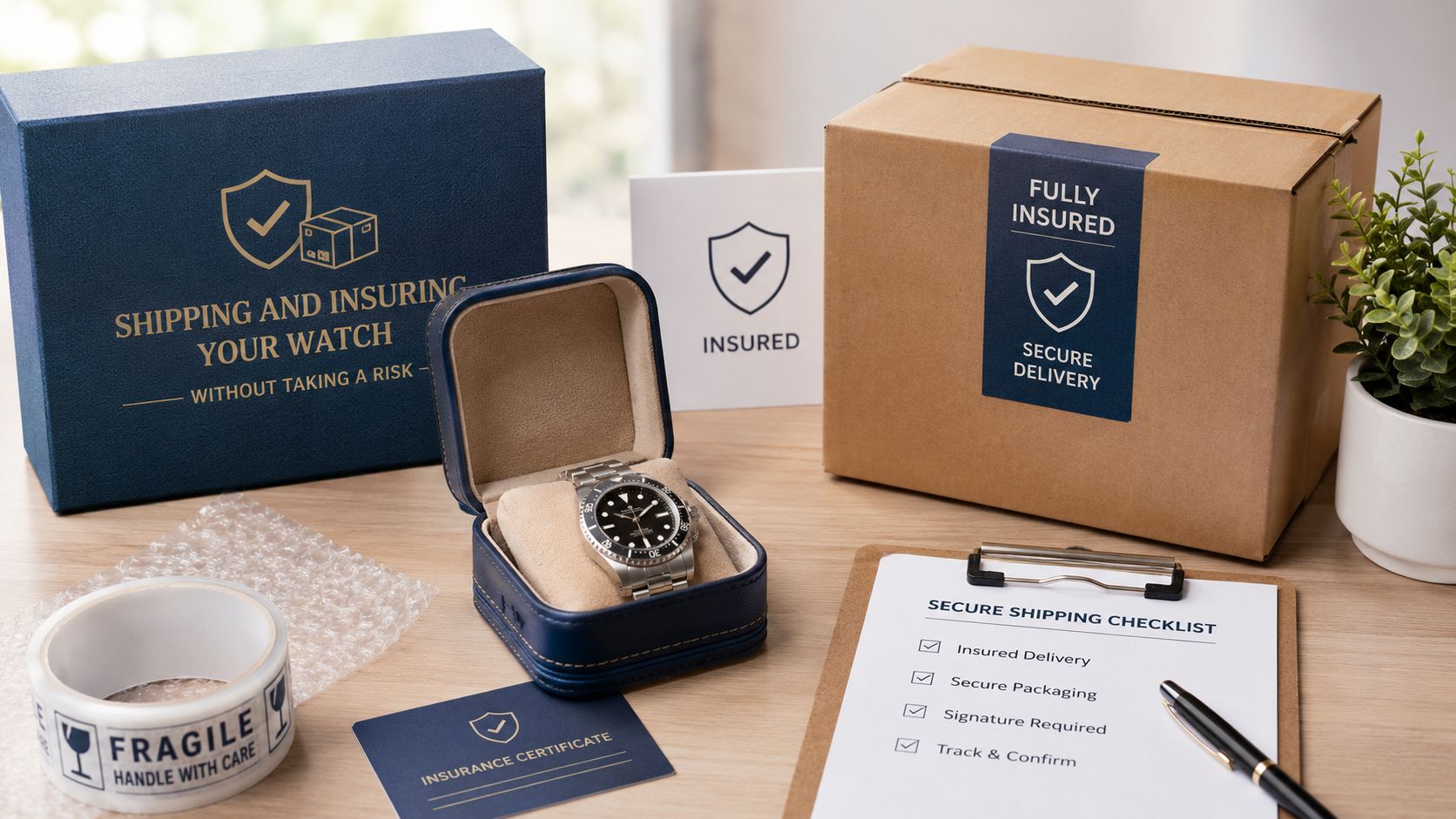
Many major buyers and platforms use a prepaid, fully insured label with signature on delivery. In practice, that means the shipment is tracked, the parcel is covered if something goes wrong, and the watch should not be left unattended at the door. The exact insurance structure depends on the provider, so read the shipping instructions before you pack anything.
The packaging should be simple and secure. Use the original box if you have it, a rigid outer box, padding that prevents movement, and a tamper-evident seal. If you're shipping a watch with a bracelet, make sure it can't rattle inside the case or shift during transit.
In-person drop-off versus mail-in
There are really two practical paths, a fully remote mail-in appraisal or an in-person drop-off. Mail-in is convenient when you live outside the area or want a broader buyer pool, but in-person removes shipping risk entirely and makes it easier to discuss condition details face to face. That can matter for vintage Rolex, complicated Patek Philippe pieces, or Cartier watches with service questions.
For owners in Atlanta, Buckhead, Sandy Springs, Alpharetta, Roswell, Brookhaven, or the greater Georgia market, a local appointment is often the least stressful option. If you're sending a high-value piece by mail, photograph the watch before you ship it, and keep those images as your own record of condition.
Before shipping, confirm who insures the parcel, what the coverage includes, and how the watch is documented on arrival and return.
If you're also thinking about broader protection for valuables, options for protecting valuables can help you think through the right kind of coverage language before you move anything.
Reading the Appraisal and Deciding What to Do Next
A finished appraisal should be readable, not mysterious. The best ones identify the watch clearly, explain the condition, show what was compared, and separate the different value types so you don't confuse one number with another. If the document skips those basics, treat it cautiously.
What to look for in the report
A solid appraisal usually includes brand, model, reference, serial, movement, condition grade, completeness statement, comparable sales, and a value opinion. The comparables should be dated and sourced, not just mentioned in passing. The methodology should also be named, because the reader should be able to see how the conclusion was reached.
There's also an important language difference between replacement value, fair market value, and liquidation value. Replacement value is the cost to replace the item, fair market value reflects what a willing buyer and seller might agree on, and liquidation value is what you might expect under a faster or more pressured sale. Those are not interchangeable.
How to use the result
If you're selling, the appraisal supports your asking price and helps with negotiation. If you're insuring the watch, the report helps frame coverage and a rider discussion. If you're servicing the piece, the appraisal shows where value is being preserved and where it may be leaking through wear, replacement parts, or weak documentation.
A credible document should also be comfortable to compare against other brands in the same range. If the stated value feels far outside what similar Rolex, Patek Philippe, or Cartier pieces would reasonably support, the appraisal deserves a second look. For practical resale context, this guide to selling high-end watches is worth reading after you review the report.
Frequently Asked Questions About Online Watch Appraisal
A watch seller often wants a quick answer first. A collector may only need a rough market range. An insurer may want a formal report that stands up to review. Those are different outcomes, and the process behind them is different too.
How long does an online watch appraisal take?
It depends on the provider and on how complete your submission is. A basic estimate can come back quickly, while a specialist review can take longer, including the 48-hour turnaround noted by Mearto on its official site.
Is an online appraisal good enough for insurance?
Online tools provide rough market estimates. For insurance purposes, formal appraisal guidance requires physical inspection to produce an official document. If you are insuring a Rolex, Patek Philippe, or Cartier piece, that distinction matters because condition, originality, and hidden service issues can change the result.
What if my watch is vintage or partially documented?
Send the best photos you can and disclose missing papers, unknown service history, or originality concerns. A vintage reference with faded lume, a replaced crown, or uncertain dial work needs that context up front, because those details can move value more than owners expect. If the answer still feels uncertain, move to an in-person inspection.
What should I do if an online offer sounds too high?
Ask what comparables were used, whether the quote is binding, and whether the offer changes after inspection. A serious reviewer should be able to explain why a number fits the market, especially for pieces where small differences in dial, bracelet, box, or papers matter. If the details stay vague, get a second opinion.
Antwerp Diamond Store offers a free online evaluation for watches, jewelry, and other luxury assets, plus private in-person appointments in Buckhead and Roswell for owners who want a hands-on review. If you're outside the Atlanta area, insured mail-in service can help you move from research to a real decision with less friction.
If you're ready to compare your watch against current market evidence, contact Antwerp Diamond for a confidential evaluation. Their team can help you sort out whether your piece is best suited for sale, in-person review, or a secure mail-in submission, so you can choose the next step with a clear picture of the watch's likely value.