
Authenticated Tiffany jewelry usually resells for 40% to 75% of original retail, and that range tells you the first move is simple, document provenance and get at least two preliminary quotes before you pick a route. If you're selling a Tiffany ring, bracelet, necklace, or pendant, don't assume retail logic still applies, because resale buyers price brand demand, condition, and paperwork, not the blue box memory.
Table of Contents
What to Know Before You Sell Tiffany Jewelry
The right expectation is 40% to 75% of original retail, not anything close to what you paid at the counter. That range is realistic for authenticated Tiffany pieces, but it's not fixed, because the market pays differently for an iconic chain, a diamond ring, a worn silver pendant, or a collectible discontinued design. Reuters reported that Tiffany's comparable-store sales rose 8%, Americas sales increased 6%, Japan sales rose 2%, and total revenue reached $895.4 million in one quarter ending April 30, 2013, which shows why brand demand still matters in resale, especially in the U.S. and Japan, where Tiffany has historically had meaningful momentum. Reuters reported those results.
Choose the route before you chase the price
You're not choosing between “sell or don't sell.” You're choosing between speed, privacy, and maximum net proceeds. The three real routes are a private buyer, a major auction house, or a consignment or resale platform.
A private buyer works best when you want a direct offer, one counterparty, and a fast close. Auction makes sense when the piece is rare, signed, or collectible enough to attract specialist bidding. Consignment and resale platforms give you reach, but they usually take more time and more of the gross price, so the headline number can look better than the money you keep.
Practical rule: Don't decide based on the biggest quoted number. Decide based on the net amount after fees, time, and risk.
Tiffany is still one of the most recognizable luxury resale categories because it combines strong brand equity, major-market demand, and the scale of a global parent company. National Jeweler reported that LVMH's watches-and-jewelry segment generated €10.49 billion in full-year revenue, with Tiffany and Bulgari described as resilient even as broader luxury sales softened. National Jeweler covered the segment revenue and brand resilience. That doesn't guarantee a strong offer on every piece, but it does explain why buyers stay active.
The seller mistake I see most often is waiting to see what “the market says” instead of comparing routes. For a first-time seller, the smart move is to document the piece, get two preliminary quotes, and then choose the route that fits the item. A wearable, mainstream Tiffany piece often belongs in a private sale conversation. A rarer design may deserve an auction specialist. A heavily worn piece may belong where the buyer can assess it fast and fairly.
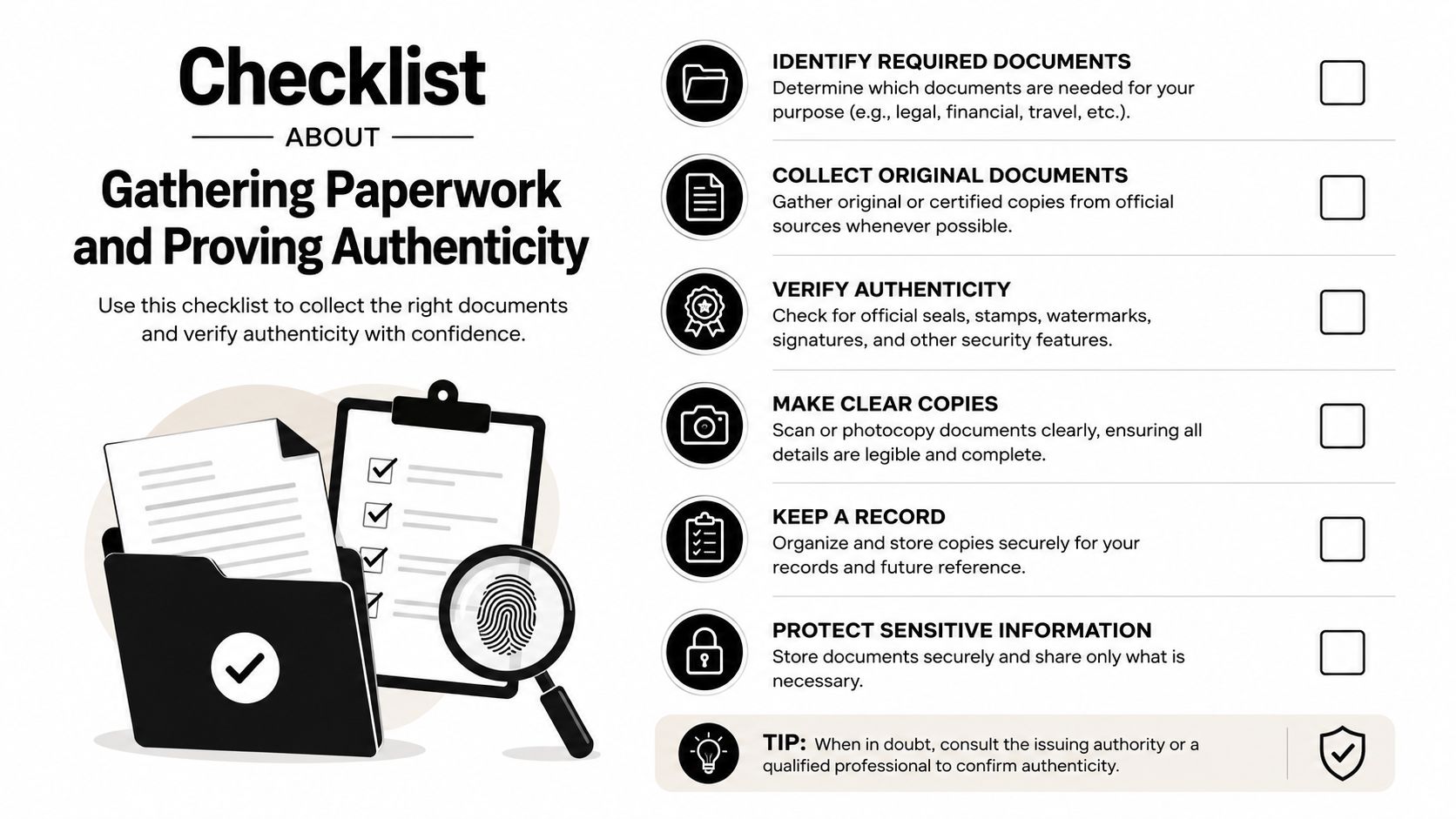
Gathering Paperwork and Proving Authenticity
Tiffany buyers don't just look at the logo. They look for the maker's stamp, the metal mark, the overall construction, and whatever documents support the story of the piece. For silver, Ag 925 matters. For gold, Au 750 matters. For platinum, Pt 950 matters. Those marks tell a buyer the piece is made from the metal you claim, and they make it easier to move from suspicion to a real offer.
Build a provenance folder before you ask for quotes
Original packaging helps, but it's not the same as proof. A blue box, a pouch, or a shopping bag can support the presentation, yet the paperwork that moves an offer is usually the receipt, a grading report, and clear photos of hallmarks and condition. If the piece has a diamond, a GIA report can matter more than brand packaging because the stone's grading often drives the resale conversation more than the brand name alone.
The cleanest way to present a Tiffany item is a one-page folder with:
Front and back photos of the item
Close-ups of hallmarks and maker's marks
Any receipts or invoices
Certificates or grading reports
Photos of the box, pouch, and papers together
A buyer can forgive missing packaging. A buyer won't ignore missing authenticity clues.
For watches, serial numbers are part of the discussion. For jewelry, the seller should photograph the clasp, engraving, links, settings, and any visible repairs. Worn items can still sell, but the buyer needs to see what's there before they quote confidently.
If you want a straightforward professional check on whether your paperwork is enough, use this independent jewelry appraiser resource as a model for how serious buyers think about documentation. The point isn't to build a museum archive. The point is to reduce uncertainty so the buyer has less reason to discount your piece.
A Tiffany seller who brings organized proof almost always gets a cleaner conversation. You're telling the buyer, in effect, that the item is real, the condition is disclosed, and there won't be surprises later.
How Buyers Actually Value a Tiffany Piece
A real buyer isn't pricing nostalgia. The offer starts with metal value, then adds the stone's quality, then adjusts for design recognition, condition, and current demand. That's why two Tiffany rings that look similar to a first-time seller can land in very different price bands.
What goes into the number
A classic Tiffany buyer weighs five things at once. The first is the precious metal itself, because gold, silver, and platinum all have intrinsic value. The second is the diamond or gemstone, if there is one, because cut, size, and grading can matter more than the setting. The third is design recognition, and names like Return to Tiffany, Tiffany T, Tiffany Setting, and HardWear can carry more resale liquidity than an obscure line or a custom build.
Condition comes next. A polished, complete piece with sharp hallmarks and intact components will generally fare better than one with worn edges, stretched links, loose stones, or visible repair work. Finally, the buyer looks at live demand, because recognizable pieces move differently from one-off items or designs that feel dated in the current market.
Factor | Impact on offer | Why it matters |
|---|---|---|
Metal purity and weight | Raises or lowers the floor | It gives the buyer a tangible baseline |
Diamond or gemstone quality | Can lift the offer meaningfully | Grading and size affect resale confidence |
Design recognition | Can improve liquidity | Iconic Tiffany lines are easier to resell |
Physical condition | Can reduce proceeds fast | Wear, damage, and repairs change buyer risk |
Documentation | Often improves the final number | Paperwork lowers authentication friction |
A simple worked example helps. If a piece has modest metal content and a stone that isn't especially rare, the buyer won't pay retail just because it says Tiffany. If the same piece is an iconic design, in strong condition, with paperwork and original packaging, the offer can move higher because the buyer expects less friction when reselling it. That logic is exactly why a well-kept, authenticated Tiffany piece can sit toward the upper end of the resale range, while an ordinary or heavily worn item settles closer to the bottom.
For a deeper view of how jewelry buyers think about the relationship between materials and final offers, this diamond resale value calculator guide is useful context. The important part is not the calculator itself, it's the mindset: resale value is built from measurable inputs, not from brand sentiment alone.
Private Buyer, Auction, or Consignment
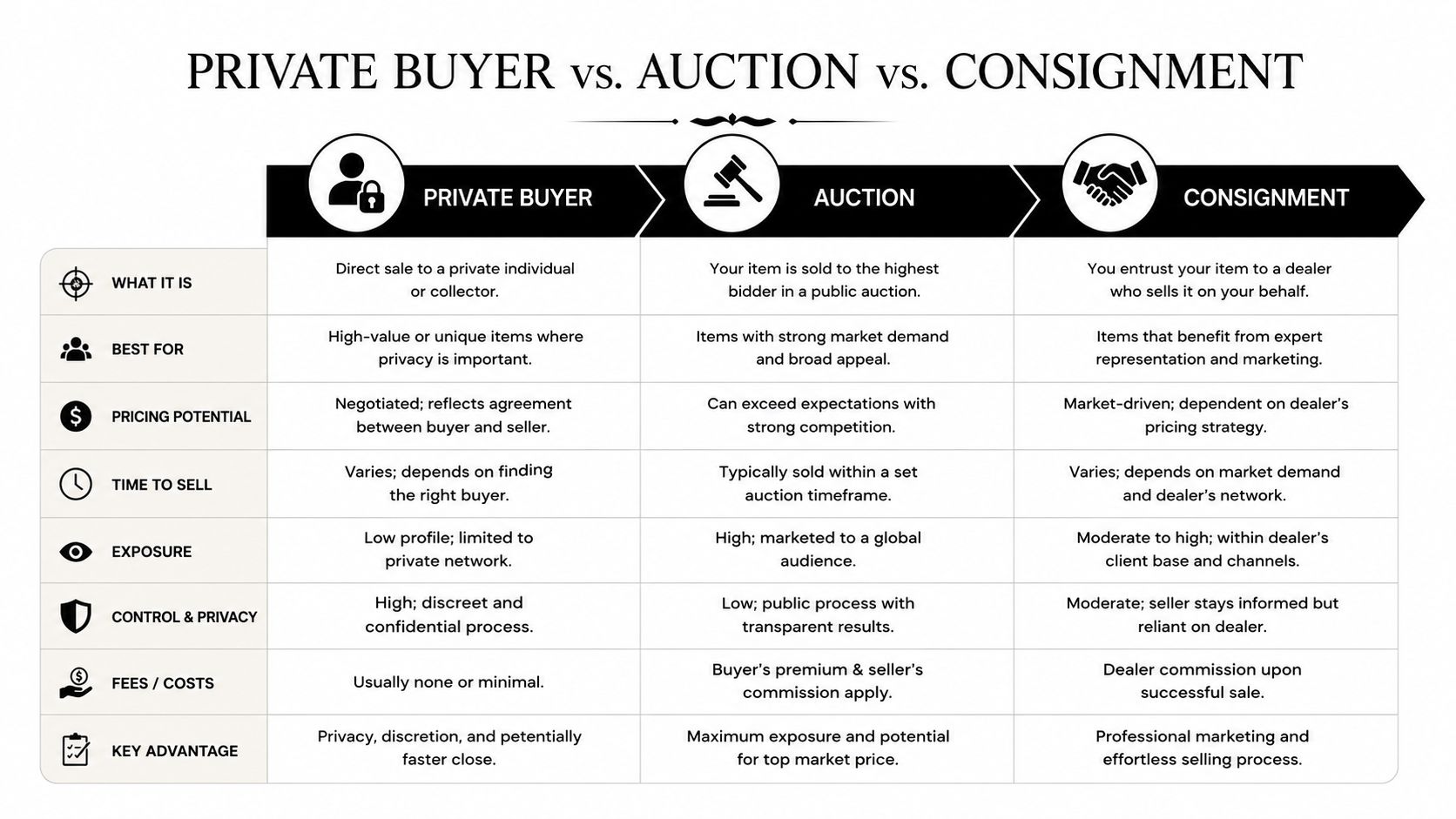
The right route depends on what you care about most. Private buyer gives you speed and privacy. Auction gives rare pieces a shot at specialist bidding. Consignment offers visibility, but the listing can sit for a while and the fees can eat the upside.
The route you choose changes the net result
A private buyer is the best fit for a seller who wants a direct, confidential transaction and a quick answer. Auction houses like Christie's or Sotheby's can be smart for a rare or highly collectible Tiffany piece, especially when specialist demand can push the result. Consignment and resale platforms reach a broader audience, but they also introduce waiting, back-and-forth, and fee drag, so the sale can look stronger than it really is.
If privacy matters, avoid public listings. If speed matters, avoid slow consignment. If maximum price matters, get the piece in front of the right specialist.
First-time sellers often get tripped up. A public platform may show a high asking price, but asking price isn't cash in your hand. An auction estimate can sound exciting, but the final hammer result depends on bidder interest, and the seller still has to account for the sale structure. A private buyer is more direct, which is why it often feels simpler.
For sellers who want to compare the channels in plain language, this where to sell fine jewelry guide is a useful benchmark. In Atlanta, Buckhead, Sandy Springs, Alpharetta, Roswell, Brookhaven, Midtown Atlanta, and across Georgia, the practical choice often comes down to whether you value quiet execution or public exposure.
My advice is blunt. If you have a mainstream Tiffany piece and you care about the cash outcome more than the auction theater, a private buyer or specialist direct buyer is usually the cleanest path. If the piece is unusual enough to justify a broader audience, then specialist auction review is worth exploring. If you're not sure, get two routes quoted before you commit.
How a Private Buyer Like Antwerp Diamond Works
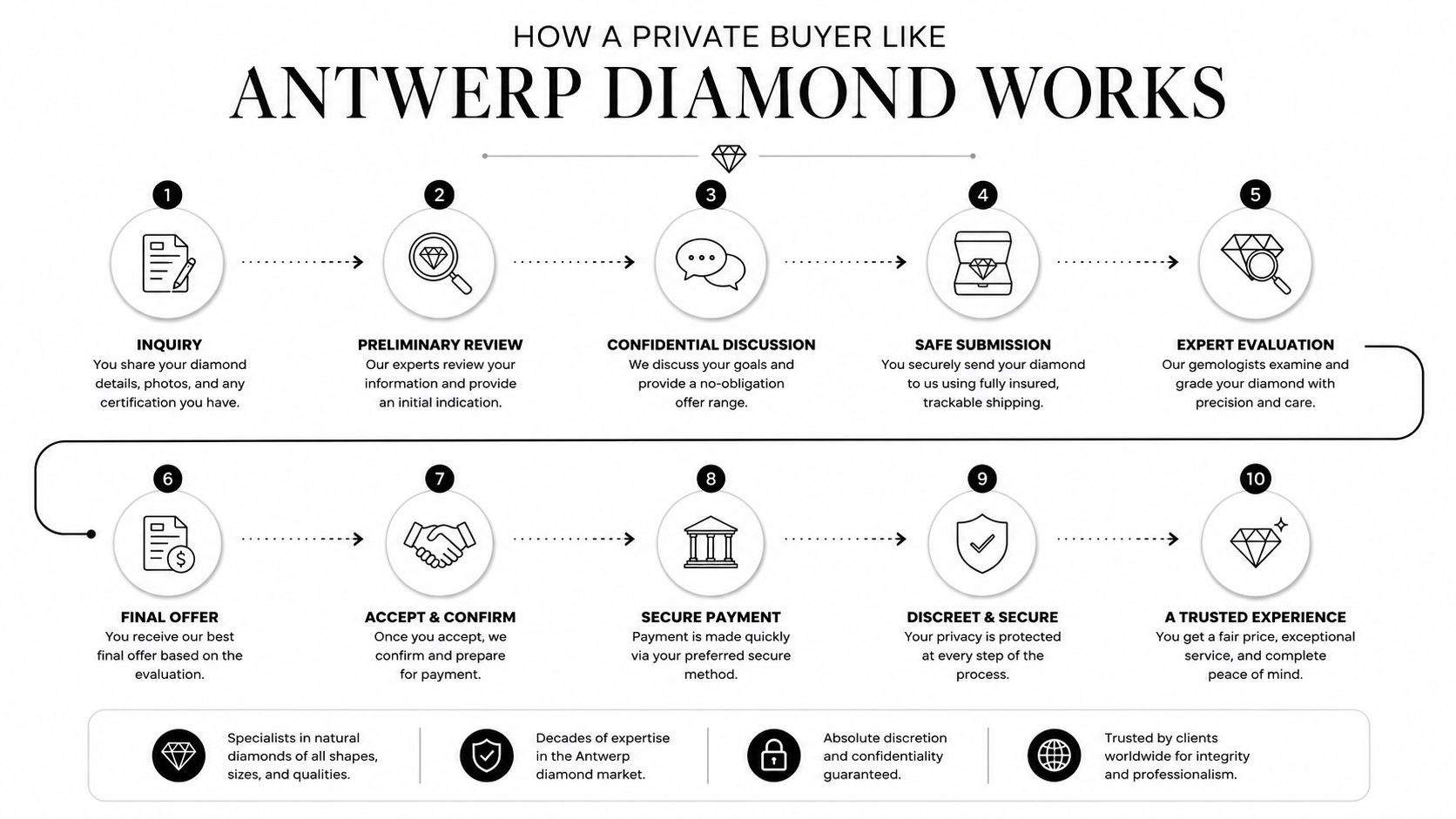
A serious private buyer should feel orderly, not mysterious. The process starts with a photo-based evaluation, then moves to a preliminary quote, then a physical inspection, and only then to payment. That sequence protects both sides, because neither the seller nor the buyer should be pricing a Tiffany piece blindly.
What the workflow looks like
A seller sends clear photos and basic details first. The buyer reviews the item and typically responds with a preliminary quote within one business day. If the seller wants to proceed remotely, insured shipping can be arranged for the physical review. If the seller prefers face-to-face handling, a private appointment is the cleaner choice.
In the Atlanta market, that can mean a confidential visit in Buckhead, with other appointments available in Roswell, Las Vegas by appointment, Fort Lauderdale, and Houston. For many first-time sellers, that kind of direct evaluation is easier than mailing a piece to a public-facing platform and waiting for a long chain of approvals.
The primary appeal of a private buyer is the single-counterparty model. You're not fielding offers from strangers, managing a public listing, or trying to guess whether the quote is serious. You're dealing with one experienced buyer who can inspect the item, explain the number, and close if you accept.
Here's the part sellers care about most. Once an offer is accepted, payment can be made the same day by cash or secure transfer, depending on the setup. That makes the route attractive for people who want discretion and speed without sacrificing a hands-on review.
If you want to see how a direct buyer presents itself to the public, visit Antwerp Diamond and look at the evaluation flow for yourself. The point isn't to chase hype. The point is to understand how a private buyer handles a luxury item from first contact to final payment.
The process only works well if the buyer is willing to look at condition, paperwork, and market demand in a disciplined way. That's the standard you should insist on, whether you sell locally in Atlanta or from another part of the U.S.
Preparing Photos, Cleaning, and Shipping Safely
Good photos do half the selling work before a buyer ever handles the piece. Start with a neutral background, then shoot the hallmark, the maker's stamp, any serial number, the stone close-up, and full profile shots from multiple angles. Buyers need to see the exact condition, not just the shiny angle.
Clean it gently, not aggressively
Use mild cleaning only. Don't polish engraved areas until they're flat, don't do any home repair on clasps or chains, and don't rework the finish just to make it look newer. A buyer would rather see honest wear than hidden damage created by a bad touch-up. If the piece has an issue, disclose it clearly.
For photo setup, a practical guide to product photography can help you frame the item better, even though you're not selling consumer goods. Good lighting, sharp focus, and a clean background make the piece easier to evaluate and reduce the odds of a lowball quote based on uncertainty.
You can also improve your own confidence by using this how to photograph jewelry guide as a reference point. If the seller can't show the piece clearly, the buyer has to price in risk.
Ship only with real protection
If you mail the item, use fully insured, tracked, and signature-required shipping. I'd only send a piece through a process the buyer coordinates, because that's where the chain of custody is clearer. Pack discreetly, keep the paperwork separate unless requested, and photograph the item before sealing the box.
For an in-person appointment, bring your ID, the papers you have, and a short list of questions. Ask about the valuation basis, the payment method, the timing, and what happens if you decline the offer. That's a normal conversation, and any serious buyer should answer it directly.
Negotiation, Fees, Payment, and Tax Basics
When the offer arrives, compare the net result, not just the top line. A quote with a bigger headline can still leave you with less money if it carries fees, holdbacks, or a slower sale path. That's why you ask about the whole structure before you accept anything.
Ask these fee questions before you agree
You want to know whether the buyer charges a buyer's premium, a listing fee, or a consignment commission. You also want to know how long the buyer holds the item before payment, whether the offer is locked after inspection, and what the return policy looks like if you decline. If a buyer can't explain those points clearly, walk away.
For sellers comparing a resale offer with other services, local guidance like Omni Tax Help for sales tax issues can be useful for broader transaction questions. I'm not giving tax advice here, and you should confirm your own situation with a qualified professional, but it's smart to understand that taxes can depend on how and where a sale is reported.
Payment method matters, too. Common options include wire transfer, cashier's check, ACH, and same-day cash for in-person deals where that's appropriate. Ask when funds clear, not just when the payment is initiated. Sellers often mistake a payment promise for actual settled money.
Best negotiation line: “Give me your best net number, tell me the fee structure, and show me how you arrived at it.”
That phrase keeps the conversation focused. Don't haggle emotionally over retail memory. Ask the buyer to explain why the offer is where it is, especially if the piece is a signed Tiffany line or a diamond piece with meaningful paperwork. You're not trying to win a debate, you're trying to make a clean decision.
For tax basics, keep the discussion simple. Personal-item sales may be reported on Form 8949 when applicable, but your exact obligations depend on your situation, and that's a question for a qualified tax professional. The key is to keep your sale records, offer sheet, payment record, and any shipping proof together.
A short checklist before you say yes
Confirm the net number. Ask what you receive after any fees.
Verify the payment method. Know whether it's cash, wire, ACH, or check.
Ask about return terms. Make sure decline means a real return path.
Keep your records. Save photos, paperwork, and the final offer.
If you're in Atlanta, Buckhead, Sandy Springs, Alpharetta, Roswell, Brookhaven, Midtown Atlanta, or elsewhere in Georgia, the smartest move is still the same, gather your paperwork, take clear photos, and get at least two preliminary quotes before you decide. A confidential evaluation from a private buyer can make sense when you want speed and discretion, and Antwerp Diamond is one option for that kind of review. For a Tiffany ring, bracelet, necklace, or inherited piece, compare on net proceeds, not the prettiest number.
FAQ
How long does selling Tiffany jewelry usually take?
It depends on the route. A private buyer can move quickly, while consignment and auction usually take longer because they add more steps.
Do I have to ship the piece?
No. If a buyer offers in-person evaluation, you can often bring the item to the appointment instead of mailing it.
What if the offer is much lower than I expected?
Ask the buyer to explain the condition, authenticity, and market factors behind the number. If the explanation doesn't make sense, get another quote.
Can I sell inherited Tiffany jewelry without paperwork?
Yes, but the offer may be lower because the buyer has less to verify. Bring whatever you do have, including photos, packaging, or family records.
If you want a confidential, professional evaluation of Tiffany jewelry, Antwerp Diamond can review the piece, explain the offer, and tell you what matters most in the resale price. Bring your paperwork, compare your options, and visit Antwerp Diamond when you're ready to see what your piece is worth.