
The Daytona Platinum Rolex is not valuable because it is platinum, it's valuable because Rolex built a reference-specific collector object around platinum, the current ref. 126506. The market for the platinum Daytona sits roughly around $108,000 to $160,000 on the secondary market depending on configuration and condition, which makes it a very different buying and selling conversation than a standard steel Daytona (secondary-market context).
If you own one, the money is usually in the reference, dial, age, and completeness of set, not in the metal alone. That's the part most sellers miss, and it's why two watches that look similar can get very different offers.
Table of Contents
What the Daytona Platinum Rolex Is and Why It Matters
The Daytona Platinum Rolex serious buyers discuss is the current ref. m126506-0001, and the platinum Daytona story begins with the first platinum model in 2013. The current watch is a 40 mm Oyster-cased chronograph with 100 m water resistance and a 72-hour power reserve. Secondary-market pricing is wide because reference, condition, and completeness drive bids far more than the metal itself, and collectors often use the watch as a benchmark for platinum Rolex demand, as covered in Antwerp Diamond Store's Rolex investment guide.
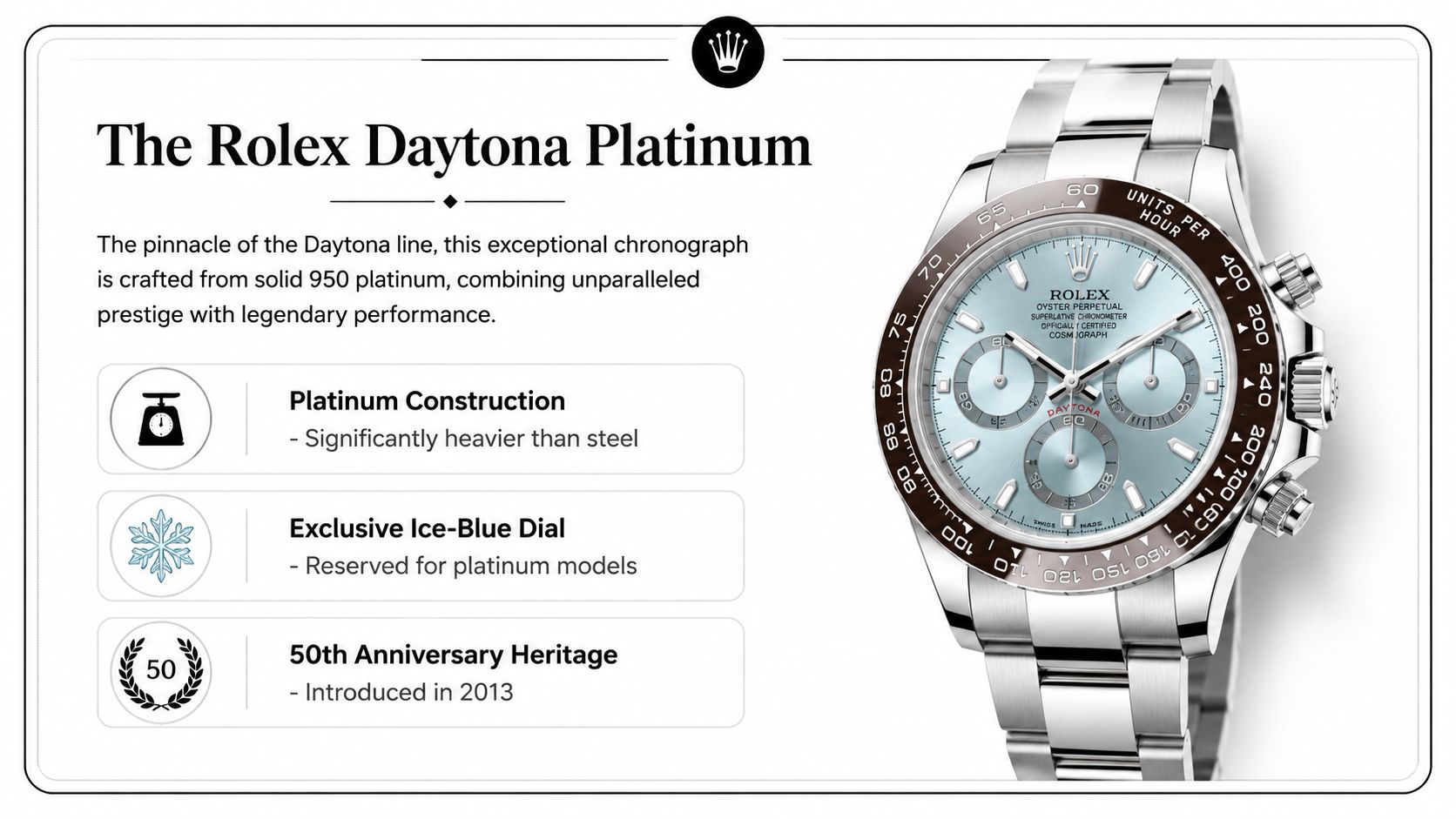
The Rolex Daytona Platinum
The top-tier Daytona execution, built in solid 950 platinum.
⚖️ Platinum Construction - Heavier in the hand than steel
❄️ Exclusive Ice-Blue Dial - Reserved for platinum models
👑 50th Anniversary Heritage - Introduced in 2013
Why buyers care
Collectors pay attention to this model for a simple reason, Rolex treats it as a full-spec flagship, and the market does the same. A platinum Daytona is not valued like a novelty variant. Buyers look first at the exact reference, then at dial type, case condition, and whether the set is complete, because those details move the offer more than the fact that the case is platinum. That is the practical lens a seller should use.
Scarcity matters too. The Daytona sits inside a production family that is limited relative to Rolex's broader output, and the line's tight supply keeps pressure on resale values. The watch also benefits from the broader Daytona collecting story, which was cemented by headline auction results and then carried into demand for top references like platinum models.
For sellers, the rule is blunt. Start with the reference, then verify the dial, condition, and box and papers, then decide whether the watch deserves a retail ask or a faster wholesale exit. That workflow gets a cleaner appraisal than treating platinum as a shortcut to the top of the range.
From 50th Anniversary to Current Reference
The platinum Daytona story starts with the ref. 116506, introduced in 2013 for the Daytona line's 50th anniversary. That watch was the first platinum Daytona in Rolex's official catalogue, and it established the now-familiar formula, a 40 mm case in 950 platinum, a chestnut brown Cerachrom bezel, and the ice blue dial that Rolex reserves for platinum models (2013 launch background).
What changed and what didn't
Rolex kept the visual identity stable because it worked. The 116506 made the platinum material obvious, but it also made the watch look unlike any steel Daytona. Collectors responded to that contrast, and the market still treats the 2013 reference as the origin point for the modern platinum Daytona family.
Today's production reference, the 126506, keeps the same platinum identity while updating the mechanics and presentation. Rolex lists the current model with a transparent sapphire case back and the newer Calibre 4131, but the key visual cues remain the same, especially the ice-blue dial and platinum case (Rolex current reference page, Rolex reference family context).
For sellers, that means the watch has to be identified by generation before anyone talks pricing. A 116506 is not just an older 126506. It belongs to the anniversary era, and collector demand can treat that historical position as part of the value story.
If you're sorting through paperwork, serials, or inherited watches, Antwerp Diamond Store's vintage watch valuation guide is a useful next read because age and reference are never separate from pricing.
Buyer takeaway
If your watch is a 116506, treat it as the anniversary-era platinum Daytona. If it's a 126506, treat it as the current generation. That distinction matters before you ask for an offer, because buyers price reference families differently even when the material is the same.
Case, Bezel, and Movement Specifications Explained
The current platinum Daytona is a heavy, precise watch that feels expensive the moment it lands on the wrist. Rolex builds it around a 40 mm Oyster case in 950 platinum, a Cerachrom ceramic bezel, a sapphire case back, and the Triplock screw-down crown. That combination gives it the dense, planted feel buyers expect from platinum, while the ceramic bezel keeps the tachymeter scale better protected than a polished metal bezel would (Rolex current model specs).
Platinum is the first thing you notice, even before you look at the dial. The extra mass changes how the watch wears, and that matters in appraisals because wrist presence is part of the appeal buyers are paying for. The bezel choice matters too. A ceramic bezel resists scratches far better than a polished metal bezel, and for buyers who care about condition, that usually supports cleaner resale presentation. For a clear breakdown of bezel materials and why they affect wear, see Antwerp Diamond Store's guide to diamond watch bezels.
The movement is where the current reference separates itself from older platinum Daytonas. Rolex powers the 126506 with the Calibre 4131, a self-winding mechanical chronograph with about 72 hours of power reserve, Superlative Chronometer accuracy of –2/+2 seconds per day, and a 4 Hz, 28,800 vph beat rate. It uses a column-wheel and vertical-clutch architecture, plus Parachrom and Paraflex shock components (Rolex model page, Rolex brochure PDF).
Buyer's note: the Calibre 4131's vertical-clutch and column-wheel setup helps the chronograph engage cleanly and reduces hand stutter at start. That is the kind of detail that affects buyer confidence, not just catalog appeal.
Platinum Daytona Key Specifications
Specification | Value |
|---|---|
Case size | 40 mm |
Case material | 950 platinum |
Water resistance | 100 m |
Power reserve | About 72 hours |
Movement | Calibre 4131 |
Beat rate | 4 Hz, 28,800 vph |
Chronograph architecture | Column-wheel, vertical clutch |
Bezel | Cerachrom ceramic |
Case back | Sapphire |
Crown | Triplock screw-down |
Dial Features and Reference Variants Compared
The dial is where the platinum Daytona becomes instantly recognizable. Rolex reserves the ice-blue dial for platinum models, so that color alone tells informed buyers they are looking at a precious-metal Daytona, not a steel or gold configuration (Rolex 116506 launch background). Against that dial, the chestnut brown Cerachrom bezel gives the watch its signature contrast, and that contrast is part of what keeps the platinum Daytona visually distinct in a crowded luxury market.

Main variants buyers actually see
The standard non-diamond current reference is the 126506. The diamond-set configuration is the 126506-0002, and the earlier anniversary reference is the 116506. Those three names matter because they tell you more about market behavior than the words “platinum Daytona” ever will.
Reference | Market position | Buyer attention |
|---|---|---|
116506 | First platinum Daytona, anniversary-era piece | Strong collector interest for historical significance |
126506 | Current production platinum Daytona | Broadest buyer pool, most straightforward comparison |
126506-0002 | Diamond-set current configuration | Higher luxury positioning, narrower buyer pool |
The resale impact comes from a few clear things. Reference age matters because collectors like the anniversary origin story. Dial configuration matters because the diamond-set version appeals to a smaller, more specific audience. Presentation and condition matter because platinum buyers expect a clean, complete set and do not pay top money for sloppy examples.
For used watch sellers, Antwerp Diamond Store's page on used luxury watches for sale is a useful reference because it reinforces a simple point, the watch's exact variant matters more than general branding.
What to watch for
If you're matching your watch to the market, don't stop at “platinum Daytona.” Check the reference number, the dial style, and whether the watch is diamond-set. That combination determines which buyer tier you're really in.
Authentication and Counterfeit Warning Signs
A platinum Daytona should read as expensive before you even inspect the dial. The case has real heft, the finish should be sharp, and the ice-blue dial needs to look exactly like Rolex's own platinum execution, not a generic light blue imitation. If the watch feels too light, the tone looks flat, or the bezel looks like polished metal pretending to be Cerachrom, stop there.
Fast checks you can do before an appraisal
Start with the metal. A real platinum Daytona should feel substantially heavier than a steel Daytona, and that weight should be obvious in the head of the watch and across the bracelet. Then check the case between the lugs for the reference and serial engravings, and make sure the Triplock crown feels precise rather than loose or gritty.
The current-generation watch should also present the movement in the way Rolex intends. The sapphire case back should reveal a clean modern chronograph layout, and the decoration should look crisp, orderly, and consistent with the model's factory spec, as shown on the movement brochure. For a visual comparison against the factory watch, the Rolex current model page is useful once, then you should move back to the actual watch in front of you.
Counterfeits tend to fail in familiar places. The dial color is off, the subdials sit badly, the tachymeter scale looks too glossy or too soft, or the paperwork does not line up with the watch. Missing box and papers do not prove anything by themselves, but they reduce confidence fast, and a serious buyer will price that risk into the offer.
A clean-looking watch can still be wrong. Weak crown action, sloppy dial printing, or a bezel that does not match the rest of the case is enough reason to pause and verify before you talk price.
For a plain-English explanation of hallmarks and stamps, what jewelry stamps mean helps because the same logic applies here, small marks and correct metal cues matter when authenticity is on the line.
Platinum Daytona Authentication Checklist
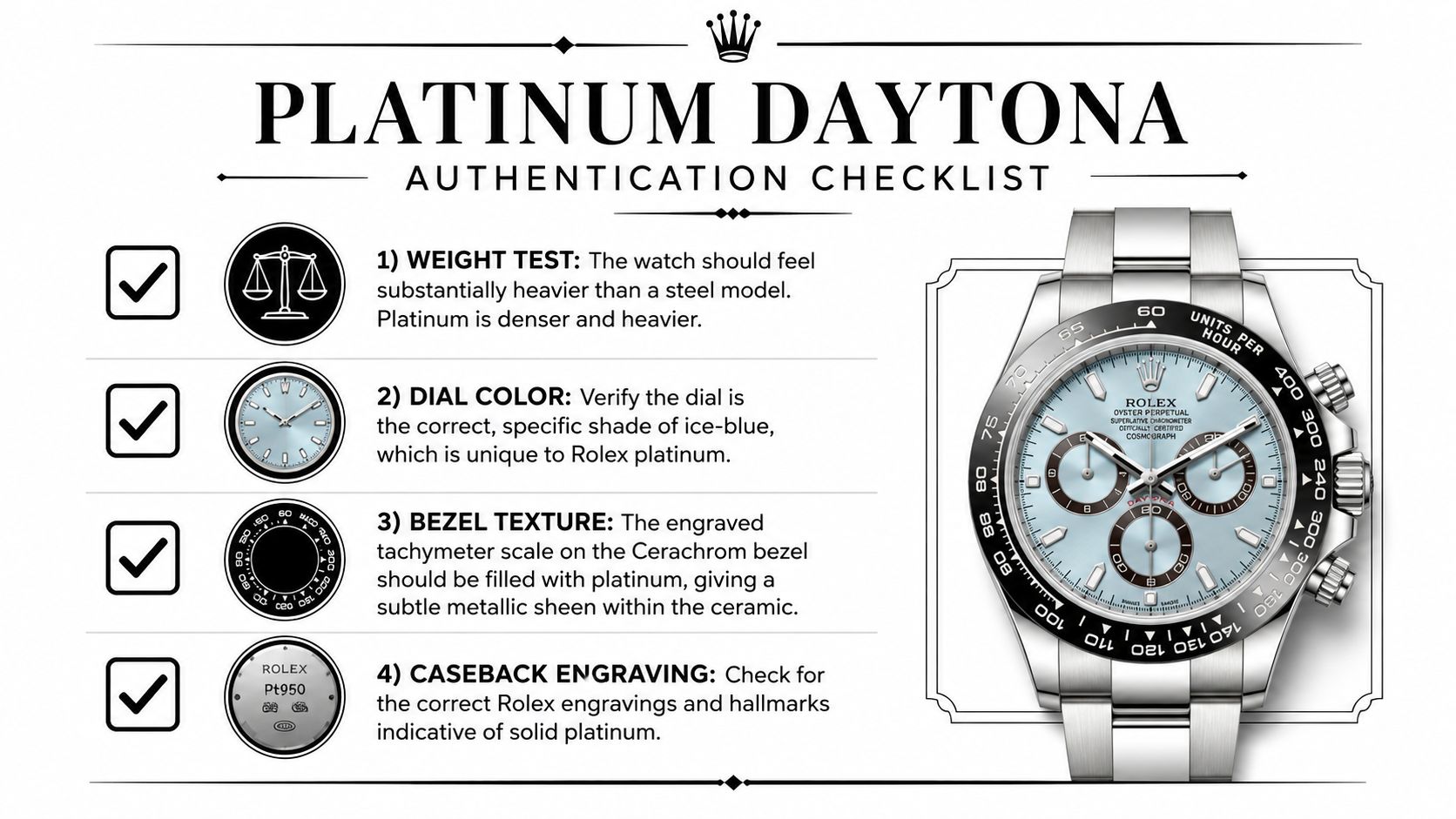
WEIGHT TEST: The watch should feel substantially heavier than a steel model. Platinum is denser and heavier.
DIAL COLOR: Verify the dial is the correct, specific shade of ice-blue, which is unique to Rolex platinum.
BEZEL TEXTURE: The engraved tachymeter scale on the Cerachrom bezel should be filled with platinum, giving a subtle metallic sheen within the ceramic.
CASEBACK ENGRAVING: Check for the correct Rolex engravings and hallmarks indicative of solid platinum.
For a deeper authenticity checklist, Antwerp Diamond Store's Rolex verification guide is a practical comparison point. Use it to line up what you see at home with what a buyer or appraiser will inspect in person.
Market Values and Price Trends in 2026
The platinum Daytona holds a premium because buyers treat it as a serious Rolex chronograph, not just a status piece. The price gap comes from reference, dial, condition, and whether the set is complete. A clean, correctly identified watch with the right papers attracts stronger offers than a loose example with a vague story.
Rolex pricing context published in 2023 placed the current platinum Daytona ref. 126506 at about CHF 74,200. By 2026, market guidance puts the same reference around $84,900 retail and roughly $108,000 to $160,000 on the secondary market depending on configuration and condition (2023 Rolex pricing context, watch guide).
What drives the spread
That spread is not mystery pricing. It reflects scarcity, collector demand, and reference-specific interest. The implied premium can run from about 27% to nearly 88% over retail, and diamond-set examples can separate further when buyers want a harder-to-source variant.
The earlier 116506 has its own pricing history. One watch guide places its launch retail at $75,000 in 2013, which shows how the model moved from a luxury retail purchase into a watch that trades like a tracked collectible (watch guide).
Key variants in the market
Buyers encounter a few clear buckets. The standard platinum Daytona with the ice-blue dial usually leads demand because it is the most recognizable configuration. Diamond-set versions pull interest from a narrower pool, but they can still price well if the condition is sharp and the stones are factory correct.
The market also rewards simple honesty. A watch that is fully original, with matching paperwork and no polishing abuse, is easier to move than a prettier example with questions around service parts or dial originality. Platinum buyers pay for confidence first, and presentation second.
Seller's view: if your watch is complete, clean, and correctly identified by reference, you are in a much stronger negotiating position than someone bringing in a loose watch with no paperwork.
If you want a broader asset-resale comparison, Antwerp Diamond Store's luxury watch and jewelry buying pages are useful for seeing how serious buyers value premium items as priced inventory, not as fashion.
Care, Servicing, and How Antwerp Diamond Evaluates Your Watch
A platinum Daytona should be cared for like a high-end tool watch, not a safe queen. Rinse it after saltwater or chlorinated water exposure, keep it away from obvious magnetic fields, and store the full set together so nothing gets lost. For modern Rolex movements, a service rhythm of roughly every 10 years is the usual long-view benchmark owners work from, though actual timing depends on wear and performance.
Keep the set intact
Box, papers, hangtags, receipts, and warranty card all help a buyer feel more confident. If you're trying to sell or borrow against a platinum Daytona, the set can matter almost as much as the watch itself because it shortens the trust gap and speeds up verification.
That's one reason packaging matters. A watch without the right presentation still may sell, but it gives the buyer less to work with. If you need to replace or organize presentation material, Packaging Panda wholesale boxes is a useful reference for understanding how professional packaging is used in luxury presentation, even though it's not the watch market itself.
How a serious evaluation works
A proper buyer looks at authenticity, reference, condition, completeness of set, and current resale demand. For owners in Atlanta, Buckhead, Sandy Springs, Alpharetta, Roswell, Brookhaven, and Midtown Atlanta, the practical move is simple, request an initial evaluation, then bring the watch in for an in-person review if the numbers make sense.
Antwerp Diamond offers a clear path for that kind of transaction, starting with a free online evaluation and continuing with private appointments for local clients. Remote sellers can also use insured shipping when that's more convenient, and offers are typically presented as transparent, no-obligation cash or secure transfer.
Frequently Asked Questions About the Daytona Platinum Rolex
Is the platinum Daytona worth buying at retail today?
If you want the watch to wear and keep, yes, because it is a top-tier Daytona with a real identity, not just a metal upgrade. If you're buying only for immediate resale, you need to understand that the spread between retail and secondary market can be meaningful, so the purchase has to make sense on your own terms.
What's the real difference between the platinum and steel Daytona?
The difference is not only material. The platinum Daytona is heavier, visually distinct because of the ice-blue dial, and positioned much higher in collector conversation. A steel Daytona is a broader sports watch play, while the platinum version is a prestige chronograph with a narrower buyer pool.
Should I insure it at agreed value or stated value?
Agreed value is usually easier to understand for a watch like this because the number is set more clearly up front. Stated value can work differently depending on the policy language, so you should read the policy carefully and confirm how a loss would be handled.
Are older 116506 examples losing value versus the 126506?
Not in a simple straight line. The 116506 has anniversary-era collector appeal, while the 126506 is the current reference with updated mechanics and broader market recognition. The better question is which reference a specific buyer wants more on the day you sell.
What should I bring to an appraisal?
Bring the watch, box, papers, warranty card if you have it, and any original receipt. The more complete the set, the faster a buyer can verify what they're looking at and make a serious offer.
If you're ready to sell, appraise, or verify a Daytona Platinum Rolex, bring it to Antwerp Diamond for a discreet in-person review. You can start online, then visit Antwerp Diamond in Atlanta or arrange a private evaluation so you know exactly where your watch stands in today's market.