
Flawless Diamond Price: What to Expect
A published flawless diamond price range for a 1-carat FL stone is $4,300 to $21,000, with a reported median of $11,900. That is a useful starting point for comparing asking prices, not a live October 2026 quote or an estimate of what a diamond will bring in resale.
FL is the highest clarity grade: a grader sees no inclusions or surface blemishes at 10× magnification. But clarity alone does not set the price. Cut, color, carat weight, and whether the diamond is natural or lab-grown also matter. An Internally Flawless (IF) or eye-clean VS diamond may look the same without magnification while costing less.

Whether you are evaluating a family heirloom, shopping for an extraordinary centerpiece, or curious about the secondary luxury market, this guide breaks down the true cost of perfection.
Anatomy of Perfection: What Defines FL and IF Clarity?

When gemologists talk about clarity, they evaluate the degree to which a natural diamond is free from internal characteristics (called inclusions) and surface irregularities (called blemishes). Natural diamonds crystallize hundreds of miles beneath the Earth's crust under immense heat and pressure. In this chaotic environment, tiny traces of non-crystallized carbon or other minerals almost always get trapped inside.
Because of this, finding a rough stone capable of yielding a flawless diamond is a geological miracle. Fewer than 1% of all gem-quality diamonds achieve a Flawless (FL) rating.
The purest natural stones often belong to an elite category known as Type IIa diamonds. These gems contain no measurable nitrogen impurities, making them chemically pure and extraordinarily transparent. Only about 1% to 2% of all natural diamonds achieve Type IIa status, and when combined with zero microscopic inclusions, they represent the apex of collector desirability.
FL vs. IF: The Microscopic Difference
On the Gemological Institute of America (GIA) grading scale, FL and Internally Flawless (IF) occupy the very top tiers. Together, they represent roughly 6% of global fine diamond sales, yet the distinction between them is subtle:
Flawless (FL): Shows no inclusions and no external blemishes visible under standard 10× magnification by an expert grader.
Internally Flawless (IF): Shows no internal inclusions under 10× magnification, but may possess minor surface blemishes such as faint polish lines, minute surface graining, or tiny natural facets along the girdle.
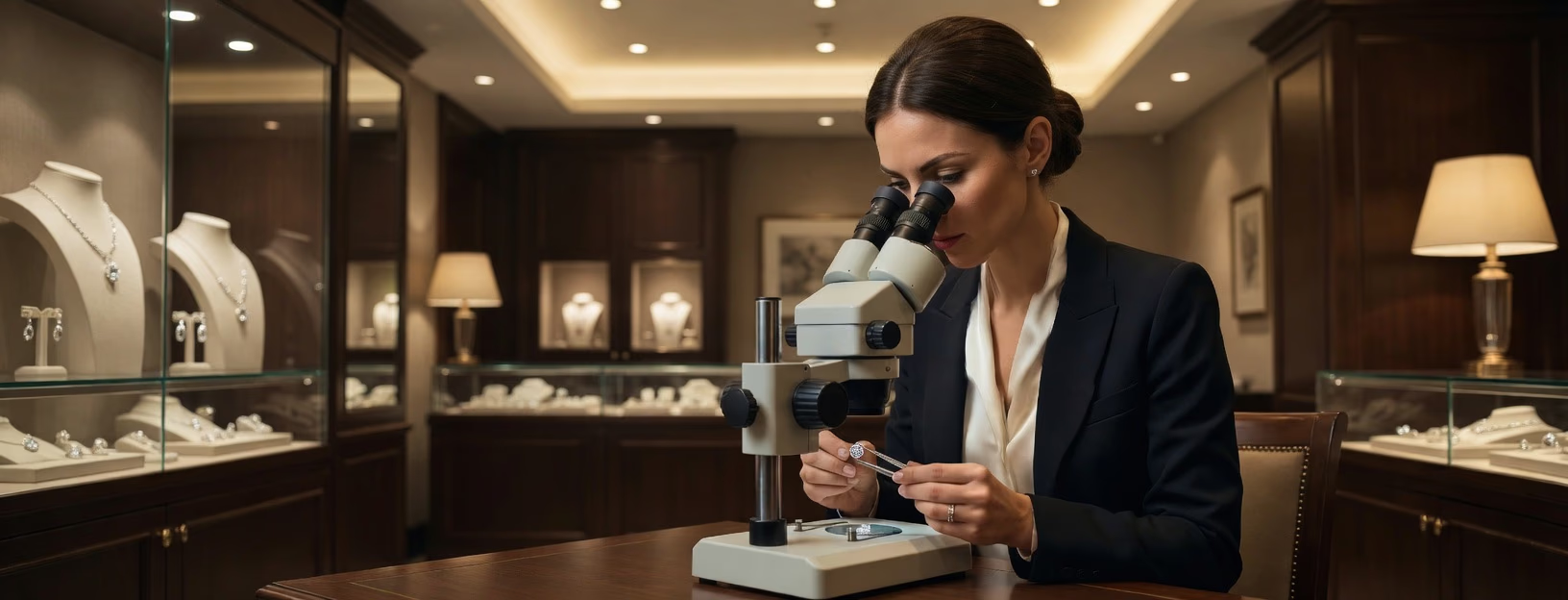
Under a standard gemological loupe, even seasoned jewelers struggle to differentiate an FL stone from an IF stone without specialized laboratory equipment. In fact, a skilled diamond cutter can often regrind and polish the surface of an IF stone to elevate it to FL status, sacrificing a tiny fraction of a carat to achieve a pristine certificate.
At the ultra-luxury level, these minute differences translate to monumental valuations. When exceptional gems cross auction blocks, collector pedigree and absolute purity command extraordinary global interest.
Laboratory Standards and Documentation
To truly secure the value of an elite stone, standardized independent documentation is mandatory. A top-tier gemological laboratory will evaluate clarity under rigid lighting and optical conditions.
When reading an official GIA diamond certification, an FL grade is instantly recognizable because the clarity plot—the schematic diagram showing flaws—is completely blank. The report also verifies the diamond's polish, symmetry, and precise microscopic laser inscription on the girdle. Independent certification protects buyers from grade inflation and guarantees that the stone has been evaluated without commercial bias.
Current Market Benchmarks: Flawless Diamond Price by Carat Weight
The market value of a flawless diamond scales exponentially rather than linearly. Because larger rough crystals free of structural flaws are exponentially rarer in nature, the price per carat surges as carat weight climbs.
Before exploring individual weights, you can explore tools to calculate diamond price estimates across various shapes and specifications.
Carat Weight | Typical Color Range | Typical Dimensions (Round) | Estimated Price Range (FL / IF) |
|---|---|---|---|
0.50 ct | D – F | ~5.10 – 5.15 mm | $1,800 – $4,200 |
1.00 ct | D – F | ~6.40 – 6.55 mm | $7,500 – $21,000 |
1.50 ct | D – F | ~7.30 – 7.45 mm | $16,000 – $38,000 |
2.00 ct | D – F | ~8.10 – 8.20 mm | $34,000 – $65,000 |
3.00 ct | D – F | ~9.20 – 9.40 mm | $75,000 – $140,000 |
5.00 ct+ | D – F | ~11.00+ mm | $250,000 – $450,000+ |
1 Carat Price Dynamics and Size Specifications
A standard 1-carat diamond weighs precisely 0.2 grams (200 milligrams). When exploring how much is a diamond at the 1-carat mark, dimensions play a crucial role alongside weight. A well-proportioned 1-carat round brilliant typically measures between 6.4 mm and 6.55 mm in diameter, with a total depth ratio of 59% to 62.5%.
Within the 1-carat category, an FL diamond can range from $4,300 for lower color tiers (such as J or K) up to $21,000 for a pristine D-color stone with an Excellent cut grade. The median market price sits near $11,900.
Factors Driving the Flawless Diamond Price Premium
Why does an FL stone command such a steep "rarity tax"? The answer lies in the intersection of the Four Cs:
Rough Yield Sacrifice: When master cutters spot an internal crystal near the edge of a rough diamond, they face a choice: leave the inclusion and cut a larger 1.5-carat VS1 stone, or polish away significant diamond weight to produce a 1.0-carat FL stone. Polishing away that rough material represents real lost revenue, which is factored into the finished gem's premium.
Color Synergy: Flawless clarity is almost always paired with top-tier color grades. Pairing an FL clarity rating with a stone from the upper tiers of the diamond color grades chart (D, E, or F) creates a collector-level asset that maximizes light return.
Cut Precision: Without exceptional cut geometry, a flawless stone cannot display its maximum fire and brilliance. An ideal cut ensures light does not leak out the sides or bottom.

Large Stones and Auction Thresholds
As diamonds pass the 2-carat and 5-carat thresholds, flawless natural specimens enter the realm of museum-grade rarities. At 2 carats, a D-color FL stone can command a 100% price premium over an identical D-color VS2 stone.
At 5 carats, pristine gems frequently cross major international sales floors. High color, advanced light-performance cutting, and impeccable clarity combine to command top dollar among private collectors.
Visual Reality vs. Gemological Rarity

One of the most surprising truths in gemology is that an FL diamond does not inherently sparkle more than a properly cut VS1 or VS2 diamond. Diamond sparkle consists of three optical components:
Brilliance: The reflection of white light back to the viewer.
Fire: The dispersion of white light into spectral rainbow flashes.
Scintillation: The flashes of light and dark created when the diamond moves.
All three properties are dictated primarily by cut quality, table percentages, and facet symmetry—not by whether a microscopic pinpoint inclusion exists miles beneath 10× magnification.
Naked Eye vs. 10x Loupe: Can You See the Flawless Difference?
To the naked human eye, diamonds graded Flawless, Internally Flawless, VVS1, VVS2, and even most VS1/VS2 stones look completely identical. Inclusions in the VS range are microscopic and cannot be resolved by 20/20 human vision without magnification.
When you pay for an FL diamond, you are paying for gemological rarity and peace of mind, not a visible visual upgrade.
How Does Shape Influence the Flawless Diamond Price?
Diamond shape dramatically influences how visible clarity characteristics are to the observer:
Brilliant Cuts (Round, Oval, Cushion, Radiant, Princess): These shapes feature numerous triangular and kite-shaped facets arranged to bounce light in multiple directions. This intense scintillation pattern effectively camouflages microscopic inclusions, making ultra-high clarity visually redundant.
Step Cuts (Emerald, Asscher): Step cuts feature wide, open rectangular facets that function like clear glass windows. Because there is less facet distortion, any internal flaw is far more noticeable. Consequently, buyers selecting emerald or Asscher cuts often justify investing in higher clarity tiers like IF or VVS1 to guarantee an eye-clean appearance.
Smart Buying Strategies: Alternatives, Resale, and Value
Navigating high-end jewelry purchases requires balancing aesthetic preferences with budget optimization. If you are comparing specifications across retail or wholesale markets, consulting a comprehensive diamond price guide 2026 will help you establish realistic market baselines.
The Eye-Clean Sweet Spot for Engagement Rings
For most engagement ring buyers, the primary goal is a diamond that looks completely pure and brilliant to the naked eye. In this case, selecting an eye-clean VS1 or VS2 clarity grade provides the ideal balance of beauty and cost efficiency.
By stepping down from FL to VS1 or VS2, you can save between 30% and 50% on the diamond's price. Those savings can be reallocated toward:
Increasing the carat weight.
Upgrading to a higher color grade (such as moving from G to D).
Selecting a premium setting, such as a custom platinum mounting that protects the diamond's girdle.
Natural vs. Lab-Grown Flawless Options
Modern technological advances in Chemical Vapor Deposition (CVD) and High-Pressure High-Temperature (HPHT) methods allow laboratories to produce genuine diamond crystals with exceptional purity.
When reviewing lab grown vs natural diamond pricing, the difference in clarity premiums is striking. While a natural 2-carat D-FL diamond carries a massive rarity premium due to geological scarcity, a lab-grown 2-carat FL diamond carries only a modest price bump over lower clarity grades because growing conditions are tightly controlled. However, natural diamonds retain an organic pedigree and finite supply that lab-created stones cannot replicate.

Resale Reality and Investment Potential
Understanding secondary market mechanics is critical when buying or liquidating luxury jewelry. While high-grade natural diamonds retain intrinsic value better than commercial-grade stones, retail markups mean that immediate liquidation rarely yields 100% of the initial purchase price.
If you already own an exceptional diamond or luxury estate piece and want to determine its cash value, using a diamond resale value calculator provides valuable insight into real-world secondary market expectations. Collector demand remains highest for GIA-certified, D-to-F color stones with impeccable provenance.
Frequently Asked Questions About Flawless Diamonds
How much does a 1 carat flawless diamond cost?
A 1-carat flawless diamond generally costs between $4,300 and $21,000 depending on color, cut quality, and certification. The median market price for a well-cut 1-carat natural FL diamond sits near $11,900.
Is a flawless diamond visibly superior to a VVS or VS diamond?
No. To the naked human eye, an FL diamond looks identical to an eye-clean VVS or VS diamond. The differences are microscopic and can only be identified by trained gemologists using 10× or higher magnification.
Do flawless diamonds hold their value better upon resale?
Flawless natural diamonds generally retain a higher percentage of their inherent wholesale value compared to heavily included stones because of their extreme rarity and ongoing demand among global collectors. However, secondary market realization depends on cut quality, laboratory certification, and current market liquidity.
Conclusion
Choosing a flawless diamond is ultimately a pursuit of absolute rarity and natural perfection. While an eye-clean VS diamond delivers identical visual sparkle on the finger, an FL stone represents one of nature's rarest geological triumphs—a pristine crystal untouched by internal imperfections.
When you are ready to explore valuation, buy, or liquidate high-end fine jewelry, working with trusted estate professionals ensures complete clarity. At Antwerp Diamond Store, we buy luxury watches, fine diamond jewelry, and designer handbags for cash. Based in Atlanta, GA, we provide private, appointment-only consultations, free expert evaluations, transparent market-based offers, and instant payouts without hidden fees.
To stay informed on market benchmarks or evaluate your luxury assets, explore the current price of diamonds with our expert valuation team today.