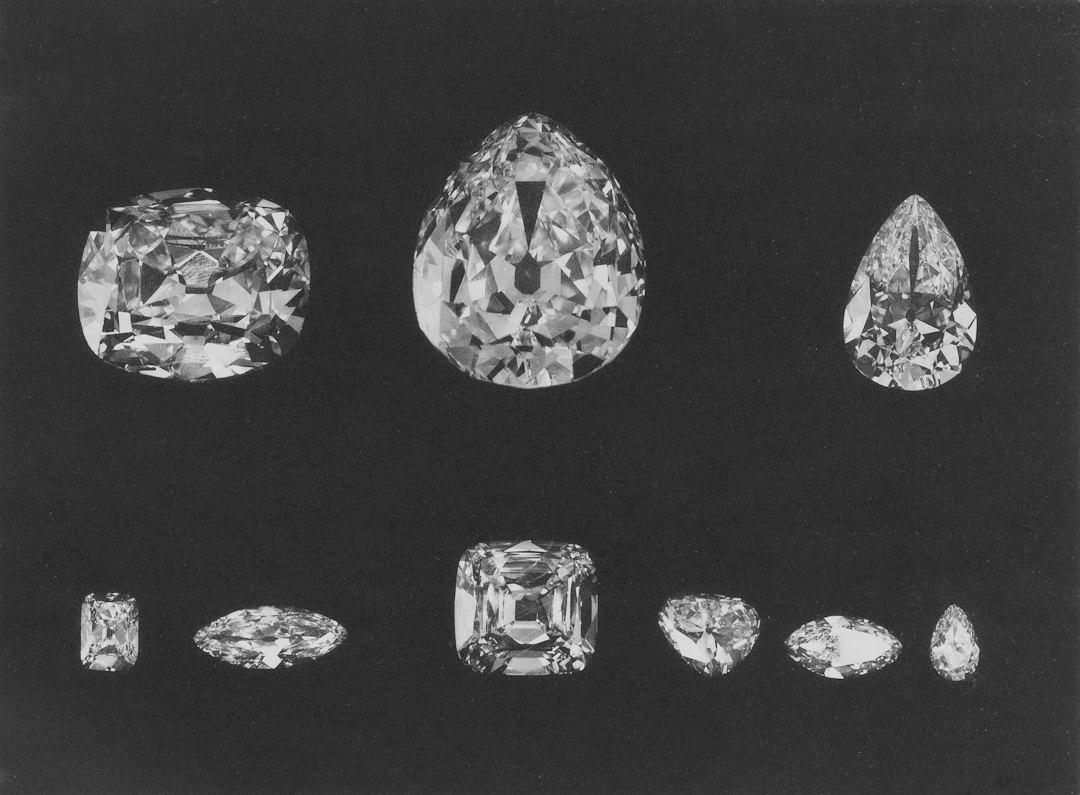

Lab-grown and natural diamonds are both real diamonds, but their market outcomes are not the same. A 1-carat lab-grown diamond averaged $1,000 or less while a natural 1-carat diamond averaged about $4,200, and a benchmark report put a 1ct G/VS2 Excellent round at $4,850 natural versus $1,060 lab-grown, a 78.1% spread.
For owners, the more important difference isn't sparkle, it's what a buyer will pay later. Natural diamonds still sit in a meaningful secondary market, while lab-grown stones usually bring very little back on resale.
Table of Contents
The Critical Difference Between Natural and Lab Diamonds
The gap that matters most is resale, not appearance. A lab-grown diamond can look identical to a mined diamond in the ring, but the offer you get from a buyer is usually shaped by origin, supply, and secondary market demand, not by the fact that both stones are diamonds.
That's the practical truth sellers need to hear. A natural diamond can still carry meaningful market value because buyers treat it as a scarce item with an established resale market, while a lab-grown diamond usually behaves like a manufactured product with much weaker liquidation value.
Practical rule: if you're selling, the question isn't whether the stone is “real,” it's whether a buyer can resell it with confidence.
This guide is for owners who need to understand what a diamond is worth for its practical worth, not just what it cost at retail. That's the difference between a stone that photographs beautifully and a stone that still supports a serious offer when it's time to sell, borrow, or appraise.
What Are Lab Grown and Natural Diamonds

Both diamonds are pure crystalline carbon with the same cubic sp3 lattice, which is why they share the same baseline gemological performance, including a refractive index of about 2.417-2.42, Mohs hardness of 10, and the same brilliance, fire, and everyday durability. For the eye, they can look indistinguishable in a finished setting. A plain-language diamond definition guide helps clear up one common misunderstanding, real diamond doesn't mean equal market value.
How each one forms
A natural diamond forms over billions of years inside the Earth under intense heat and pressure. That long formation window is part of its scarcity, and scarcity is what buyers price into the secondary market.
A lab-grown diamond is produced in weeks through HPHT or CVD growth methods. Both methods reproduce the conditions that allow carbon to crystallize into diamond, but they do it in a controlled manufacturing setting rather than underground.
Why origin matters more than appearance
The finished stone can perform the same in daily wear, but origin changes the story buyers tell themselves and the prices they'll pay. Natural diamonds are tied to geological rarity, while lab-grown diamonds are tied to production capacity and industrial scaling.
Natural and lab-grown diamonds can share the same sparkle, but they don't share the same market psychology.
That's why a seller can't rely on the stone's beauty alone. A buyer will ask for documentation, origin, and grading, then decide what the item can realistically bring in today's market.
What sellers should remember
If you own a diamond and plan to sell it, the key issue is not whether it looks authentic. The key issue is whether the market treats it as scarce, collectible, and easy to resell. That's where natural and lab-grown diamonds diverge sharply.
Key Differences That Affect Diamond Value
Value comes from scarcity, not just chemistry
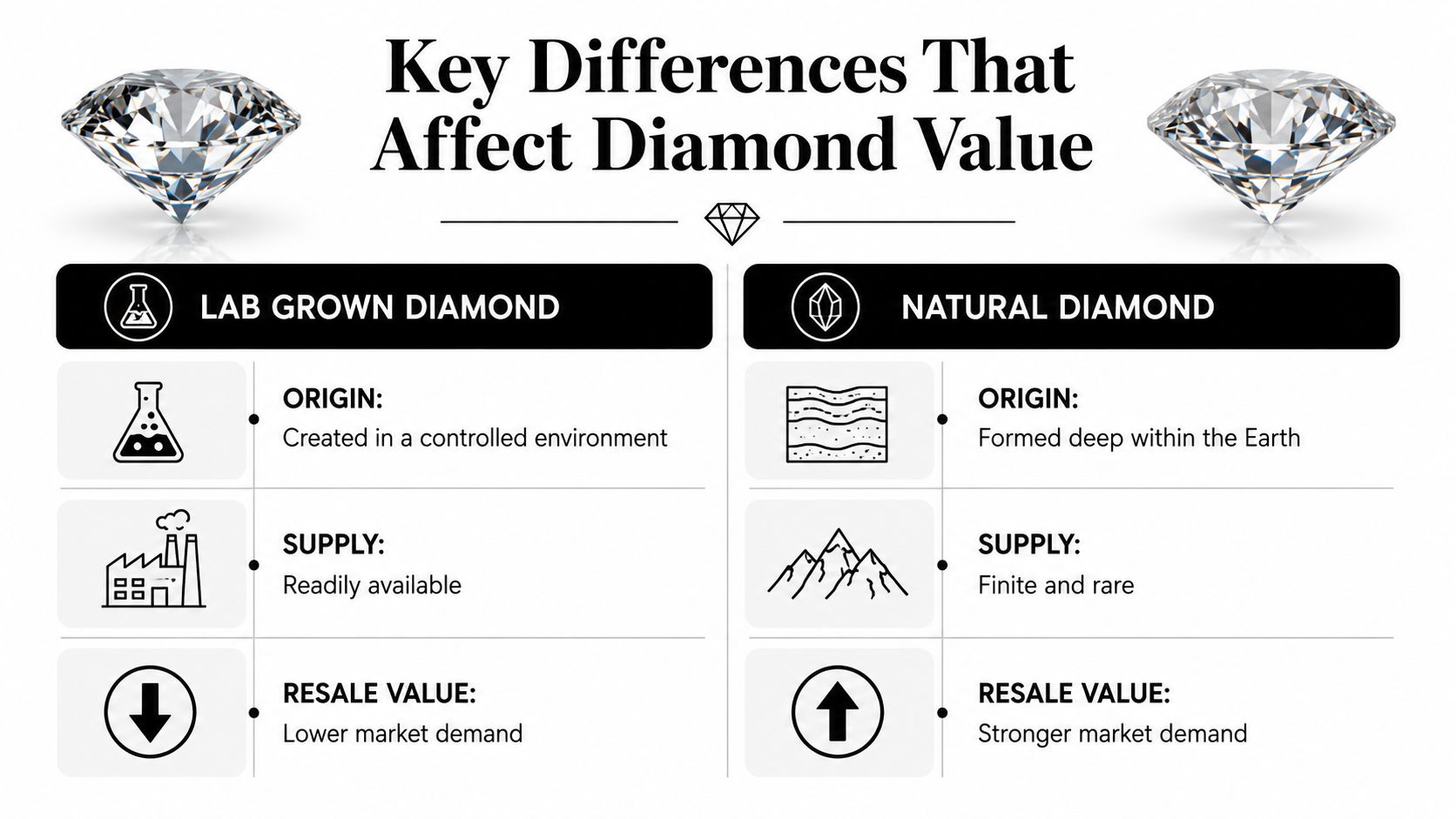
Lab-grown and natural diamonds share the same basic gemology, but the market doesn't price them as twins. The modern retail market shows how wide the gap has become, with a 1-carat lab-grown diamond averaging $1,000 or less versus about $4,200 for a natural 1-carat diamond, and one benchmark report placing a 1ct G/VS2 Excellent round at $4,850 natural and $1,060 lab-grown. That same report describes a 78.1% spread, which reflects how much the market discounts lab-grown stones relative to comparable natural ones. Brite's 2025 and 2026 diamond price benchmark report makes the difference hard to ignore.
Factor | Natural Diamond | Lab Grown Diamond |
|---|---|---|
Origin | Formed deep within the Earth | Created in a controlled environment |
Supply | Finite and rare | Readily produced in volume |
Resale outlook | Stronger secondary market | Much weaker secondary market |
Buyer confidence | Easier to price for resale | Often priced for current use, not future recovery |
Documentation | Graded and identified by origin | Graded and labeled by production method |
Why resale is the decisive issue
Sellers often find themselves surprised. The headline discount at purchase does not translate into proportional recovery later. A natural diamond can still sit inside an active resale framework because buyers can justify pricing it against rarity and established demand, while a lab-grown diamond often doesn't have the same room to move once it leaves retail.
Bottom line: a lower purchase price usually means the stone had less secondary market value built in from the start.
That doesn't make lab-grown diamonds “bad.” It does mean they behave more like a consumer product than a value-preserving asset. If you're buying with a short time horizon, that distinction matters less. If you're selling or borrowing against the piece, it matters a lot.
Certification changes how the stone is described
The trade also handles paperwork differently. Grading labs use internal-growth features to distinguish origin, and GIA now uses a production-method-based reporting framework for lab-grown stones, which makes official documentation central to any sale. This explanation of GIA reporting and identification is one reason professional buyers ask for reports first and small talk later.
What diamond inclusions mean for valuation is relevant here too, because clarity details matter less than many sellers expect if the origin itself changes the buyer's resale calculation. A stone can be well cut and clean, but still be priced conservatively if it's lab-grown.
Where the market lands in practice
A seller should think in terms of liquid value, not retail romance. Natural diamonds tend to have a clearer path to an offer because a buyer can judge them against an established market, while lab-grown stones are often evaluated more cautiously because the buyer knows the pool of future buyers is thin.
How Origin Impacts Appraisals and Offers
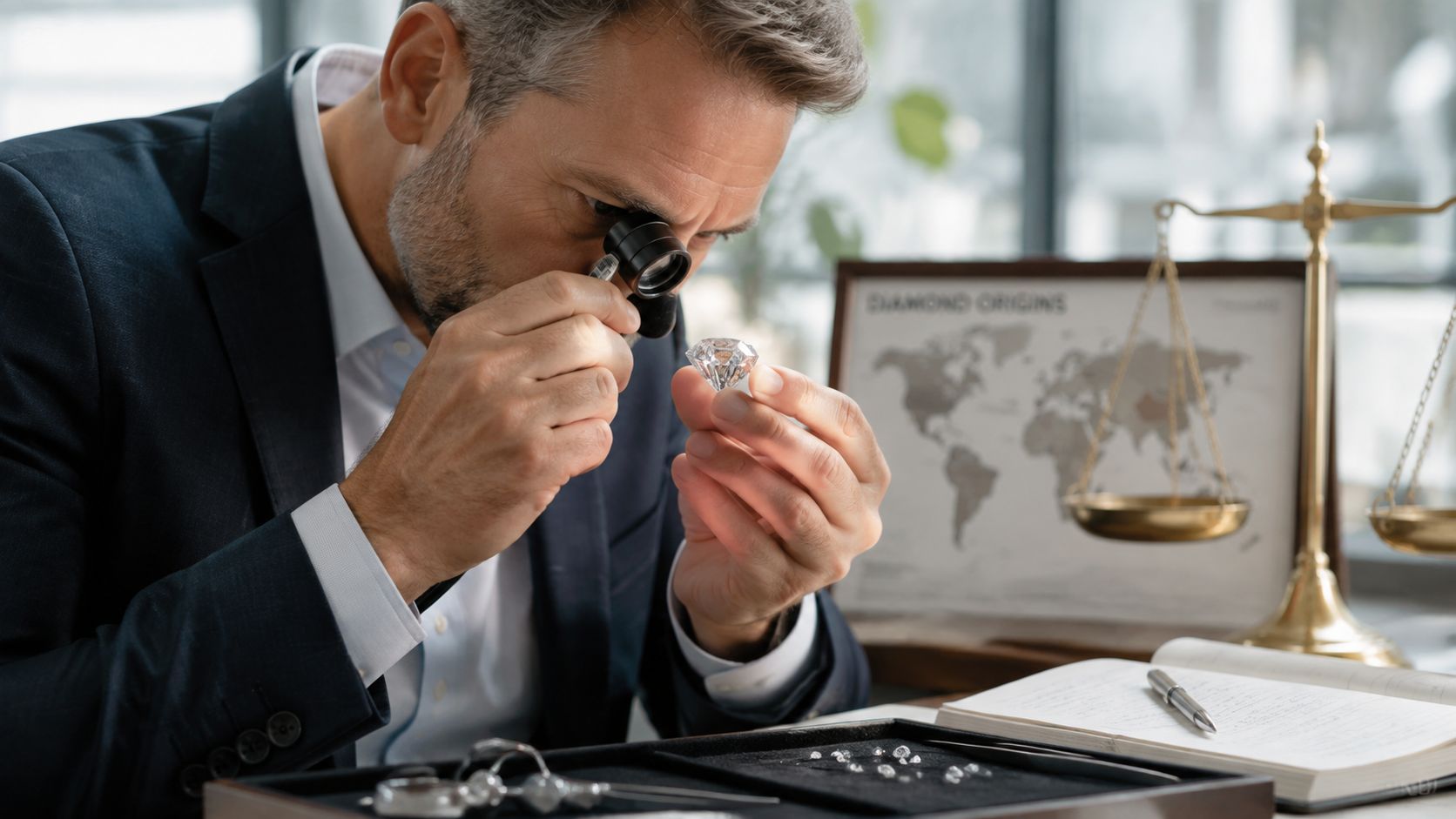
Origin drives the offer before the buyer spends much time on the rest of the stone. Lab-grown diamonds and mined diamonds can look the same under the microscope, but they do not behave the same once money changes hands. The resale picture is very different, and that is the real question behind how much a diamond is worth. A buyer-focused explanation of resale value and identification makes the practical difference clear.
A seller should expect the first question to be about paperwork. A report gives the buyer the starting point, but the offer follows the buyer's confidence that the diamond can be resold later. Natural stones usually fit an established trade with familiar benchmarks. Lab-grown stones often get priced with much more caution because the next buyer pool is thin and the stone can be replaced easily.
What a buyer checks first
A serious appraisal starts with the report, then the stone itself. If the diamond is natural, the evaluator can compare it to a long-running market and weigh cut, color, clarity, carat, brand, and condition against known demand. If it is lab-grown, origin becomes part of the pricing conversation immediately, along with current demand and the likely difficulty of reselling it.
That is why two diamonds with similar 4C grades can receive very different offers. The appraisal is not only about gem quality. It is about what the buyer believes the stone can recover later.
Why lab-grown offers are usually conservative
A lab-grown stone is manufactured, widely replaceable, and harder to move at a strong margin. The buyer knows the next customer will face a market full of similar stones, so the intake offer has little room to stretch.
Natural diamonds are handled differently. They still trade in a long-established market, so the buyer can base the offer on scarcity, age, and the way those traits are recognized by other buyers.
A weak exit path lowers the number fast.
That is the part many sellers miss when they focus only on the original purchase price. A lab-grown diamond may have cost less at the counter, but that savings often shows up again as a lower liquidation number later.
Why in-person evaluation still matters
A visual inspection, the grading report, and a quick origin check tell a buyer what they need to know. That matters in an Atlanta market where clients often want a direct answer on pieces they may sell or borrow against.
For that reason, Antwerp Diamond Store can be a practical option for sellers who want a straightforward in-person review of their stone in Buckhead, Roswell, Sandy Springs, Alpharetta, Brookhaven, or Midtown Atlanta. A careful evaluation does not overpromise. It tells you how the market is likely to read the diamond today.
Market Trends and Demand For Each Diamond Type
Retail demand for lab-grown diamonds has grown quickly because the stones are easier to price and easier for many buyers to afford at the counter. That retail growth does not carry over cleanly into resale. One 2022 estimate placed the global natural diamond market at about $100.4 billion and the lab-grown diamond market at about $24 billion, so lab-grown stones were already about one-fifth of combined market value even as the newer consumer product. U.S. sales also surged 66% in 2022 to over $1 billion, which shows how fast showroom demand moved. A market report with these figures makes the split clear.
Strong retail demand doesn't equal strong resale demand
That gap is where many owners get caught off guard. New buyers may choose a lab-grown diamond because the price is lower and the stone can look larger, but secondhand buyers evaluate the item very differently. They care less about the original retail appeal and more about what they can recover if they buy it.
Natural diamonds still hold a firmer resale position because buyers view them as scarce, established, and easier to justify in trade or purchase decisions. Lab-grown diamonds sell in larger volume, but higher volume in the retail case does not create a matching floor in the secondary market.
Why the secondary market looks different
Resale buyers stay conservative for a reason. They know a lab-grown stone is not limited in the way a natural diamond is, and they know similar stones can be produced again and again. That reality keeps offers tight, even when the diamond is attractive and well graded.
A busy retail category can still have a weak buyback market.
The practical effect is simple. Lab-grown stones may be common at the point of sale, but common does not mean liquid later. Natural diamonds still give buyers more confidence that another buyer will want the stone, which supports stronger offers in resale settings.
This trend is visible across shapes, including styles such as the oval lab grown diamond, which has become a popular choice for new engagement rings.
What this means for owners
Buying lab-grown for personal wear can still make perfect sense. The market issue appears when you try to sell, borrow against, or appraise the piece, because the buyer is focused on current demand and likely exit value.
A seller in Georgia should expect the same pattern whether the appointment is in Atlanta, Buckhead, Sandy Springs, Alpharetta, Roswell, or Brookhaven. Buyers price on what they can recover now, not on what the stone meant at the original point of purchase.
Preparing to Sell Your Diamond A Practical Checklist
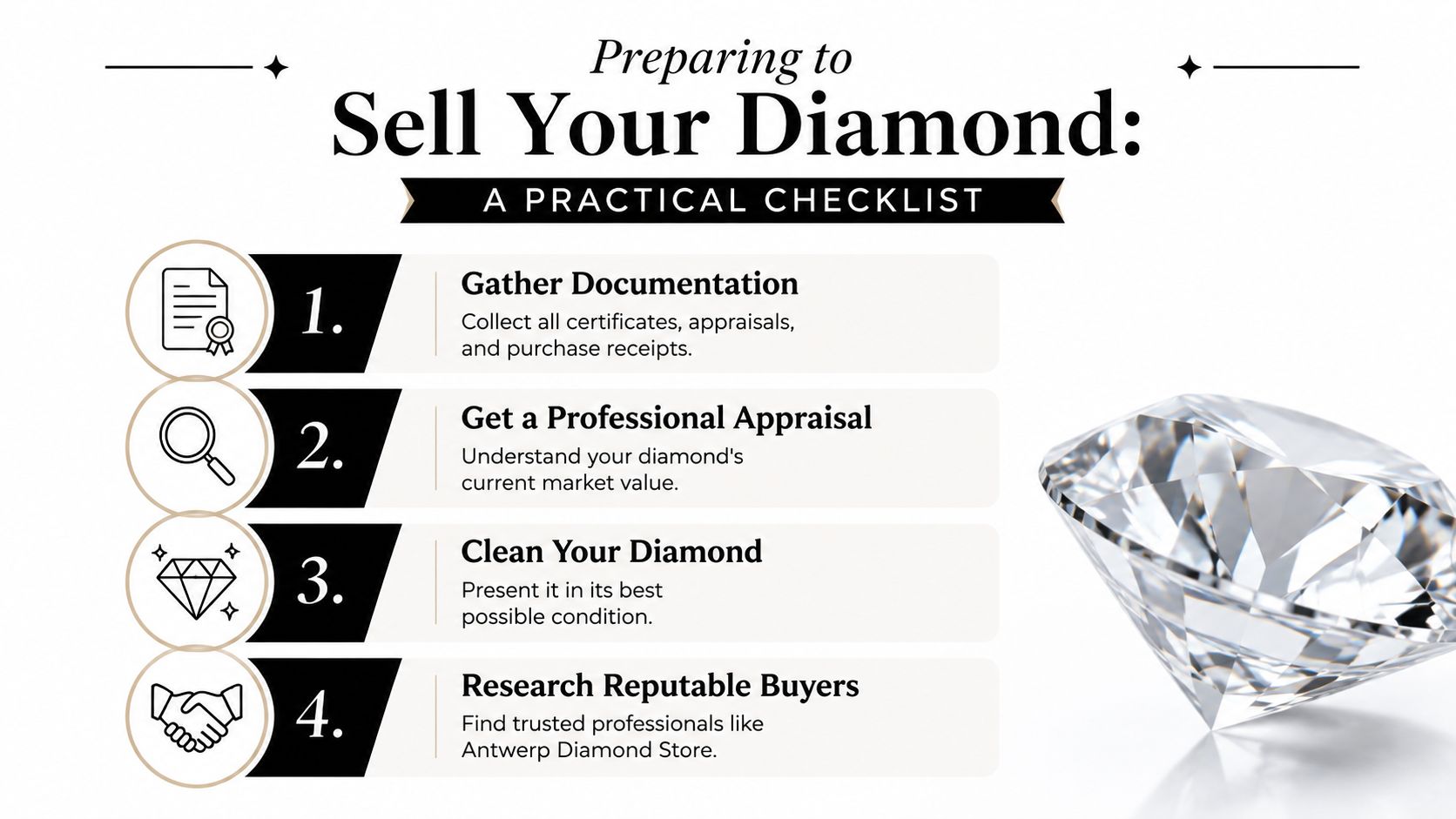
Start with the paperwork
Bring the grading report, any original receipt, and any prior appraisal. If the diamond is lab-grown, that documentation matters even more because the origin has to be verified, and a resale value calculator can help frame expectations before you visit.
Know what the buyer will ask
The first question is usually whether the stone is natural or lab-grown. After that, the buyer will look at condition, cut quality, brand, setting, and whether the paperwork matches the stone.
Present the diamond cleanly
A clean stone helps the evaluator see the details quickly. It won't turn a weak resale market into a strong one, but it does remove avoidable friction from the inspection.
Choose a buyer who evaluates in person
A trusted evaluator should explain how origin affects offer value and should verify the stone rather than guess. That's especially useful if you're comparing options across Atlanta or using a secure mail-in process from elsewhere in the U.S.
If you want a practical reference point, Antwerp Diamond Store offers in-person evaluations in local markets and secure remote intake for clients who can't visit in person. That's the simplest way to find out what a buyer really sees in your diamond before you decide whether to sell.
Frequently Asked Questions About Lab and Natural Diamonds
Are lab-grown diamonds more ethical or sustainable
Not automatically. The environmental comparison depends on specifics, because laboratory-grown emissions can range from 15-480 kg CO2e per carat depending on the grid, while mined diamonds are cited around 125-160 kg CO2e per carat. That framework for ethics and emissions shows why energy source matters as much as origin.
Can a jeweler tell the difference just by looking
Usually not with confidence. Lab-grown and natural diamonds can look the same to the eye, so professional identification relies on grading labs, specialized equipment, and documentation.
Do I have to disclose that my diamond is lab-grown when selling
Yes, transparency matters. Any serious buyer will verify origin, and the report should match what the stone is.
Which type has better resale value
Natural diamonds, by a wide margin. Lab-grown diamonds generally have much weaker secondary market value, which is why buyers tend to be cautious on offers.
Is a lab-grown diamond still a real diamond
Yes. It's still diamond in the gemological sense, but the market treats it differently because origin changes scarcity, demand, and resale.
If you're deciding whether to sell a diamond, bring it in for a no-pressure evaluation at Antwerp Diamond Store. You can visit Antwerp Diamond in Atlanta or reach out for a private review, and a specialist will tell you how origin, condition, and current demand affect your real-world offer.