
14K gold is about $81.4 per gram in the U.S. market right now, and the quick way to estimate it is 24K spot per gram multiplied by 0.583. That gives you a live melt-value baseline before a buyer adds or subtracts anything for testing, refining, or resale demand.
If you're holding a ring, chain, bracelet, or scrap piece and wondering what price gold 14K really means for you, the answer depends on more than the karat stamp. The gold content sets the floor, but the offer you receive depends on weight, condition, brand value, and the kind of buyer you choose.
Table of Contents
What 14K Gold Is Worth Right Now
14K gold is trading around $81.41 to $81.43 per gram in U.S. live trackers on August 9, 2026, which is the best quick reference if you want a current starting point for price gold 14k. That figure is a snapshot, not a fixed price, because it moves with the global gold market throughout the day. Independent trackers showing that tight band include Gold Buyers USA's 14K gold price page, GoldPriceZ's U.S. 14K gram quote, and GoldCalcTool's current 14K reference.
Live 14K Gold Price per Gram, August 9, 2026
Source | 14K Price per Gram (USD) | Date |
|---|---|---|
Gold Buyers USA | $81.41 | 2026-08-09 |
GoldPriceZ | $81.43 | 2026-08-09 |
GoldCalcTool | $81.39 | 2026-08-09 |
That narrow range matters because it tells you the market is using the same basic math, even if each site updates on a slightly different schedule or uses a slightly different retail spread. The practical takeaway is simple, 14K is priced first as metal, then the final offer changes based on who's buying it and what they plan to do with it.
Practical rule: when you see a 14K quote, check whether it's a melt reference, a buyer payout, or a retail asking price. Those are not the same number.
The reason this value moves so visibly is that 14K is not priced from style alone. It's an alloy with a fixed gold share, so its value is tied to the live gold benchmark, then adjusted for the item's form and resale potential. A plain scrap band and a designer chain can start from the same metal base, but they don't end at the same offer.
If you only want one number to remember, use the live per-gram quote as your anchor. It's the fastest way to estimate whether an offer is in the right neighborhood before you hand over a ring, bracelet, or chain for evaluation.
Why 14K Gold Is 58.3% Pure and What That Means
14K means 14 parts gold out of 24, so the alloy is 58.3% pure gold and 41.7% other metals. Those added metals are what make the piece harder, more durable, and easier to wear every day. The karat number is just a purity label, not a style rating.
How purity changes both value and wear
Think of 14K as a blend, not a lesser version of gold. The gold portion is what gives it intrinsic value, while the alloy mix helps determine color, stiffness, and how well the jewelry holds up under daily use. That's why a 14K ring can be more practical than a softer higher-karat piece, even though it has less pure gold inside it.
The alloy portion can include metals such as copper, silver, nickel, or zinc, and that mix affects whether the piece looks yellow, white, or rose. It also helps explain why two 14K items can feel different in the hand, even though both are the same purity. For valuation, though, the purity system stays the same, 14K always starts from the same gold-content share.
The simple concept behind the math is this, the market pays for the gold content first. That's why the standard estimate uses the live 24K benchmark, then multiplies it by the 14K purity factor, which is the whole logic behind spot times 0.583.
A 14K piece is not “almost gold.” It is real gold, just blended for strength and wearability.
Learn how 14K and 18K compare in real jewelry terms
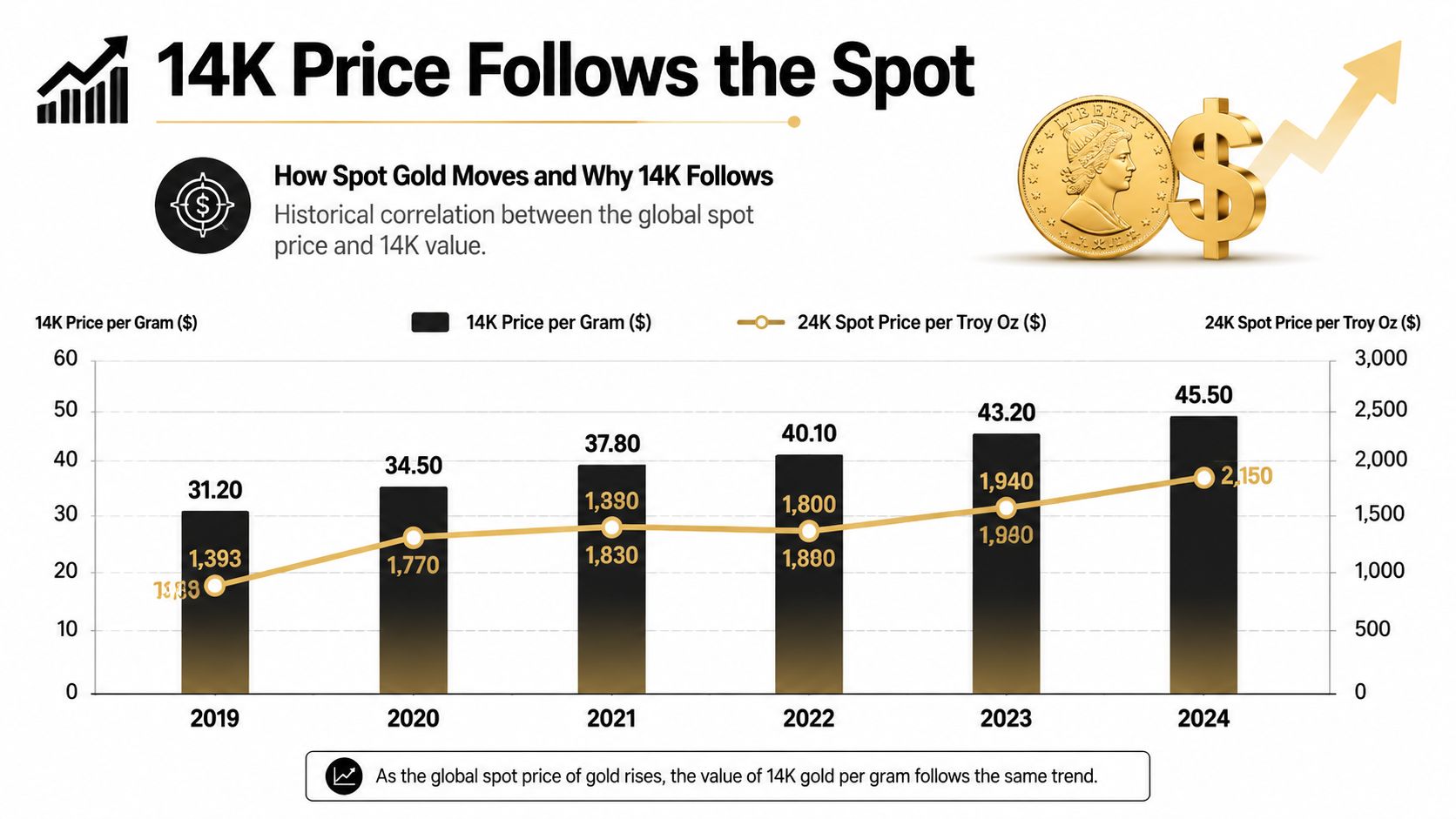
How Spot Gold Moves and Why 14K Follows
Gold pricing starts with the global spot market, which is quoted in U.S. dollars per troy ounce. Since 14K is a fixed purity fraction of fine gold, its value moves in the same direction as spot gold, just at a reduced rate because of the alloy mix. That's why a rise in bullion prices shows up quickly in 14K melt value.
Why a live spot quote matters before you sell
The published U.S. gold closes in the historical series show how fast this market can change. Annual closes rose from $1,282.57 per ounce in 2018 to $1,517.24 in 2019, then to $1,898.60 in 2020, a 25.04% year-over-year jump according to J.M. Bullion's 20-year gold price chart. More recent data show a much wider trading band, with an average U.S. price per ounce of $3,396.35 over the last year, a low of $2,604.71 on 2024-12-30, and a peak of $4,459.11 on 2025-12-22 from the same chart source.
Those swings matter because 14K doesn't have its own separate market. It inherits the same bull and pull of the underlying metal. If 24K spot is higher, 14K is higher. If spot eases, 14K eases too.
Here's the simplest way to think about it, if the 24K benchmark is around $4,800 per ounce, the 14K equivalent lands near $89.97 per gram using the standard purity factor and ounce-to-gram conversion noted in the market data. The exact dollar result changes with spot, but the relationship doesn't. The percentage move in 14K value is the same percentage move you see in the underlying gold price.
See how gold and silver pricing is tracked in live markets
Calculating Your 14K Piece with a Simple Method
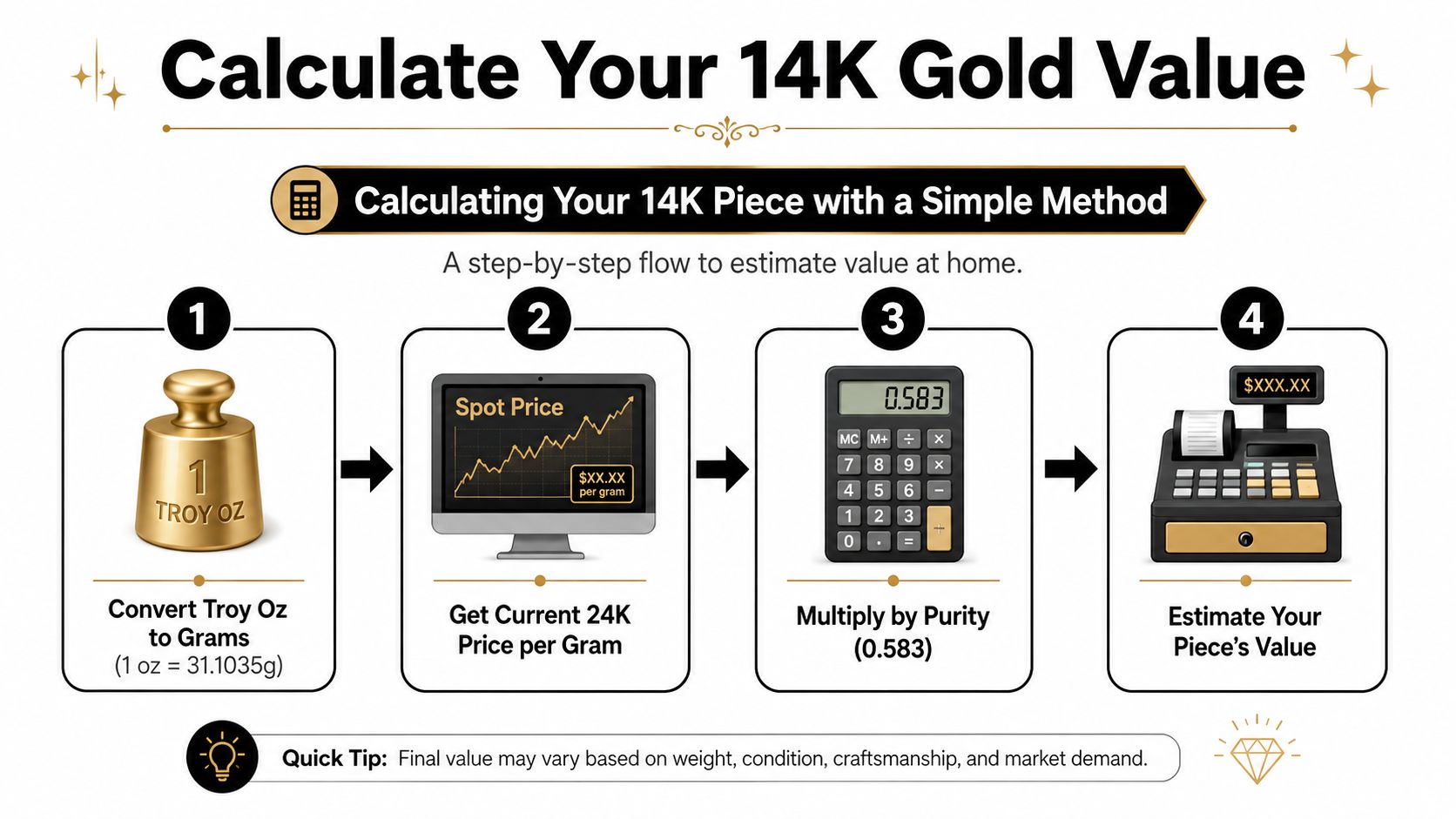
The home estimate is straightforward if you keep the units clean. Start with the current 24K price, convert it to a per-gram figure if needed, then multiply by 0.583 for 14K. After that, multiply by the item's weight in grams to get a melt-value estimate.
What to measure before you estimate value
The easiest formula is:
Weight in grams × current 14K price per gram = melt value
If you only know the 24K spot in troy ounces, convert first using the standard ounce-to-gram relationship from the market guides, then apply the 14K purity factor. That's the part many first-time sellers skip, which is why they often feel unsure when a buyer quotes them a number quickly.
A worked example makes the method feel less abstract. A 10-gram 14K chain at a 24K spot of $150 per gram would have a 14K melt estimate of about $874.50, because the chain's gold content is 10 grams multiplied by 0.583, then valued at the live gold rate. Small rounding differences are normal in real-world pricing, especially when a buyer is working from a live screen rather than a printed chart.
Use a careful scale, not a guess. Kitchen scales can be close, but jewelry transactions are better handled with a calibrated gram scale, especially if the piece has stones, clasps, or mixed components that shouldn't be treated as pure gold weight. If a necklace has diamonds, for example, the stones need to be separated conceptually from the metal before the buyer values the gold.
Buyers value the metal they can recover. Decorative pieces can still be worth more than melt, but only if the item has resale demand beyond its gold content.
A simple checklist keeps you grounded:
Item weight: the gram weight of the gold portion
Live spot reference: the current 24K benchmark
Purity factor: 0.583 for 14K
Non-gold deductions: stones, clasps, mixed metals, or missing parts
Buyer spread: the gap between melt value and actual payout
For people who want to verify the math with a trade-style calculator, Mid-States Recycling's karat calculator shows the same purity logic, and the page is useful because it reinforces that 14K value is a live market function, not a fixed retail tag.
Where to Sell 14K Gold and What to Expect
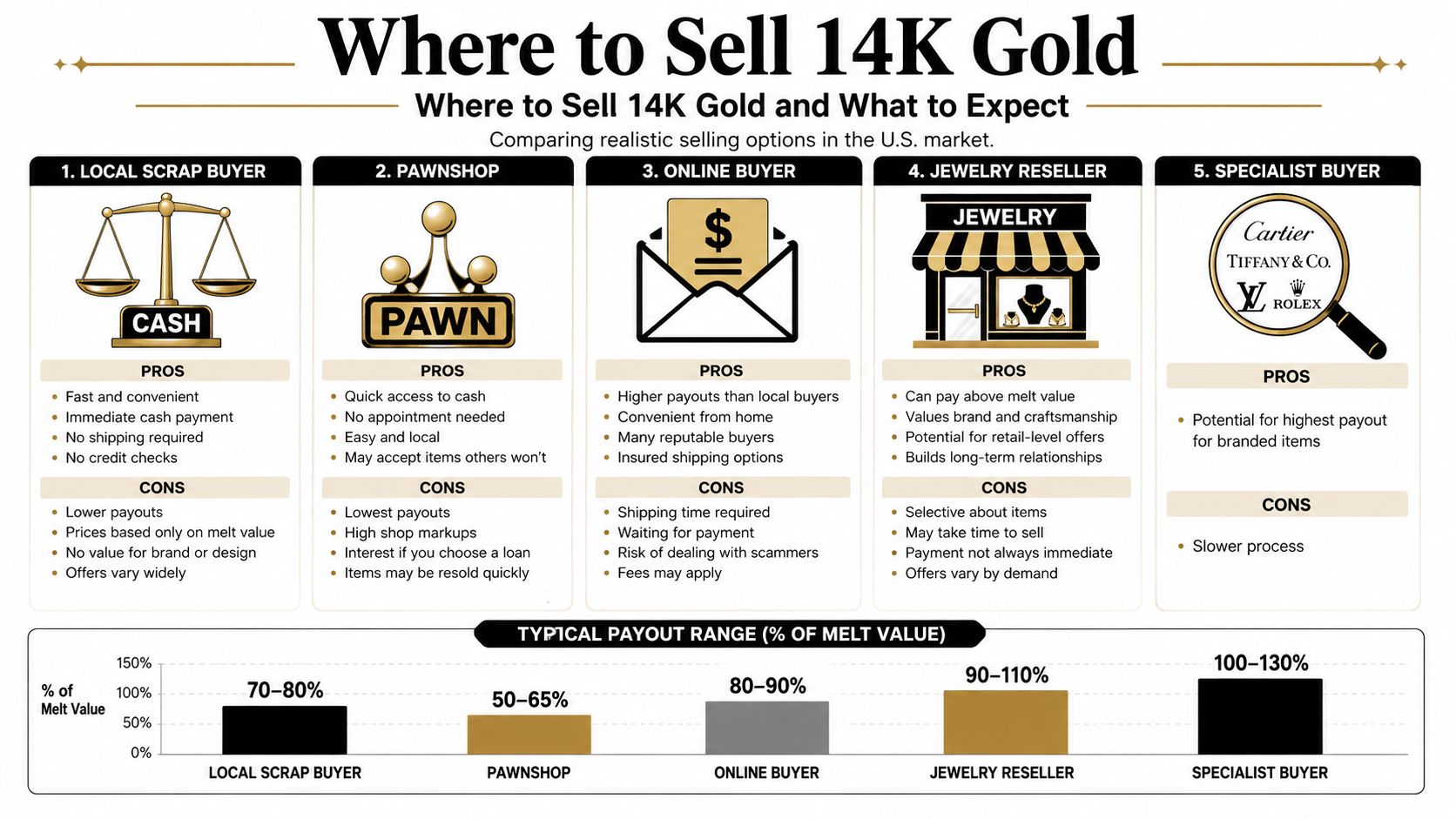
A 14K chain, a broken bracelet, and a designer ring can all carry the same stamp, yet they do not belong in the same selling lane. A buyer who pays for melt value is focused on the gold content. A buyer who pays for resale value is looking at design, condition, and whether someone else will want the piece as it is.
How each selling channel handles payout
Local scrap buyers usually work from metal recovery. They weigh the item, confirm purity, and then apply a discount from melt to cover refining and margin. That makes the process quick and easy to understand, but it does not always give the best result for branded or finished jewelry. You can often walk out with an offer after the scale reading, which helps if you want speed more than comparison shopping.
Pawnshops also move fast, but they usually build in a wider discount because they need room to resell or liquidate the item. That setup can suit someone who needs cash right away, yet the offer may still come in below what a specialist buyer would pay for a well-made piece.
Online mail-in buyers are convenient if you do not have a buyer nearby that you trust. The tradeoff is the shipping process, since you want insured mailing, package records, and a clear return policy before you send anything valuable. If you want a closer look at how presentation and trust signals affect online jewelry sales, Suby's guide on online jewelry business tips is a practical reference.
Jewelry resellers can be a better fit when the piece has visible design value, good condition, or recognizable branding. In that case, the buyer is not only looking at the metal weight, they are also asking whether the item can be sold again as jewelry.
Specialist buyers focus on fine jewelry, watches, and branded luxury assets, so they are often the better choice when craftsmanship, condition, or demand can lift the price above scrap. For a closer look at how to match the buyer to the piece, this guide on the best place to sell gold explains why the right channel depends on what the item can realistically become in the next sale.
Read a practical guide to buying gold chains
Antwerp Diamond's Buckhead and Roswell offices give sellers a transparent, face-to-face review, which helps when you want the weight, purity check, and offer explained in plain language. That in-person setting can be especially useful for people who want to see how the buyer arrives at the payout instead of taking a number on faith. Insured mail-in service can still make sense for clients elsewhere in the U.S. when drop-off is not practical. The goal is to match the selling channel to the piece, so a plain scrap item, a damaged chain, and a piece with resale appeal are each judged in the right way.
Getting the Best Payout and Avoiding Lowball Offers
A lot of sellers compare the market value of 14K gold to the final check and assume something is wrong. Usually, the gap comes from normal buyer deductions, not a mistake. Refining, testing, overhead, and margin all affect the number you receive.
The key is to know which deductions are reasonable and which ones deserve a follow-up question. If a buyer can't explain the spot price they're using, the offer is harder to trust. If they won't show the weight on a scale, that's another warning sign.
Before you agree to a sale, ask these questions:
Which spot price are you using? The buyer should be able to name the live reference.
Is the item weighed in front of me on a calibrated scale? That protects you from hidden deductions.
How is purity verified? A simple stamp is not always enough on its own.
Are there any commissions, testing charges, or refining fees? Those can cut the payout.
Will I receive the offer in writing? A written quote is easier to compare.
How do you handle stones or mixed materials? This matters for rings, pendants, and watches.
Documentation also matters more than many first-time sellers expect. If a piece has a designer signature, original box, receipts, or a serial number, that information can strengthen the case for value above scrap. The same logic applies to branded luxury pieces, because condition and market demand can change the buyer's offer dramatically.
Security should be part of the comparison too. In-person appointments, insured shipping, and clear payment methods tell you a buyer is operating with real process discipline. If the experience feels rushed, vague, or pressure-heavy, that's usually a sign to pause.
Compare the most practical way to sell gold jewelry
Smart Timing, Local Context, and Next Steps
If you're trying to get the best result, don't obsess over a perfect single day. Watching spot for a few days is usually more useful than trying to call the top, because the difference in payout often comes from buyer selection and item classification, not just the market quote. Gold is priced globally, but local currency handling, buyer margin, and transaction process shape what lands in your hand.
That matters in the Atlanta market too. Sellers in Buckhead, Sandy Springs, Alpharetta, Roswell, Brookhaven, and Midtown Atlanta often want a face-to-face answer before they decide whether to sell, keep, or borrow against an item. For people elsewhere in Georgia or across the U.S., an insured mail-in path can still work when the piece is appropriately documented and packaged.
The next step is simple. Gather the weight, any hallmark or paperwork you have, and a current market reference, then ask for a preliminary evaluation before you commit to a sale. That lets you compare a melt quote against a real payout and decide whether your item belongs in the scrap category or in a more specialized resale lane.
Transparent, no-obligation offers with no hidden fees are the trust signal worth watching for. If a buyer explains the math clearly, weighs the item in front of you, and doesn't pressure you to decide on the spot, you're dealing with the kind of process that deserves your attention.
If you want a clear, in-person evaluation of 14K gold, fine jewelry, watches, or other luxury items, Antwerp Diamond can review the piece, explain the pricing, and give you a straightforward offer with no hidden fees. Visit Antwerp Diamond to request an evaluation or book a private appointment, then decide whether selling now is the right move for your item.