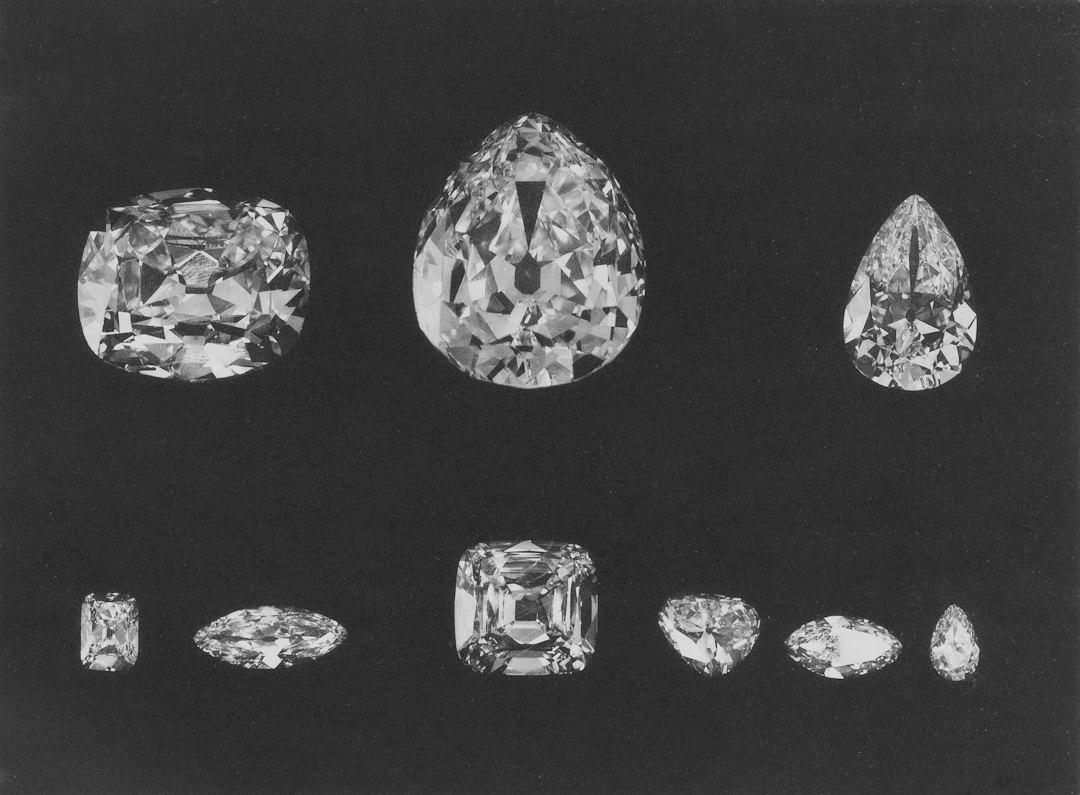

What Makes Antique Jewelry Authentic and Valuable
Antique jewelry is generally at least 100 years old. As of September 2026, that means a piece normally needs to date to 1926 or earlier. Jewelry made 20 to 99 years ago is usually called vintage, not antique.
Authenticity is more than an age claim. Look for a match between the piece's design, materials, gemstone cuts, construction, wear, and any hallmarks or provenance. A genuine antique may be unmarked, repaired, or resized, so no single detail proves its age on its own.
From hand-made Georgian settings to Victorian mourning lockets and sharply geometric Art Deco rings, antique jewelry offers craftsmanship and cultural history that cannot be reproduced exactly. These details also affect resale value, collector appeal, and how confidently a buyer or seller can evaluate a piece.
This guide explains how to recognize the major eras, inspect period features, assess condition, and seek a reliable professional appraisal before buying, selling, or preserving an heirloom.
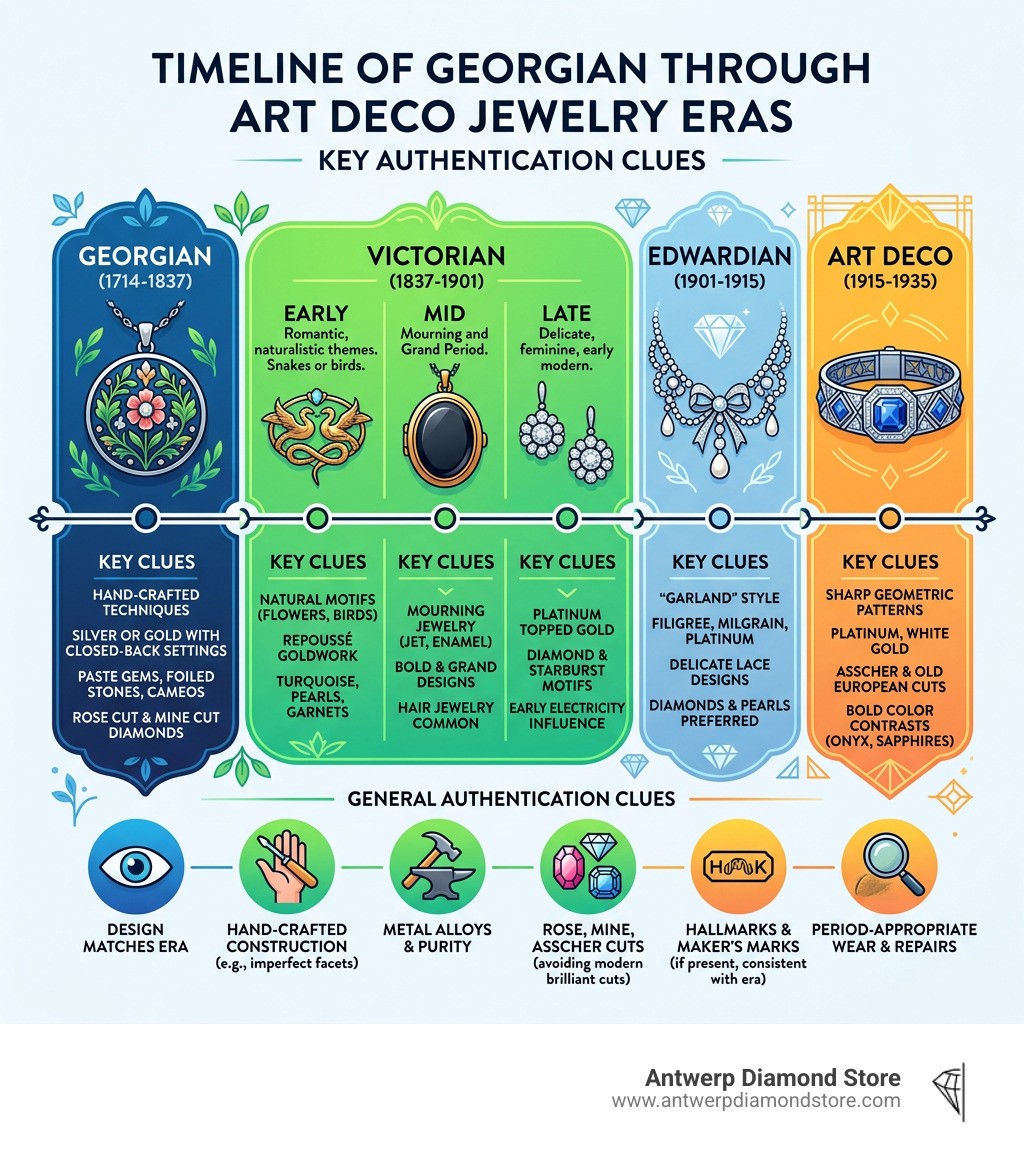
Major Eras and Hallmarks of Antique Jewelry
To properly evaluate historic pieces, we must first understand the eras in which they were born. Jewelers of each historical movement relied on distinct metal alloys, fabrication techniques, and symbolic vocabularies.
Historical Era | Active Dates | Dominant Metals | Distinctive Hallmarks & Assays | Defining Artisan Techniques |
|---|---|---|---|---|
Georgian | 1714–1837 | 18k–22k Gold, Silver-topped Gold | Early city marks, duty marks; often unmarked | Repoussé, chasing, closed-back foil settings |
Early Victorian (Romantic) | 1837–1860 | 14k–22k Yellow Gold, Rolled Gold | Regional assay symbols, maker stamps | Intricate granulation, cannetille wirework, acrostic gem setting |
Mid-Victorian (Grand) | 1860–1885 | 15k Gold, Whitby Jet, Silver | 15ct stamps (introduced 1854), patent marks | Deep die-stamping, Etruscan revival granulation, black enamel tracery |
Late Victorian (Aesthetic) | 1885–1901 | 9k, 15k, 18k Gold, Silver | Standardized UK date letters, sponsor marks | Whimsical celestial motifs, star-set diamonds, gypsy mounts |
Art Nouveau | 1890–1910 | Yellow Gold, Silver, Gilt Bronze | French eagle head, designer stamps (e.g., Lalique) | Plique-à-jour enamel, bas-relief sculpting, whiplash curves |
Edwardian | 1901–1915 | Platinum, Platinum-on-Gold | Platinum purity marks (dog head, "PLAT"), French assay | Millegrain borders, open lace filigree, pierced gallery saw-work |
Art Deco (Antique threshold) | 1920–1926+ | Platinum, 18k White Gold | "PLAT 900/950", 18k eagle/crown marks | Calibré stone cutting, geometric lapidary bezels, die-struck filigree |
Understanding assay office traditions helps separate authentic heirlooms from modern reproductions. In Great Britain, assay offices in London, Birmingham, Sheffield, and Edinburgh stamped items with a maker's mark, town mark, standard mark, and date letter. However, hallmark regulations were not legally obligatory across all styles and imports until the UK Hallmarking Act was enacted decades later, meaning many legitimate treasures never received official punches.
Georgian Era and Handcrafted Intricacy (1714–1837)
The Georgian era was characterized by fully handcrafted, labor-intensive metalwork. Because rolling mills were primitive, Georgian goldsmiths hand-hammered gold and silver alloys into ultra-thin sheets.
A signature technique of this period was the repoussé method—hammering metal from the reverse side to form intricate, raised relief designs—combined with front-facing chasing. To prevent gemstones from losing their brilliance in candlelit rooms, jewelers mounted gems in closed-back settings lined with colored or silver metallic foil.
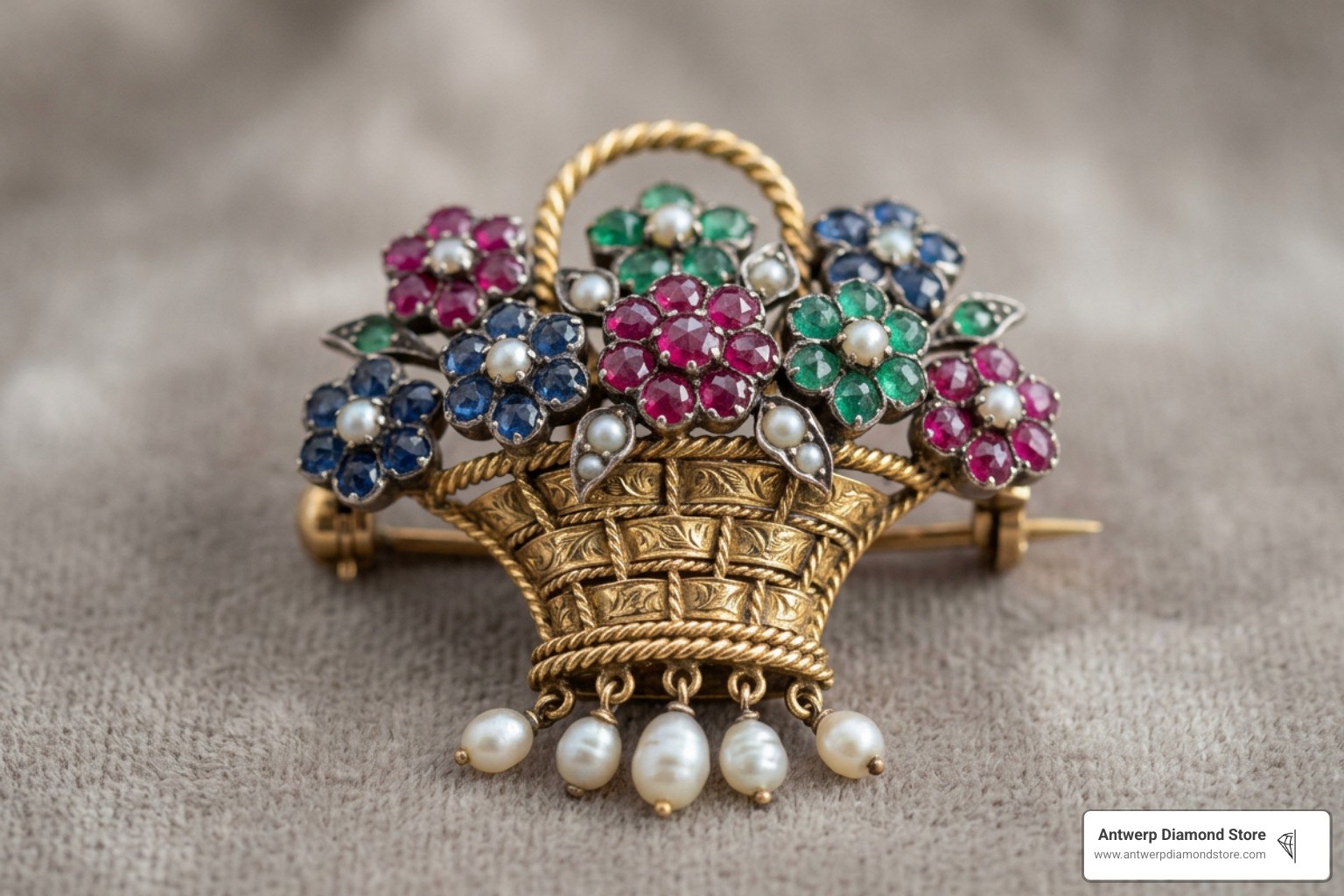
Popular high-Georgian items include the Georgian Flower Basket Pendant | – Laurelle Antique Jewellery, featuring a classic Giardinetti (little garden) design with rubies, sapphires, emeralds, and natural pearls. You will also find Stuart crystal cipher rings, Iberian diamond bow brooches, and silver-topped 18ct gold collets surrounding early rose-cut diamonds.
Victorian Eras and Sentimental Romanticism (1837–1901)
Queen Victoria’s nearly 64-year reign is traditionally divided into three distinct design sub-eras:
The Romantic Period (1837–1860): Inspired by the young queen’s marriage to Prince Albert, jewelry from this era radiated sentimentality, naturalism, and warmth. Bright 14k to 22k gold, serpents (symbolizing eternal love), hearts, and floral sprays abounded. A stunning example from this era is the Antique Victorian Romantic Period 14k Gold Amethyst Seed Pearl Necklace 16" , which pairs vivid purple amethysts with delicate natural seed pearls.
The Grand Period (1860–1885): Following the untimely death of Prince Albert in 1861, Victoria entered deep mourning, establishing strict societal mourning dress. Jewelers created somber, dramatic pieces using Whitby jet, vulcanite, black enamel, and woven human hair. Simultaneously, archaeological excavations in Italy ignited the Etruscan Revival style, popularized by artisans like Fortunato Pio Castellani. These pieces showcased master-level granulation and wirework, as seen in the Victorian 15ct Gold Etruscan Style Pendant set with a Diamond with Locket on the Reverse (292R) | The Antique Jewellery Company, crafted in English 15ct gold (a purity legal from 1854 to 1932) with a concealed reverse compartment for a memento.
The Aesthetic Period (1885–1901): As industrial prosperity expanded and women joined the workforce, heavy mourning pieces gave way to whimsical, lighthearted designs. Popular motifs included stars, crescent moons, double horseshoes, swallows, and insect brooches set with seed pearls and sapphires.
Edwardian, Art Nouveau, and Art Deco Movements (1890–1939)
As the 20th century turned, distinct artistic philosophies emerged across Europe and North America:
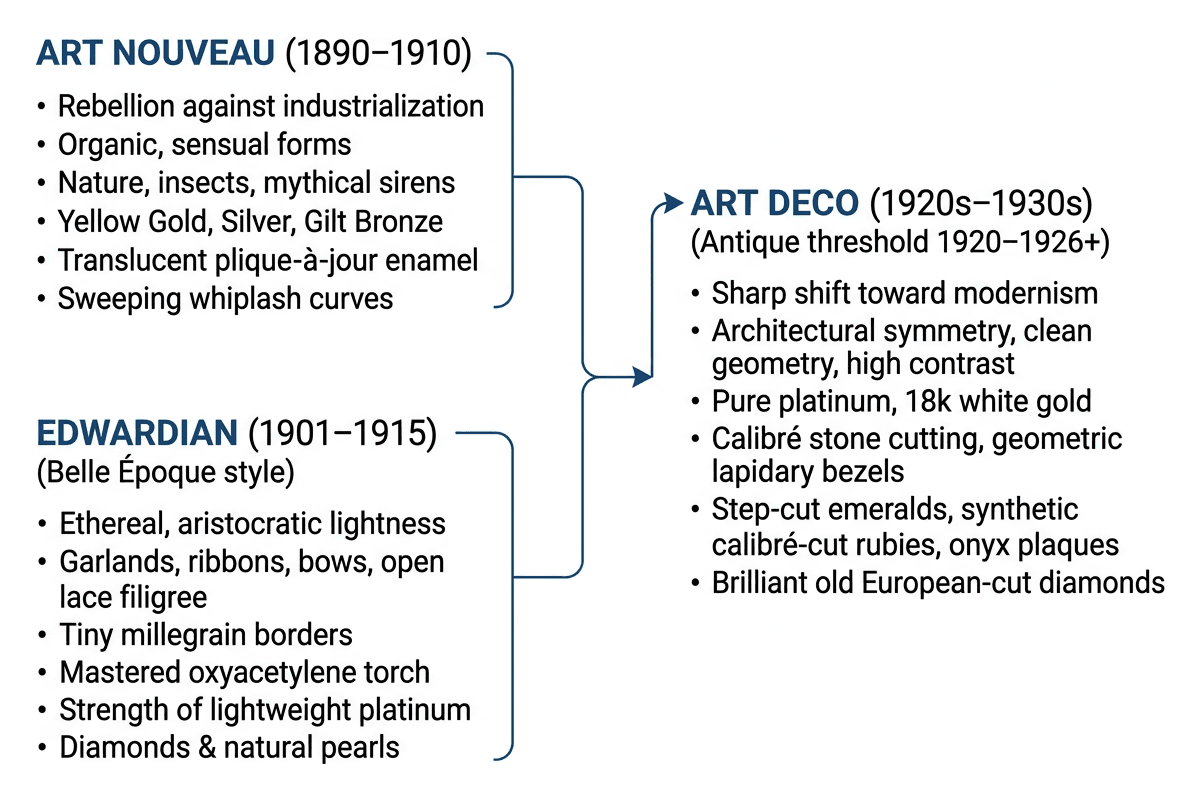
Art Nouveau (1890–1910): A rebellion against Victorian industrialization, this movement embraced organic, sensual forms. Nature, insects, mythical sirens, and orchids were rendered in translucent plique-à-jour enamel and flowing yellow gold. A prime example is the Antique Art Nouveau Baroque Pearl Ring with Old European Cut Diamonds Bezel Antique baroque pearl ring nature inspired antique pearl ring edwardian – Opaline Estate Jewelry, which centers an organic freshwater baroque pearl framed by sweeping diamond bezels.
Edwardian (1901–1915): Named for King Edward VII and Queen Alexandra, this Belle Époque style emphasized ethereal, aristocratic lightness. Jewelers mastered the oxyacetylene torch, allowing them to mount diamonds and natural pearls in strong, lightweight platinum. Garlands, ribbons, bows, and open lace filigree finished with tiny millegrain borders defined the era.
Art Deco (1920s–1930s): Marking a sharp shift toward modernism, Art Deco embraced architectural symmetry, clean geometry, and high contrast. Early 1920s pieces that have crossed the 100-year antique threshold combine pure platinum mountings with step-cut emeralds, synthetic calibré-cut rubies, onyx plaques, and brilliant old European-cut diamonds.
Materials, Period Gemstone Cuts, and Historic Craftsmanship
Recognizing how antique jewelers cut stones and mixed alloys is one of the most reliable ways to authenticate age. Modern computer-controlled lasers produce uniform facets, whereas antique cutters shaped every facet by hand by candlelight or natural sunlight.
Identifying Period Cuts and Settings in Antique Jewelry
Historic diamond cuts were designed to maximize color and carat weight retention rather than modern optical fire. When inspecting antique stones, look for these distinctive cuts:
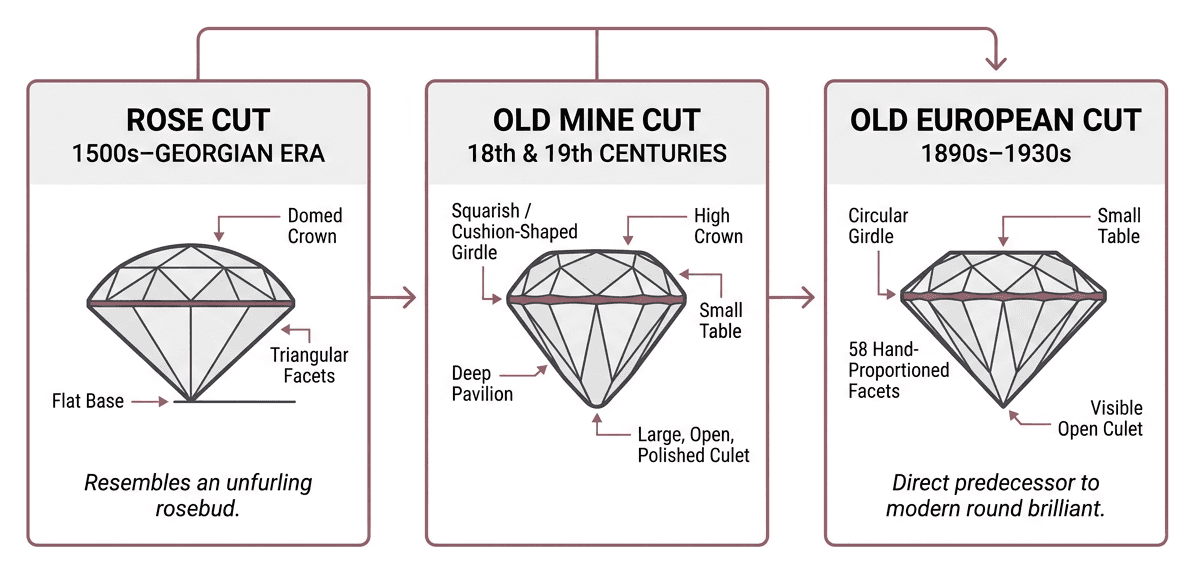
Table Cut: Developed in the Renaissance and used through the 18th century, this cut features a flat top, beveled sides, and a broad base, resembling a truncated pyramid.
Rose Cut: Dating from the 1500s through the Georgian era, rose cuts have a flat base and a domed crown with 3 to 24 triangular facets resembling an unfurling rosebud.
Old Mine Cut: Popular throughout the 18th and 19th centuries, old mine cuts feature a squarish or cushion-shaped girdle, a high crown, a deep pavilion, a small table, and a large, open, polished culet at the bottom.
Old European Cut: The direct predecessor to the modern round brilliant, popular from the 1890s to the 1930s. It features a circular girdle, 58 hand-proportioned facets, a small table, and a visible open culet. An authentic example is the late-19th-century Antique marquise ring in 18K gold, platinum and diamonds - 58 Facettes, which highlights 1.80 carats of hand-faceted diamonds in a mixed 18k gold and platinum marquise setting.
Beyond the stone cuts, antique settings are uniquely telltale. Pre-Victorian and early Victorian gems were often set in heavy rubbed-over collets or scalloped buttercup mounts rather than modern cast prongs.
Sentimental Motifs and Hidden Symbolic Meanings
Antique jewelry was deeply communicative, serving as a visual code for personal sentiment, romantic courtship, and social standing:
Ouroboros & Serpents: A snake coiling to swallow its own tail symbolized eternity, endless devotion, and renewal.
The Witch's Heart: A heart with its tail curved to the right historically served as an amulet to ward off evil spirits, later symbolizing that the wearer's heart had been "enchanted" by a lover.
Acrostic Jewelry: Popularized by French jewelers like Chaumet, rings and lockets spelled secret messages using the first letter of each gemstone (e.g., Diamond, Emerald, Amethyst, Ruby, Emerald, Sapphire, Tourmaline spelled DEAREST).
Posy Rings & Fede Bands: Dating back to medieval and Georgian times, these gold bands were engraved with rhyming verse (posies) inside the shank, or featured clasped hands (fede) that swiveled apart to reveal a hidden secret.
Mizpah & Padlocks: Inscribed with the biblical phrase "The Lord watch between me and thee when we are absent one from another," Mizpah brooches and heart padlock clasps promised fidelity between separated lovers.
How to Authenticate and Evaluate Value
Authenticating fine historic pieces requires a structured, multi-step physical inspection. Whether assessing an estate collection or mastering how to appraise jewelry, look beyond surface aesthetics and evaluate construction methods and metallurgical properties.
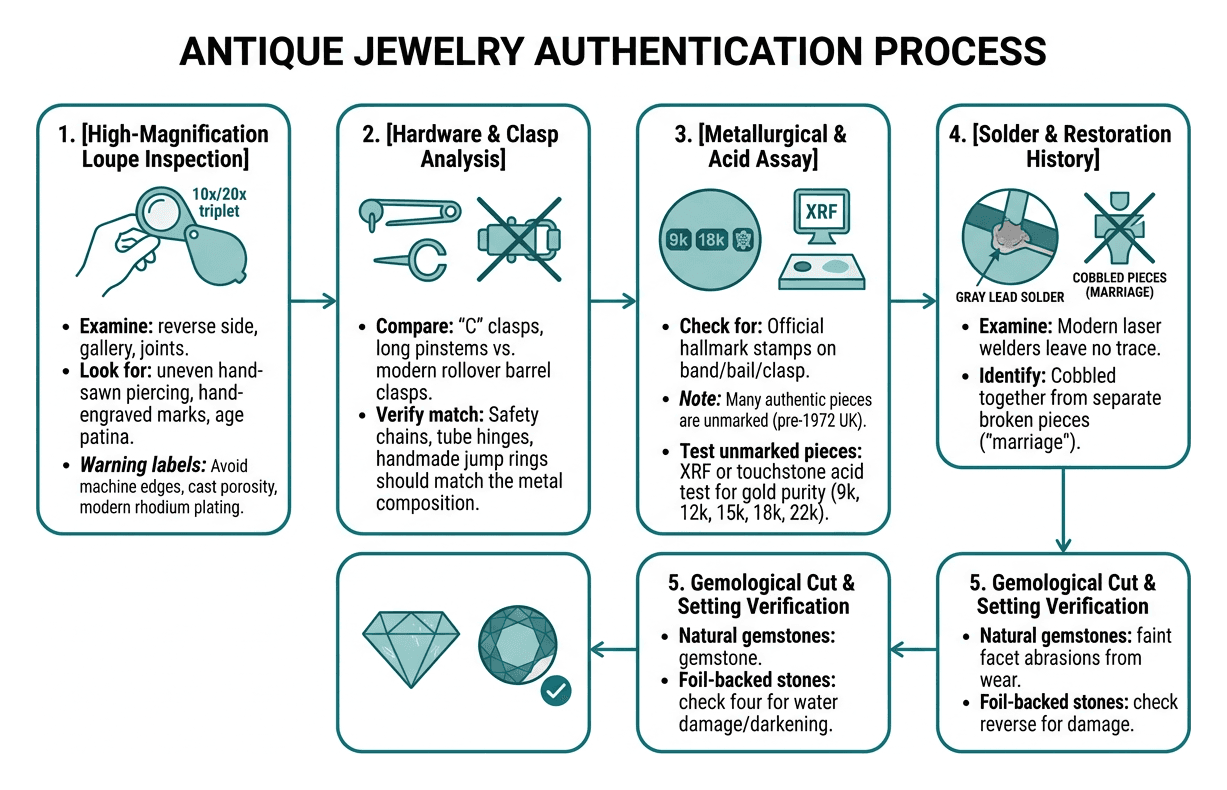
Step-by-Step Guide to Authenticating Antique Jewelry
Perform a High-Magnification Loupe Inspection: Using a 10x or 20x triplet loupe, examine the reverse side, gallery, and joints of the piece. Look for uneven, hand-sawn pierced work, hand-engraved tool marks, and subtle age patina. Be suspicious of razor-sharp machine edges, cast porosity (tiny surface pitting from modern centrifugal casting), or modern rhodium plating.
Examine Fasteners, Hinges, and Clasps: Victorian brooches typically feature long, extending pinstems and simple "C" clasps. Modern safety rollover barrel clasps were not widely used until after the turn of the 20th century. Safety chains, tube hinges, and handmade jump rings should match the metal composition of the main body.
Verify Metal Hallmarks and Test Unmarked Alloys: Check the inner band, bail, or tongue clasp for official stamps. Because hallmark regulations were not universally mandatory in the UK until 1972, many authentic pieces are unmarked. In such cases, non-destructive X-ray fluorescence (XRF) or touchstone acid testing should be used to confirm gold purity (e.g., 9k, 12k, 15k, 18k, or 22k).
Evaluate Solder and Restoration History: Antique repairs often left gray lead solder marks, which modern laser welders avoid. Examine whether components have been cobbled together from separate broken pieces (a practice known as a "marriage").
Inspect Gemstone Mountings and Wear: Natural gemstones should show faint facet abrasions consistent with decades of gentle wear. If a piece contains foil-backed gemstones, check the reverse for water damage or darkening.
If you are cataloging an inheritance and deciding where to sell old jewelry, consulting an accredited gemologist ensures you receive a fair, market-tested appraisal.
Condition Assessment, Modifications, and Mechanical Features
Antique jewelry often surprises collectors with ingenious mechanical features. Skilled Victorian and Edwardian goldsmiths created convertible tiaras that broke down into necklaces, pendant-brooches with fold-down bails, and expandable pieces. A striking example of this craftsmanship is the RARE 2 for 1 Convertible RING to BRACELET Surprise Antique Sapphire Ru – Mouse's House Antiques, a 9k gold and silver mechanism that opens from a single ring into an expandable, multi-hoop bracelet.
When assessing an item against an estate jewelry appraisal guide 2026, check for alterations:
Sizing Breaks: Look for color discrepancies along the back of the shank where a jeweler added metal.
Re-Tipped Prongs: Original settings were often softer than modern prongs; verify whether worn prongs have been rebuilt to secure the stones.
Replaced Center Stones: Verify whether modern round brilliant cuts have been added to an older Georgian or Victorian mounting.
Modern Collecting, Sustainability, and Preservation
Beyond their romantic charm, authentic antique pieces represent the pinnacle of sustainable luxury. Acquiring pre-owned jewelry completely bypasses the ecological disruption, habitat destruction, and carbon footprint of new mineral extraction. Every antique jewel represents a preserved historical artifact in a continuous circular economy.
For families navigating the responsibilities of selling inherited jewelry, passing these items to appreciative collectors honors their artistic legacy while unlocking real financial value.
Wearability, Care, and Conservation Best Practices
Because antique pieces were crafted with historic techniques and natural organic materials, modern cleaning methods can cause irreversible damage:
Never Use Ultrasonic or Steam Cleaners: High-frequency vibrations can shatter delicate inclusions in emeralds, shake seed pearls loose from their settings, and permanently ruin antique enamel.
Protect Closed-Back and Foil-Backed Settings: Never submerge Georgian or early Victorian foil-backed rings in water. Moisture can seep behind the collet, oxidizing the foil and turning brilliant stones dull or black.
Care for Soft & Organic Materials: Pearls, natural coral, Whitby jet, tortoiseshell, and opals should only be cleaned with a damp, lint-free micro-cloth. Avoid exposing them to perfumes, hairsprays, or household chemicals.
Storage Environment: Store antique pieces individually in velvet-lined boxes or soft pouches away from direct sunlight and humidity.
Resale Trends and Professional Market Valuation
The market for verified antique jewelry remains strong. Signed heirloom pieces from legendary design houses (such as Cartier, Boucheron, Tiffany & Co., or Castellani) command significant premiums at international auctions.
When evaluating pieces for sale, market liquidity depends on original condition, rarity, historical documentation, and aesthetic appeal. If you are researching how to sell antique jewelry, seek out reputable, discreet buyers who evaluate both the precious metal melt value and the artistic, collectible provenance of each piece.
Frequently Asked Questions
What is the precise age threshold that separates antique from vintage jewelry?
By standard international trade and customs definitions, an item must be at least 100 years old to be classified as an antique. As of September 2026, authentic antique pieces date to 1926 or earlier, encompassing the Georgian, Victorian, Edwardian, Art Nouveau, and early Art Deco eras. Pieces produced between 1927 and 2006 (20 to 99 years old) are categorized as vintage.
Why are many genuine antique jewelry pieces unmarked with no metal hallmarks?
Many authentic pieces lack hallmarks because mandatory hallmarking laws did not cover all jewelry types or imported pieces until the late 20th century (such as the UK Hallmarking Act of 1972). Additionally, custom pieces created by private master bench jewelers were rarely stamped, and subsequent ring resizing often removed hallmarks on the bottom of the shank. Genuine age is confirmed through construction style, gemstone cuts, and metallurgical testing rather than stamps alone.
Does resizing or repairing an antique ring lower its authentic market value?
Minor, sympathetic adjustments—such as a clean ring sizing using period-appropriate solder or laser welding that preserves original hallmarks—have minimal impact on value and improve wearability. However, aggressive modifications, such as replacing original hand-cut gemstones with modern stones, grinding down hand-carved galleries, or removing historic enamel, can lower a piece's collectible value.
Conclusion
Every piece of antique jewelry serves as a wearable time capsule—connecting you to the artisans, romances, and artistic movements of centuries past. Whether you are building a personal collection of Georgian treasures, caring for an Edwardian heirloom, or parting with an inherited estate, working with experienced specialists ensures your pieces are properly identified, protected, and valued.
At Antwerp Diamonds, we help collectors and families assess fine antique heirlooms, luxury watches, and historic jewelry. Based in Atlanta, GA, we offer private, appointment-only evaluations with transparent market offers and instant payouts. When you are ready to evaluate your fine collection, schedule a private consultation for an estate jewelry appraisal.