
Find a Trusted Diamond Ring Valuation Near Me
A diamond ring valuation near me should start with a qualified local appraiser who can inspect the diamond, setting, and current market conditions in person. For a quick, credible result, choose a professional with recognized gemological training, ask for a flat written fee, and state why you need the value before the appointment.
If you need to... | Ask for this type of value |
|---|---|
Insure your ring | Retail replacement value |
Sell for cash or privately | Fair market or resale value |
Settle an estate or divide assets | Estate or fair market value |
Verify a recent purchase | Independent pre-purchase appraisal |
A ring's value is not one fixed number. The answer can change based on the diamond's 4Cs - carat, cut, color, and clarity - as well as its metal, condition, brand, and the valuation purpose. An insurance figure, for example, is usually not the amount a buyer will pay in a quick sale.
A professional valuation gives you clear documentation and a more realistic basis for insurance, estate planning, resale, or an immediate cash decision. It also helps protect you from relying on an old receipt, an informal estimate, or a diamond grading report that describes quality but does not assign a value to the finished ring.

Understanding Diamond Ring Appraisals: Types and Key Differences
When searching for a diamond ring valuation near me, it helps to realize that an appraisal is fundamentally a legal and financial document. However, the numeric dollar figure printed on that document will vary dramatically depending on the specific standard of valuation used.
An appraiser acts much like an economic analyst evaluating physical property under specific conditions. Are we looking at what it would cost to build or purchase an exact brand-new duplicate at a high-end retail boutique today? Or are we calculating what a willing buyer would pay a willing seller in an open secondary market? Choosing the wrong type of appraisal is one of the most common mistakes diamond owners make.
Retail Replacement Value vs. Fair Market Value
The two primary valuation standards used in the jewelry industry are Retail Replacement Value (RRV) and Fair Market Value (FMV).
Retail Replacement Value (RRV): This standard estimates the total financial cost to replace an item with a brand-new equivalent in pre-loss condition at full modern retail pricing. Insurers use this figure to establish personal property scheduled coverage riders. Because retail prices factor in retail overhead, custom jewelry design labor, markup, and taxes, RRV figures represent the highest dollar estimate.
Fair Market Value (FMV): Used predominantly for tax filings, estate planning, probate distribution, and legal settlements, Fair Market Value reflects a realistic transaction price between a willing buyer and a willing seller, with neither being under compulsion to buy or sell.
Liquidation / Immediate Cash Value: If your goal is an immediate cash sale, an appraiser or buyer assesses immediate liquidation value. This reflects secondary market demand, liquidity, metal melt rates, and current diamond wholesale demand.
If you are wondering How Much to Value a Diamond Ring before attempting to sell it, relying on an old retail replacement document can lead to false expectations. To get an accurate sense of potential payout figures, tools like a Diamond Resale Value Calculator can provide realistic secondary market expectations.
Jewelry Appraisal vs. Diamond Grading Certificate
Many consumers confuse a diamond grading report (such as one issued by the GIA or AGS) with a formal jewelry appraisal. While both are critical documents, they serve completely different purposes.
A diamond grading report acts as an official identity document for a loose diamond. It measures physical proportions, assigns clarity and color grades, details cut quality, and notes any laser inscriptions or fluorescence. Crucially, a gem lab certificate never assigns a monetary dollar value to a diamond.
In contrast, a formal jewelry appraisal evaluates the entire assembled piece—including the center diamond, side accent stones, total carat weight, mounting metal purity, and craftsmanship—and assigns a specific dollar value based on market research. If you already have lab certification, booking a specialized GIA Ring Appraisal allows the appraiser to reference those verified scientific metrics to arrive at a precise value.
Document Feature | Diamond Grading Report (e.g., GIA) | Formal Jewelry Appraisal |
|---|---|---|
Primary Focus | Loose diamond quality metrics (4Cs) | Complete assembled piece (ring, metal, accents) |
Assigns Monetary Value? | No | Yes (Stated in USD) |
Includes Metal Karat Purity? | No | Yes |
Primary Purpose | Scientific quality verification | Insurance policy, estate division, or resale baseline |
Market Relevance | Permanent physical grade | Time-sensitive (requires periodic updates) |
How to Choose a Reputable Diamond Ring Valuation Near Me
Searching online for a diamond ring valuation near me will yield dozens of results ranging from local retail jewelry stores to independent laboratories. However, choosing the right professional requires looking beyond basic local search results or paid advertising listings.
To secure an unbiased assessment, look for an appraiser whose primary role is evaluation rather than retail sales. When an appraiser offers impartial analysis, you avoid conflicts of interest. For example, some retail appraisers who charge fees based on a percentage of the appraised value face a direct conflict of interest, as higher valuations artificially inflate their fee and your insurance premiums.
Key Appraiser Credentials to Look For
When evaluating local experts, verify their formal gemological education and professional appraisal society credentials. Key credentials include:
Graduate Gemologist (G.G.): Conferred by the Gemological Institute of America (GIA), this is the international benchmark for technical stone identification, diamond grading, and laboratory analysis.
AGS Certified Appraiser: The American Gem Society enforces strict ethical standards and continuous testing. AGS gemological laboratories use an advanced 0-to-10 diamond grading scale, where 0 represents ideal perfection.
NAJA Membership: The National Association of Jewelry Appraisers focuses exclusively on jewelry valuation, requiring continuous professional development and strict ethical compliance.
USPAP Compliance: The Uniform Standards of Professional Appraisal Practice represent the recognized quality control standards for legal, tax, probate, and government property valuations.
Choosing an certified Independent Jewelry Appraiser who operates on a transparent flat-fee pricing structure ensures that your valuation report is objective, thorough, and legally defensible.
How to Locate Certified Appraisers Locally
To find qualified valuation specialists near you without relying solely on search engine ads, consider these practical steps:

Search Professional Organization Directories: Consult member databases hosted by NAJA, AGS, or the International Society of Appraisers (ISA) to locate verified credential holders in your area.
Verify Licensing and Certifications: Ensure the gemologist holds an active G.G. diploma or equivalent recognized credential.
Confirm Fee Structures Upfront: Always select appraisers who charge a set flat rate or an hourly fee rather than a percentage of the item's overall worth.
Check Sample Reports: Review sample written documentation to ensure it includes full 4Cs analysis, high-resolution color photographs, millimeter dimensions, metal purity testing, and the appraiser’s signature.
Learning How to Appraise Jewelry standard practices helps you recognize true expertise during your initial consultation. Specialized valuation hubs highlight how certified experts deliver thorough documentation across insurance, estate, and pre-purchase needs.
What Happens During a Diamond Valuation Appointment and What It Costs

Knowing what happens during a professional evaluation appointment can give you peace of mind when handing over your precious heirloom.
What to Expect During a Diamond Ring Valuation Near Me Appointment
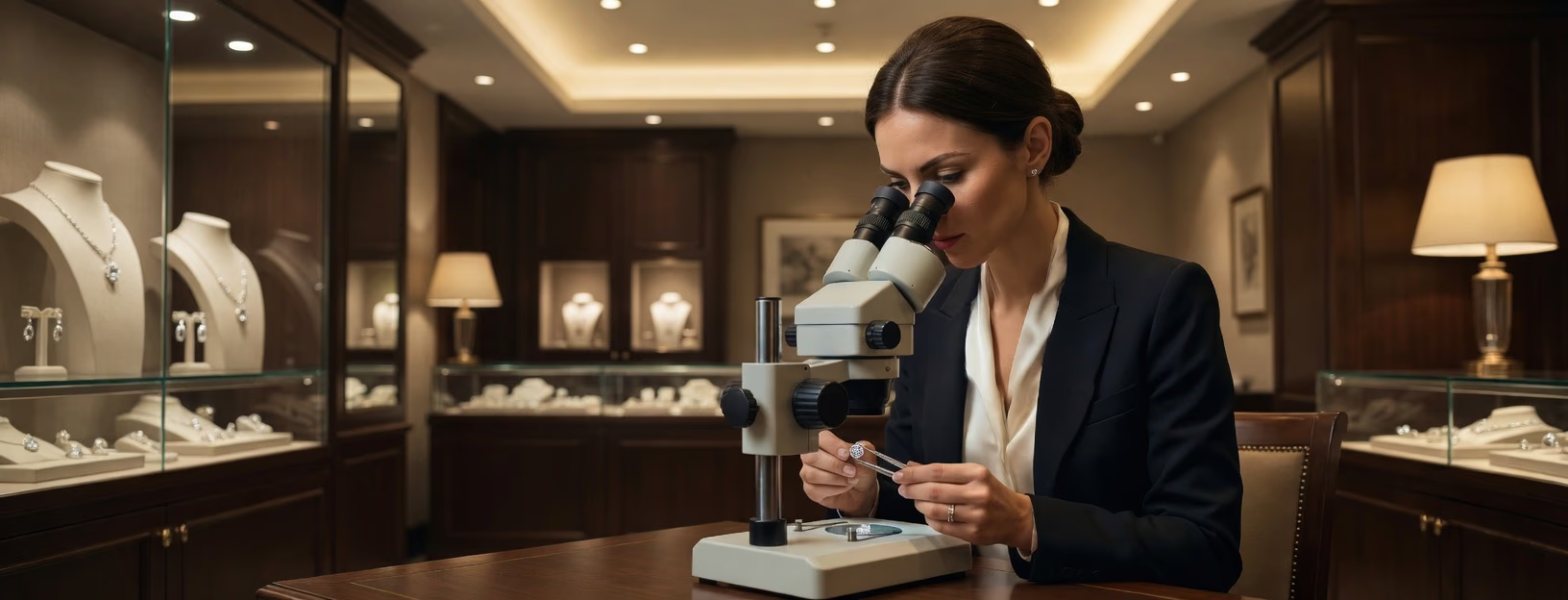
During a standard evaluation, a qualified gemologist conducts a step-by-step examination of your piece using dedicated laboratory equipment:
Cleaning and Preparation: The ring is placed in an ultrasonic cleaner and steam cleared to remove oil, lotion, and dust, ensuring inclusions and surface characteristics are fully visible.
Microscopic Inspection & Stone Identification: Using a binocular microscope and refractometer, the gemologist verifies whether the diamond is natural, treated, or synthetic (lab-grown), while inspecting prong integrity.
4Cs Quality Grading: The center diamond’s carat weight is calculated (either via precise millimeter dimensions or loose scale weight), while color and clarity are graded against master sets.
Metal Analysis: Metal karats (such as 14K, 18K gold, or Platinum 950) are verified using non-destructive X-ray fluorescence (XRF) spectrometry or electronic gold testers.
Plotting Diagram and Photography: A visual diagram mapping internal clarity characteristics is drawn or digitally rendered alongside macro photography.
For single items, this complete process usually takes 30 to 60 minutes. Many providers allow scheduled appointments where you can watch the inspection in person. If you are preparing for an evaluation, reviewing guides on how to Appraise My Diamond can help you gather essential prior receipts or certs beforehand. Furthermore, options to Appraise My Ring Online provide preliminary digital estimates prior to committing to a full in-person laboratory inspection.
How Much Does a Diamond Ring Valuation Near Me Cost?
Appraisal costs vary depending on the item's complexity, the appraiser's qualifications, and the purpose of the report. Most independent jewelry appraisals fall within standardized cost brackets:
Single Item Written Appraisals: Flat fees typically range between $75 and $350 for single items like engagement rings. Straightforward pieces frequently fall into the $50 to $150 flat-fee tier, while highly intricate designer settings or complex vintage items may cost $100 to $250.
Hourly Rates for Collections: For multi-piece family estates or large jewelry collections, appraisers usually charge hourly rates ranging from $150 to $300 per hour.
Verbal Evaluations: Many gemologists offer free or low-cost verbal consultations if you simply want to establish quick market value without formal legal documentation.
Transparent fee structures are standard practice among top-tier valuation centers. Flat fee pricing protects consumers from inflated cost structures.
Frequently Asked Questions About Diamond Ring Valuations
Can I get a diamond ring appraised while I wait?
Yes. Most single-item appraisals, such as a traditional solitaire engagement ring, can be completed within 30 to 60 minutes during a scheduled appointment while you wait.
However, larger collections, extensive heirlooms requiring specialized Estate Jewelry Appraisal, or pieces requiring complex gemstone identification may need to remain in the lab for up to 3 to 7 business days.
How often should I update my diamond ring appraisal?
Insurance providers typically require an updated written appraisal every 2 to 3 years to maintain adequate scheduled personal property coverage.
Because precious metals (gold, platinum, silver) and polished diamond wholesale markets fluctuate over time, reviewing appraisals every 3 to 5 years prevents under-insurance or overpaying premiums. Dedicated appraisal services emphasize periodic re-evaluations to adjust policy values to contemporary economic realities.
What information is included in a professional appraisal report?
A comprehensive formal appraisal report includes:
Detailed Description: Item type, style, mounting construction, and metal karat composition.
Gemstone Grading (4Cs): Exact carat weight, GIA color/clarity grades, and cut measurements.
High-Resolution Photography: Color photographs documenting setting condition and laser inscriptions.
Valuation Metric Used: Explicit statement declaring whether the figure reflects Retail Replacement Value, Fair Market Value, or Liquidation Value.
Appraiser Signature & Credentials: Formal declaration of appraiser qualifications, society memberships, and USPAP compliance.
Clear documentation ensures high acceptance rates with insurance providers, court probate systems, and financial institutions. Qualified appraisal providers structure their formal reports around these exact transparency criteria.
Conclusion
Securing an accurate diamond ring valuation near me protects your financial investment, ensures seamless insurance coverage, and offers complete peace of mind when navigating estate planning or resale decisions. By understanding the distinction between retail replacement figures and real-world market values, verifying credentials like GIA Graduate Gemologist diplomas, and demanding flat-fee pricing, you ensure an objective evaluation.
If your primary goal is to turn luxury items into immediate funds rather than paying for an insurance policy report, navigating options to Sell My Diamond Ring Near Me or evaluating Where to Sell Fine Jewelry opens direct options. Knowing How to Sell Diamonds empowers you to secure maximum value.
At Antwerp Diamond Store, we specialize in purchasing luxury diamond jewelry, high-end watches, and designer handbags. Operating out of Atlanta, GA, we offer free evaluations, complete market-based transparency, and instant payout options in private, appointment-only consultations. Whether you need expert advice on an inherited piece or are looking for immediate Cash for Diamond Ring transactions without hidden fees, our team delivers discreet, professional service every step of the way.