

CTW stands for Carat Total Weight, the combined weight of all diamonds in a piece of jewelry. It's an important metric for understanding jewelry value, especially for multi-stone items like engagement rings or tennis bracelets.
If you're looking at an old appraisal, a ring box, or an insurance paper and seeing something like 1.00 CTW or 1.50 CTTW, you're probably asking a very practical question: what does that mean for what my jewelry is worth today?
That question matters most when you're thinking about selling, borrowing against jewelry, or getting a realistic appraisal. Many owners assume a higher CTW always means a higher offer. Sometimes it does. Sometimes it doesn't, especially when that weight is spread across many very small stones instead of concentrated in one larger diamond.
Table of Contents
What Is CTW in Jewelry
CTW means Carat Total Weight. In plain English, it's the total carat weight of all the diamonds in one piece of jewelry, including the center stone and any side or accent stones, as explained in Fink's guide to ct, ctw, tw, and cttw.
If you found 1.50 CTW on an older appraisal for a ring, that doesn't automatically mean there's one 1.50 carat diamond in the center. It means all the diamonds in that ring add up to 1.50 carats. That could be one large center stone with a halo. It could also be many small diamonds spread across the band.
This detail often causes confusion. The number sounds simple, but it doesn't tell you how the weight is distributed. For resale, that missing detail can make a major difference.
Practical rule: CTW tells you total diamond weight, not the size of the main diamond and not the likely cash offer by itself.
CTW is most useful in multi-stone jewelry. Think halo engagement rings, three-stone rings, diamond bracelets, cluster earrings, and necklaces with several diamonds. If you're also sorting out broader jewelry terms, this guide on what counts as fine jewelry helps put CTW in the larger context of materials, craftsmanship, and resale potential.
Why sellers need to read CTW carefully
A seller usually sees CTW first on one of these documents:
An old appraisal: Insurance paperwork often lists total diamond weight but may not break down each stone clearly.
A receipt from years ago: Retail descriptions often highlight CTW because it's easy to market.
A stamp or tag: Some jewelry is described in sales materials by total weight rather than center stone size.
That makes CTW a starting point, not a final answer. If you want to know what your ring, bracelet, or pendant may bring in the current Atlanta or Georgia resale market, you need to know both the total weight and how that weight is built into the piece.
CTW vs Single Carat Weight and Points
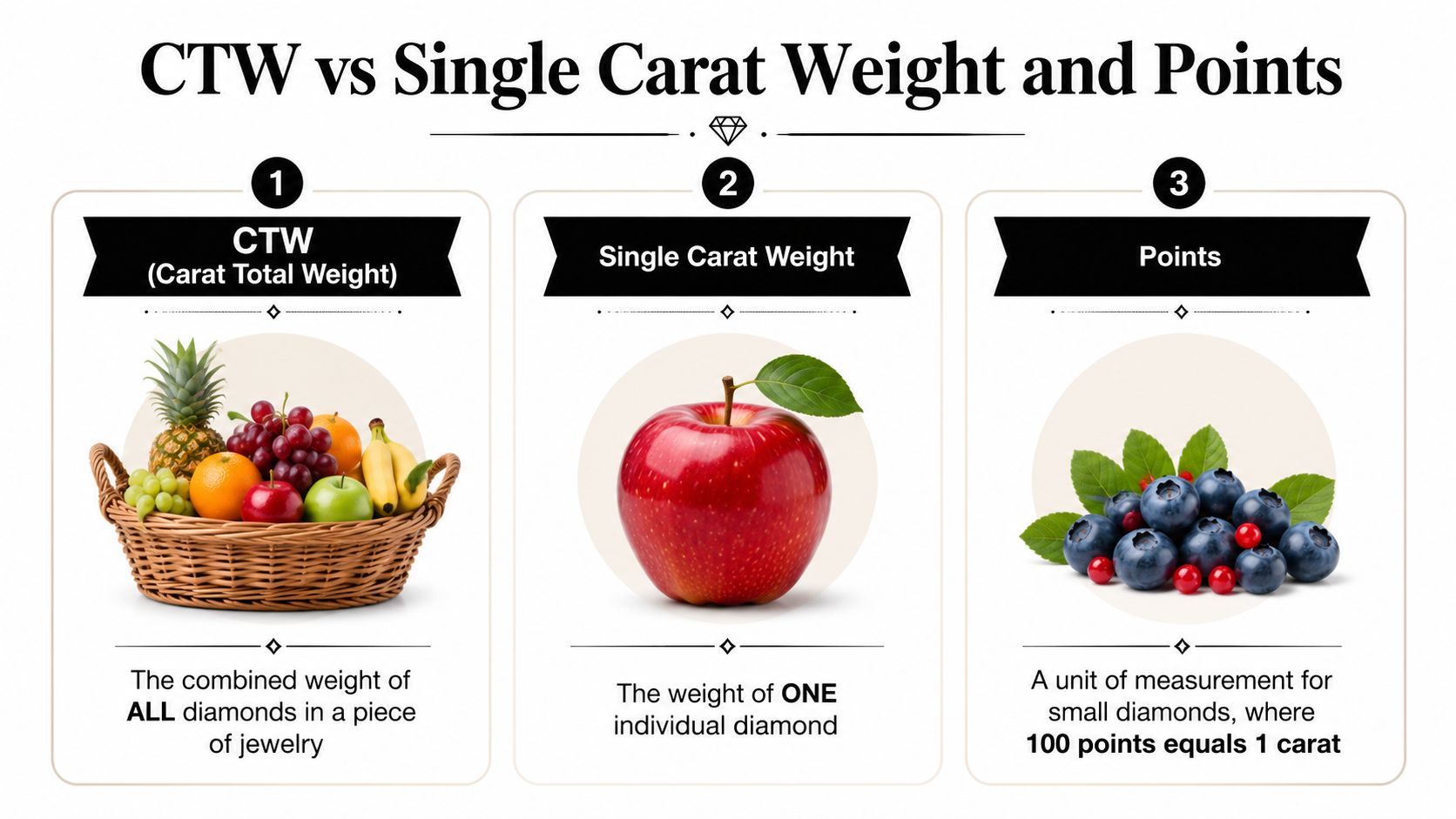
A lot of confusion around what is CTW comes from mixing up three different measurements: CTW, single carat weight, and points.
The simplest way to think about it
Think of CTW like the total weight of all the fruit in a basket. Single carat weight is the weight of one apple. They're related, but they aren't the same thing.
The carat itself is a fixed standard. 1 carat equals 200 milligrams, or 0.2 grams, and a 1.00 CTW piece contains exactly that amount of total diamond mass. For example, a ring with a 0.70-carat center stone and two 0.15-carat side stones equals 1.00 CTW, as shown in Brilliant Earth's explanation of ct, ctw, cttw, and tw.
Here's the real-world difference:
Term | What it means | What it tells you |
|---|---|---|
CTW | Total of all diamond weights in the piece | Combined diamond mass |
Single carat weight | Weight of one specific diamond | Size of an individual stone |
Points | Small unit used for diamond weight | Fine measurement for small stones |
A 1.00 CTW cluster ring and a 1.00 carat solitaire ring may contain the same total diamond mass. They won't look the same, and they usually won't sell the same way.
A buyer pays attention to where the weight sits. One larger diamond is usually more important than many tiny ones.
Why points matter
Points are used heavily in jewelry with small accent diamonds. A point is one-hundredth of a carat, written as 0.01 ct. Sellers may hear terms like ten-point diamond or one-point melee when discussing halo or pavé settings.
Many multi-stone rings often achieve an impressive CTW number by adding lots of tiny stones. A ring made from 100 one-point diamonds still totals 1.00 carat overall. But that isn't the same as having a single 1.00 carat center stone.
Here are the questions to ask when reading a document:
Is the listed weight total or individual? If it says CTW, it's total.
Is there a center stone breakdown? That's often more important for value.
Are the side stones melee? Very small stones affect appearance, but not the same way a larger center diamond does.
If you're selling, this distinction shapes expectations before anyone even looks at color, clarity, cut, or condition.
How CTW Is Calculated and Reported
CTW isn't a marketing guess. It's a formal measurement used in the jewelry trade.
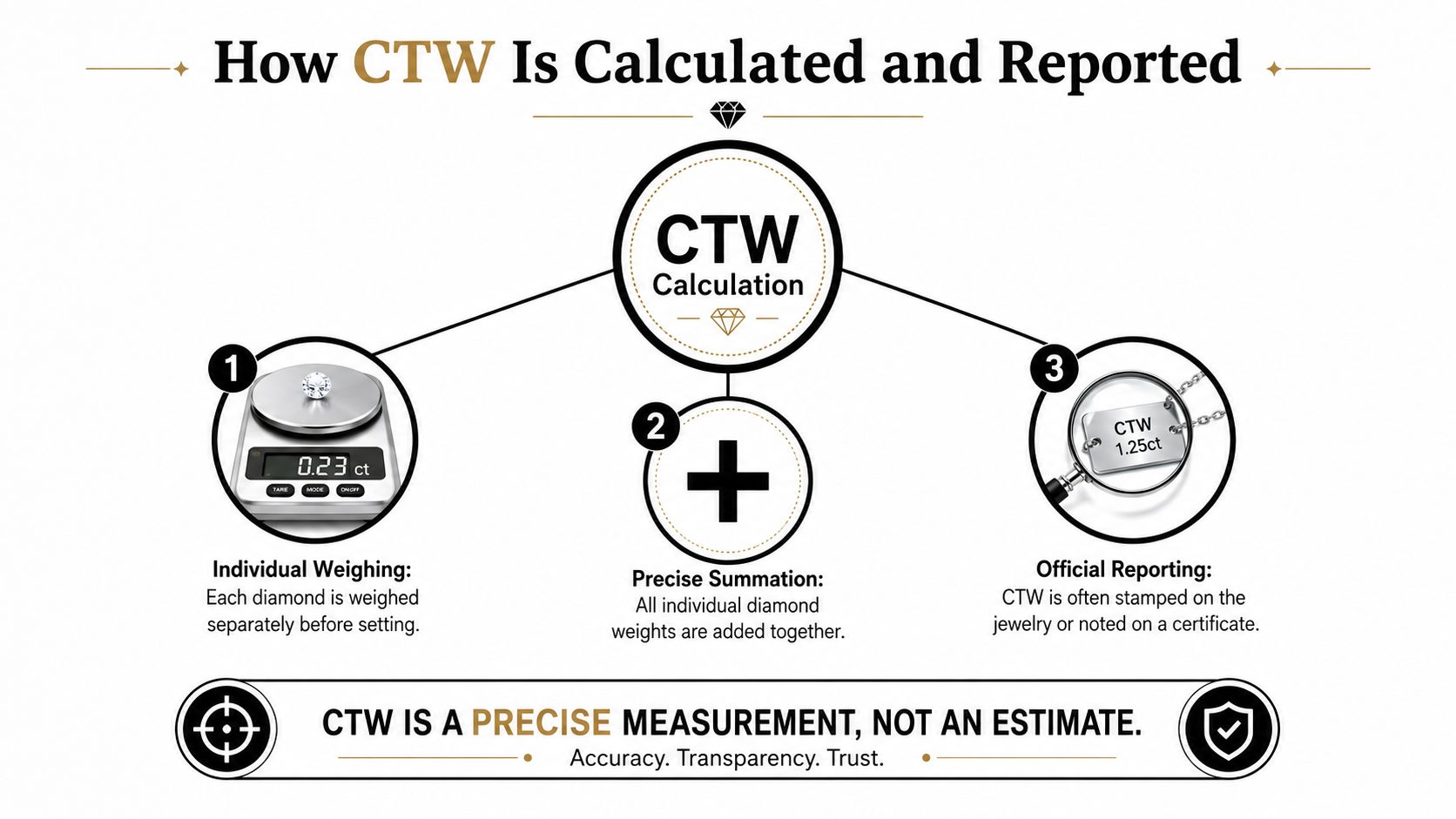
The standard definition is straightforward. CTW is the arithmetic sum of the individual carat weights of all diamonds in a jewelry piece, and 1 carat = 200 mg (0.2 g), as described in this overview of CTTW and GIA usage.
What gets counted and what doesn't
Only the diamonds count toward CTW. The gold, platinum, or other metal doesn't count. Neither do non-diamond gems such as sapphires or rubies.
If a ring has one center diamond and several side diamonds, a professional totals the individual diamond weights to reach the final CTW figure. That's why a multi-stone ring can have a larger CTW on paper than it appears to have at first glance.
A simple example looks like this:
Center diamond: listed separately
Side diamonds: combined with the center for total weight
Metal setting: excluded from CTW
Colored stones: excluded from diamond CTW
How professionals record it
On appraisals, sales receipts, and some jewelry tags, you may see CTW written in a few ways, such as CTW, CTTW, or TW. The exact letters can vary, but the meaning is usually the same when referring to total diamond weight.
A careful evaluator won't stop at the total number. They'll also identify whether the piece has one dominant center stone, a matched group of side stones, or mostly melee. That's where the value picture becomes much clearer.
If you're trying to estimate potential resale before an in-person review, a diamond resale value calculator can help frame the right questions, but it still won't replace a stone-by-stone assessment.
Accurate reporting builds buyer confidence. A vague line that says 1.50 CTW is helpful, but a breakdown of the center diamond and accents is far better.
How CTW Impacts Jewelry Valuation and Resale Price
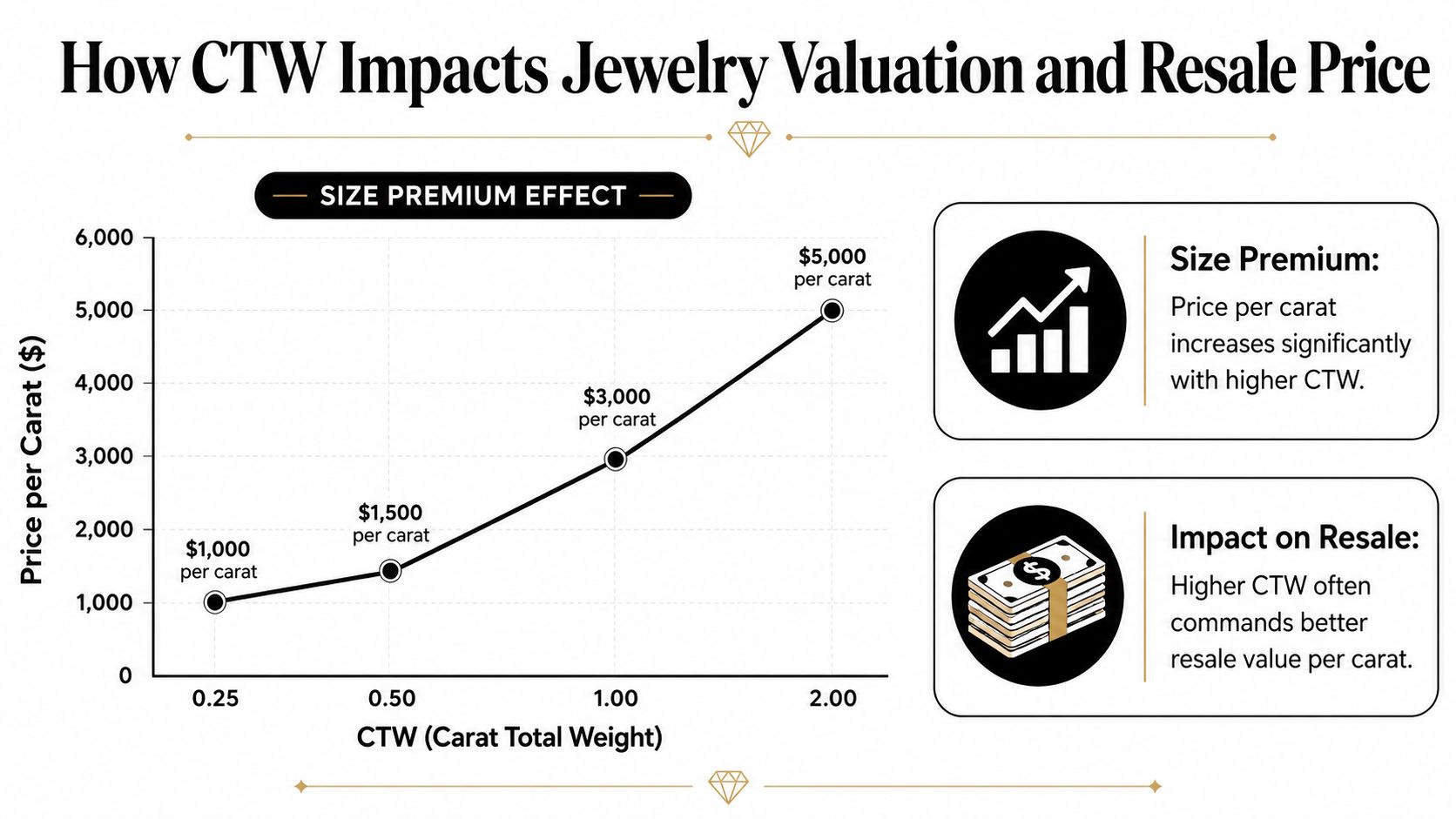
This is the part sellers care about most. CTW affects value, but it doesn't control value by itself.
Why equal CTW doesn't mean equal cash value
Two rings can have the same total weight and still produce very different offers.
A strong example comes from multi-stone valuation: a 1.2 CTW piece with a single 1.0 ct center stone typically retains 40–60% higher market value than a 1.2 CTW piece made entirely of melee diamonds under 0.05 ct each, because CTW doesn't reflect the nonlinear price-per-carat curve, according to Bengarelick's explanation of ctw and cttw meaning.
That difference exists because larger individual diamonds are rarer and more desirable in the resale market. Buyers, jewelers, and estate purchasers usually pay closer attention to the size and quality of the main stone than to a collection of tiny accent stones adding up to the same total.
A good way to picture it is real estate. One large, highly desirable property and many tiny units may add up to the same square footage. They won't command the same price, the same demand, or the same buyer interest.
What a buyer looks at besides total weight
When a professional evaluates a CTW piece for resale, these factors matter alongside the total:
Center stone size: One larger diamond often drives the offer.
Stone quality: Cut, color, clarity, and overall appeal can shift value significantly.
Setting style: Halo, pavé, cluster, and three-stone designs distribute weight differently.
Condition: Chipped stones, worn prongs, or missing accents reduce buyer confidence.
Current demand: Some styles resell better in Atlanta, Buckhead, Sandy Springs, Alpharetta, Roswell, Brookhaven, Midtown Atlanta, and the broader Georgia market than others.
If you're trying to estimate what your ring might be worth before selling, this guide on how much to value a diamond ring is a useful next step.
Higher CTW can sound impressive on paper. In resale, the distribution of that weight usually matters more.
A Seller's Guide to CTW Jewelry
If you're preparing to sell CTW jewelry, the smartest move is to organize the piece the way a buyer will review it. That means focusing on documentation, diamond layout, and realistic expectations.
What to gather before an evaluation
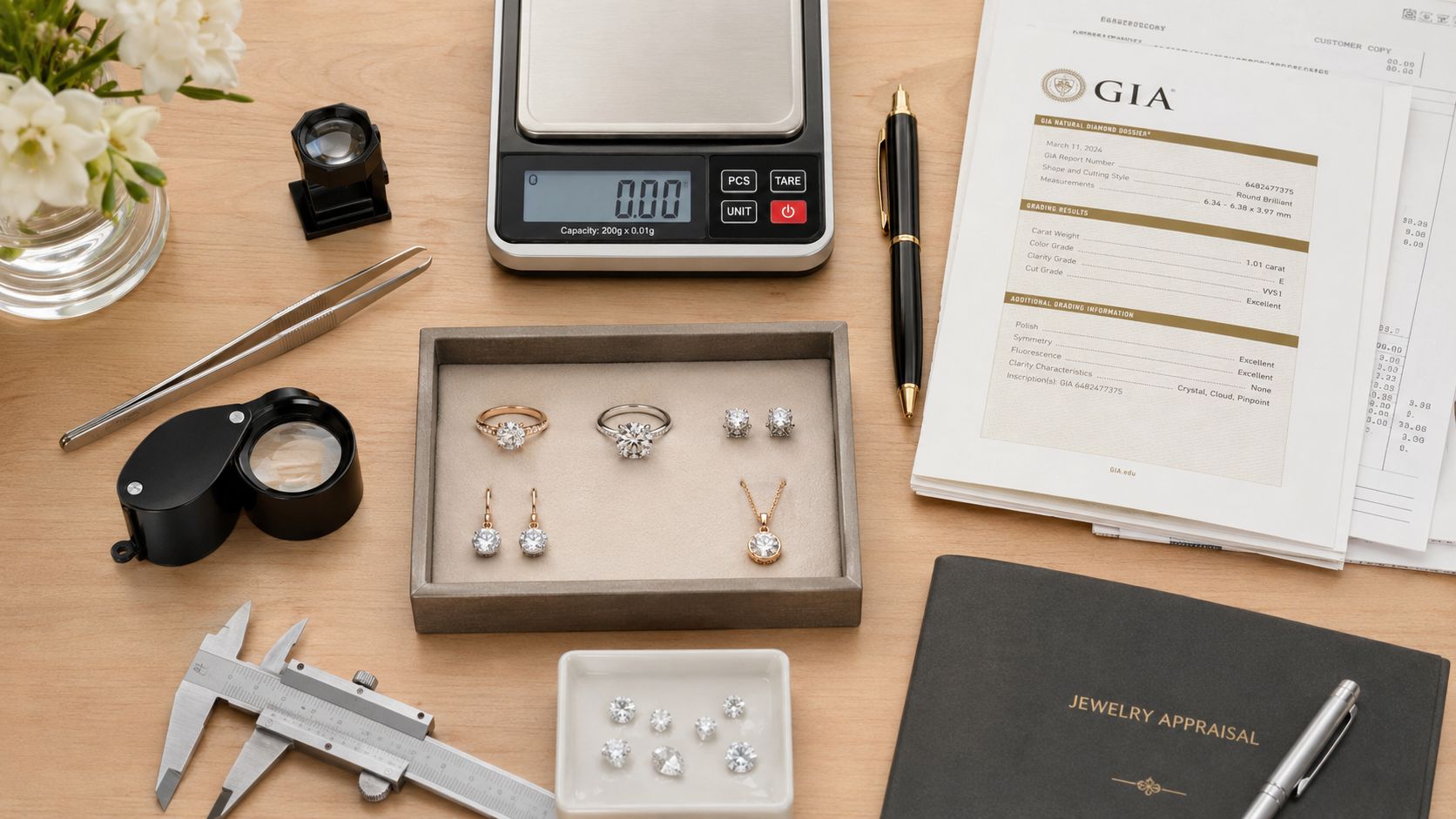
Bring every document you have, even if it's old. A dated appraisal won't set today's market price, but it can still help identify the original description of the piece.
Useful items include:
Previous appraisals: These may list the total weight and sometimes the center stone separately.
Sales receipts: Original retail descriptions often note CTW, metal type, and brand.
Diamond grading reports: If the center stone has a report, that can be more valuable than a generic jewelry appraisal.
Repair records: Resizing, stone replacement, or retipping can matter.
Original box or branded packaging: Sometimes helpful for buyer confidence, especially with branded jewelry.
If you're sorting out the selling process more broadly, this guide on where to sell fine jewelry can help you compare your options.
How to set realistic expectations
Sellers often focus on the total number first. That's understandable. But a buyer will usually focus on the largest and best stone first.
A useful benchmark for expectation setting is this: two rings with identical 1.00 CTW can have vastly different market values, and a single 1.00-carat center stone often commands a 30–50% higher price per carat than the same weight distributed as 100 one-point diamonds, as noted in WJD Exclusives' discussion of what CTW stands for.
That doesn't mean small-stone jewelry has no value. It does mean you shouldn't assume a halo ring marked 1.00 CTW will be treated like a 1.00 carat solitaire.
Use this quick checklist before you sell:
Read the paperwork carefully: Look for total weight versus center stone weight.
Check the setting style: Halo and pavé designs often carry a lot of weight in very small stones.
Inspect condition: Loose or damaged stones can affect the offer.
Ask for a breakdown: A serious evaluator should explain what part of the value comes from the center stone, side stones, and mounting.
Keep expectations market-based: Insurance replacement value and resale value aren't the same thing.
The most common seller mistake is treating CTW as if it were the size of one diamond. It isn't.
Get an Expert CTW Evaluation in Atlanta
If you're in Atlanta and trying to understand what is CTW in practical resale terms, the most useful next step is an in-person evaluation. That's especially true for multi-stone rings, tennis bracelets, and halo settings, where the layout of the diamonds matters as much as the total weight.
A trained evaluator will usually review the piece in layers: overall CTW, center stone presence, quality of the individual diamonds, setting condition, metal purity, and current buyer demand. That's how a realistic offer or appraisal comes together. It isn't based on one number alone.
For sellers in Buckhead, Sandy Springs, Alpharetta, Roswell, Brookhaven, Midtown Atlanta, and the wider Georgia market, local access matters because in-person review allows a buyer to inspect wear, verify stone matching, and evaluate whether the piece has stronger resale potential as jewelry or primarily for its component value.
If you're ready to explore your options, this article on where to sell my diamond ring near me can help you prepare for the process and know what questions to ask before you visit.
Frequently Asked Questions About CTW
Is CTW the same as CTTW
Usually, yes. Both terms refer to Carat Total Weight, meaning the combined weight of all diamonds in the piece.
Does CTW include the metal setting
No. CTW refers to the diamonds only. Gold, platinum, and other metals are excluded.
Does CTW include sapphires or other gemstones
No. CTW for diamonds doesn't include non-diamond stones such as sapphires or rubies.
Does higher CTW always mean higher resale value
No. A higher CTW can help, but the way the weight is distributed is often more important. One larger center diamond may be worth more than many tiny stones that add up to the same total.
Is a 1.00 CTW ring the same as a 1.00 carat diamond ring
Not necessarily. A 1.00 CTW ring could be one 1.00 carat diamond, or it could be several smaller diamonds whose weights add up to 1.00 carat.
Why do buyers ask about the center stone first
Because the center stone often drives desirability, rarity, and resale value more than small accent diamonds do.
If you'd like a clear, professional opinion on your diamond ring, bracelet, earrings, or other fine jewelry, Antwerp Diamond offers confidential evaluations with a focus on transparency and real market conditions. You can contact the team, request an evaluation, or visit for an in-person review if you're in Atlanta, including Buckhead, or elsewhere in the Georgia market.