

If you're shopping for a diamond name pendant, or thinking about selling one, the smartest approach is to look at the entire life of the piece before money changes hands. The design you choose today, the metal, the setting style, and the way the diamonds are mounted all affect not just how it looks on your neck, but how it wears, how it's appraised, and what a buyer may pay for it later.
That matters in Atlanta, Buckhead, Sandy Springs, Alpharetta, Roswell, Brookhaven, Midtown Atlanta, and across the Georgia market, where buyers often want personalized jewelry that feels meaningful but still want clear guidance on quality, authenticity, and resale reality.
Table of Contents
What Is a Diamond Name Pendant
A diamond name pendant is a personalized pendant that spells out a name, nickname, or word in precious metal and sets small diamonds into the letters. It sits somewhere between fine jewelry and personal storytelling. Unlike a plain initial pendant or a monogram, a full name pendant usually has more curves, more metal surface, and more engineering challenges.
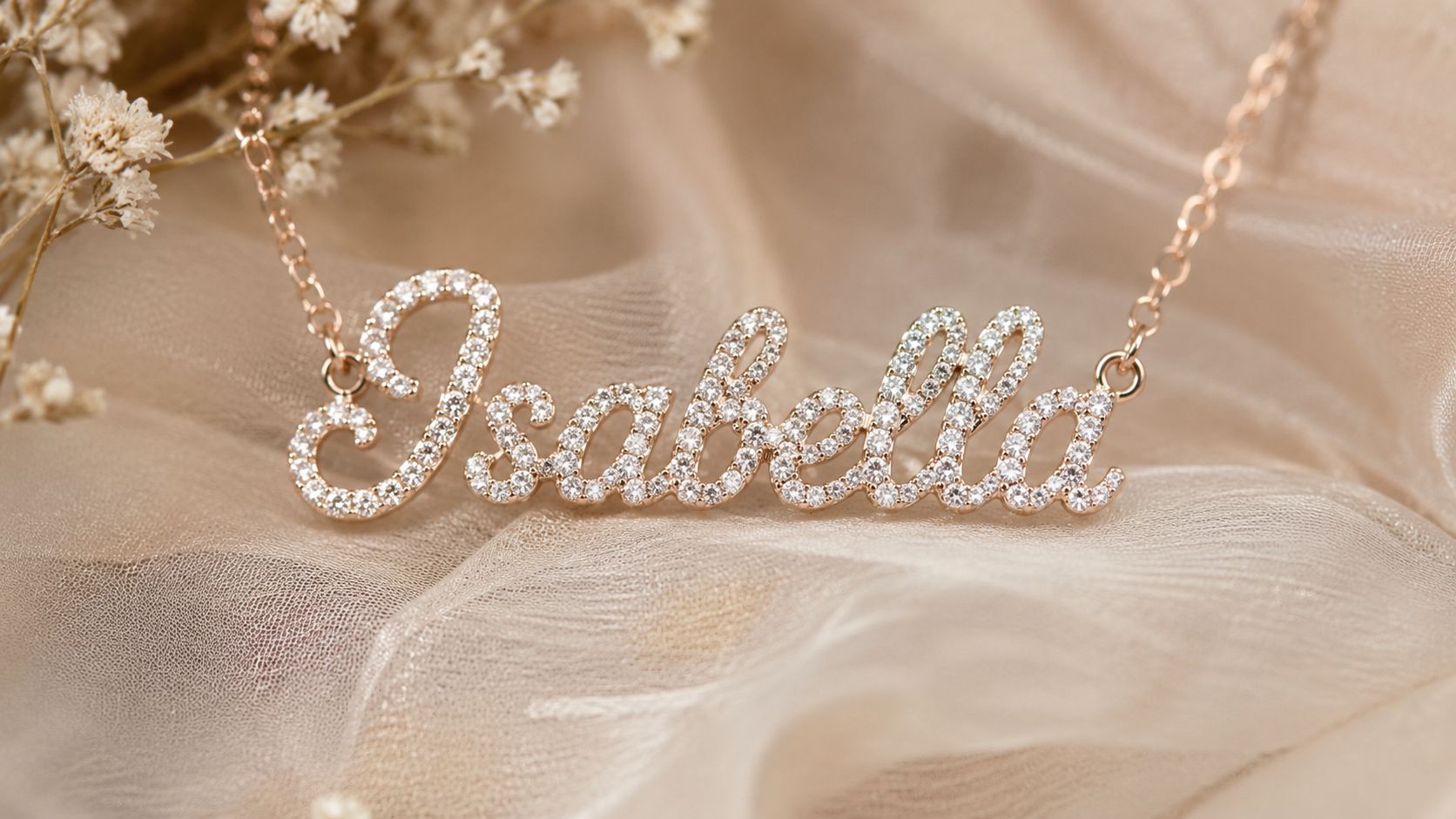
Some are done in flowing script. Others use block letters for a cleaner architectural look. The most personal versions trace actual handwriting, which can produce a beautiful result, but also introduces practical concerns if the strokes become too thin or uneven for daily wear.
These pendants aren't a fringe category. The global diamond jewelry market reached USD 348.6 billion in 2023, which shows the scale of demand surrounding diamond-set jewelry, including personalized pieces such as name pendants, according to Custom Market Insights on the diamond jewelry market. In other words, this isn't novelty jewelry. It's part of a large, established luxury market where craftsmanship and materials matter.
Why people choose them
A good diamond name pendant does two jobs at once. It reads clearly as jewelry, and it means something specific to the person wearing it.
That could be:
A child's name, worn as an everyday sentimental piece
A partner's name or initials, chosen for anniversaries or weddings
A memorial word or signature, where emotional value outweighs resale value
A personal style statement, especially in script or custom lettering
Practical rule: If the pendant only works as a message and not as jewelry, it usually won't age well stylistically.
For buyers comparing personalized pieces, even a non-diamond option like this candy-inspired initial necklace can be useful as a design reference because it shows how letter scale, spacing, and charm-like styling affect wearability. The lesson carries over to high jewelry. Readability and proportion matter as much as sparkle.
If you want a broader baseline for what separates precious, wearable pieces from fashion-grade jewelry, Antwerp Diamond's guide to what fine jewelry is is a solid place to ground that distinction.
Choosing Styles Metals and Diamond Settings
The visual design gets attention first, but the structure underneath determines whether the pendant holds up. A piece that's attractive in a rendering can still be fragile in real life if the letters are too thin, the chain isn't matched properly, or the melee diamonds are set into weak walls.
How name pendant styles differ
Script pendants usually feel softer and more fluid. They suit cursive names and signatures, but they also create narrow turns and connected strokes where stress tends to concentrate.
Block-letter pendants are easier to read and often easier to build with stronger metal support. They can look more modern and usually tolerate daily wear a bit better when the letters have enough thickness.
Custom handwriting pendants are the most personal. They're also the least forgiving. If the original handwriting has sharp loops, thin downstrokes, or long unsupported tails, the jeweler has to interpret it intelligently instead of tracing it blindly.
Precious metal comparison for daily wear
The metal affects color, wear resistance, repair options, and value perception.
Metal | Purity | Characteristics | Best For |
|---|---|---|---|
14K Gold | 14 parts gold | Stronger feel for daily wear, practical for active use, available in yellow, white, and rose | Buyers who want durability and lower maintenance |
18K Gold | 18 parts gold | Richer gold color, more luxurious look, commonly used in fine pavé work | Buyers prioritizing color richness and high-end finish |
Platinum | Platinum alloy | Dense, substantial, naturally white, secure for fine settings, usually heavier on the neck | Buyers who want weight, premium feel, and longevity |
Metal choice isn't just aesthetic. If you're comparing alloys, Antwerp Diamond's overview of the difference between 14K and 18K gold helps explain why one client may prefer hardness while another chooses color and prestige.
Why the setting matters more than most buyers think
Most diamond name pendants use micro-pavé or beaded settings, where many small diamonds are placed close together across the face of the letters. In practice, the typical stones are 0.01 to 0.03 ct each, and they're secured with 18K gold beads formed directly onto the metal. The construction also calls for a minimum stone diameter of 1.2mm, because walls thinner than 0.4mm can fracture during polishing or later wear, as described by RW Fine's custom handwritten diamond name necklace specifications.
That technical detail matters because a name pendant isn't flat like a basic bar pendant. Letters bend. Cursive strokes twist. Daily wear introduces torsion, especially where the chain attaches.
When I inspect estate jewelry, I pay close attention to:
Letter junctions, where one stroke meets another and metal may be thinnest
End letters, because they tend to catch on clothing first
Bead integrity, since worn beads are an early warning sign for stone loss
Bail or chain attachment points, which often fail before the pendant itself
A delicate look is fine. A structurally weak look is expensive later.
Chain choice also matters. A heavy pendant on a chain that's too fine will rotate or pull forward. A light pendant on a thick chain can look unbalanced. The best combinations feel intentional, not improvised.
Understanding Diamond Quality for Name Pendants
Small diamonds don't get a free pass on quality. In a name pendant, you're not judging one center stone. You're judging the collective appearance of many stones working together. If the matching is poor, the whole piece looks uneven even when each individual diamond seems acceptable on paper.
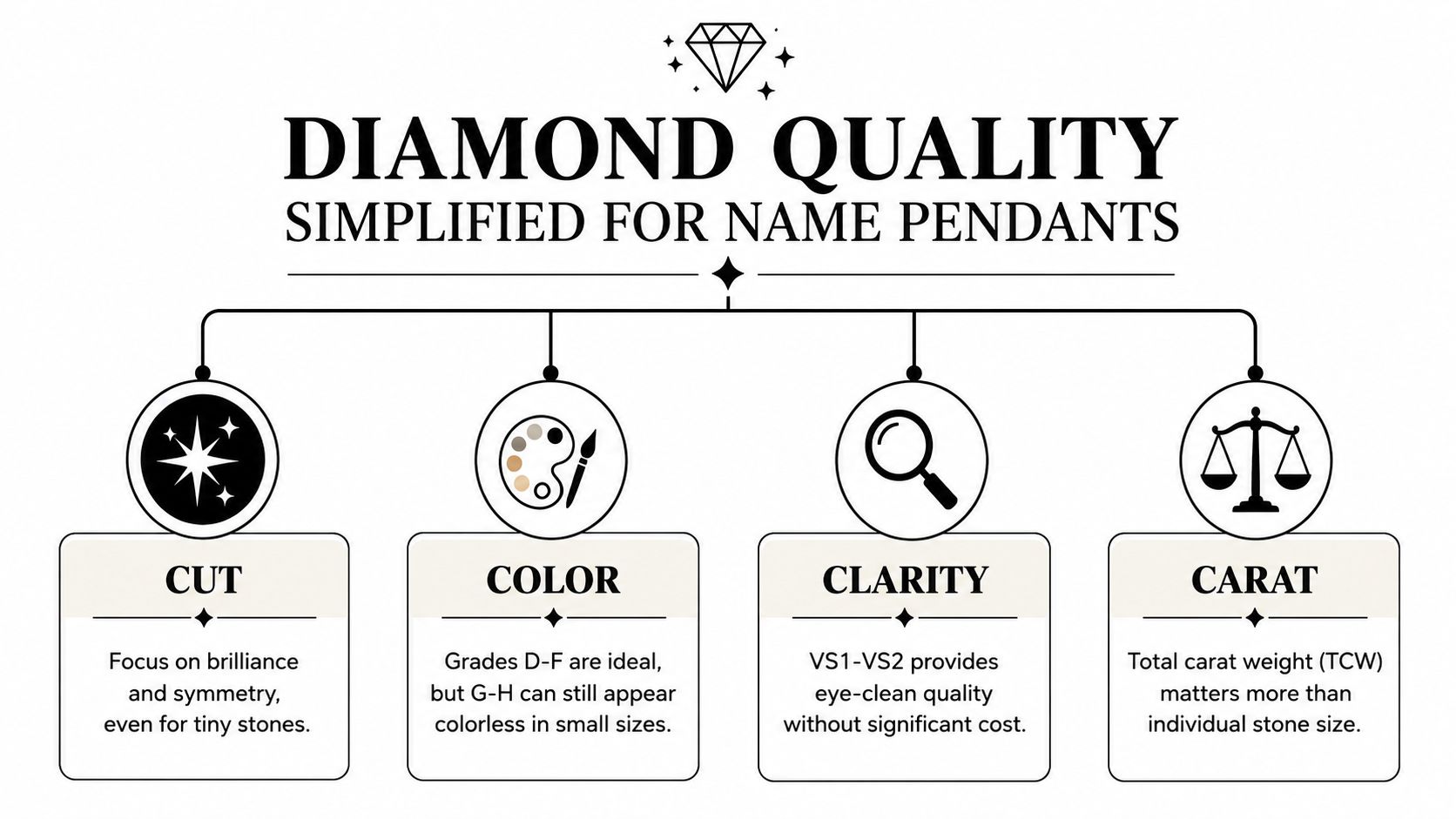
The 4Cs look different in pavé work
For melee diamonds, cut drives sparkle across the surface. Tiny stones still need decent symmetry and light return. If the cuts are inconsistent, some parts of the name flash while others go dull.
Color should be reasonably consistent across the entire pendant. A few warmer stones mixed into a brighter run of pavé can stand out more than many buyers expect.
Clarity matters less for naked-eye inspection at very small sizes, but consistency still matters. You don't want one section looking sleepy or cloudy next to another.
Carat works differently here. Total carat weight affects presence, but distribution is just as important. A pendant with uneven stone spacing or different size groupings can look patchy.
Buyer's note: Ask about matching, not just total carat weight. Total weight doesn't tell you whether the surface looks clean and even.
Modern buyers are taking more time to check these details. Pre-purchase research for diamond jewelry reached 11.2 days on average in 2026, up from 4.7 days in 2021, according to Alibaba's 2026 jewelry market analysis. That doesn't surprise me. Clients today compare hallmarks, videos, listings, and lab language far more carefully than they did a few years ago.
What to ask before you buy
If you're buying a custom or semi-custom pendant, ask direct questions:
Are the melee diamonds matched by color and size?
Is the total carat weight spread evenly across the name?
Will the finished piece sit flat, or will it flip when worn?
Are the attachment points reinforced?
Can the seller explain the quality in plain English, not just shorthand?
If you need a broader pricing framework before you evaluate a finished piece, Antwerp Diamond's guide on how much a diamond is worth gives useful context for how quality affects value.
Customization Options and Modern Trends
Some of the best diamond name pendants don't start with a jewelry sketch. They start with a signature on a birthday card, a child's handwritten note, or a word that carries family meaning. That's where customization becomes more than decoration.
Custom details that add meaning
A handwriting pendant can preserve the motion of a real hand, which gives it emotional force that standard fonts can't duplicate. The trade-off is that natural handwriting often needs editing. The jeweler may thicken weak strokes, shorten a flourish, or rebalance letter spacing so the pendant can survive regular wear.
Other custom options include:
Font selection, from clean block lettering to old-style script
Name and date combinations, when a client wants more context built into the piece
Mixed gemstones, such as adding a small accent stone instead of covering every letter in diamonds
Front and back personalization, where engraving adds private meaning without changing the face design
The strongest custom pieces balance sentiment with legibility. If the word can't be read at conversational distance, the design usually needs refinement.
What looks current without looking disposable
For projected 2026 jewelry trends, the bezel setting has emerged as the leading design detail for diamond pendants, and name necklaces and custom engravings are identified as major trends for turning jewelry into personal keepsakes, according to Brilliant Earth's jewelry trend guide.
That lines up with what works in practice. Bezel-set accents can protect stones better than exposed pavé in high-contact areas. Custom engraving also adds meaning without forcing the entire pendant to carry every design idea at once.
A smart modern design often looks like this:
A readable name or word
Limited but deliberate diamond coverage
Protected stone placement in vulnerable spots
Clean chain integration
One personal element, not five competing ones
Trend-driven doesn't have to mean short-lived. The best custom work feels specific to the owner, not captive to one season's styling.
How to Value Authenticate and Care for Your Pendant
Owners often confuse retail price, insurance value, and resale value. Those are not the same number. A diamond name pendant's value depends on the materials, workmanship, condition, and how easy it is for the next market participant to understand and trust what they're seeing.
What drives value
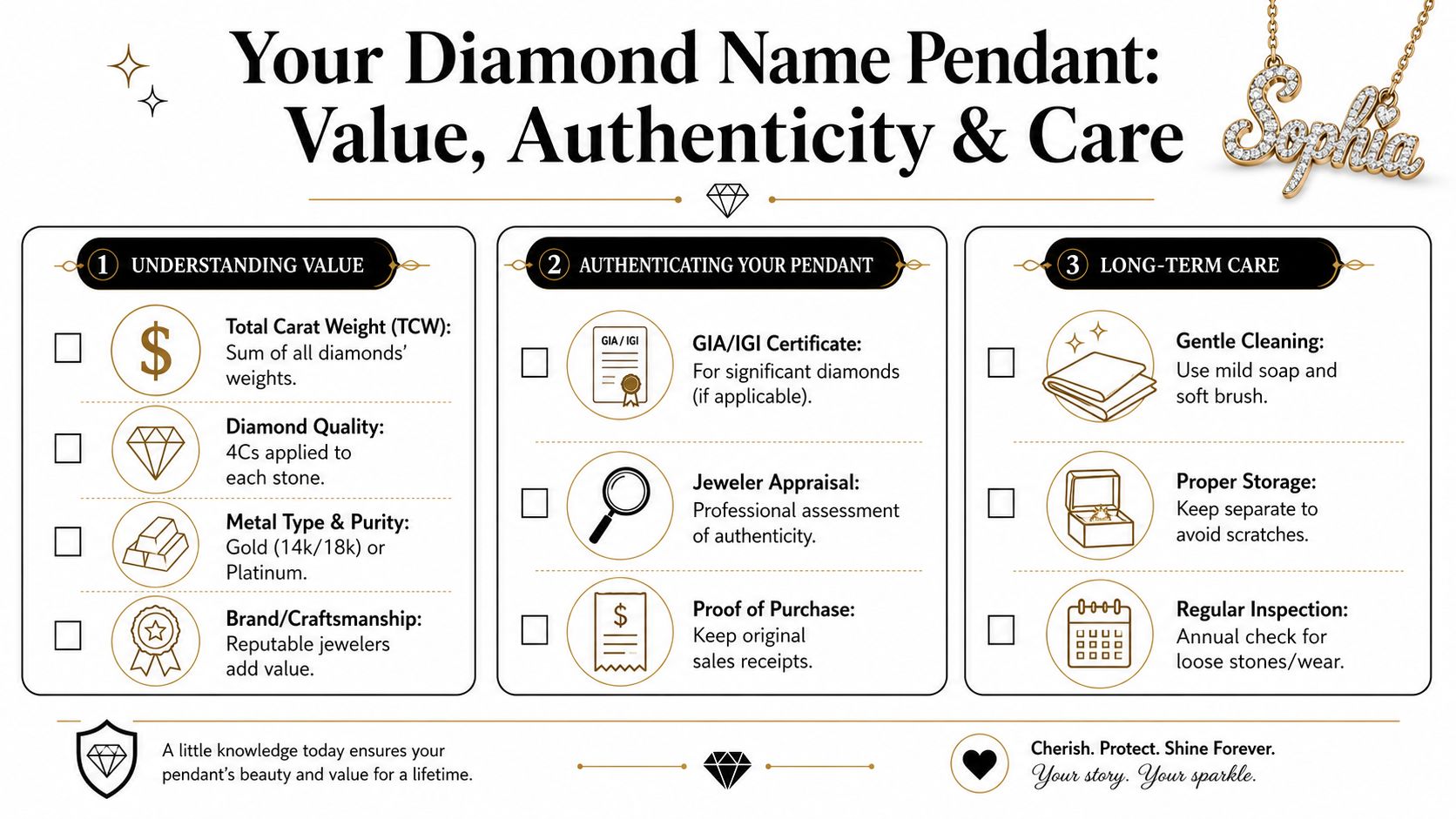
Start with the obvious: metal type, metal purity, and total diamond content. Then look harder at execution. Is the name balanced? Are the letters cleanly finished on the back as well as the front? Are the stones set evenly? Is the chain original and appropriate to the pendant?
Brand can matter, but craftsmanship matters more when a piece is custom. A beautifully built pendant from a respected bench jeweler can outperform a poorly made branded custom piece in buyer confidence.
For owners who need documentation for insurance, estate planning, or a future sale, a formal appraisal is worth doing properly. Antwerp Diamond's article on how to appraise jewelry outlines what professionals look for during evaluation.
How to check authenticity
Before you rely on any verbal description, verify the basics.
Check the hallmark: Look for 14K, 18K, Pt, or other metal marks in an accessible area.
Inspect stone security: Under magnification, worn beads or gaps around melee can signal future loss.
Review paperwork: Receipts, prior appraisals, and custom design invoices all help establish provenance.
Compare workmanship: Sloppy solder seams, rough undersides, and irregular spacing usually indicate lower-grade manufacture.
This video gives a useful visual starting point for what owners should pay attention to when reviewing jewelry condition and structure.
If you're trying to understand broader resale taste in letter-based jewelry, these profitable letter necklace styles are useful to review because they highlight how design simplicity tends to help second-market appeal, even when the original purchase was personal.
Care habits that protect the piece
A name pendant is often worn daily, which means soap film, body oil, friction, and knocks from countertops all add up.
Use a simple care routine:
Clean gently with mild soap, warm water, and a soft brush.
Store separately so the diamonds and metal don't scratch other jewelry.
Inspect regularly for lifted beads, bent letters, or chain wear.
Avoid sleeping in it if the design includes delicate script or exposed pavé.
Jewelry doesn't have to look damaged to be at risk. Loose melee often shows up before obvious breakage.
Selling or Consigning Your Diamond Name Pendant
Selling a diamond name pendant requires a realistic mindset. The emotional value may be high. The secondary market may see the piece very differently.

Why resale is harder for personalized pieces
This is the issue most sellers don't hear clearly enough at the beginning. There is documented concern around the resale viability of custom name pendants, including the point that they often lose 40 to 50 percent more value upon resale due to their personalized nature, as discussed in BlueStone's diamond pendant context.
That doesn't mean the piece is worthless. It means the resale market usually pays for materials and marketability, not your story.
A pendant that says "Sophia" has a narrow buyer pool compared with a generic diamond pendant. A handwriting pendant based on one person's signature is even more specific. If the design is heavily customized, some buyers will value it mainly for scrapable gold content, recoverable melee value, or reusable craftsmanship elements.
How a buyer evaluates the pendant
An experienced jewelry buyer usually separates the piece into layers of value:
Evaluation Area | What the buyer looks at | Why it matters |
|---|---|---|
Metal | Purity, weight, wear, repair history | Metal provides baseline recoverable value |
Diamonds | Presence, matching, condition, setting security | Buyers assess whether stones add resale appeal or just material value |
Design | Readability, taste level, adaptability | Broad appeal helps. Highly personal wording limits demand |
Workmanship | Finish, symmetry, structural soundness | Better-made pieces inspire more confidence |
Documentation | Receipt, appraisal, original custom records | Paperwork reduces uncertainty |
One practical limitation also matters. Custom name settings are often cast as a single unit, so later stone upgrades or redesign work can be difficult without damaging the inscription. That's one reason personalized jewelry doesn't behave like a flexible investment asset.
If you're buying with future resale in mind, choose restraint. Cleaner names, better metal, and stronger craftsmanship age better than overly specific design choices.
How to prepare before you sell
Before asking for offers, do a little groundwork.
Gather your documents: Original receipt, any appraisal, custom order invoice, and repair history help establish what the piece is.
Have it cleaned, not rebuilt: Light professional cleaning helps presentation. Major alterations usually don't.
Be honest about condition: Missing stones, bent letters, and chain replacements should be disclosed.
Choose the selling route carefully: Direct sale is faster. Consignment may suit unusual pieces, but it can take longer and depends on buyer demand.
If you're trying to understand seller options more broadly, Antwerp Diamond's resource on where to sell fine jewelry covers how direct buyers, consignors, and other channels differ.
For sellers in Atlanta, Buckhead, Sandy Springs, Alpharetta, Roswell, Brookhaven, Midtown Atlanta, and the wider Georgia region, an in-person review is often the quickest way to separate sentimental expectations from real market value. For clients outside Georgia, insured shipping and remote evaluation can also make sense, provided the process is documented and secure.
Frequently Asked Questions About Diamond Name Pendants
Can you use your own diamonds in a custom name pendant
Sometimes, yes. It depends on the size, condition, and matching quality of the diamonds you already have. In practice, many small stones from older jewelry don't match well enough for clean pavé work, so a jeweler may recommend using only some of them or none at all.
Are diamond name pendants a good investment
They can be a meaningful luxury purchase, but they shouldn't be treated like a straightforward investment. Personalization often narrows resale demand, so buy one because you want to wear and keep it, not because you expect easy liquidity later.
What metal is usually best for everyday wear
For many buyers, 14K gold is the practical daily-wear choice because it balances durability and fine-jewelry status. Clients who prefer richer color or more luxurious finish often choose 18K, while platinum appeals to those who want weight and a naturally white metal.
How long does it take to make a custom pendant
Production timing varies by design complexity, stone sourcing, and the jeweler's workflow. A simple font-based name pendant is usually easier to produce than a handwriting model with detailed pavé and custom chain integration.
Do all diamond name pendants come with certificates
No. Many name pendants use small melee diamonds that are not individually certified in the same way a larger center stone might be. What matters more is clear disclosure, trustworthy workmanship, and proper documentation of the finished piece.
Is consignment better than selling outright
It depends on the design. A highly wearable pendant with broader appeal may do well on consignment. A very personal name or signature piece is often better suited to direct evaluation because the buyer can quickly determine whether the value sits mainly in materials, workmanship, or niche demand.
If you want a professional opinion on a diamond name pendant, whether you're buying, valuing, borrowing against, or preparing to sell, Antwerp Diamond is a trusted local option for confidential evaluations. You can request a review, visit the Atlanta area location, or bring in your jewelry for a straightforward assessment based on condition, craftsmanship, documentation, and current resale demand.