
Online jewelry buyers are now a major part of the market, with digital channels accounting for approximately 25% of all global jewelry purchases in 2024 and 2025, and the online jewelry market valued at $76.2 billion in 2025 with a projection of $85.7 billion in 2026 according to Jewel360's online jewelry sales statistics. Selling to online jewelry buyers involves vetting their reputation, getting a preliminary evaluation, securely shipping your item, and negotiating a final offer based on expert inspection. Reputable buyers offer transparent processes, insured shipping, and clear communication from start to finish.
If you're holding a diamond ring, Cartier bracelet, Rolex, or inherited gold jewelry and wondering whether mailing it to a buyer is actually safe, your caution is justified. High value items attract serious buyers, but they also attract poor operators, vague offers, and avoidable mistakes. The safest path is a disciplined one: verify the buyer first, prepare the item properly, understand how the offer process works, and keep control of shipping, documentation, and payment at every step.
Table of Contents
How to Identify and Vet Reputable Online Jewelry Buyers
Trust is the entire transaction. A buyer can have a polished website and still be a poor fit for a high value item if their process is vague, their communication is evasive, or their return terms are hard to pin down.
That concern isn't theoretical. Business Research Insights reports that counterfeit jewelry accounts for 21% of online jewelry sales, and 33% of buyers report significant concerns about authenticity and product trust. When you're selling a diamond ring, Tiffany & Co. necklace, or Audemars Piguet watch, those trust issues matter on the seller side too.
Start with verifiable business details
Look for a real street address, a working phone number, and a business identity you can verify beyond the website itself. If a buyer only offers a form fill and generic email responses, that's not enough for a transaction involving precious metals, diamonds, or branded luxury goods.
A credible buyer should also explain what happens after you submit photos. You should be able to tell, before shipping anything, whether they provide a preliminary estimate, whether they inspect in person before making a final offer, and what happens if you decline.
Practical rule: If the process isn't clear before your item leaves your possession, stop there.
Professional credentials matter too. For diamond and gemstone pieces, you want specialists who understand metal purity, hallmark interpretation, brand authentication, and grading language such as GIA or IGI reports. A buyer doesn't need flashy jargon. They need to show competence.
Read reviews like a jeweler reads a grading report
Don't skim for star ratings alone. Read the language people use. Specific reviews are more useful than glowing but empty praise.
Look for patterns such as:
Clear explanations: Reviewers mention how the offer was calculated, not just that the experience was “good.”
Consistent communication: Sellers describe timely replies, named staff, and a process that stayed the same from start to finish.
Fair handling of declines: Good buyers don't create friction when a seller says no.
Real issue resolution: The most useful reviews often include a complication and how the company handled it.
If a buyer has only perfect testimonials hosted on their own website, be careful. Independent platforms are far more useful than curated praise.
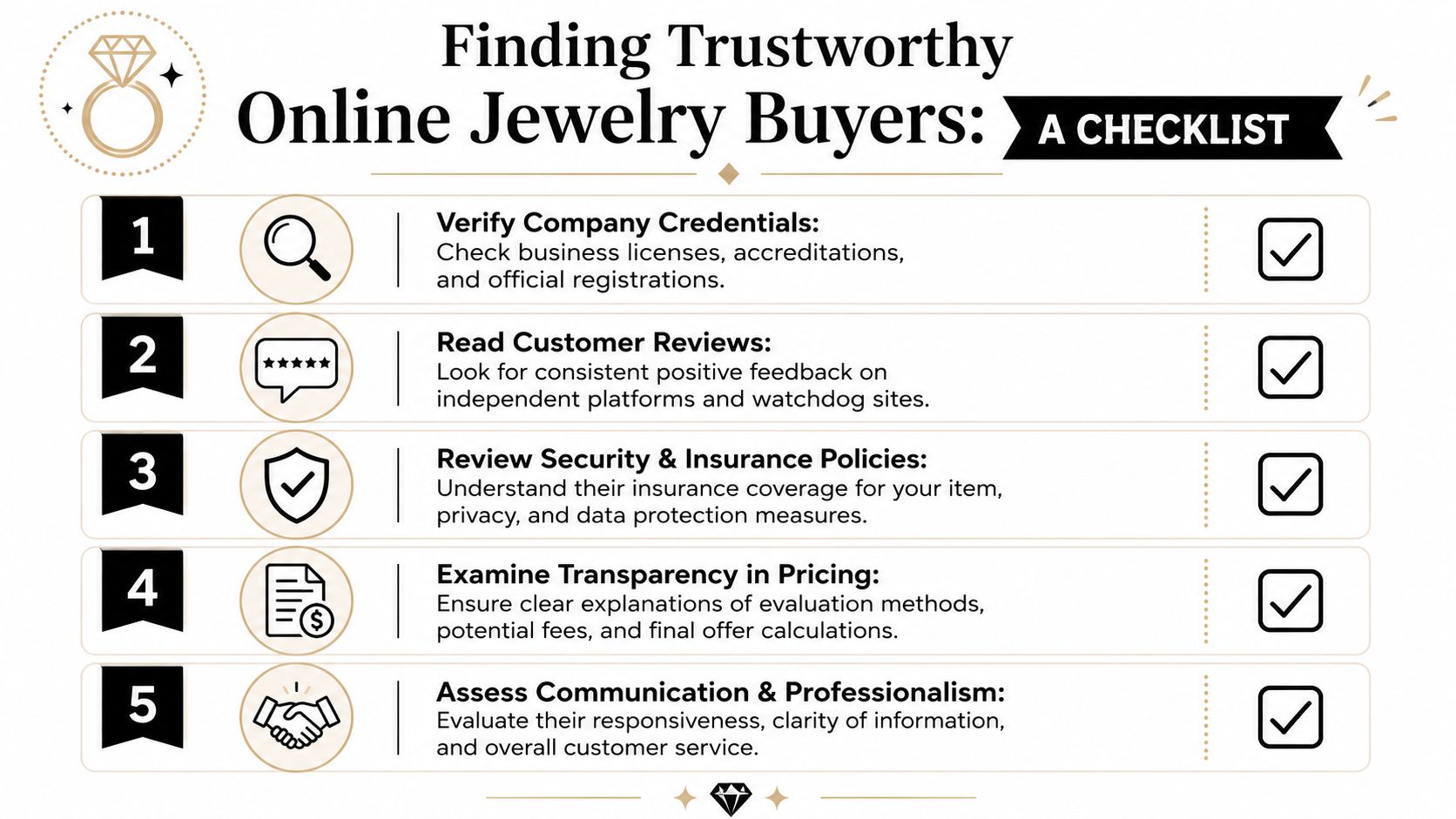
Use a practical vetting checklist
Before you shortlist any online jewelry buyers, run through these points:
Verify identity: Confirm the company has a physical address, direct contact details, and a visible operating presence.
Check process transparency: You should see how estimates, shipping, inspection, returns, and payment work.
Review insurance language: The buyer should explain shipping protection, signatures, and return handling in plain English.
Test communication: Ask one direct question about evaluation or returns. The answer will tell you a lot.
Confirm item fit: Some buyers are strong with gold scrap, others with branded estate jewelry, loose diamonds, watches, or handbags.
For sellers in Atlanta, Buckhead, Sandy Springs, Alpharetta, Roswell, Brookhaven, Midtown Atlanta, and the wider Georgia market, it also helps to compare remote options with reputable local buyers in Atlanta who explain how to sell jewelry online. A buyer with both online capability and a local presence usually has more accountability.
Preparing Your Jewelry for an Accurate Evaluation
A careless cleaning job can lower confidence faster than a scratch. Before you request an online estimate, focus on presentation, not restoration.
Clean carefully, don't over-restore
A lot of sellers overdo this step. They use harsh cleaners, aggressive brushes, polishing compounds, or home methods that leave residue in settings or create fresh wear on soft surfaces.
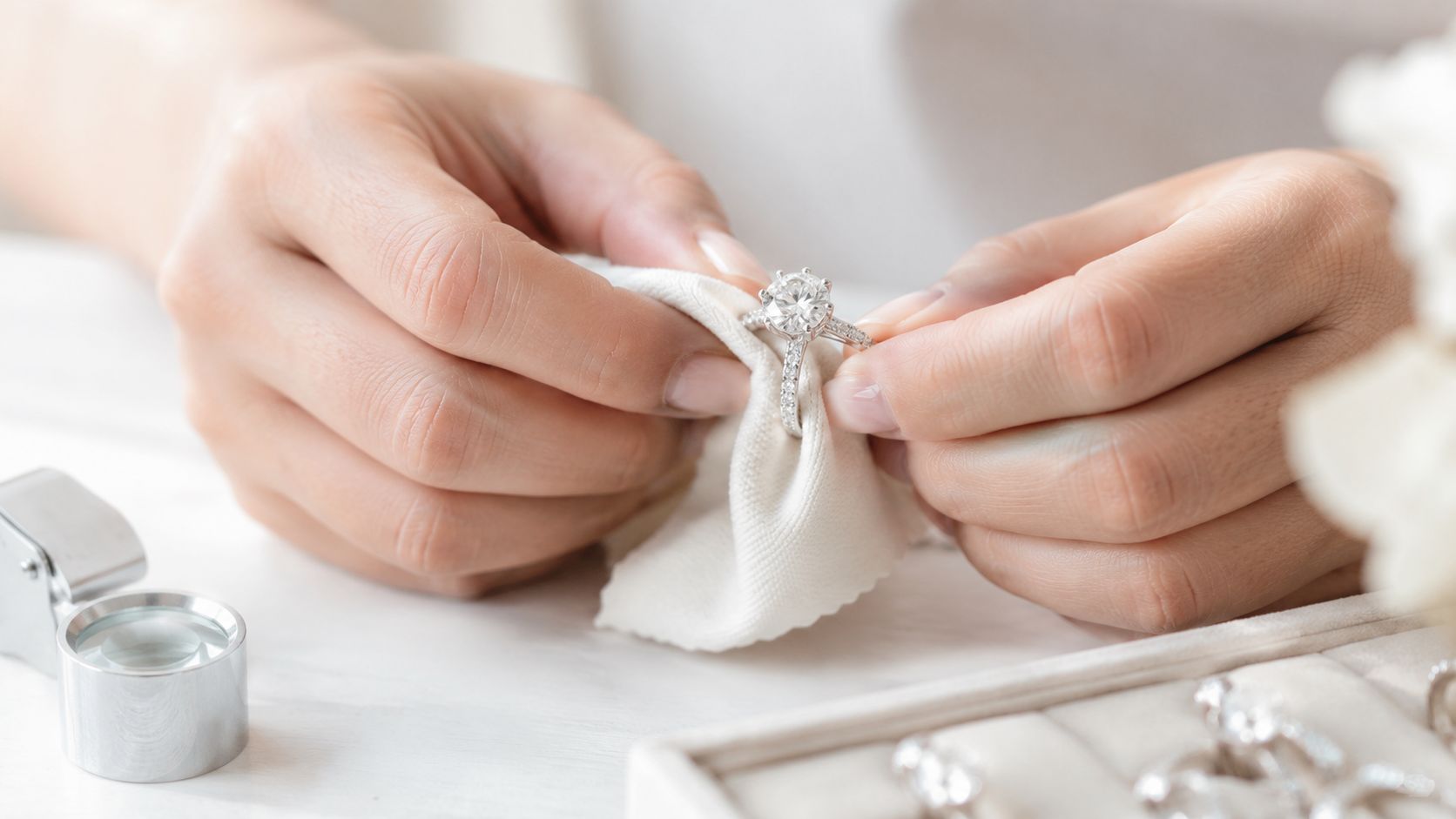
Use a soft microfiber cloth. For many pieces, gentle wiping is enough. If you're dealing with antique gold, older prongs, pavé settings, enamel, pearls, or mixed materials, don't experiment. Leave deeper cleaning to a professional.
The right preparation removes doubt. It doesn't try to make an item look newer than it is.
Gather the documents that support value
Original paperwork doesn't create value by itself, but it supports authenticity and reduces uncertainty. That can affect how confident a buyer feels about making a strong offer.
Useful documents include:
Grading reports: GIA or IGI paperwork for diamonds and gemstones.
Purchase records: Original receipts, invoices, or prior appraisals.
Brand materials: Boxes, warranty cards, service papers, serial documentation.
Repair history: Records of sizing, stone replacement, refinishing, or service.
For diamond pieces, understanding your diamond's grading report from GIA and related documentation for photography and presentation helps you describe the item accurately before anyone sees it in person.
Take submission photos that answer buyer questions
Your photos are not a glamour shoot. They are evidence. The goal is to help a buyer see what the piece is, what condition it's in, and what supporting marks it carries.
Photograph:
Front and back views: Show the entire piece.
Close details: Capture hallmarks, karat marks, brand stamps, serials, and clasps.
Stone views: Include side angles so prongs, mountings, and depth are visible.
Condition notes: Show scratches, dents, thinning shanks, chipped stones, or missing parts clearly.
A short visual guide can help if you're unsure how much detail buyers need:
Good photos don't replace physical inspection. They do reduce avoidable misunderstandings early.
Understanding the Online Jewelry Evaluation Journey
Most online jewelry buyers work in two stages. First comes the preliminary estimate based on your description and photos. Then comes the physical evaluation, which is the only stage where a firm offer should be made.
That distinction matters because online fine jewelry sales can be difficult to convert without trust and hands-on verification. Branvas reports that fine jewelry e-commerce with an average order value above $500 commonly benchmarks at 0.8% to 1.0% conversion, while consultation-led approaches perform far better, and return rates average 16.9% to 20% when buyers face discrepancies in grading, weight, or stones. The practical lesson for sellers is simple: serious buyers rely on expert review, not guesses.
The preliminary offer is a starting point
The first number you receive should be treated as a range or conditional estimate. It is based on what the buyer can see and what you've disclosed.
That first pass usually reflects:
Item type: Ring, bracelet, necklace, earrings, watch.
Materials: Gold, platinum, silver, diamonds, colored stones.
Brand cues: Cartier, Tiffany & Co., Van Cleef & Arpels, Rolex, Patek Philippe.
Visible condition: Wear, repairs, missing accents, aftermarket changes.
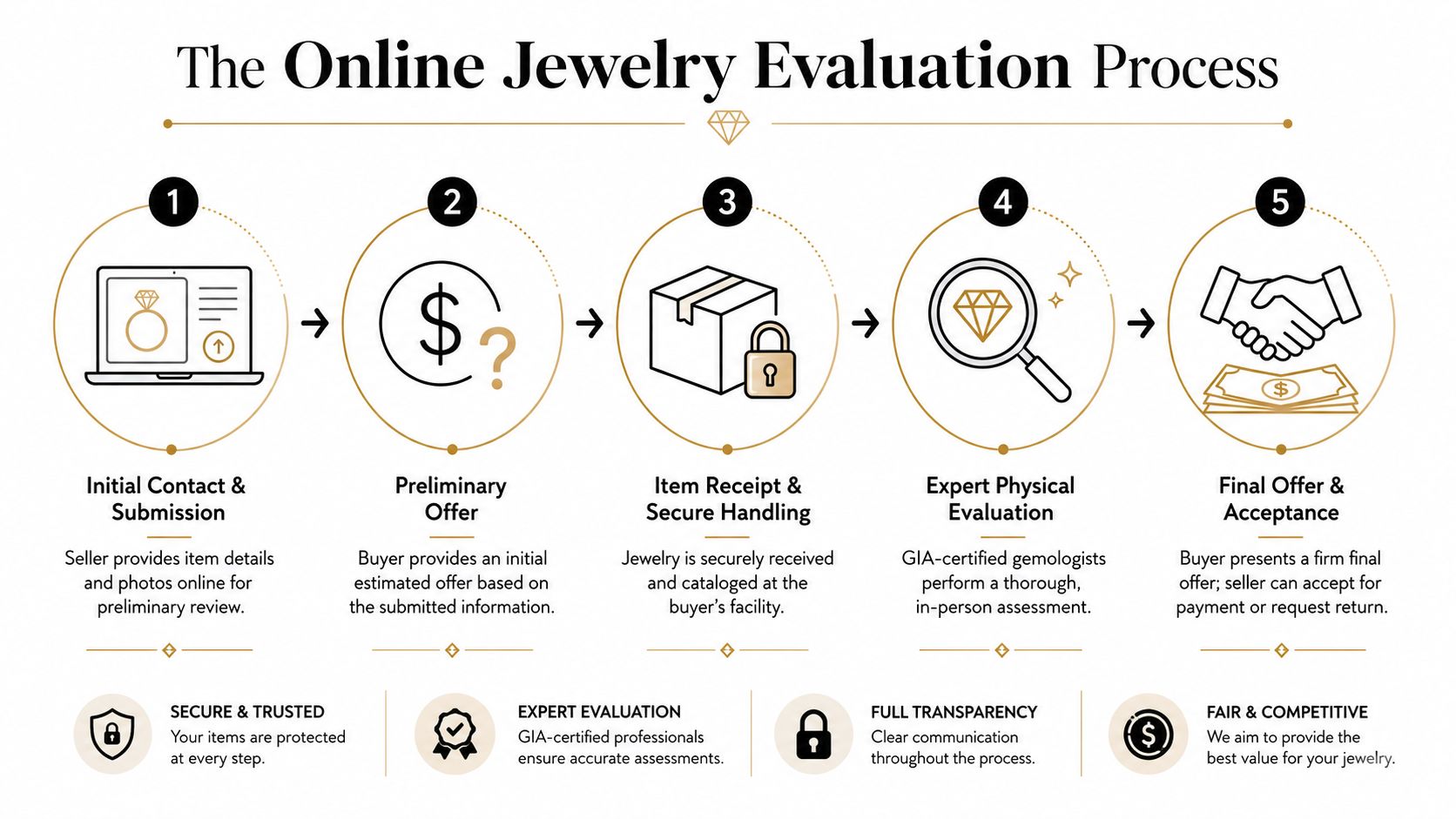
A strong buyer will state that the offer is preliminary. If they present a remote quote as final before testing metal purity, checking stones, or confirming authenticity, that's not a sign of confidence. It's a sign of a weak process.
What experts check during physical evaluation
Once the item arrives, a real evaluation starts. At this point, many sellers finally see what separates professionals from formula buyers.
A proper inspection usually includes:
Checkpoint | What the specialist is verifying |
|---|---|
Metal testing | Whether the item is 10k, 14k, 18k, platinum, or another metal composition |
Stone review | Carat weight, cut, color, clarity, matching, treatments, and setting security |
Condition | Wear, damage, repairs, thinning, chipped stones, or replaced parts |
Brand authentication | Hallmarks, serial numbers, construction quality, and model consistency |
Marketability | Whether the item is best valued for resale, collector demand, or material content |
For those comparing options, some buyers let you start with a free online evaluation and learn how jewelry appraisal works in practice before deciding whether to ship or visit in person.
When offer changes are legitimate, and when they are not
Sellers are right to be wary here. Closo notes that many sellers worry about bait and switch tactics where initial instant quotes are invalidated by 50% upon physical inspection due to alleged weight or quality discrepancies, and that dramatic, poorly explained drops are a major red flag.
A change can be legitimate if the buyer finds something material that was not visible in photos, such as:
undisclosed damage
lower metal purity than expected
synthetic or replaced stones
mismatched brand parts
inaccurate stated measurements
A change is suspicious when the explanation is vague, rushed, or unsupported. Ask for specifics. If a buyer claims the diamond is smaller, the gold weighs less, or the Cartier bracelet has authenticity issues, they should explain exactly what they found.
A fair buyer can defend the number. A risky buyer just repeats it.
Choosing Between Secure Shipping and In-Person Appointments
This choice comes down to control, convenience, and your comfort level. Both methods can work well when handled properly, but they solve different seller concerns.
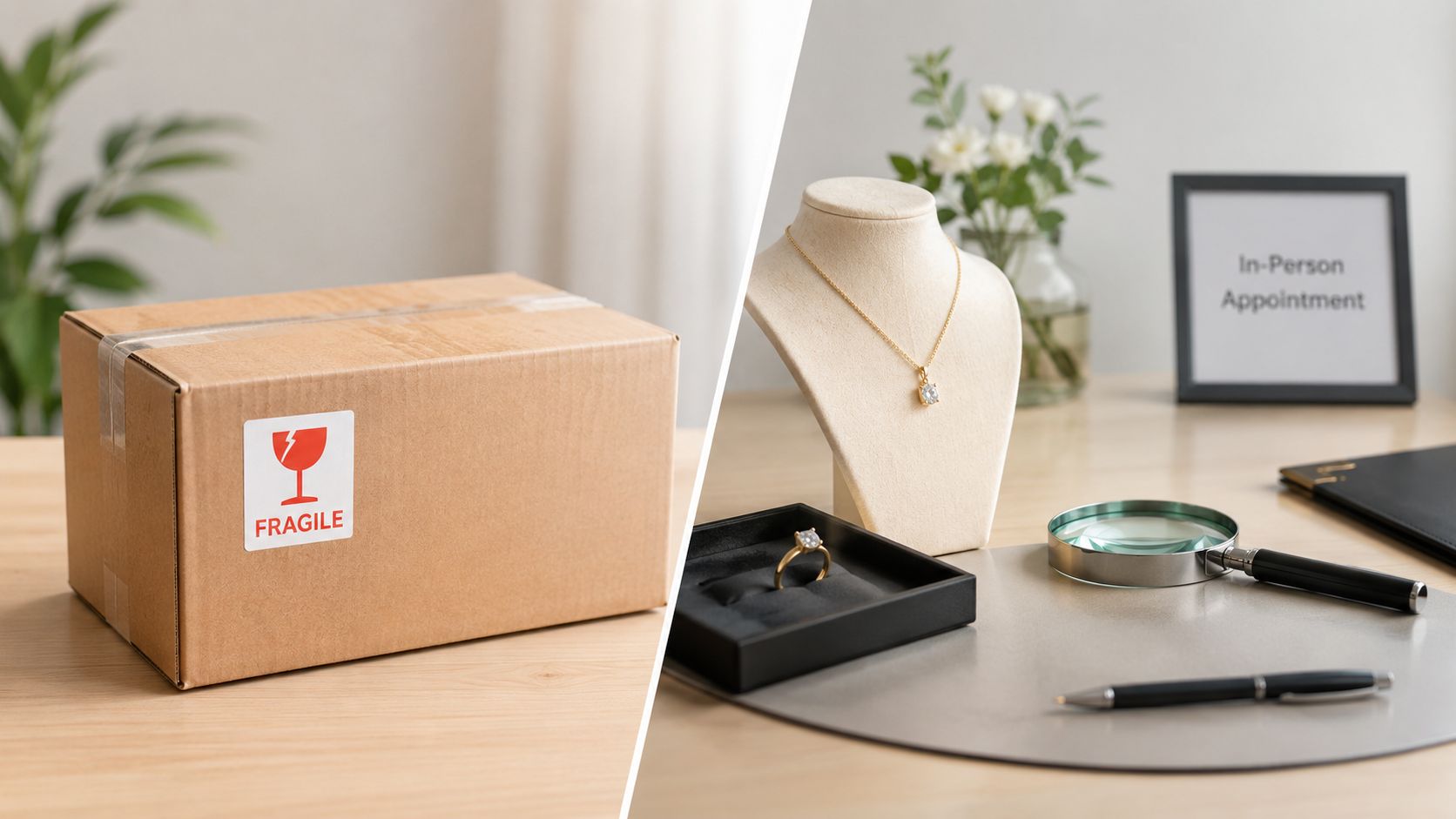
When secure shipping makes sense
Shipping is practical when the buyer has a defined intake process and you don't live near a trusted office. It also works well for straightforward diamond jewelry, gold pieces, and branded items with complete paperwork.
Pack discreetly. Avoid branded boxes and external descriptions that identify the contents. If you need sturdy packaging materials, plain small postal boxes that don't advertise what's inside are a useful reference for the kind of low-profile outer packaging sellers should use.
Use these rules:
Document the item first: Photograph the piece before packing.
Follow written instructions: Use the buyer's approved label and service level.
Require signature confirmation: Don't waive delivery controls for convenience.
Keep your records: Save tracking, drop-off proof, and all email confirmations.
Ship the item exactly the way the buyer instructs, or don't ship it at all. Insurance often depends on procedure.
When an in-person appointment is the better option
In-person appointments are often better for very high value pieces, emotionally sensitive estate items, or sellers who want immediate answers. You can see the evaluation happen, ask questions in real time, and decide on the spot.
This is especially useful in Atlanta and surrounding areas such as Buckhead, Sandy Springs, Alpharetta, Roswell, Brookhaven, and Midtown Atlanta. Local sellers often prefer face-to-face review for Rolex watches, large diamond rings, Cartier Love bracelets, or inherited collections with mixed items.
If you're also comparing how specialists handle other luxury assets, it helps to review how online watch buyers structure similar secure evaluations and offers.
Shipping versus in-person at a glance
Option | Best for | Main advantage | Main caution |
|---|---|---|---|
Secure shipping | Remote sellers, straightforward transactions, documented pieces | Convenient and private | You must follow shipping and insurance instructions exactly |
In-person appointment | High value items, local sellers, complex collections | Direct answers and immediate review | Requires travel and scheduling |
Neither route is automatically better. The right choice depends on the item, the distance, and how much direct interaction you want before accepting an offer.
Seller's Final Steps Negotiation Payment and Checklist
Once the final offer arrives, the transaction becomes less about jewelry and more about judgment. At this juncture, disciplined sellers protect value.
The market for online jewelry buyers keeps expanding. Forge Craft Men's Jewelry reports that online jewelry sales in the United States reached $22.5 billion in 2024 and are projected to reach $37.9 billion by 2029, a 68% increase, with Millennials and Gen Z driving digital buying behavior. That growth brings more legitimate buyers into the market, but it also means sellers need a framework for comparing offers, not just reacting to them.
How to respond to the final offer
Don't negotiate from memory. Negotiate from facts.
If you have a GIA report, original Cartier paperwork, a recent service receipt for a Rolex, or a clear inventory of what you're selling, refer to those specifics. You are not trying to prove retail replacement value. You're trying to make sure the buyer has accurately assessed resale value, condition, and authenticity.
A practical negotiation approach looks like this:
Ask what drove the number: If the offer is lower than expected, ask whether the issue is condition, market demand, authenticity, missing paperwork, or material weight.
Separate retail from resale: Retail price and insurance appraisal figures usually don't predict a buyout offer.
Challenge vague deductions: If a buyer says “condition issues,” ask which ones. A serious evaluator can identify them.
Know when to stop: If a buyer won't explain the number, walking away is often the right move.
For sellers comparing channels, this is also where direct sale buyers can outperform auction-style platforms in real terms. Time, holding periods, and deductions can gradually erode an apparently higher gross result. That is one reason many experienced sellers compare speed, clarity, and net proceeds, not just top-line promise.
Choose payment methods that leave a clear record
Once you accept, payment should be simple and traceable. For remote transactions, secure transfer methods are usually the cleanest because they create a documented trail. For in-person deals, some sellers prefer immediate payout, while others prefer transfer records for their own file.
Keep these points in mind:
Confirm the exact payee details: Make sure names and account information are correct before funds are sent.
Match payment to acceptance: The amount paid should match the agreed final offer.
Get written confirmation: Even a concise invoice or transaction email helps.
Be cautious with rushed changes: If payment instructions suddenly change late in the process, verify them directly.
If you're specifically selling a diamond ring, it helps to compare how specialists buy and evaluate diamond rings online before committing to a final transaction path.
Seller checklist before you complete the sale
Use this as your final control sheet:
Buyer verified: Real address, real contacts, independent reviews, transparent terms.
Item prepared: Cleaned safely, photographed clearly, defects disclosed.
Documents assembled: Reports, receipts, service papers, box, serial references.
Estimate understood: Preliminary number recognized as conditional.
Shipping controlled: Tracking saved, signature required, records kept.
Evaluation explained: Final offer supported by real inspection findings.
Payment confirmed: Method chosen, amount matched, written record retained.
A few final judgment calls matter more than people expect. If the buyer is evasive when you ask basic questions, that's a warning. If they pressure you to accept quickly, that's another. If they explain the item well, document the process, and make it easy to decline, that's usually a healthier sign.
Frequently asked questions
How long does the process usually take
It depends on the buyer, shipping timeline, and how quickly you respond. A well-run process should feel organized, with prompt communication at each step.
What happens if I decline the final offer
A reputable buyer should return your item according to the return terms they gave you before shipment or evaluation. You should know that process in advance, not after the fact.
Do original boxes and papers matter
Yes, often. They don't guarantee a higher offer, but they can strengthen authenticity, improve buyer confidence, and support resale appeal.
What items do serious luxury buyers usually purchase
It varies, but many focus on diamond jewelry, gold, platinum, luxury watches, loose diamonds, branded pieces such as Cartier or Tiffany & Co., and sometimes other luxury assets. Before submitting, review clearly listed buying categories and what items we purchase.
Selling to online jewelry buyers is safe when you stay methodical. Vet the buyer first, present the item accurately, insist on a transparent evaluation, and don't accept pressure in the final stage.
If you're in Atlanta, Buckhead, Sandy Springs, Alpharetta, Roswell, Brookhaven, Midtown Atlanta, or anywhere in Georgia and want a professional second look before selling, Antwerp Diamond offers no-obligation evaluations for fine jewelry, diamonds, luxury watches, handbags, and other high-value assets. You can request an online review or arrange a private appointment if you'd rather discuss your item face to face.