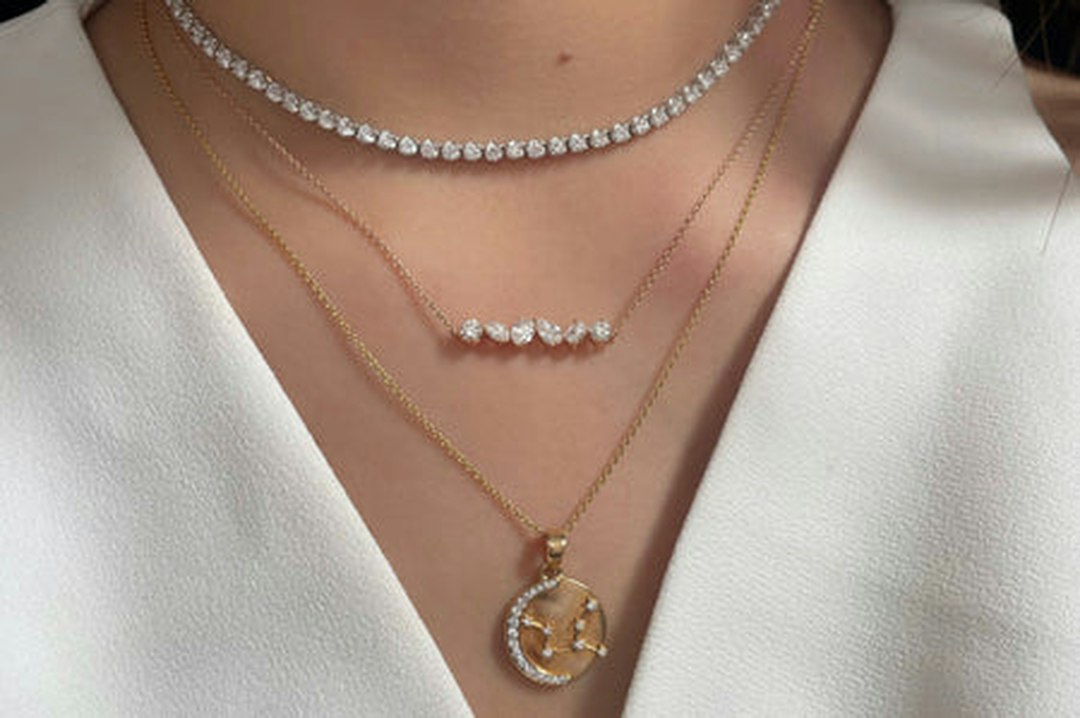

You're probably here because a tennis chain is sitting in your hand, on your neck, or in a jewelry box, and you want straight answers. You want to know what mens tennis chains are, how to tell if yours is well made, whether it's worth appraising, and what to watch for if you plan to sell it or borrow against it in Atlanta or elsewhere in Georgia.
That's the right instinct. A mens tennis chain can be a style piece, a luxury asset, or both. If you understand the build, the stones, and the paperwork, you'll make better decisions about wear, resale, and appraisal. If you're new to fine jewelry, this plain-English guide to fine jewelry basics is a helpful starting point.
Table of Contents
Introduction to mens tennis chains
A lot of first-time buyers have the same moment. They see the chain sparkle under normal room light, then they wonder why one piece feels fluid and luxurious while another feels stiff, thin, or slightly off. That difference usually comes down to structure, stone quality, and how accurately the chain was represented.
Mens tennis chains have become a staple in men's luxury jewelry because they combine clean lines with obvious visual impact. They can work as daily jewelry, occasion wear, or a piece you eventually appraise for insurance, resale, or a collateral-based loan. In practical terms, they sit somewhere between fashion accessory and portable asset.
If you live in Atlanta, Buckhead, Sandy Springs, Alpharetta, Roswell, Brookhaven, Midtown Atlanta, or the wider Georgia market, this matters even more. Local buyers and appraisers tend to look closely at craftsmanship, documentation, condition, and current resale demand, not just how bright the chain looks at first glance.
Understanding mens tennis chains
A tennis chain is easiest to understand if you think of it as a line of light. Instead of chunky links or a heavy woven pattern, the design creates one smooth row of closely set stones that catches light across the full length of the necklace.
What defines the style
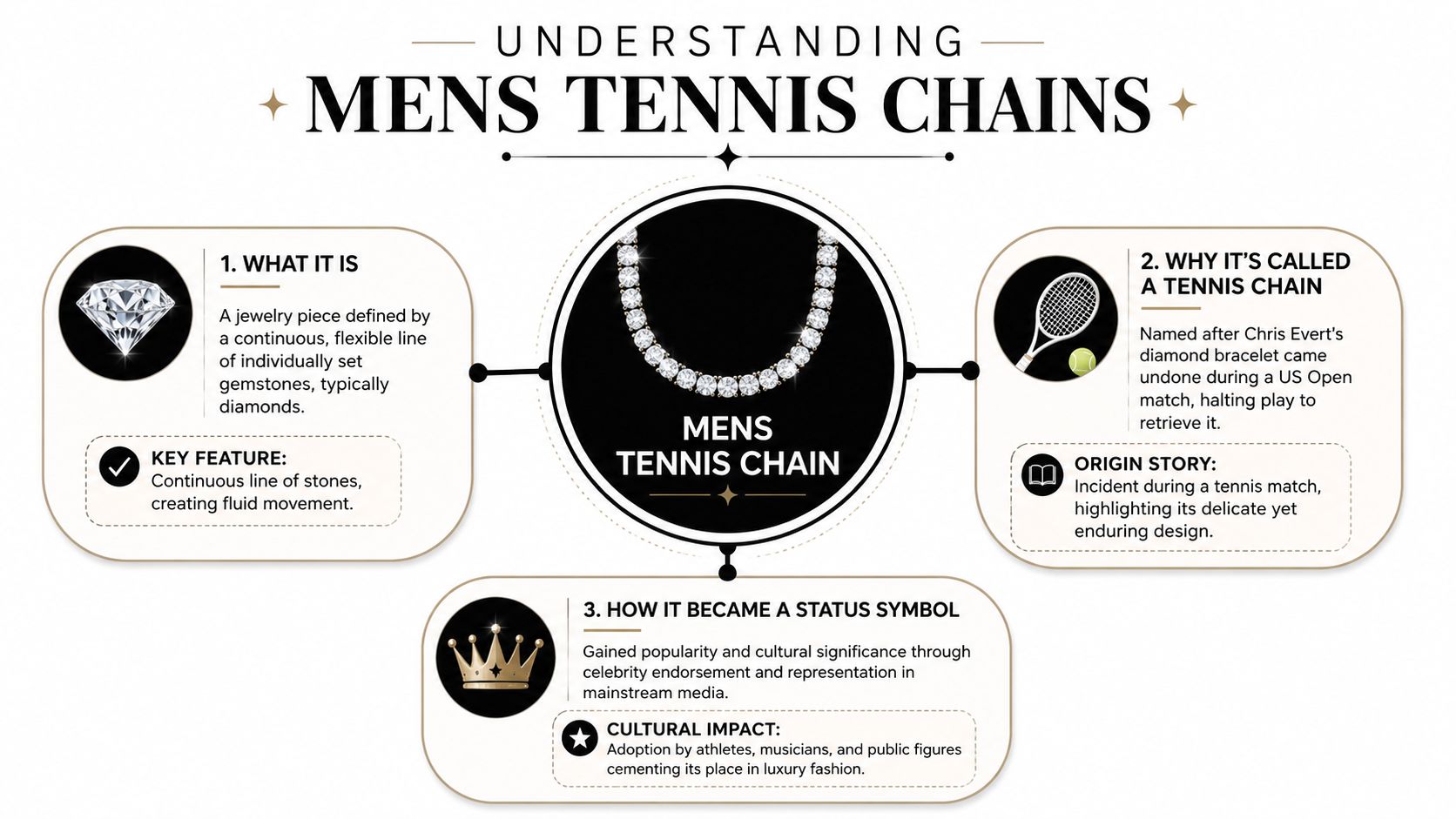
The clearest definition comes from Icecartel's explanation of what a tennis chain is, which describes the term as a necklace style featuring a continuous line of small, closely-set gemstones, typically diamonds or moissanites, mounted on a base metal and connected by links, creating a sleek, uniform appearance that rose to mainstream status in the 1990s as athletes and celebrities embraced high-end jewelry.
That “continuous line” part is the key. A Cuban link chain shows its metal. A rope chain shows its pattern. A tennis chain is built to make the stones read as one uninterrupted surface.
Why the name causes confusion
People often assume the chain was invented for tennis players. The name sounds that way, but the history is less exact than many buyers expect. The style is associated with tennis because the look feels clean, sporty, and polished, not because there's a single confirmed design origin tied to the sport.
The safest way to talk about the name is this: it's a recognized jewelry style with a strong tennis association, but the product itself should be judged by construction, not mythology.
That matters because sellers sometimes rely on storytelling when they don't have solid grading details.
How the look became mainstream
The reason mens tennis chains still matter is cultural staying power. The style moved from a niche luxury look into a mainstream men's jewelry category when public figures, especially athletes and entertainers, started wearing high-end jewelry as part of their image.
For a first-time buyer, the takeaway is simple:
It's meant to look uniform: The row should appear smooth and intentional.
It's meant to move well: A good chain drapes rather than fighting your neckline.
It's meant to feel finished: The clasp, stone alignment, and link articulation should all look consistent.
When any one of those elements is missing, the chain usually feels cheaper in person than it did in photos.
Evaluating materials and quality markers
If style is the surface, materials are the engine. Two tennis chains can look similar from six feet away and perform very differently over time.
How metal and structure work together
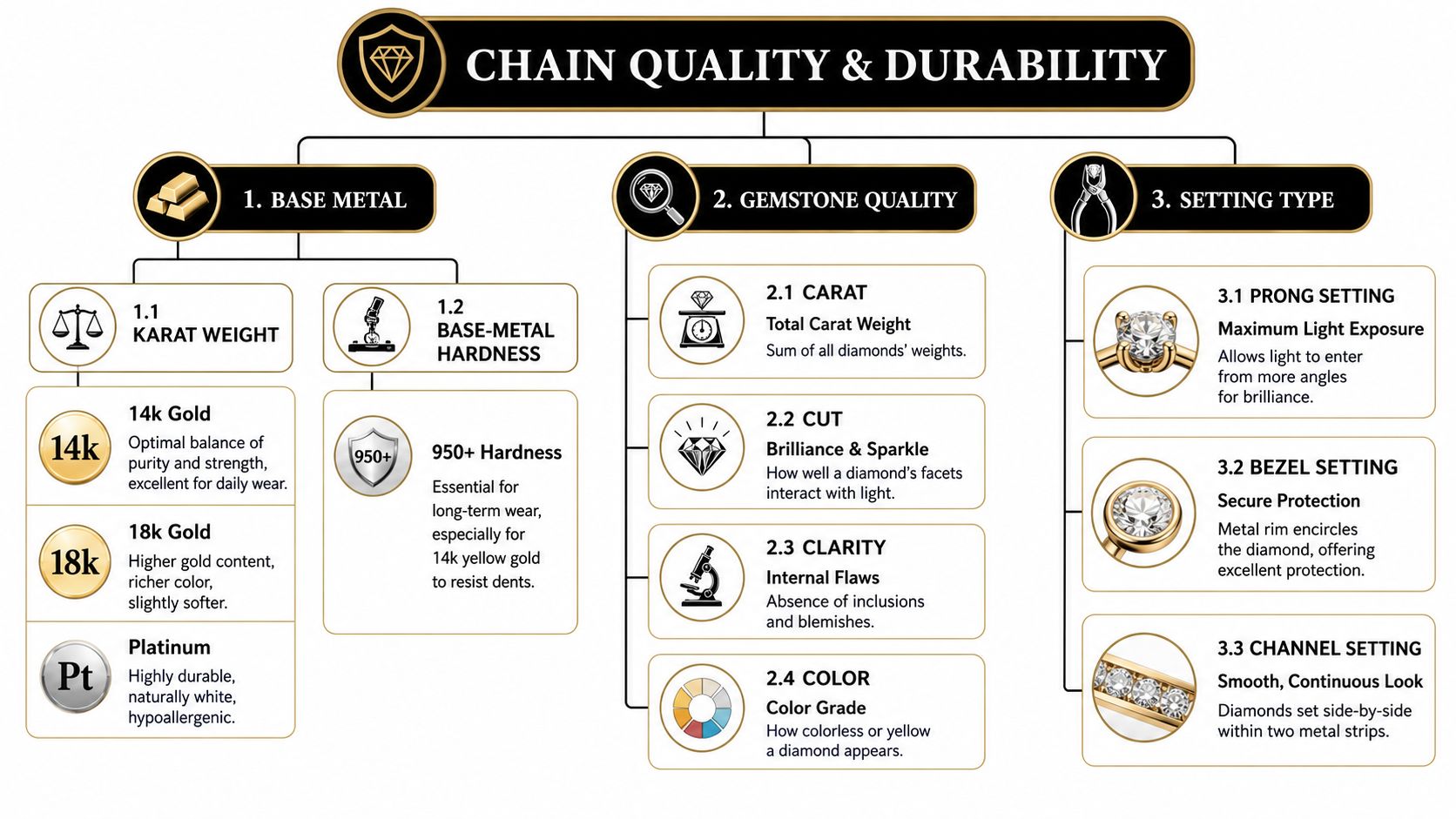
One of the more useful technical benchmarks appears in this TraxNYC product specification, which states that a premium men's tennis chain in the 2026 market typically uses 14k yellow gold, a 950+ hardness profile, and a 7pt setting density so the continuous line of stones stays uniform without deforming.
That sounds technical, but the idea is easy to picture. A tennis chain is like a suspension bridge carrying many small loads across one narrow structure. If the metal is too soft or the setting too weak, the line can stretch, loosen, or lose its clean rhythm.
If you're comparing gold purity options, this guide to 14k versus 18k gold gives useful context on how purity affects wear and durability.
What to ask about stones
Stone conversations often get fuzzy because buyers hear shorthand like “VVS,” “lab,” or “moissanite” without seeing paperwork. Keep your questions basic and direct.
Ask what the stones are: Diamonds, lab-grown diamonds, or moissanite.
Ask how the quality is described: Especially clarity and color.
Ask whether there is matching documentation: Certificates for individual stones are handled differently than for a complete chain, so you want item-specific clarity.
A useful market shift to know is that Accio's 2025 trend overview notes men's tennis chains are increasingly made with lab-grown diamonds, reducing cost by up to 40 to 50 percent compared to mined diamonds while preserving the traditional aesthetic.
Here's the practical meaning. Lab-grown can be a smart buy if you want the diamond look and stronger visual size for your budget. It doesn't remove the need for quality inspection, but it changes the pricing conversation.
A short visual walkthrough can also help when you're comparing construction details in motion:
A broader design perspective
Not every collector wants the same jewelry personality. Some prefer a tennis chain because it's clean and linear. Others lean toward more sculptural pieces. If you like studying how collectors compare understated and statement accessories, Unique luxury accessories for collectors offers an interesting contrast in how form, metal, and diamonds can create a very different visual language.
Practical rule: Judge a tennis chain by how well its metal, stone setting, and flexibility support the one thing the style promises, a smooth uninterrupted line of sparkle.
Authenticating and assessing value
The biggest mistake buyers make is assuming sparkle equals quality. It doesn't. Brightness can hide weak grading, poor setting work, or a mismatch between what was promised and what was delivered.
The biggest buyer mistake
One of the most important warnings in this category comes from this video discussion of the “grade bait” problem. It notes that many sellers market chains as VVS while delivering SI1 stones, creating a hidden value loss of $250 to $400 per carat without clear consumer warnings.
That gap matters because many first-time buyers hear “VVS” and stop asking questions. They treat the label as proof. In reality, the safest move is to ask for grading language in writing and to compare that paperwork against the piece in front of you.
If you want a more complete walkthrough of jewelry valuation logic, this jewelry appraisal guide is a useful companion.
A practical authentication checklist
Start with the parts of the chain that are hardest to fake well.
Hallmarks: Check for metal marks that match the claimed material.
Clasp quality: A premium chain shouldn't have a flimsy closure or rough action.
Stone consistency: Look for even size, even spacing, and consistent color appearance.
Link articulation: The chain should bend naturally without dead spots or awkward stiffness.
Invoice details: Ask whether clarity is written specifically, not described vaguely.
A good seller won't get defensive when you ask precise questions.
What affects resale or loan value
Value isn't based on one factor. Buyers and lenders usually consider a group of signals together:
Factor | Why it matters |
|---|---|
Metal purity | Helps establish intrinsic material value |
Stone type | Diamond, lab-grown diamond, and moissanite trade differently |
Clarity representation | Misrepresented grades can sharply affect confidence |
Condition | Loose stones, worn links, and clasp issues reduce appeal |
Documentation | Invoices, reports, and original purchase records support trust |
Market demand | Some looks move faster in resale than others |
If a seller can describe the chain beautifully but can't document it clearly, slow down.
That one habit saves many buyers from overpaying.
Styling and sizing guidance
A tennis chain should fit your frame and your wardrobe, not just your feed. The right choice depends on whether you want a subtle line at the collar or a more visible statement lower on the chest.
How to choose the right look
For most men, the easiest approach is to decide how often the chain will show.
Closer fit: Better if you want the chain to stay near the neckline and work under an open collar.
Mid-length fit: Usually the most flexible for everyday wear.
Longer fit: Better when you want the chain to sit lower and read as the center of the outfit.
Thickness changes the mood. A slimmer tennis chain reads refined. A thicker one looks more assertive and more obviously jewelry-forward.
If you're comparing chain aesthetics beyond tennis styles, this look at the gold Jesus chain helps show how pendant-focused pieces create a very different silhouette.
Easy outfit pairings
A tennis chain is more versatile than many first-time buyers expect.
Casual: Plain T-shirt, clean sneakers, and a chain worn on its own.
Business casual: Open-collar shirt with the chain sitting just inside or just above the collar line.
Evening wear: Dark shirt, minimal extras, and the chain as the main reflective detail.
For readers who like the cultural styling side of jewelry, PhotoMaxi's ultimate Y2K guide gives useful context for how mens jewelry, including bright chains, fits into a broader Y2K menswear aesthetic.
Caring for your tennis chain
A tennis chain doesn't usually fail all at once. Problems start small. A little looseness in one stone. A clasp that feels less crisp. A section that twists differently than it used to.
A safe home care routine
Use a gentle routine, not an aggressive one.
Place the chain in lukewarm water with a small amount of mild soap.
Let it sit briefly so residue loosens.
Use a very soft brush to clean around the settings.
Rinse carefully.
Dry with a soft lint-free cloth.
Skip harsh cleaners, rough scrubbing, and improvised polishing compounds. The goal is to remove buildup, not to force shine.
Clean the chain lightly and inspect it closely. The inspection matters as much as the cleaning.
Storage and inspection habits
Store the chain separately so it doesn't rub against harder jewelry or snag on other pieces. A soft pouch or lined compartment works well.
Also build a habit of checking these areas before and after wear:
The clasp: It should close securely and feel deliberate.
The stone line: Look for any section that sits unevenly.
The underside: Dirt often collects where you don't immediately see it.
If anything looks loose, stop wearing it until a professional checks it. That's especially important if the chain has sentimental or resale value.
Price ranges for tennis chains
Price confusion usually comes from comparing chains that look similar in photos but differ in stone type, clarity, metal, and workmanship. The right way to think about price is not “What does a tennis chain cost?” but “What kind of tennis chain am I pricing?”
What changes the price
The biggest drivers are material and credibility. Moissanite sits in one lane. Lab-grown diamonds sit in another. Mined diamonds sit in another. Then you layer in gold purity, finish quality, stone matching, and whether the seller has transparent paperwork.
For buyers watching budget closely, this guide to diamond necklace pricing helps put chain pricing into a broader jewelry context.
A useful benchmark from the verified data is that lab-grown diamond mens tennis chains are gaining ground because they can reduce cost by up to 40 to 50 percent versus mined diamonds while keeping the traditional look, as noted earlier from the Accio market overview.
Typical price ranges by chain length and material
The verified data provides these usable pricing references:
Moissanite often appears at $40 to $60 per carat.
“Middle of the pack” mined diamonds often appear at $750 to $950 per carat.
Because this article can only cite verified figures, the table below uses those confirmed material ranges and shows how chain length tends to influence total spend qualitatively rather than inventing unsupported totals.
Length | Moissanite Price Range | Mined Diamond Price Range |
|---|---|---|
Shorter chain | $40 to $60 per carat | $750 to $950 per carat |
Mid-length chain | $40 to $60 per carat | $750 to $950 per carat |
Longer chain | $40 to $60 per carat | $750 to $950 per carat |
The table doesn't mean every length costs the same overall. Longer chains usually require more stones and more metal, so the final ticket rises with total material used. The point is that per-carat stone category is one of the clearest pricing filters when you're comparing offers.
A good buyer asks two separate questions: what is the stone type, and what is the quality inside that stone type? That keeps flashy listings from collapsing very different products into one easy headline price.
Selling and appraisal options at Antwerp Diamond Store
If you're evaluating a tennis chain as an asset, there are usually three practical paths. You can keep it and insure it, sell it, or use it in a collateral-based loan discussion where permitted and appropriate. Each path depends on authentication, condition, and how clearly the chain can be documented.
What the process usually looks like
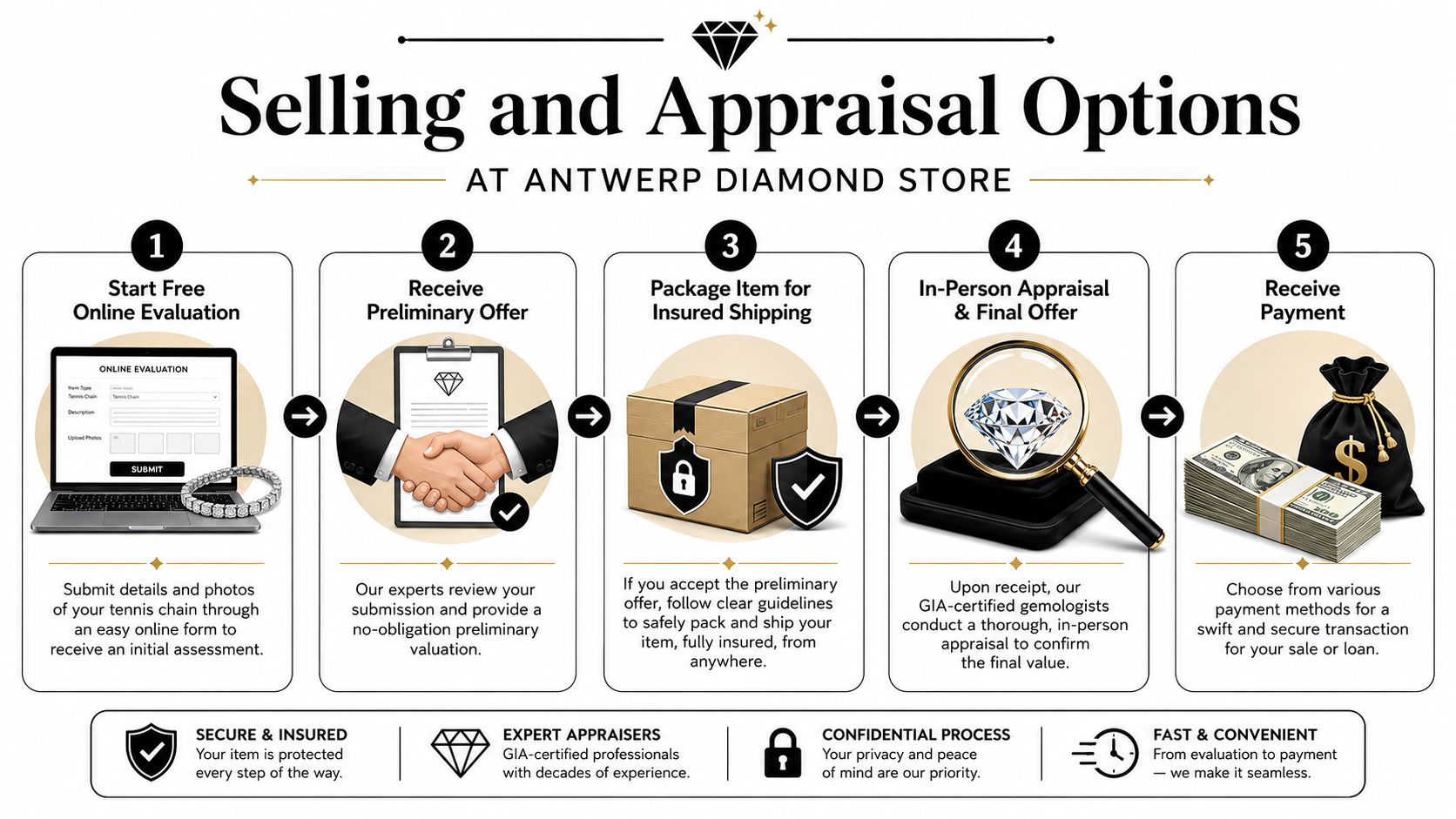
A professional evaluation typically starts with photos and basic item details, then moves to in-person inspection. The appraiser will usually review metal purity, stone type, condition, workmanship, and any available records such as invoices or prior appraisals.
For sellers in Atlanta, Buckhead, Sandy Springs, Alpharetta, Roswell, Brookhaven, Midtown Atlanta, and the wider Georgia market, in-person review can be especially useful because a tennis chain's flexibility, clasp action, and stone alignment are easier to judge in hand than from a photo set alone.
Why local evaluation still matters
Demand also plays a role. According to Dataintelo's market projection, the men's tennis apparel and gear market, including accessories like chains, is projected to grow from USD 1.2 billion in 2023 to USD 2.3 billion by 2032 at a 7.1% CAGR, which points to meaningful momentum in related resale channels.
That doesn't mean every chain will command the same offer. Buyers still care about wear, stone authenticity, paperwork, and whether the piece is easy to resell. A clean, well-documented chain generally inspires more confidence than one with vague grading and visible repairs.
If you want a professional, low-pressure opinion on a tennis chain, Antwerp Diamond is a trusted local option for evaluation, appraisal guidance, and resale review. You can start with an online assessment or arrange an in-person visit if you're in Atlanta, Buckhead, Roswell, or nearby Georgia communities. Bring the chain, any paperwork you have, and clear questions. A careful review is the fastest way to understand what you own.
FAQs
Are mens tennis chains made only with mined diamonds
No. They can be made with mined diamonds, lab-grown diamonds, or moissanite.
What's the main visual sign of a good tennis chain
The row of stones should look even, fluid, and consistent from end to end.
Is 14k gold a common choice for mens tennis chains
Yes. The verified specification cited earlier identifies 14k yellow gold as a typical premium-market choice because it balances strength and wearability.
Why do buyers need to worry about clarity labels
Because some chains are marketed as higher-clarity stones than they possess. That mismatch can affect value materially.
Can a tennis chain be appraised for resale or a loan discussion
Yes. Appraisers and buyers usually look at metal purity, stone type, craftsmanship, condition, and documentation.
Is a local in-person review better than sending only photos
Usually, yes. Photos are a starting point, but an in-person review makes it easier to assess movement, setting integrity, and overall condition.