

A 1-carat natural diamond necklace can range from $2,000 to $25,000, and that wide spread exists because price isn't driven by size alone. Cut, finish, design, metal, branding, and resale realities all change what a necklace is worth, especially if you're trying to sell rather than buy.
If you're looking at a necklace in your box right now and wondering why the original purchase price doesn't seem to line up with resale conversations, you're not alone. This is one of the most common pain points in fine jewelry. Sellers often assume the retail tag reflects a recoverable market value, but necklaces are one of the clearest examples of the gap between what buyers pay in a store and what the secondary market will support.
A diamond necklace can be a simple solitaire pendant, a graduated line necklace, a branded designer piece from Tiffany & Co. or Cartier, or a full diamond collar with extensive craftsmanship. Those aren't valued the same way, and they don't resell the same way either.
Table of Contents
What Is the Price of a Diamond Necklace?
For a buyer, the honest answer is broad. A 1-carat natural diamond necklace can range from $2,000 to $25,000 depending on cut and finish, which shows how much visual performance and workmanship can move the price beyond raw weight, as noted by Whiteflash on diamond necklace cost.
For a seller, the more useful answer is different. The price that matters isn't the original tag. It's the current resale value, which depends on the necklace's construction, the type and quality of its diamonds, whether it has a major brand name, and how much of the original price was tied up in labor and setting work that a resale buyer won't fully pay for.
Retail price and market value are different questions
A store price answers, "What did it cost to make, market, and sell this piece in a retail environment?"
A resale offer answers, "What would a knowledgeable buyer pay today for the diamonds, the metal, the design, and any brand value that still matters in the secondary market?"
Those answers can be far apart. That's especially true with necklaces because they often contain substantial craftsmanship, chain work, finishing, and small matched stones. Those elements matter a lot at retail. They often matter much less when someone is buying the piece back.
Practical rule: If you're selling, stop using the insurance appraisal or original receipt as your primary benchmark. Start with the necklace's current secondary-market demand and the recoverable value of its components.
Why sellers get conflicting numbers
Different buyers look at different things. A pawn transaction, a consignment estimate, an auction specialist, a jeweler buying for stock, and a private estate buyer may all value the same necklace differently.
Here is the simplest way to frame diamond necklace and price from a seller's side:
Situation | What usually drives the number |
|---|---|
Retail purchase | Diamond quality, craftsmanship, branding, markup |
Insurance appraisal | Replacement cost in a retail environment |
Resale offer | Secondary-market demand, diamond quality, metal, brand, condition |
Loan evaluation | Recoverable collateral value, not sentimental or replacement value |
If you understand that distinction early, you're much less likely to be disappointed by a realistic market offer.
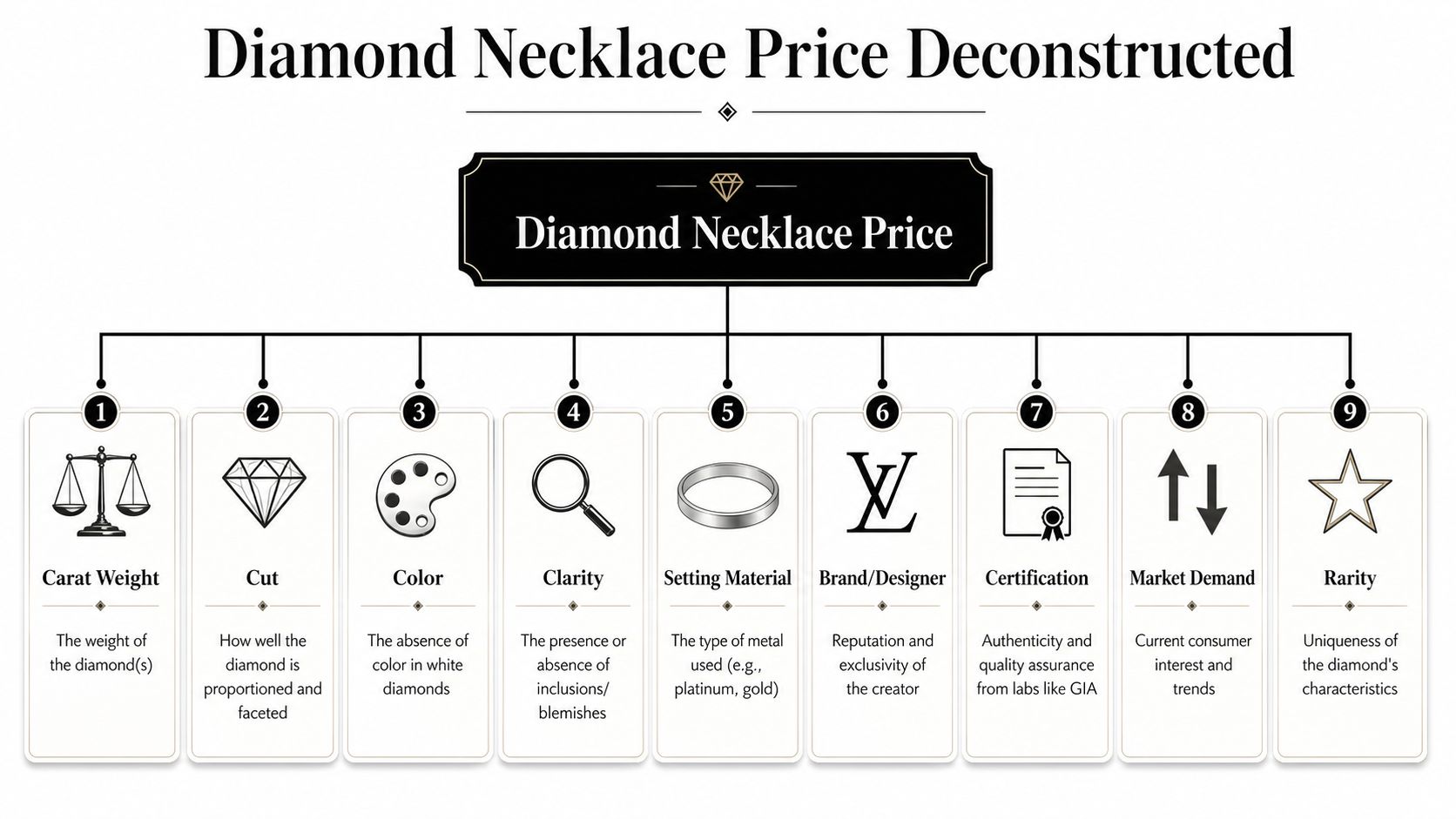
What Key Factors Determine a Diamond Necklace Price
A necklace is priced like a finished luxury object, not just a bundle of stones. Consider a car. Engine size matters, but so do the trim level, materials, brand, engineering, and condition. With jewelry, the equivalent pieces are the diamonds, the setting metal, the make, the documentation, and the market that piece belongs to.
The diamond matters, but not by carat alone
Carat weight still matters. In fact, diamond pricing data shows how sharply price per carat can change by size. Diamonds under 0.50 carats average USD 2,190 per carat, while diamonds in the 1.00 to 1.49 carat range average USD 4,448 per carat. That tells you something important. Larger stones don't cost more solely because they're heavier. They often cost more per carat as well.
But sellers make a mistake when they stop at carat weight. A necklace's visual appeal can change dramatically based on:
Cut quality: Better cut usually means stronger brilliance and a better face-up look.
Color and clarity: These affect both beauty and buyer confidence.
Stone layout: A centered solitaire, halo, bezel pendant, rivière style, and tennis necklace don't trade the same way.
Lab report presence: A GIA report can make valuation cleaner when a major center stone is involved.
A helpful background read on finished jewelry construction is what counts as fine jewelry.
Metal, make, and market position
The diamonds are one part of the value. The rest sits in the mounting.
A necklace in platinum or substantial gold often carries more intrinsic material value than a delicate fashion setting. Still, sellers shouldn't assume metal weight solves everything. Buyers pay more attention to whether the metal adds useful recoverable value or whether most of the original cost went into fabrication.
Three practical drivers tend to matter:
Setting material
Platinum, 18k gold, and heavier construction usually support value better than light, mass-produced settings.Craftsmanship
Hand-finishing, secure stone setting, balanced proportions, and durable construction matter. They matter more at retail than resale, but poor workmanship can still hurt offers.Brand and documentation
A necklace from Cartier, Tiffany & Co., or Van Cleef & Arpels may carry brand value if the piece is authentic, desirable, and supported by original paperwork or recognizable design details.
Buyers don't pay for every hour of bench labor on the secondary market. They do pay attention when excellent workmanship makes a piece easier to resell, safer to wear, and more credible.
Why Total Carat Weight Can Be Misleading
Many sellers come in focused on the total carat weight stamped on the appraisal or sales receipt. That's understandable, but it's often the wrong number to lead with.
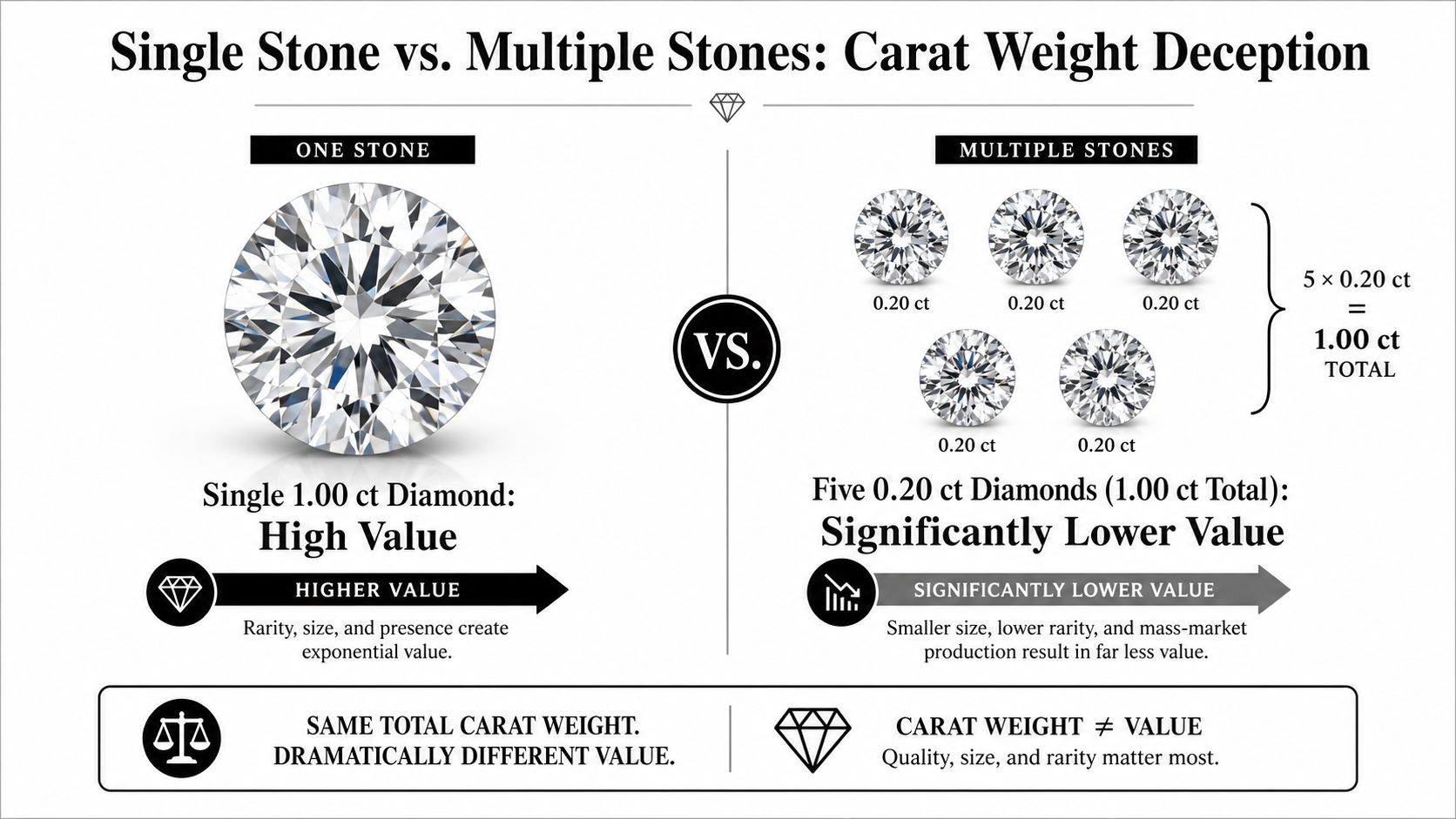
Equal weight does not mean equal value
A necklace with many small diamonds can have the same total carat weight, or TCW, as a pendant with one larger center diamond. That does not mean the two pieces should sell for similar amounts.
A verified trade point worth knowing is that a full diamond necklace can cost up to 300% more than a pendant with the same total carat weight because matched strands require visually consistent diamonds, making TCW a misleading metric when used without context.
That sounds backwards at first, because sellers often assume the bigger, more elaborate necklace should always recover more. In practice, the market can reward a well-documented single stone more predictably than a piece built from many small stones.
Why matching costs more and resells differently
At retail, matching is expensive. A jeweler has to source stones that look consistent in color, clarity, size, and face-up appearance. That's real labor and real inventory discipline.
At resale, however, buyers often separate the necklace into components mentally:
Necklace feature | Retail effect | Resale effect |
|---|---|---|
Single larger center stone | Strong price driver | Easier to evaluate and compare |
Many small matched stones | Raises manufacturing and sourcing cost | Often less efficient to monetize |
Complex setting work | Adds significant retail cost | Usually discounted in resale |
Recognizable branded design | Premium at retail | May still help, if demand is strong |
A good companion read on size versus value is how much a 1.00 ct diamond is worth.
TCW is a description, not a conclusion. It tells you how much diamond weight is present. It doesn't tell you how desirable, liquid, or easy to resell that weight is.
If you're selling a necklace with multiple small stones, expect a buyer to look closely at uniformity, condition, and whether the diamonds are worth preserving in the piece or valued more as part of a broader material assessment.
Understanding Retail Price vs Resale Value
Most of the frustration stems from a seller remembering what the necklace cost, while the market assesses what can realistically be recovered.
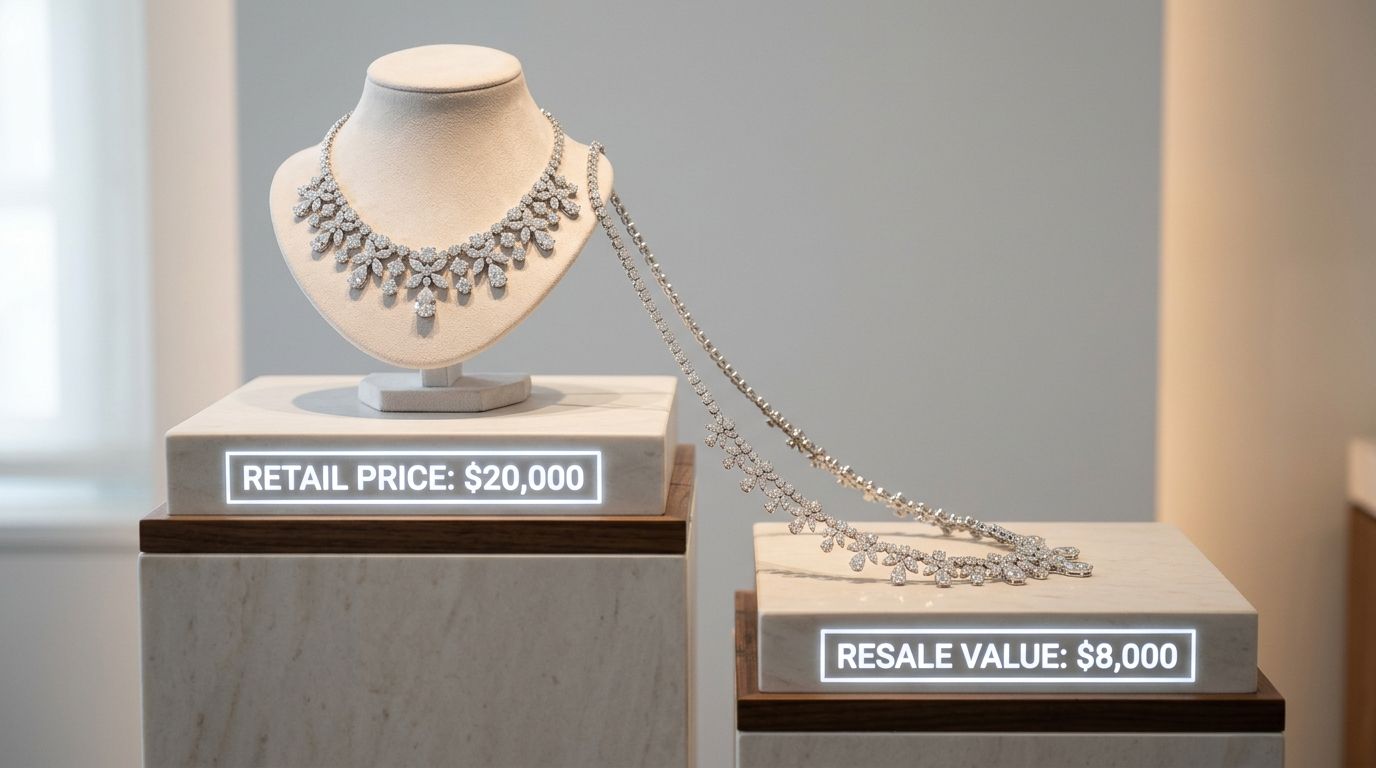
What retail includes that resale usually does not
Retail pricing includes much more than diamonds and metal. It may include showroom overhead, design development, brand presentation, inventory carrying costs, bench labor, packaging, marketing, and profit margin.
Resale buyers usually don't pay full value for those layers. That's why necklace resale value often drops 40 to 60% below retail because the pricing of the setting, metal, and craftsmanship is not fully monetized by the seller, while loose diamond pricing is more standardized.
That doesn't mean a necklace has poor value. It means the value changes once the piece leaves the retail environment.
Why the resale value cliff surprises sellers
Necklaces are especially vulnerable to this gap because they often combine hard costs and soft costs in one object. The hard costs are the diamonds and precious metal. The soft costs include design complexity, matching work, finishing, and brand theater.
Here is the part many sellers don't hear clearly enough:
Craftsmanship adds cost, but not all craftsmanship converts cleanly into resale proceeds.
Metal adds value, but light chain work may contribute less than expected.
Brand premiums can survive, but only when the brand, design, and authenticity are strong enough for the secondhand market.
Appraisals can mislead, because replacement value is not the same as market offer value.
If you're also comparing natural and lab-created pieces, this overview of lab grown vs mined diamonds is useful context because the resale conversation can diverge sharply depending on the stone type.
A practical way to sense-check expectations is to review a diamond resale value calculator discussion, which helps frame why asking price, appraisal price, and actual offer price are rarely identical.
Retail tells you what it cost to buy. Resale tells you what the market will absorb today.
How to Get an Accurate Evaluation and Sell Your Necklace
If you want a serious answer, prepare the necklace the way a serious buyer would want to review it. That means documents first, assumptions second.
A useful visual summary is below.
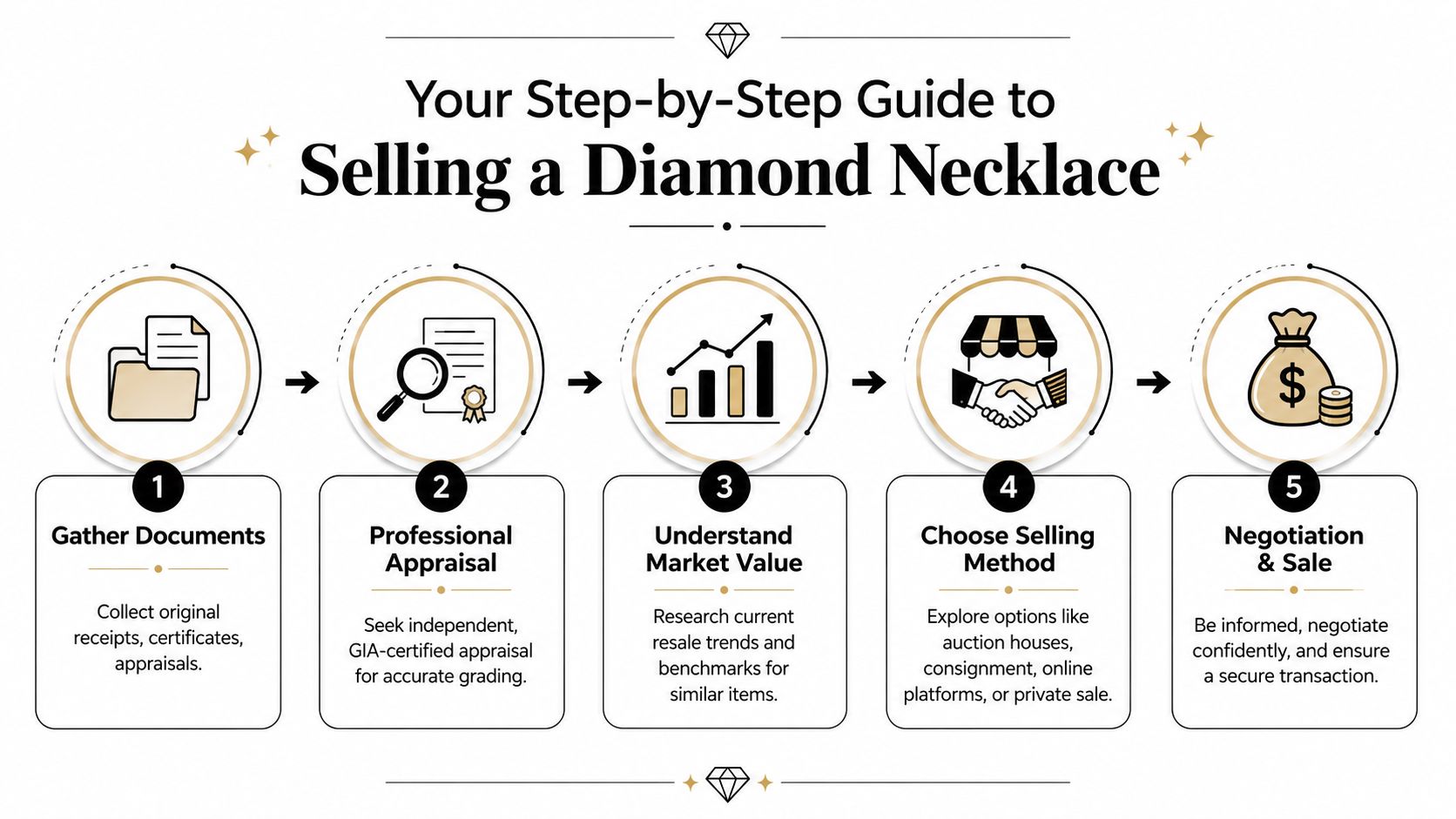
What to gather before an evaluation
Start with anything that reduces uncertainty:
Diamond grading reports: GIA paperwork is especially helpful for larger center stones.
Original receipt: Useful for identification, not as proof of current value.
Prior appraisals: Helpful background, but they often reflect replacement pricing.
Brand packaging and paperwork: Important for Cartier, Tiffany & Co., Van Cleef & Arpels, and similar houses.
Repair history: Stone replacements, chain repairs, and altered clasps can affect how a buyer sees the piece.
A professional perspective on this step is covered well in what an independent jewelry appraiser does.
How a real resale evaluation works
A sound evaluation usually looks at the necklace in layers.
First, the evaluator identifies whether the value sits mainly in a center stone, the total diamond layout, the precious metal, or the brand name. Then the piece is examined for condition, authenticity, wear, modifications, and salability in the current secondary market.
This video offers a useful overview of selling process expectations:
Three distinctions matter:
Evaluation type | What it answers |
|---|---|
Insurance appraisal | What it may cost to replace |
Estate or fair market appraisal | What it may be worth in a broader market context |
Purchase or loan offer | What a buyer or lender is willing to advance today |
Selling options in the Atlanta and Georgia market
In Atlanta, Buckhead, Sandy Springs, Alpharetta, Roswell, Brookhaven, Midtown Atlanta, and the wider Georgia market, sellers usually want one of three things: speed, privacy, or maximum confidence in the grading.
That changes where they should go. A branded necklace with strong paperwork may appeal to a specialist buyer. A generic diamond necklace may need a more materials-driven evaluation. A larger center-stone pendant may benefit from independent review before any sale decision.
Bring the necklace clean but not over-polished, and don't replace missing paperwork with guesses. Good evaluators would rather verify facts than unwind assumptions.
If you're considering a loan rather than an outright sale, use the same caution. The offer will still be based on recoverable market value, not on what the piece meant to you or what it cost new.
Diamond Necklace Price Examples
Examples help because most sellers aren't holding an abstract concept. They're holding a specific necklace and trying to figure out where it lands.
Example one, the simple solitaire pendant
This is often the cleanest category to evaluate. A single natural diamond pendant with strong cut, attractive finish, and a useful lab report will usually be easier for buyers to price than a complicated multi-stone necklace.
The broad retail range is already telling: a 1-carat natural diamond necklace can range from $2,000 to $25,000 depending on cut and finish, according to Whiteflash's discussion of diamond necklace pricing. In real selling situations, the center stone quality often drives the conversation more than the chain.
Example two, the branded everyday necklace
Consider a Tiffany & Co. pendant or a Cartier necklace with modest diamond weight but strong design recognition. Here, the raw diamond content may not be the whole story.
If the piece is authentic, in good condition, and still desirable in the secondhand market, the brand can help support resale interest. If the necklace is heavily worn, altered, or missing identifying features, brand value can weaken quickly. That's why sellers should think in terms of buyer confidence, not brand name alone.
For a broader grounding in jewelry valuation basics, how much a diamond is worth is a helpful reference.
Example three, the multi-stone statement necklace
Now take a diamond line necklace, tennis necklace, or ornate vintage piece with many small stones. These often looked expensive at retail because they required matching, setting labor, and substantial finishing.
At resale, the buyer may ask harder questions:
Are the stones matched well enough to preserve the piece as-is?
Is the setting structurally sound?
Does the necklace have market appeal in its current style?
Would the piece be sold intact, or valued closer to its component content?
A seller can own a beautiful necklace and still get a lower-than-expected offer if most of the original cost sat in labor-intensive construction that the next buyer won't fully pay for.
That isn't a flaw in the necklace. It's how the market treats finished jewelry.
Frequently Asked Questions and Selling with Confidence
A diamond necklace's price and resale value aren't the same thing. The strongest offers usually come when the evaluator can clearly identify where the value sits, in the center diamond, the brand, the metal, the design, or the overall marketability of the piece.
If you remember one thing, make it this: sellers do best when they stop anchoring to the original receipt and start thinking like the next buyer.
FAQ
What is the difference between an appraisal and an offer
An appraisal is usually a valuation document created for insurance, estate, or record-keeping purposes. An offer is what a buyer or lender is willing to pay or advance right now based on current resale conditions.
Does the original box and paperwork matter
Yes, especially for designer jewelry. Original receipts, branded packaging, and diamond reports can improve buyer confidence and make authentication easier.
Is a full necklace worth more than a pendant with the same carat weight
Not automatically. Construction, matching, design, and resale demand all matter. Total carat weight alone doesn't settle the question.
Will a better setting increase my resale price
Sometimes, but not in full proportion to what it added at retail. The secondary market often discounts labor and design cost more heavily than sellers expect.
Should I sell, consign, or borrow against the necklace
That depends on your timeline, your comfort with market risk, and whether immediate liquidity matters more than waiting for a retail-style buyer. A professional evaluation can help you compare those options, but it isn't legal, tax, or financial advice.
If you're in Atlanta, Buckhead, Sandy Springs, Alpharetta, Roswell, Brookhaven, Midtown Atlanta, or elsewhere in Georgia, an in-person review can be especially useful for high-value necklaces, branded fine jewelry, and pieces with larger center stones.
If you want a professional, low-pressure review of your necklace, Antwerp Diamond offers confidential evaluations for diamond jewelry, luxury items, and other high-value assets. You can start with an online inquiry or arrange an in-person visit if you'd prefer a direct market-based assessment before deciding whether to sell, borrow against, or understand what your piece is worth today.


