

The price of a Cuban link chain can range from under $100 for plated versions to over $100,000 for heavy, high-karat gold or diamond-encrusted pieces. Its actual value comes down to material, weight, purity, and any diamond embellishments, not just how impressive it looked in the store case.
If you're holding a Cuban link right now and wondering what it's really worth, you're asking the right question. Most owners remember what they paid. Buyers, appraisers, and lenders look at something else first: what the chain is made of, how much it weighs, how pure the metal is, and whether the diamonds, if any, add resale demand or just retail markup.
Table of Contents
How Much Is a Cuban Link Chain Actually Worth?
A seller walks in with a heavy-looking Cuban link and a retail receipt from a jewelry store. The first question is usually the same. What is this chain worth today? The answer rarely matches the original purchase price, because resale value and retail pricing are built on different math.
A Cuban link chain can range from inexpensive fashion jewelry to a high-value gold piece, but a seller needs to focus on what the secondary market will pay. In practice, buyers price a chain around verifiable metal content, total weight, purity, and current demand. Store markup, labor, branding, and the story behind the purchase usually do not carry over in a cash offer.
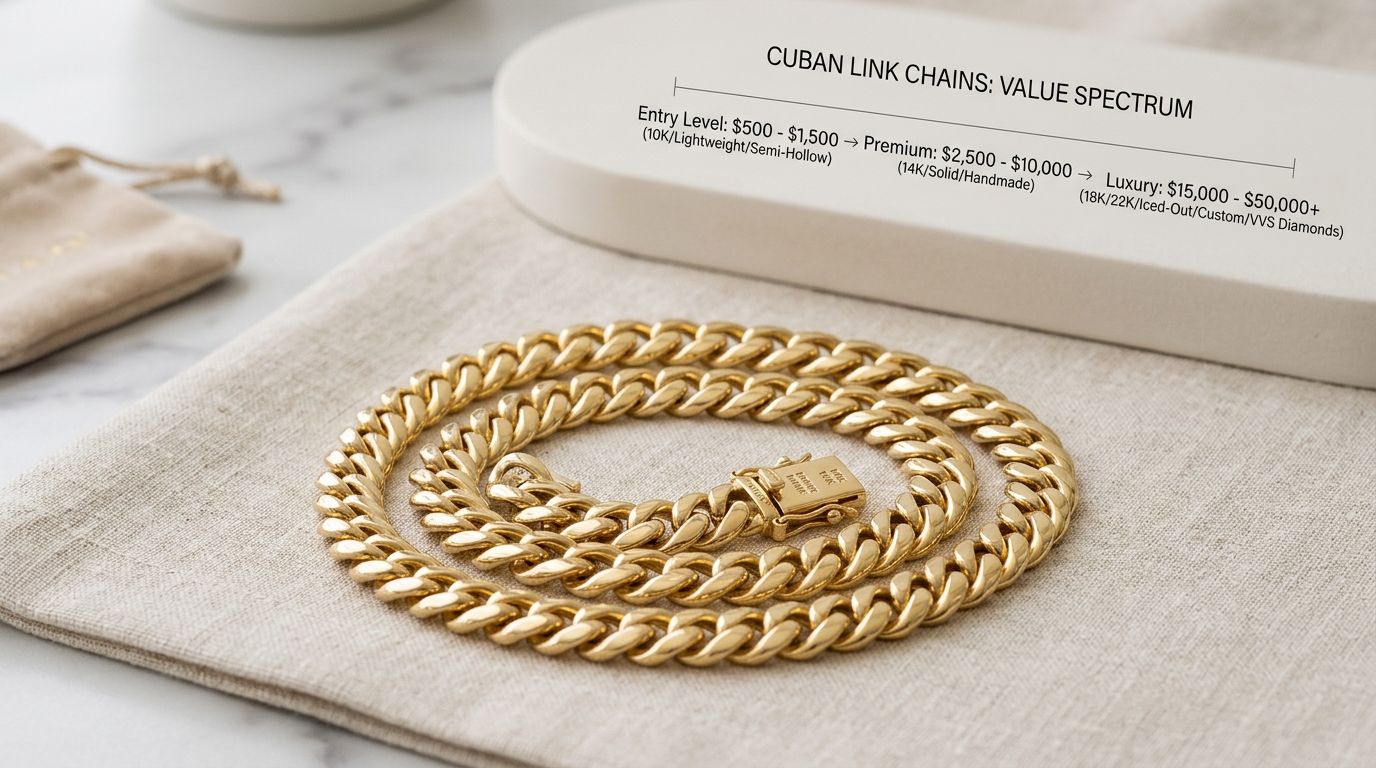
That is why two chains with a similar look can produce very different offers. One may be plated, hollow, or made with light construction. Another may be solid gold with meaningful gram weight, higher purity, and better resale liquidity. Even details like whether the chain is 14K or 18K can shift value, especially if you understand the difference between 14K and 18K gold before you sell.
The practical way to judge a Cuban link's resale value starts with a few questions:
What is it made of? Solid gold, silver, plated base metal, and stone-set pieces all trade differently.
What is the purity? A 10K chain does not carry the same melt value as a 14K or 18K chain of the same size.
How much does it weigh? In resale, grams matter more than visual width alone.
How well is it built? Solid links, secure locks, and clean soldering support stronger buyer confidence.
How easy is it to resell? A buyer pays based on what can be verified and moved again without much risk.
For a seller, the cleanest starting point is simple. Set the receipt aside, confirm the metal, confirm the karat, weigh the chain, and judge it by current resale demand. That is the baseline for a fair offer.
What Core Factors Determine Cuban Link Prices?
A seller usually hears the same frustrating line after bringing in a chain that cost thousands at retail. The offer comes back far lower than expected. In practice, that gap comes from how resale works. Buyers price Cuban links from the inside out, starting with what can be verified in metal, weight, and marketability.

Metal purity sets the floor
Karat changes value immediately because karat tells a buyer how much precious metal is present. Two chains can share the same width and length yet produce very different offers if one is 10K and the other is 14K or 18K.
For resale, that difference is not academic. It affects melt value, liquidity, and how aggressively a buyer can bid. Sellers who want a clearer sense of how purity changes value should review the difference between 14K and 18K gold. A correct stamp helps, but experienced buyers still verify the alloy because mismarked or altered pieces show up regularly in the secondary market.
Weight matters more than visual size
A Cuban link can look substantial and still disappoint on the scale. That usually happens with hollow construction, lighter alloys, or chains built to maximize appearance over gold content.
In a resale setting, gram weight does the heavy lifting. Width and length matter because they often increase weight, but the scale is what turns a nice-looking chain into a cash number. Retail pricing may include labor and brand markup. A resale offer starts much closer to recoverable metal value and then adjusts for demand, wear, and salability.
Ask for three specifics before evaluating any offer:
Verified gram weight
Verified karat purity
Whether the buyer is paying mainly for melt, wearability, or both
That short checklist prevents a lot of bad assumptions.
Construction quality affects resale, but less than owners expect
Good construction still matters. Solid links, tight assembly, a dependable clasp, and clean solder work make a chain easier to resell because they reduce risk for the next buyer. If I see a chain with sloppy repairs, thin weak points near the lock, or uneven links, I know the offer has to account for those problems.
But sellers should keep the trade-off clear. Fine workmanship usually adds more at retail than it does at resale. The original jeweler may have charged a premium for finishing, hand assembly, or a better lock design. A secondary buyer will notice those details, but the offer still starts with verified metal content and what the chain can bring in the current pre-owned market.
Stones add value only if the market agrees
Stone-set Cuban links create the most confusion for sellers. A diamond-heavy chain may have a very high original ticket price, but resale depends on whether the stones are natural, well-matched, securely set, and supported by documentation or strong buyer confidence.
Aftermarket work can complicate that evaluation fast. If the diamonds are commercial quality, the setting work is uneven, or the piece needs repair, the premium over metal value can shrink sharply. Moissanite pieces face an even steeper drop because resale demand is thinner and replacement cost does not translate cleanly into secondary-market value.
The practical takeaway is simple. Sellers get the most accurate picture of Cuban link value by separating four questions: what metal it is, how pure that metal is, how many grams are present, and whether the finished piece has enough demand to earn more than a metal-driven offer.
Cuban Link Price Examples by Type
The easiest way to understand Cuban link price is to compare categories side by side. Retail asking prices can span from entry-level fashion pieces to elite diamond jewelry, but resale works on narrower logic.
Example Cuban Link Chain Price Ranges
Chain Type | Specifications | Estimated Retail Price | Estimated Resale Value |
|---|---|---|---|
Gold-plated Cuban link | Fashion construction, non-solid precious metal | Around $30 at the low end for simple plated versions | Usually depends on fashion demand, condition, and wearability |
Solid 10K gold Cuban link | Comparable size example, 8mm x 22-inch | Starts around $9,000 | Primarily tied to verified gold content, weight, and resale demand |
Solid 14K gold Cuban link | Comparable size example, 8mm x 22-inch | Starts around $13,500 | Usually stronger than 10K in absolute value because of higher gold content |
Solid 18K gold Cuban link | High-karat, authentic woven construction | Can reach $27,000 in a cited example | Varies by weight, purity, condition, and buyer demand |
Moissanite Cuban link | Precious-metal or alternative build with moissanite | Approximately $1,000 to $8,000 | Often lower than retail because moissanite doesn't trade like natural diamond jewelry |
Diamond Cuban link | Diamond-set luxury piece | Starts around $25,000, can reach hundreds of thousands | Depends heavily on diamond quality, metal value, workmanship, and salability |
The biggest trap for sellers is assuming retail and resale move in parallel. They don't. A chain that sold well at retail may have a narrower resale audience, especially if it relies on trend, branding, or highly customized styling. If you're comparing stone-set options, this overview of a diamond Cuban link chain for men helps frame what buyers look for beyond appearance.
If you're selling, use retail figures as context, not as your expected payout.
That approach keeps expectations realistic and helps you focus on the factors that survive a second transaction.
Why Is a Resale Offer Lower Than the Retail Price?
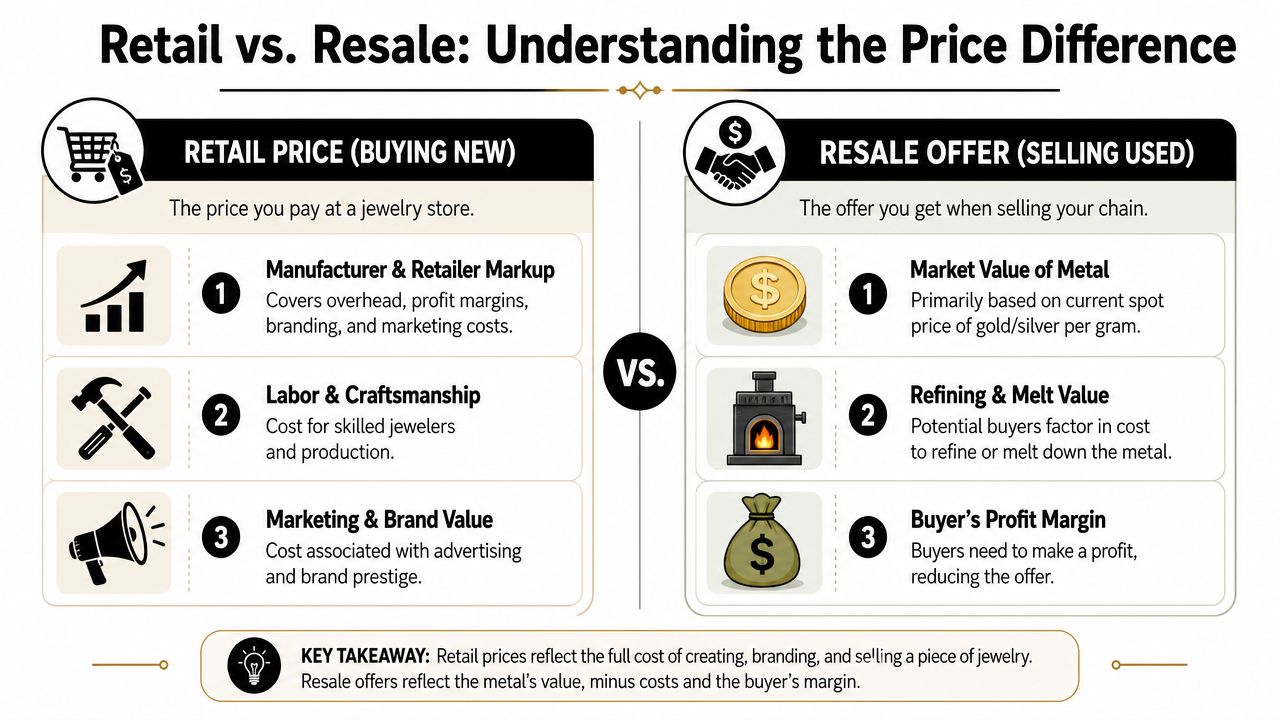
This is the part sellers usually want explained plainly. A resale offer is lower because a second buyer isn't paying for the same things you paid for when the chain was new.
Retail price includes costs a second buyer won't repay
When a chain sells new, the price can include showroom overhead, brand positioning, labor, finishing, and standard retail margin. A used jewelry buyer doesn't step into that same economics. They have to evaluate what they can verify today, what risk they're taking, and what the item will realistically bring in the current secondary market.
As this discussion of Cuban links as an investment notes, owners often assume the price is fully tied to gold weight, but resale often penalizes for condition and effectively strips away the original retail markup. That's a major reason an owner's purchase price and a buyer's offer don't match.
Here is the simplest way to understand it:
Retail includes presentation costs: Store margin, branding, and customer acquisition live inside that ticket price.
Resale starts from recoverable value: Gold content, usable diamonds, and current demand carry the offer.
Buyers price for risk: Pre-owned jewelry may need polishing, repair, testing, or recutting of expectations.
Condition, brand, and liquidity matter in resale
A solid plain gold Cuban link with clean construction can be easier to value than a heavily customized chain. That's because plain gold has straightforward intrinsic value. Once the piece depends on style-specific branding, unusual modifications, or uncertain diamonds, the buyer has to discount for uncertainty.
In practice, these details move an offer:
Resale factor | Why it matters |
|---|---|
Condition | Bent links, weak locks, heavy wear, or repairs can limit resale appeal |
Authenticity | Clear karat verification and confident testing support stronger offers |
Construction | Solid, well-made chains tend to inspire more confidence than light or compromised builds |
Diamond quality | Real diamonds may add value, but only if they are marketable and properly set |
Liquidity | A broad, easy-to-resell style usually performs better than a highly niche custom piece |
A lot of disappointment comes from treating jewelry like bullion. They're related, but they're not the same. A chain is a finished consumer product first and a precious metal object second. Once it becomes pre-owned, the market recalculates what portion of that original purchase still has resale utility.
If you want to track the metal side of the equation before you walk into an appraisal, it helps to monitor current gold and silver price context. Just don't confuse live metal pricing with a guaranteed purchase offer for finished jewelry.
How to Get Your Cuban Link Appraised and Sold in Atlanta
A seller walks in with a heavy Cuban link, a retail receipt, and a number in mind. The appraisal starts, the chain is tested and weighed, and the offer comes in lower than expected. In Atlanta, that gap usually comes from one issue. Retail price reflects store markup, labor, branding, and presentation. Resale value is based on what the chain is worth in the secondary market today.
Preparation helps close that expectation gap before you sit down with a buyer.
What to bring before an appraisal
Paperwork helps, but it is not what creates value. Bring receipts, prior appraisals, diamond grading reports, and repair records if you have them. Those documents can answer questions faster and support cleaner decision-making, especially if the chain has diamonds or past modifications.
Bring the chain untangled and in its current condition. Skip aggressive home polishing. Fresh buffing can soften edges, hide solder work, or make wear harder to read during inspection.
A useful seller checklist:
Bring any documentation you have: Receipts, old appraisals, and diamond paperwork can speed up verification.
Know the basics: Length, width, karat stamp, and whether the chain is solid or hollow give the appraiser a starting point.
Set resale expectations before you arrive: What you originally paid may explain the chain's retail story, but an actual offer will be tied more closely to verified gold content, salability, and current demand.
What happens during a professional evaluation
A proper evaluation should be methodical. The buyer should inspect the chain, verify the metal, confirm the gram weight, and assess whether the piece has resale appeal as jewelry or is being priced mainly for its material value.
For sellers, the key questions are usually these:
Is the gold authentic, and what is the actual karat?
What does the chain weigh on a calibrated scale?
Do any diamonds add resale value, or do they create more uncertainty?
Is the buyer valuing it as a wearable chain, a scrap candidate, or a combination of both?
Ask one direct question before you react to the number: What part of this offer is based on gold value, and what part is based on resale potential?
That answer tells you how the buyer sees your chain.
What sellers in Atlanta should look for
Choose a buyer who can show the process, not just quote a figure. In practice, that means in-person testing, visible weighing, and a clear explanation if the offer changes because of hollow construction, repairs, weak clasps, aftermarket diamonds, or inconsistent purity.
Local knowledge matters too. A plain solid Cuban link usually has a broader resale audience than a highly customized piece, but every buyer has a different appetite for used designer-style chains and diamond work. If you are comparing local options, review what experienced gold buyers in Atlanta typically test for and how they explain offers.
Take your time. A serious buyer will let you compare, ask questions, and decide without pressure.
Frequently Asked Questions About Cuban Link Value
Is a hollow Cuban link chain worth anything?
Yes. A hollow Cuban link can still have resale value, but the offer usually comes in lower than a solid chain with the same look because there is less gold in the piece.
That matters for sellers. Wide links and bold styling can create a strong retail impression, yet resale buyers usually start with confirmed purity and usable metal weight. Hollow construction also tends to raise more condition questions if the chain has dents, thinning, or repair history.
How can I tell if my Cuban link is real gold at home?
Start with the stamp near the clasp or lock. Marks such as 10K, 14K, and 18K are helpful, but they are only a starting point.
You can also check for plating wear, odd color changes, or magnetic response. Those signs can point to a problem, but they do not replace professional testing. I would not advise pricing a chain from a stamp alone because mismarked and altered pieces show up often enough to mislead sellers.
Are Cuban link chains a good investment?
They can hold value better than plated fashion jewelry if they are solid gold and in strong condition, but sellers should view them as jewelry with recoverable material value, not as a direct stand-in for bullion.
Many owners are often surprised. The purchase price often includes labor, finishing, brand positioning, and store markup. A resale offer may recognize some of that if the chain is clean, wearable, and easy to place with another buyer, but cash offers still tend to track gold content and current demand far more closely than the original receipt. If you want to compare selling options in more detail, this guide on the best way to sell gold jewelry lays out the process clearly.
Do diamonds always raise resale value?
No. Diamonds add value only when a buyer can verify what is there and see a realistic resale path for the finished piece.
Natural diamonds, consistent color and clarity, solid setting work, and a style that fits current demand can help. Heavily customized chains, aftermarket stone work, and uncertain diamond quality often narrow the buyer pool. In those cases, the chain may be priced mainly for its gold, with limited credit for the stones.
Sell Your Cuban Link Chain with Confidence
A Cuban link price makes more sense once you separate retail pricing from cash resale value. Retail reflects labor, presentation, and margin. Resale usually starts with verified metal content, gram weight, purity, and how easy the piece is to place back into the market.
That distinction protects you from two common mistakes. The first is assuming the original purchase price sets today's value. The second is accepting an offer without understanding whether the buyer sees your chain as wearable jewelry or mostly recoverable material.
If you're preparing to sell, get your facts in order first. Confirm the karat, know the weight, gather any paperwork, and ask direct questions about how the offer was built. This guide on the best way to sell gold jewelry is a good next step if you want to compare your options more carefully.
If you'd like a professional, low-pressure review, Antwerp Diamond offers confidential evaluations for jewelry, gold, diamonds, watches, handbags, and other luxury assets. You can start online or arrange an in-person appointment in the Atlanta area, including Buckhead and Roswell, to get a clear, no-obligation assessment of your Cuban link chain.