
Gold and silver prices come from the global spot market, and recent published figures show gold reached $5,598.30 per ounce and silver reached $121.66 per ounce on January 29, 2026. But if you're selling a ring, bracelet, old coins, or scrap metal, the cash you receive depends on the item's form, purity, weight, and the buyer's spread, not just the ticker price.
That gap is where most sellers get frustrated. You look up the gold silver price online, see a big headline number, then get an offer that feels lower than expected. In many cases, the offer isn't wrong. It's based on what you own, how much pure metal is in it, and what it costs a buyer to test, sort, refine, or resell it.
If you're in Atlanta, Buckhead, Sandy Springs, Alpharetta, Roswell, Brookhaven, Midtown Atlanta, or elsewhere in Georgia, this matters even more when you're deciding whether to sell now, hold, or ask for an appraisal first. The more clearly you understand spot price versus resale value, the more confident you'll feel when someone puts a number in front of you.
Table of Contents
Understanding Today's Gold and Silver Prices
The gold silver price you see online is a benchmark, not a guaranteed payout. It tells you what the raw metal market is doing at that moment. It doesn't automatically tell you what a buyer will pay for your chain, dental gold, sterling flatware, or old coin collection.
That difference matters because personal items aren't traded the way large bars are traded. A buyer has to determine purity, confirm authenticity, weigh the item correctly, and decide whether it's being purchased for resale, melt, or collectible value.
A simple way to think about it is this:
Term | What it means | Why it matters to a seller |
|---|---|---|
Spot price | Global market price for raw precious metal | Sets the reference point |
Item value | Value of your specific ring, coin, or bar | Depends on purity, form, and demand |
Offer price | What a buyer is willing to pay now | Includes testing, risk, and resale margin |
Most confusion starts when people compare a jewelry offer to the full headline price for pure bullion. That's not an apples-to-apples comparison.
Practical rule: Spot price is the starting line. Your actual offer is the result after purity, weight, form, and buyer costs are considered.
Gold's long history also helps explain why people watch it so closely. The historical U.S. gold price was officially set at $19.39 per ounce in the early republic, then moved to $20.67 per ounce in 1834, where it stayed until 1933, before modern floating prices eventually pushed gold to $5,598.30 per ounce on January 29, 2026, with silver reaching $121.66 per ounce on the same date, according to historical and current precious metals price charts.
If you're trying to decide where to begin, this guide to the best place to sell gold is useful because it focuses on the actual transaction, not just the headline market.
What Is the Spot Price of Gold and Silver
The spot price is the current market price for a troy ounce of raw gold or silver for immediate delivery. It's the core reference number dealers, refiners, investors, and financial media use when they talk about the market.
Think of spot price as the wholesale metal price
Think of spot price the way a chef thinks about a raw ingredient. The wholesale price of flour isn't the same as the retail price of a finished cake. In the same way, the spot price of gold isn't the same as the price of a finished bracelet, and the spot price of silver isn't the same as what someone pays for a sterling tea set.
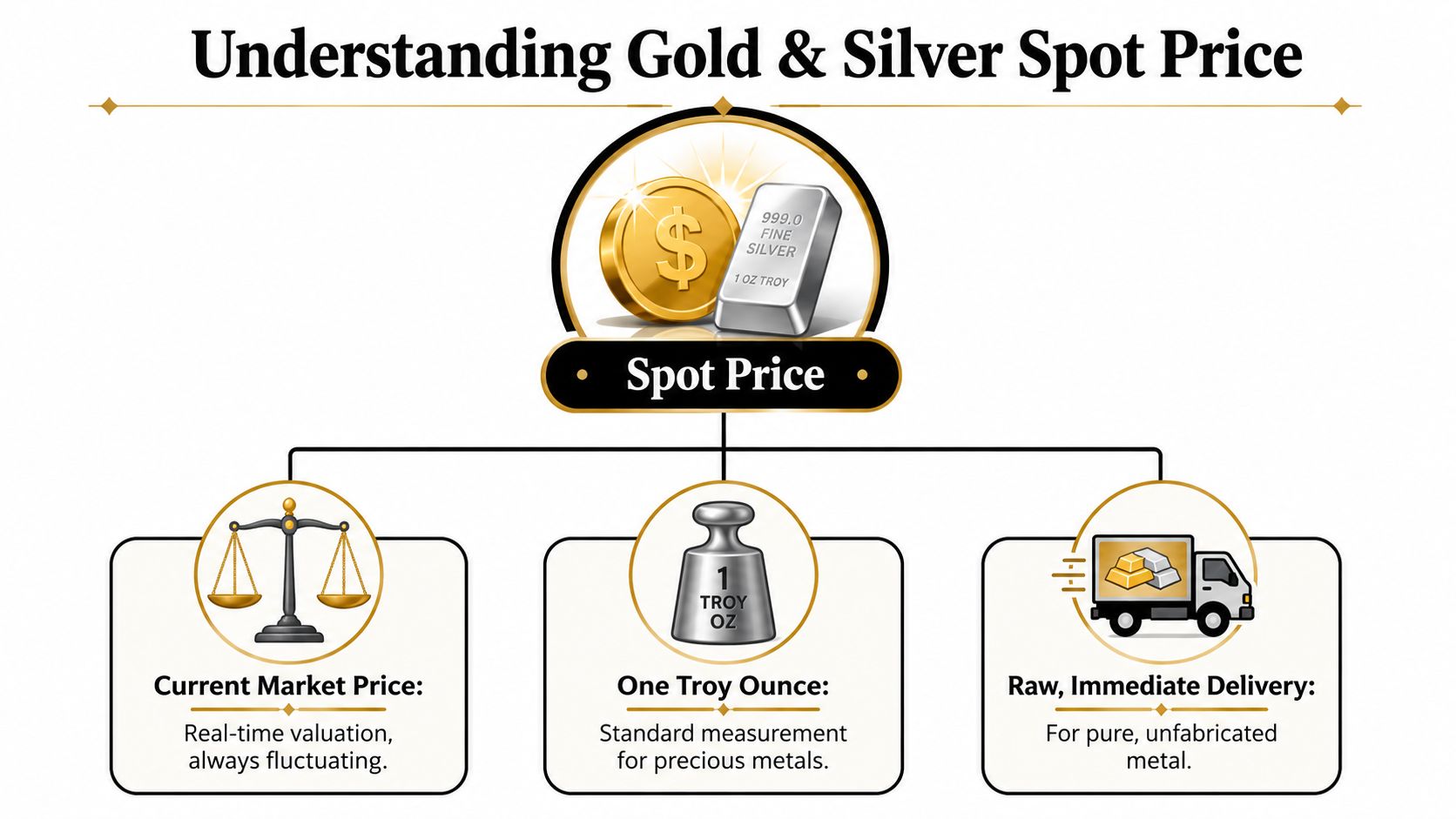
Spot price is usually quoted per troy ounce, which is the standard precious metals weight. Sellers often get confused here because jewelry is usually weighed in grams, while market reports use ounces. A reputable buyer converts the weight and purity into a clear metal value calculation.
Why spot price and seller payout are different
Once metal is turned into a coin, chain, ring, or serving set, more variables enter the picture:
Purity: A pure bar and a 14K bracelet don't contain the same amount of gold.
Form: Bullion is easier to price than mixed-metal jewelry.
Testing: Buyers may need to assay, sort, or verify the piece.
Resale path: Some items are resold intact, others are bought for melt.
You'll also hear terms like bid and ask. In plain English, the ask is what buyers pay to acquire metal, and the bid is what the market will pay when selling. Retail transactions sit on top of that market structure, which is why there is always some spread.
If you're comparing silver products specifically, this overview of selling Silver Eagles helps because recognizable government-minted coins are usually treated differently from generic rounds or scrap silver.
Spot price tells you what the metal is worth in the market. It does not promise what any finished item will bring at a local counter.
What Factors Actually Move Gold and Silver Prices
Gold and silver don't move for one single reason. They respond to a mix of monetary stress, investor behavior, industrial demand, and market structure.
Gold reacts to monetary stress and official buying
Gold often attracts attention when people are worried about inflation, currency strength, or financial instability. Recent market commentary noted that gold had surpassed the $5,100 per ounce breakout level, with $5,400 identified as the next major resistance target and all-time highs near $5,600 in view if that level breaks, while support sat near $4,400 and deeper support in the $3,450 to $3,500 range, according to technical analysis of gold and silver price levels.
Another important force is official sector buying. Since 2019, the silver market has operated in a persistent supply deficit primarily driven by industrial demand, while recent central bank gold purchases have exceeded 1,000 tons net annually, representing roughly one-third of global mine supply, according to this market discussion on gold and silver demand dynamics.
If you want a plain-language outside perspective on macro drivers, Alpha Scala has a useful page with gold price insights for investors.
Silver also has an industrial side
Silver behaves differently because it isn't only a monetary metal. It also matters in manufacturing, electronics, and energy-related applications. That means silver can react sharply when growth expectations change.
Recent commentary also points out that short-term drops in gold and silver can be driven by futures market amplified trading, ETF flows, margin calls, and concentrated speculation, rather than a sudden collapse in fundamental demand, according to this analysis of precious metals market mechanics.
A short explainer helps put those moving parts in context:
For a seller, the practical lesson is simple. A sudden drop on a chart doesn't always mean your ring or coin became worthless overnight. Sometimes the market is digesting financially amplified trading stress, not making a judgment about the long-term value of precious metals.
Why Is My Gold Jewelry Not Worth the Full Spot Price
This is the question almost every seller asks, and it's a fair one. If the gold silver price is public, why doesn't a buyer just hand over that exact amount?
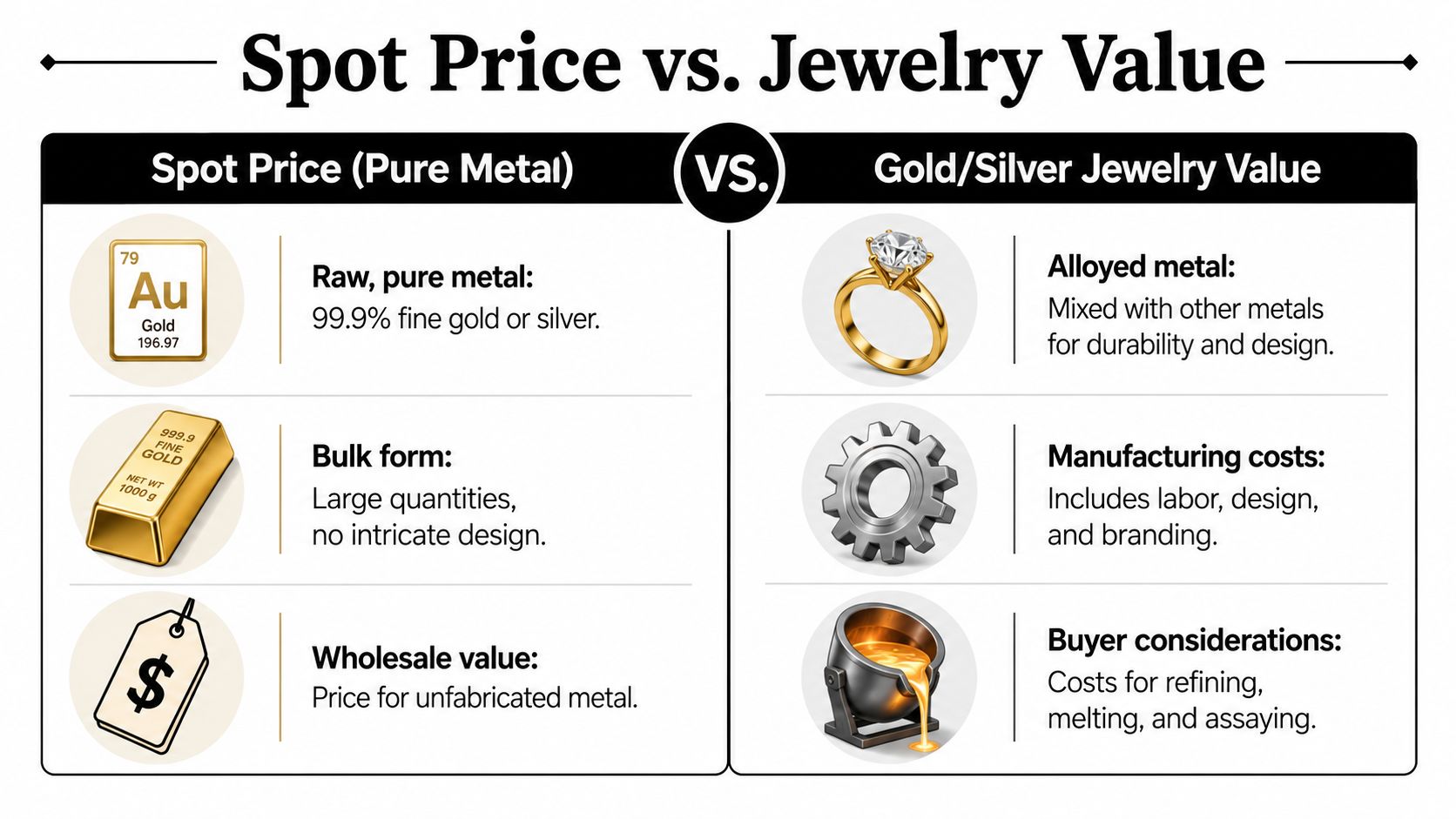
Because spot price applies to raw, pure metal, while most personal items are finished products made from alloys, components, and craftsmanship. A buyer doesn't purchase your average gold necklace the same way a commodities desk buys a large bullion bar.
Different item types are priced differently
A quick comparison makes this easier to see:
Item type | Main basis of value | Why seller payout differs from spot |
|---|---|---|
Bullion bars and rounds | Metal content | Usually closest to raw metal pricing |
Government-minted coins | Metal content plus market recognition | Can carry resale premium if in demand |
Jewelry | Melt value, workmanship, brand, stones, condition | Often requires testing and refining |
Scrap gold or broken silver | Recoverable precious metal only | Usually valued primarily for melt |
Bullion tends to be the cleanest transaction because it's close to the raw metal form. Jewelry is more complicated because the buyer may need to separate stones, test karat purity, and decide whether the piece has resale appeal as jewelry or only as scrap.
Melt value is not the same as retail value
The phrase melt value means the value of the recoverable precious metal in the item. If a piece is 14K, it is not pure gold. If it's sterling silver, it's not pure silver. The offer reflects the amount of precious metal present, plus the cost and risk of converting that item back into marketable metal or resalable inventory.
That doesn't mean jewelry has no added value. Some signed pieces from Cartier, Tiffany & Co., Van Cleef & Arpels, or other recognized houses can be evaluated beyond melt because brand, design, and buyer demand matter. But many everyday chains, rings, and bracelets are bought primarily for metal recovery.
A useful comparison for smaller budgets shows why item form matters. In May 2026, a $1,000 budget bought less than 0.25 oz of gold but 12 to 13 oz of silver in standard coins, according to this gold versus silver first-buyer framework. That same logic carries into resale. Small gold pieces can be more affected by fabrication premiums, while silver often gives sellers more visible weight for the money.
If you aren't sure what your jewelry is made of, this explanation of the difference between 14K and 18K gold helps clarify why two similar-looking pieces can produce very different offers.
A jewelry store receipt shows what someone paid for a finished product. A resale offer often reflects what a buyer can recover or realistically resell today.
How Can I Get the Best Value When Selling My Gold and Silver
Good selling results usually come from preparation, not luck. Sellers don't need a complex strategy. They need a clean way to present the item, understand what they own, and compare offers intelligently.

What to check before you walk in
Start with the basics:
Sort your items: Separate likely gold, likely silver, plated pieces, costume jewelry, and coins.
Look for marks: Common examples include 10K, 14K, 18K, 24K, and 925.
Gather paperwork: Original boxes, certificates, receipts, and grading documents can help buyer confidence.
Leave coins alone: Cleaning can hurt collectible appeal.
Know the likely category: Bullion, scrap, estate jewelry, and branded jewelry are not priced the same way.
If you're selling in Atlanta, Buckhead, Sandy Springs, Alpharetta, Roswell, Brookhaven, Midtown Atlanta, or nearby Georgia communities, an in-person review can be helpful because you can watch the weighing and testing process and ask questions in real time.
How to read a live price chart without overthinking it
A live chart can be useful, but only if you know what matters.
First, look at whether you're seeing gold or silver, and which timeframe is displayed. A one-day move can look dramatic without changing the broader trend. Second, remember that a chart usually reflects the market for raw metal, not a finished piece of jewelry. Third, understand that local transaction offers may lag or differ because physical buyers manage inventory and risk.
Here is the simplest way to use a chart before selling:
Check the current metal direction: Are prices broadly rising, falling, or choppy?
Identify your item type: Bar, coin, scrap, branded jewelry, or sterling object.
Ask how the offer is calculated: Weight, purity, collectible value, or brand resale.
Compare more than one quote: Not every buyer values the same category equally.
This guide on the best way to sell gold jewelry is worth reading before an appointment because it focuses on transparent evaluation rather than guesswork.
Bring your items organized, ask how purity is tested, and make sure the buyer explains whether the offer is based on melt value, resale value, or both.
Your Next Steps for Selling Precious Metals
Selling precious metals gets easier once you stop treating the online ticker as the final answer. The smarter approach is to treat the market price as a reference, then evaluate your actual item on its own facts.
A simple seller checklist
Use this checklist before you decide:
Identify what you have. Is it bullion, coinage, jewelry, sterling silverware, or mixed scrap?
Check for hallmarks. Purity marks give you a starting point, even if the buyer still needs to test.
Separate branded pieces from generic ones. A Cartier bracelet and a plain gold bangle shouldn't automatically be grouped together.
Set aside stones and documents. Diamond grading reports, boxes, receipts, and certificates can matter.
Ask for a clear explanation. You should understand how weight, purity, and resale potential affect the offer.
A local seller in Roswell or Buckhead may prefer a private appointment. Someone in a different part of Georgia may want to call first and ask what categories the buyer handles. Both are reasonable approaches if the goal is clarity.
When you're ready to compare options, this overview of where to sell gold and silver is a practical next step.
Frequently Asked Questions About Gold and Silver Prices
Should I wait for a price pullback before selling
Not always. Gold prices soared 75% over the past year, moved above $5,000 per ounce for the first time in January 2026, and then saw a 12% single-month decline in February, according to BlackRock's discussion of gold and silver price volatility. That kind of move shows why trying to perfectly time the market is difficult.
If you need liquidity now, your decision may be more about your item, your goals, and the quality of the offer than about catching the exact top.
Why does silver seem more volatile than gold
Silver is usually more sensitive to short-term shifts because it has both precious metal and industrial demand characteristics. It's also a smaller, less liquid market in many situations, which can make moves feel sharper.
That pattern still shows up in current market data. Silver was listed at 61.76 USD per troy ounce on July 6, 2026, down 1.02% from the prior day and down 9.36% over the past month, according to Trading Economics silver market data.
Can a coin be worth more than its metal content
Yes. Some coins trade mainly for metal content, while others can attract additional value because of recognizability, condition, mint origin, or collector demand.
That said, not every old coin is rare, and not every government coin carries a major premium. Sellers should ask whether the offer is being made as bullion, numismatic material, or scrap.
Does cleaning jewelry or coins help
Usually, no. Cleaning can remove surface evidence, alter finish, or lower collector interest, especially with coins. For jewelry, heavy polishing before evaluation can also make inspection harder if the buyer needs to assess condition, hallmarks, solder, or repairs.
Leave the item as it is unless a specialist specifically tells you otherwise.
Should I get an appraisal before I sell
Sometimes. An appraisal can be useful if the piece might have value beyond metal content, especially if it contains diamonds, colored stones, important branding, or estate significance.
But keep the purpose straight. An insurance appraisal and a resale offer are not the same thing. Insurance documents often reflect replacement cost, while a buyer's offer reflects current resale conditions, metal value, market demand, and the buyer's intended exit channel.
Why is the gold-to-silver ratio important
The gold-to-silver ratio compares the price of gold to the price of silver by dividing one by the other. It helps people see whether silver is relatively strong or weak compared with gold.
Published market history notes that the ratio was about 31:1 in April 2011, was officially set at 12:1 in the Roman Empire, and was roughly 15:1 under Roosevelt's 1934 policy setting gold at $35 per ounce. By 2026, the ratio remained 42% above its 2000 to 2015 average, according to this long-term gold-to-silver ratio chart and commentary. For a seller, that doesn't create a guaranteed strategy, but it does help explain why gold and silver often don't feel equally strong at the same moment.
What if I only have a small amount to sell
That's common. Sellers often bring in a few broken chains, a class ring, a small group of sterling items, or a handful of coins. The key is still the same: identify the category, verify purity, and ask how the offer is being calculated.
Small lots can still be worth evaluating, especially if they include branded pieces, solid precious metal, or collectible coins.
If you'd like a professional second look before making a decision, Antwerp Diamond offers confidential evaluations for gold, silver, jewelry, watches, handbags, and other high-value assets. You can request an evaluation, visit the Atlanta area location, or bring in your items for a clear, no-pressure review so you understand what you have and what today's market may support.