

A 24 carat gold ring is made of 99.9% pure gold, making it the purest form of gold jewelry available. Its softness makes it less practical for hard daily wear, but that same purity means its value stays closely tied to the live gold market.
If you're holding a ring that feels richer in color than typical yellow gold, dents a little easier than expected, or was bought as a gift, heirloom, or savings piece, you're probably asking two things at once: what exactly is this, and what is it worth today? That's the right place to start, because a 24 carat gold ring sits at the intersection of jewelry, bullion, and personal property in a way lower-karat rings do not.
For owners in Atlanta, Buckhead, Sandy Springs, Alpharetta, Roswell, Brookhaven, Midtown Atlanta, and across Georgia, this matters whether you plan to keep the ring, insure it, appraise it, sell it, or borrow against it. Pure gold rewards careful handling and informed decisions.
Table of Contents
What Exactly Is a 24 Carat Gold Ring?
You open a family box, slip on a ring that looks unmistakably rich yellow, and within a short time you notice a small mark along the edge. That usually surprises owners the first time they handle pure gold. The same quality that gives a 24 carat gold ring its appeal also shapes how it wears, how it should be stored, and how it should be sold.
A 24 carat gold ring is made from nearly pure gold, commonly described in the trade as 999.9 fine gold. In plain terms, very little or no alloy has been added to harden the metal or change its color.
Purity is the whole point
The appeal starts with appearance. Pure gold has a saturated yellow tone that alloyed rings rarely match, and experienced buyers can often spot that color before they check a hallmark.
Purity also affects ownership in practical ways. A 24 carat gold ring is softer and more malleable than lower-karat jewelry, so surface marks, rounded edges, and slight shape changes are normal over time. That does not make it poor-quality jewelry. It means the ring was made with a different priority: maximum gold content. For readers comparing categories of precious-metal jewelry, this guide on what fine jewelry means gives useful context.

In appraisal work, that distinction matters. Owners often assume a ring with more gold should outperform lower-karat rings in daily wear. It usually does the opposite. Pure gold holds value well because of its metal content, but it asks more from the owner in exchange: careful wear, realistic expectations, and proper evaluation when it is time to sell.
Why some buyers see it as jewelry and savings
A 24 carat ring often sits in two categories at once. It can be personal jewelry, and it can function as a compact store of value. That is one reason pure gold rings are often bought for weddings, gifts, inheritance, and long-term holding rather than hard daily use.
This is also where myths cause problems. A 24k ring is not automatically worth more than any 18k designer ring, because workmanship, brand, and resale channel all affect price. It is also not “too soft to own.” It needs to be treated more like high-purity metal than utility jewelry.
Some buyers are drawn to high-purity gold in forms beyond wearable pieces. Collectors who appreciate unusual specimens may also look at collectible gold for enthusiasts, where the fascination is the material itself as much as the object.
Comparing Gold Karats: 24k vs 18k, 14k, and 10k
A karat comparison matters because many owners assume higher karat always means better ring performance. It doesn't. Higher karat means more gold content. Lower karat usually means better resistance to the wear patterns that rings face every day.
Gold Karat Comparison Chart
Karat | Pure Gold % | Durability | Color | Common Use |
|---|---|---|---|---|
24K | 99.9% | Very soft | Deep rich yellow | Savings jewelry, ceremonial pieces, investment-oriented wear |
18K | 75% | Better suited to regular wear | Warm yellow | Fine jewelry, luxury rings, higher-end everyday pieces |
14K | Qualitatively lower than 18K | Strong everyday choice | Lighter yellow | Daily wear rings and practical fine jewelry |
10K | Qualitatively lower than 14K | More resistant to wear | Paler gold tone | Budget-conscious jewelry and harder-wearing pieces |
The key takeaway is simple. A 24 carat gold ring gives you the purest metal content. An 18K or 14K ring usually gives you a more practical ring for active use.
For readers comparing common U.S. jewelry standards, Antwerp Diamond's overview of the difference between 14K and 18K gold helps frame where pure gold sits on the spectrum.
Why Western ring buyers usually choose lower karats
In the U.S. and much of Europe, ring buyers often prefer 14K or 18K because rings hit hard surfaces constantly. Desks, gym equipment, steering wheels, tools, shopping carts, and even another ring on the same hand can leave marks.
Whiteflash's gold comparison states that 24K gold is extremely soft and prone to bending, denting, or scratching during everyday activities such as typing or shaking hands, which is why it's less practical for durable everyday rings.
That doesn't make 24K a mistake. It makes it specialized.
If you're evaluating chain purchases rather than rings, this explainer on choosing 18K gold for chains is helpful because chains and rings wear differently, and alloy choices often follow use case more than status.
24K is usually the right answer for purity. It's often the wrong answer for someone who wants a ring they never have to think about.
Testing, Hallmarks, and Valuing Your 24k Gold Ring
Owners usually come to this stage with one practical question. Is the ring pure gold, and what would a serious buyer pay for it today?
A professional evaluation answers that in a set order. First confirm purity. Then confirm exact weight. Then decide whether the piece should be valued strictly for gold content or also as finished jewelry.
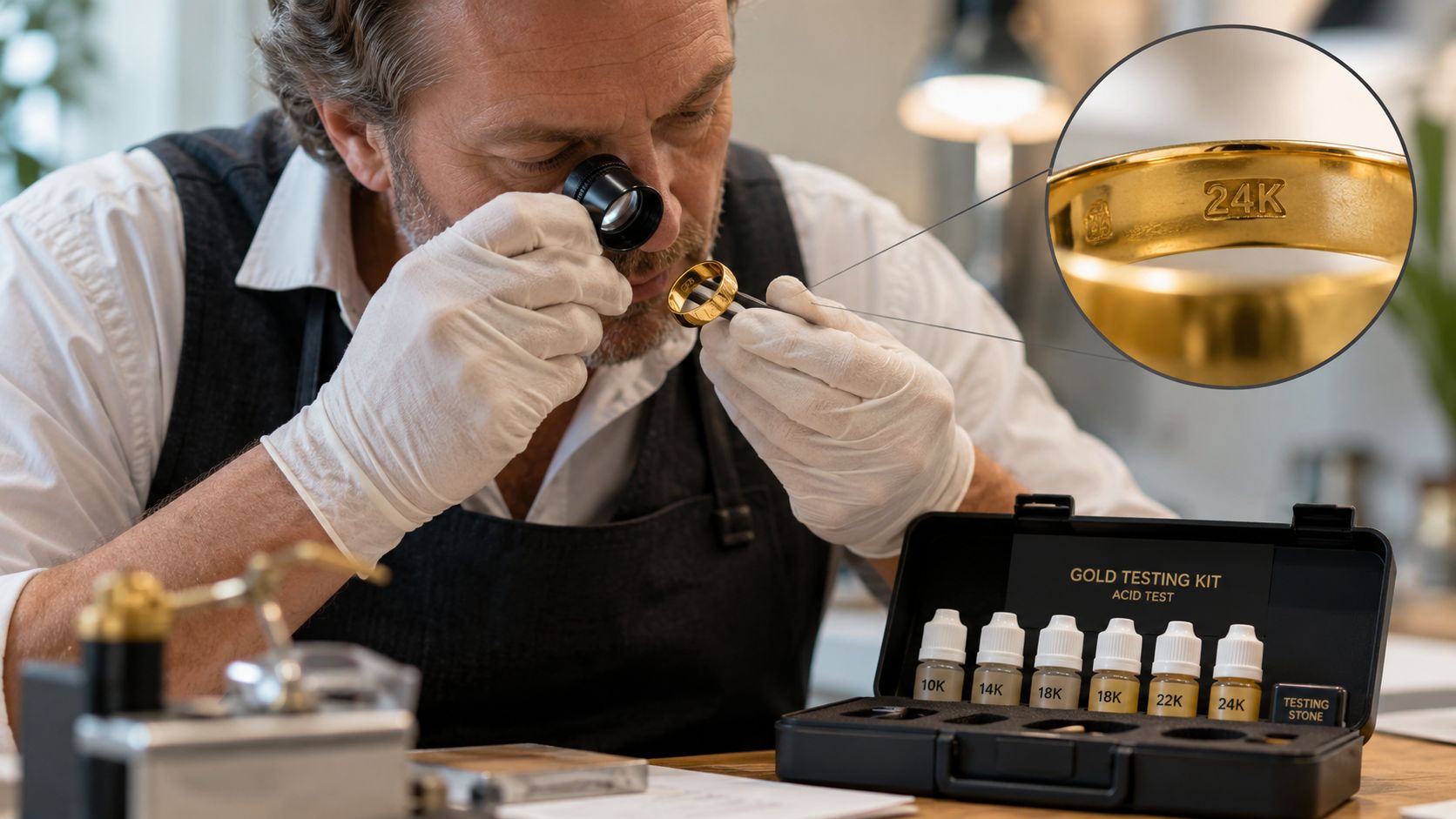
What professionals look for first
The first checkpoint is the hallmark. On a pure gold ring, common marks include 24K, 999, or 999.9. Those marks are useful, but they do not prove everything on their own. Stamps wear down. Counterfeit marks exist. Imported pieces may also use different fineness conventions.
That is why a competent buyer or appraiser tests the metal instead of relying on the stamp alone. Depending on the piece, that may include acid testing, electronic testing, XRF analysis, or a combination. XRF is especially useful for high-purity jewelry because it helps confirm metal content without cutting into the ring.
Weight also needs careful handling. A plain ring may look substantial and still deliver less fine gold than an owner expects if it has been resized, repaired, or worn down over time. The market pays on actual recoverable gold, not on memory, original receipt price, or what the ring looked like when it was new.
If you want a clear overview of the review process, Antwerp Diamond explains how a professional jewelry appraisal works in practical terms.
How melt value is calculated
For many plain 24k rings, valuation starts with melt value. The formula is simple. Take the ring's weight in grams, adjust for confirmed purity if needed, and multiply by the current gold price per gram.
In practice, the offer can differ from a headline gold price. Buyers have refining costs, hedging risk, and resale margins to account for. That does not mean every lower offer is unfair. It does mean owners should ask a direct question: what purity did you verify, what weight did you use, and what percentage of spot are you paying on that basis?
Some rings deserve more than melt. Handmade work, a known maker, collectible regional styles, or a strong secondary market can justify a premium above raw gold content. Many plain 24k bands do not trade that way, which is one of the most common myths owners bring into an appraisal.
This short video gives useful context on how jewelry testing and review fit into a professional process:
Hallmarks start the conversation. Verified purity and exact weight determine the final number.
The Risks and How to Care for Pure Gold Jewelry
Owners usually worry about one thing first. Will a 24 carat gold ring get ruined if I wear it?
The honest answer is that it can change shape, scratch, and show wear faster than alloyed rings. But the usual phrase, “too soft,” often oversimplifies what's happening.
Soft does not mean fragile in the same way
The common myth is that a pure gold ring is automatically a bad ring. A more accurate view is that it behaves differently under stress. Mene's discussion of pure gold ductility argues that 24K gold flexes and absorbs pressure without cracking, unlike more rigid alloys, so it bends rather than breaks.
That distinction matters in appraisal and ownership. A bend can often be seen and addressed. A crack is a different problem.
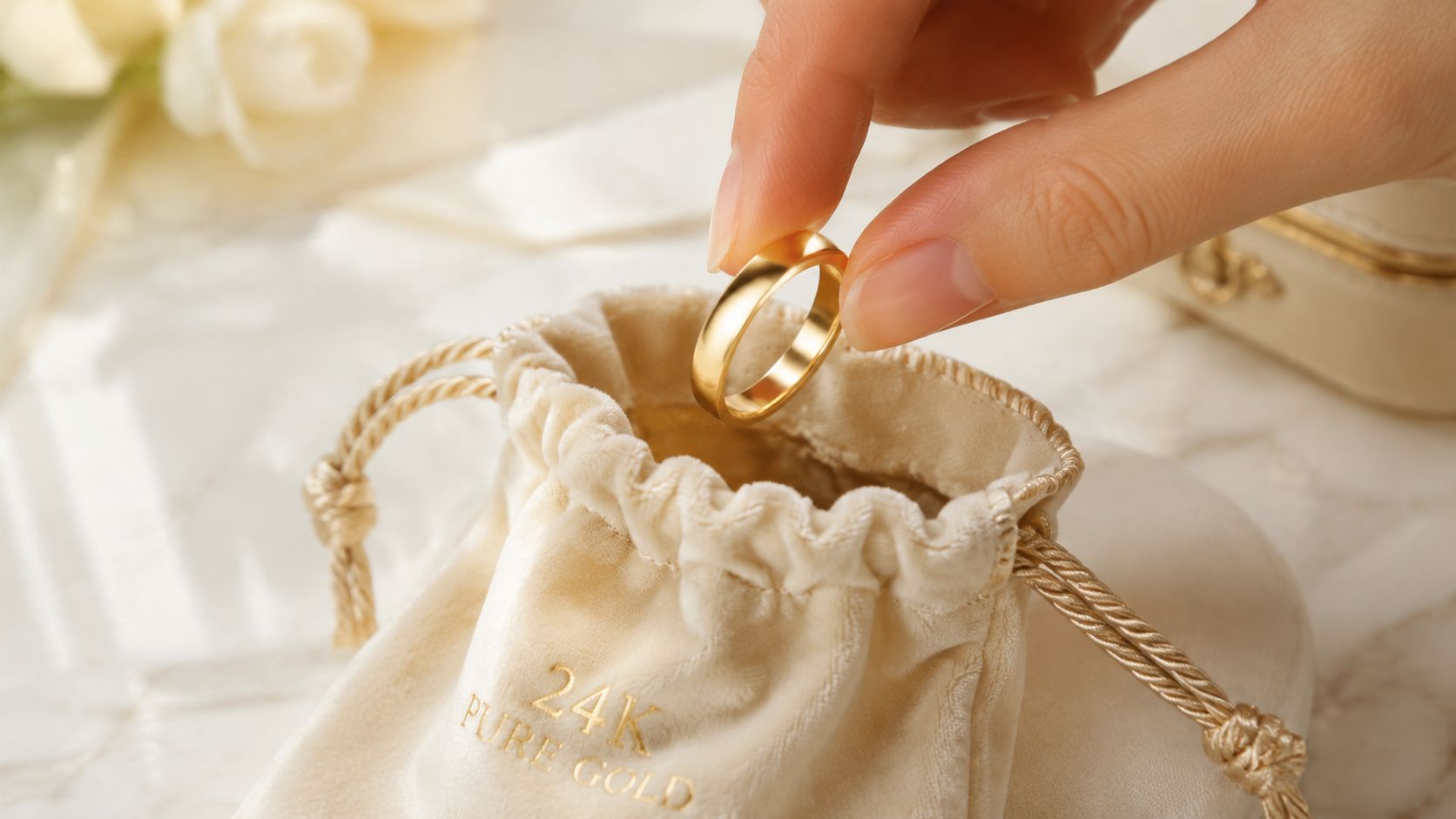
Pure gold is also generally a strong option for people who prefer minimal alloy exposure, and because it isn't alloy-heavy, it doesn't behave like lower-karat jewelry that can discolor from the non-gold metals mixed into it.
A practical care routine
If you own one, treat it more like a high-purity asset you can wear than a ring you never remove. That mindset prevents most avoidable damage.
Take it off for impact work: Remove it before weightlifting, yard work, moving furniture, or using hand tools.
Keep it away from abrasion: Typing, gripping gym bars, and carrying heavy bags can mark a soft band over time.
Clean it gently: Use mild soap, lukewarm water, and a soft cloth. Skip harsh chemicals and abrasive pastes.
Store it separately: A soft pouch or dedicated box compartment helps prevent scratches from diamonds, watches, or other jewelry.
Check shape and fit: If the ring starts looking oval instead of round, have a professional inspect it before the distortion gets worse.
For readers who also buy and wear other gold items, Antwerp Diamond's article on buying gold chains is useful because it highlights how wear patterns differ by jewelry type.
A 24K ring rewards careful use. It doesn't reward indifference.
How to Sell or Appraise Your 24k Gold Ring
If you plan to sell, the strongest position is a calm, documented, in-person process. A 24 carat gold ring is easy to undervalue if the buyer doesn't test properly, doesn't explain the weight calculation, or treats it like ordinary scrap without confirming purity.
A safe selling process
Start with the basics. Gather any receipt, prior appraisal, original packaging, or documentation that helps establish what the ring is and where it came from. Those items may not change melt value directly, but they can speed up review and reduce uncertainty.
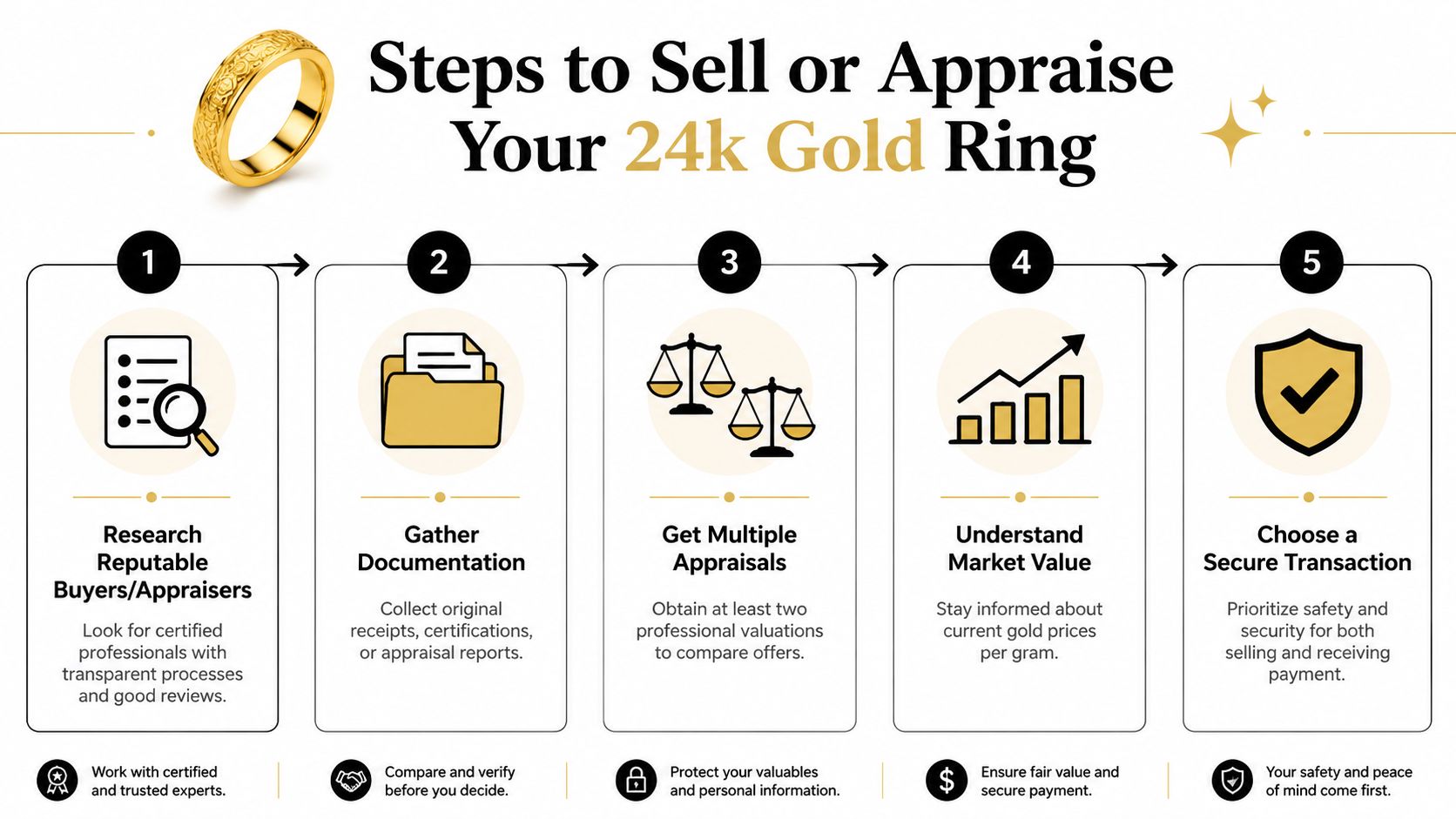
Then use a process like this:
Choose a real physical buyer or appraiser
Look for a business that evaluates precious metals in person, explains testing, and weighs the item in front of you when possible.Ask how purity is verified
For a high-value pure gold piece, testing methods matter. You want more than a quick glance at a stamp.Understand the market basis
Estate Diamond Jewelry's 24K guide notes that as of mid-June 2024, 24-karat gold was approximately $75 per gram, and that 24K jewelry is highly liquid and can often be converted to cash at prices closely aligned with the global spot rate. That gives owners a useful benchmark for evaluating whether an offer is grounded in current market conditions.Separate appraisal from offer
An appraisal explains what the item is and how value is considered. A purchase offer reflects what a buyer is willing to pay in that moment.Prioritize privacy and security
High-purity gold is compact, valuable, and easy to carry. Private appointments and direct payment methods are worth considering.
For owners comparing jewelry and watch paperwork standards, this resource on understand your luxury watch appraisal needs offers a useful lens on documentation and valuation expectations.
What a fair evaluation should include
A good appraisal or purchase review should be clear enough that you can follow each step without industry jargon. If a buyer can't explain the process in plain English, pause.
Look for these trust signals:
Visible weighing: You should know the measured weight being used.
Purity confirmation: Hallmark plus testing is stronger than hallmark alone.
Condition review: Bent, resized, or heavily worn pieces may be handled differently from crisp, well-kept rings.
Current market context: Offers should reflect live gold conditions, not stale assumptions.
No-pressure presentation: A credible buyer doesn't need urgency tactics.
In the Atlanta area, many owners prefer a face-to-face evaluation rather than mailing in a pure gold ring first. That's especially true in Buckhead, Sandy Springs, Roswell, Alpharetta, Brookhaven, Midtown Atlanta, and nearby Georgia communities where clients want discretion and an immediate understanding of value.
If you're preparing to liquidate, Antwerp Diamond's overview of the best place to sell gold is a practical starting point for comparing what a transparent process should look like.
Frequently Asked Questions About 24k Gold Rings
Is a 24K gold ring hypoallergenic
It often works well for people who want minimal alloy exposure because it is near-pure gold. Sensitivity concerns are usually more common with alloyed metals, not high-purity gold.
Can a 24K gold ring be resized
Sometimes, yes, but it requires care. Pure gold behaves differently from alloyed gold, so resizing should be handled by a jeweler familiar with soft, high-purity metal.
Does a 24K gold ring tarnish
Pure gold is chemically stable and doesn't tarnish the way alloy-heavy jewelry can. What owners usually notice instead is surface scratching, smoothing, or shape change from wear.
Why does one 24K ring look different from another
Finish changes appearance. A matte ring, highly polished ring, hand-finished ring, or ring made in a different market can reflect light differently even when purity is similar.
Is a 24K gold ring a good choice for daily wear
It depends on your habits. If you work with your hands, exercise with jewelry on, or want a ring that stays crisp with little thought, lower karats are usually easier. If you value purity and wear it carefully, a 24 carat gold ring can still make sense.
Should I sell it as jewelry or for gold value
That depends on design, workmanship, brand, and buyer demand. Plain pure gold rings are often valued primarily for gold content, while distinctive pieces may deserve a broader review before you accept a melt-based offer.
If you want a professional, low-pressure evaluation of a 24 carat gold ring, Antwerp Diamond offers private reviews for owners who want clarity before they sell, appraise, or borrow against a valuable item. Whether you're in Atlanta, Buckhead, Roswell, Sandy Springs, Alpharetta, Brookhaven, Midtown Atlanta, or elsewhere in Georgia, bringing the ring in for an in-person assessment can help you understand purity, weight, market value, and your options without guesswork.