

A 100-carat diamond can be worth anywhere from a few million dollars to over $30 million, and the final number depends on quality, not size alone. In the auction market, exceptional 100-carat diamonds have sold from $12 million to over $30 million, with a flawless 100-carat stone selling for $22 million and lower quality or colored examples trading well below that top tier.
That's the first point most owners miss. At this size, you're no longer dealing with a simple price-per-carat exercise. You're dealing with a separate class of asset, a tiny market with elite buyers, intense scrutiny, and a sharp premium for stones that enter the rarest quality bracket.
Table of Contents
How Much Is a 100-Carat Diamond's Price
A 100-carat diamond can sit in an eight-figure range, but there is no standard market price the way owners expect with smaller stones. At this level, pricing separates into tiers. Fine stones are rare. True headline stones belong to a much smaller club, and that club pricing rises fast.
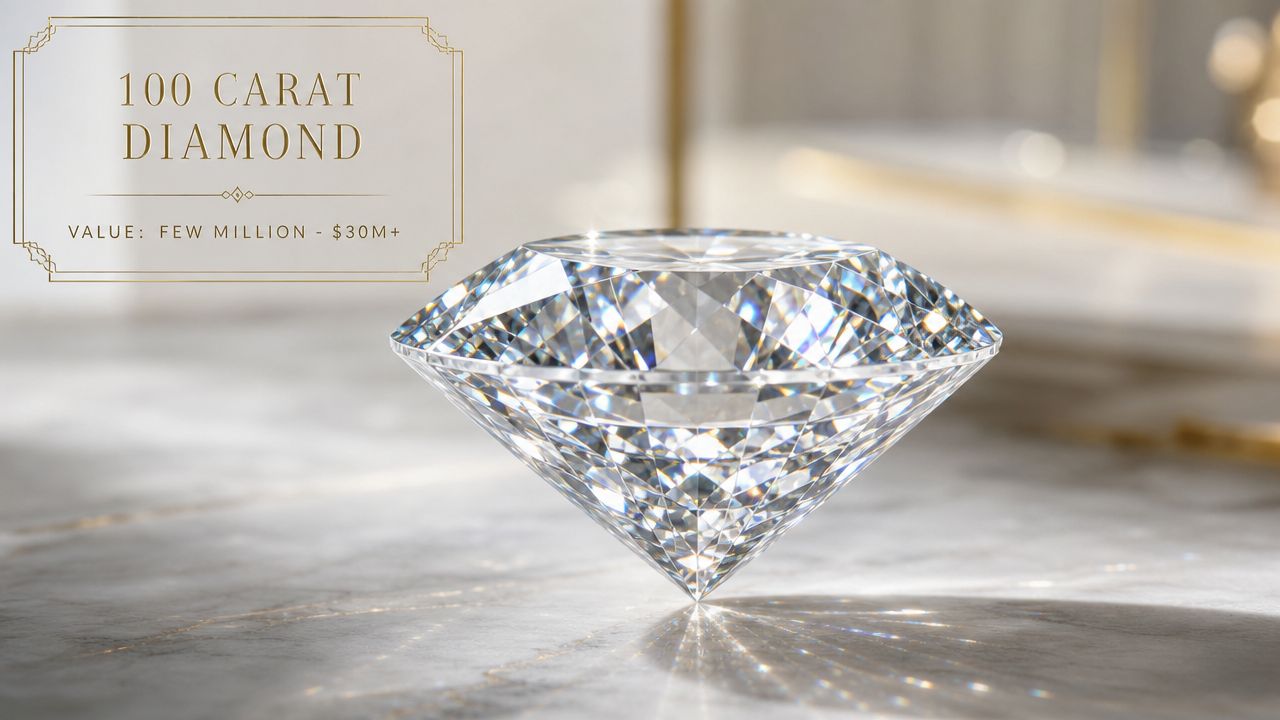
That distinction matters more than the round number itself. Once a diamond reaches 100 carats, buyers stop treating it as a larger version of a 5-carat or 10-carat stone. They assess whether it qualifies as a trophy asset with international auction appeal, private-collector demand, or museum-level visibility. If it does, the price curve steepens sharply. If it does not, the stone can still be extremely valuable, but it trades in a different bracket.
In practice, two 100-carat diamonds can be separated by millions because one clears the psychological and commercial thresholds that define this top tier. A stone with exceptional face-up presence, strong grading, and a story buyers can repeat in a catalog or private sale attracts a narrower but far more aggressive audience. A stone with weaker color, visible inclusions, or a make that wastes its size advantage enters a thinner pool of buyers who negotiate harder.
Why 100 carats changes the pricing logic
At 100 carats, value no longer moves in a smooth per-carat line. It jumps.
The trade prices these stones by rarity bands, buyer confidence, and sale venue. Private dealers, major auction houses, ultra-high-net-worth collectors, and luxury maisons do not all pay for the same reasons. One buyer wants a wearable masterpiece. Another wants a once-in-a-generation asset with naming rights, press value, and provenance potential. That is why broad online calculators and retail comparison tools break down here.
I tell owners to start with market position, not just carat weight. Is the stone a top-tier white diamond with real auction potential? Is it a lower-color or lower-clarity 100-carat stone that remains important but appeals to a more specialized trade audience? Those are different valuation cases.
Replacement paperwork also causes problems at this level because it often reflects insurance logic rather than what an informed buyer would pay. For a useful baseline on how valuation methodology changes between retail, resale, and replacement contexts, see this guide on how much to value a diamond ring.
How the 4Cs Determine a 100-Carat Diamond's Price
The 4Cs still control value, but at 100 carats they do so with much more force. A minor issue that might be tolerated in a smaller stone becomes a major pricing event in a diamond this visible, this rare, and this expensive.
Start with the visual reality. On a stone this large, buyers can study broad facets, body color, transparency, and internal characteristics with far less effort. There's nowhere to hide. What might look insignificant on paper can change market appeal dramatically once the diamond is in hand.
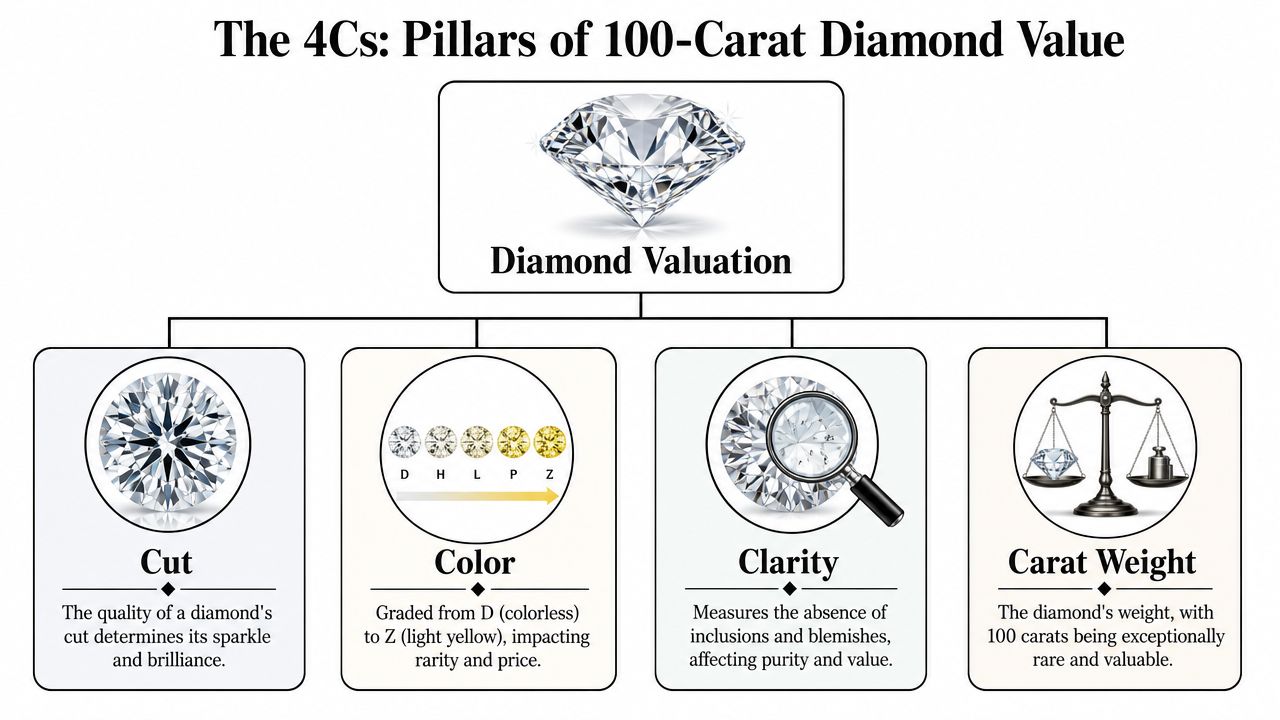
How each C affects price at this scale
Cut matters because the stone has to justify its size with life, balance, and finish. A 100-carat diamond that looks sleepy, windowed, or poorly proportioned won't command elite money. Info Diamond states that a diamond lacking optimal polish and symmetry can see its value fall by 5 to 10% because re-polishing can reduce total carat weight, which directly affects value (Info Diamond on price factors).
That detail matters more at 100 carats than many owners expect. Recutting isn't cosmetic housekeeping. It can destroy one of the key pricing advantages, the headline weight itself.
Here's a useful visual primer on what professional grading looks at in real stones:
Color often creates the biggest emotional divide between top-tier and second-tier 100-carat diamonds. In this size category, a colorless appearance carries a prestige premium that's difficult to overstate. A visible tint across a large face-up surface changes the entire impression of the gem.
Clarity becomes unforgiving because inclusions scale visually with the stone. Even when the inclusion plot looks manageable on paper, a buyer may react differently when broad, open facets make internal features easier to notice.
Carat weight still matters, but not as commonly believed. Once you're already at 100 carats, the issue isn't just weight. It's whether the stone combines that weight with the grades discerning buyers expect.
Why the 4Cs create an exponential jump
The value jump is exponential because the market pays heavily for combinations that are both huge and difficult to replace. Many large diamonds exist. Far fewer are large and colorless. Fewer still are large, colorless, highly clear, and finished to a level that top auction buyers will fight over.
A concise explanation:
Cut quality: Weak make lowers confidence and can force value-reducing rework.
Color purity: Warmth that seems minor in a smaller stone becomes obvious here.
Clarity profile: A buyer isn't paying only for the grade, but for how clean the stone presents.
Weight threshold: At 100 carats, the market starts treating the stone as part gem, part collectible.
A single grading compromise can move a 100-carat diamond out of the elite auction conversation and into a much broader, lower-paying market.
For owners comparing documents, the most useful exercise isn't chasing a simplistic headline figure. It's reading the report as a chain reaction. One downgrade often changes how the next category is perceived. If you're evaluating mounted jewelry rather than a loose stone, this guide on how much to value a diamond ring helps frame that analysis.
What Factors Increase a Diamond's Value Beyond the 4Cs?
At this level, the 4Cs are the foundation, not the whole answer. The final number also depends on confidence, narrative, and whether the diamond feels replaceable or one-of-one to the people capable of buying it.
Documentation and grading confidence
A world-class stone needs world-class paperwork. Buyers want consistency between the diamond in front of them and the grading report that describes it. If the report is old, unclear, or from a lab the market doesn't fully trust, confidence drops.
That confidence issue is especially important because the data set is so thin. Only five perfect diamonds over 100 carats have sold at auction in the past 25 years, which is one reason accurate forecasting is difficult (Opulent Jewelers on rare 100-carat auction stones).
In practice, that means buyers don't lean on a broad commodity history. They lean on paper, inspection, and precedent.
Provenance and buyer psychology
A 100-carat diamond can develop a premium from provenance, but only if the story is credible and documented. A notable prior owner, a well-known jewelry house, or a stone with recognized auction history can change how buyers frame the piece. They're no longer bidding only on mineral quality. They're bidding on status and narrative.
What I call club pricing appears. A stone doesn't merely meet grading thresholds. It qualifies for a smaller room with richer bidders and tighter supply.
That shift changes the questions buyers ask:
Who handled it before? An established house or important collection can increase confidence.
How is it presented? A loose stone, ring, or named jewel can attract different buyer profiles.
Is the story documentable? Unsupported lore doesn't add value. It often creates skepticism.
Does the stone feel singular? Unusual presence, proportions, or historical context can affect demand.
Buyers at this level aren't just buying a diamond. They're buying permission to compare it with the rarest stones they've ever seen.
The opposite is also true. Weak documentation, uncertain treatment history, or a vague ownership story can cap value even when the stone itself is impressive. If you're reviewing whether a stone is represented accurately, this explanation of what genuine diamond means is a useful baseline before getting into ultra-high-value grading questions.
Price Examples of Famous 100-Carat Diamonds
Public auction results make one point clear fast. A 100-carat diamond does not enter the market as a bigger version of a 10-carat stone. It enters a different pricing club, where a small change in color, clarity, cut precision, or sale context can move value by many millions.
What public sales actually show
One useful benchmark is the 100-carat flawless diamond sold in New York in 2013 for $22 million, or roughly $220,000 per carat, as reported by Diamond Guild on the $22 million sale. For owners, that result matters because it shows what can happen when rarity, presentation, and buyer confidence line up at the highest level.
The gap below that benchmark is just as instructive.
Christie's Geneva sold the 100-carat Spectacle diamond for $14.1 million in 2023. That is still a major result by any ordinary standard. In the 100-carat category, though, it shows how quickly pricing separates into tiers. Once a stone falls short of the top white, top clarity, top make category, buyers do not trim value gently. They re-rank the stone into a different competitive set.
Color examples make the same point from another angle. A vivid yellow diamond weighing just over 100 carats can attract serious bidding, yet it may still trade in a lower band than a top colorless stone of similar size. Fancy color can create rarity, but not all rarity is priced the same. In practice, elite white diamonds and elite fancy colors often appeal to overlapping but not identical buyer pools, and that affects bidding depth.
Recent 100+ Carat Diamond Auction Results
Diamond Name / Type | Carat Weight | Key Feature | Sale Price (USD) |
|---|---|---|---|
Flawless De Beers stone | 100 carats | Flawless, colorless benchmark example | $22 million |
Spectacle diamond | 100 carats | Sold within estimate, below the top flawless tier | $14.1 million |
Vivid yellow diamond | 100.09 carats | Fancy color example, distinct buyer pool from top white stones | High-value auction example, below top colorless benchmark |
Large diamond ring | 103.46 carats | Ring presentation can widen interest, but does not erase grading trade-offs | High-value auction example with broad estimate range |
For an owner, the practical lesson is simple. Comparable sales help, but only when the comparison is strict. At this size, a stone is not “like” another one just because both weigh about 100 carats.
Use public results to bracket expectations, not to copy a headline price. A D Flawless stone with elite make and clean provenance belongs in one conversation. A 100-carat stone with warmth in color, lower clarity, a weaker cut, or less persuasive sale presentation belongs in another. That is why owners who are evaluating sale options often start by understanding where to sell loose diamonds before treating an auction record as a direct comp.
What separates the strongest results is not size alone. It is membership in a very small club of stones that check almost every box at once, then reach buyers willing to compete for that level of rarity.
Common Mistakes to Avoid When Selling a Large Diamond
Owners lose the most money when they treat a major stone like ordinary jewelry. A 100-carat diamond needs specialist handling, current market context, and a buyer or evaluator who understands what serious buyers screen for.
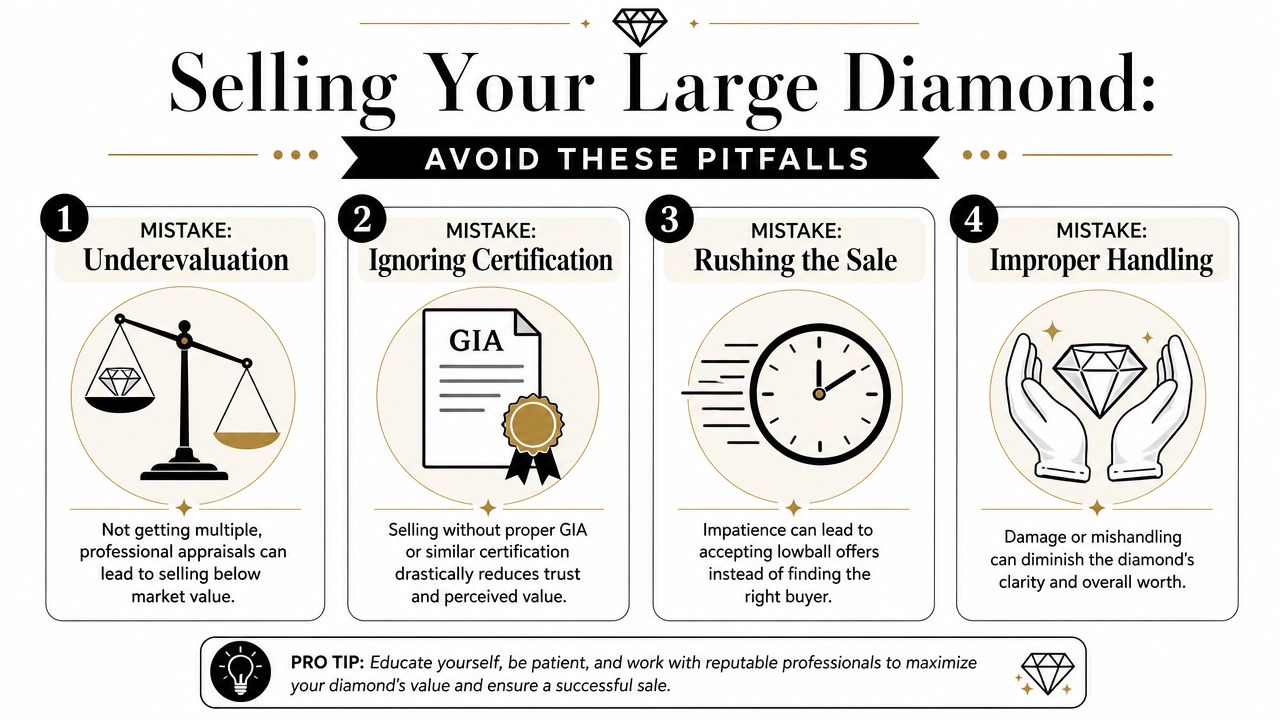
Where sellers lose leverage
The first mistake is relying on an old insurance appraisal. Insurance paperwork is usually built around replacement logic, not current resale reality. That doesn't make it useless, but it does make it a poor proxy for what a discerning buyer would offer today.
The second mistake is skipping fresh documentation. If the stone doesn't have current grading from a respected lab, buyers often price in uncertainty. In this category, uncertainty is expensive.
The third mistake is shopping the stone to generalists. A buyer who's comfortable with ordinary bridal goods may not be equipped for a trophy-size diamond. That affects both confidence and liquidity.
A large diamond doesn't sell well in a casual market. It sells best when the buyer can verify it, finance it, and place it with the right next owner.
A practical seller checklist
If you're in Atlanta, Buckhead, Sandy Springs, Alpharetta, Roswell, Brookhaven, Midtown Atlanta, or elsewhere in Georgia, a private in-person review often makes more sense than trying to reduce the stone to photos and old paperwork.
Use this checklist before taking any offer:
Bring all documents: Lab reports, purchase records, prior appraisals, and repair history all help frame the asset.
Disclose setting details: If the diamond is mounted, the mounting condition and design can affect handling and sale strategy.
Avoid quick cleaning or repair decisions: Unnecessary work can create risk, especially on a major stone.
Ask how the evaluation works: You want to know what's being checked, not just hear a headline number.
If the stone is loose, this guide on where to sell loose diamonds gives a practical overview of what to compare before choosing a path.
Get an Accurate Diamond Valuation The Next Steps
A serious valuation starts with preparation, not guesswork. The goal is to identify what the stone is, how it presents, and where it fits in the current resale or acquisition market.
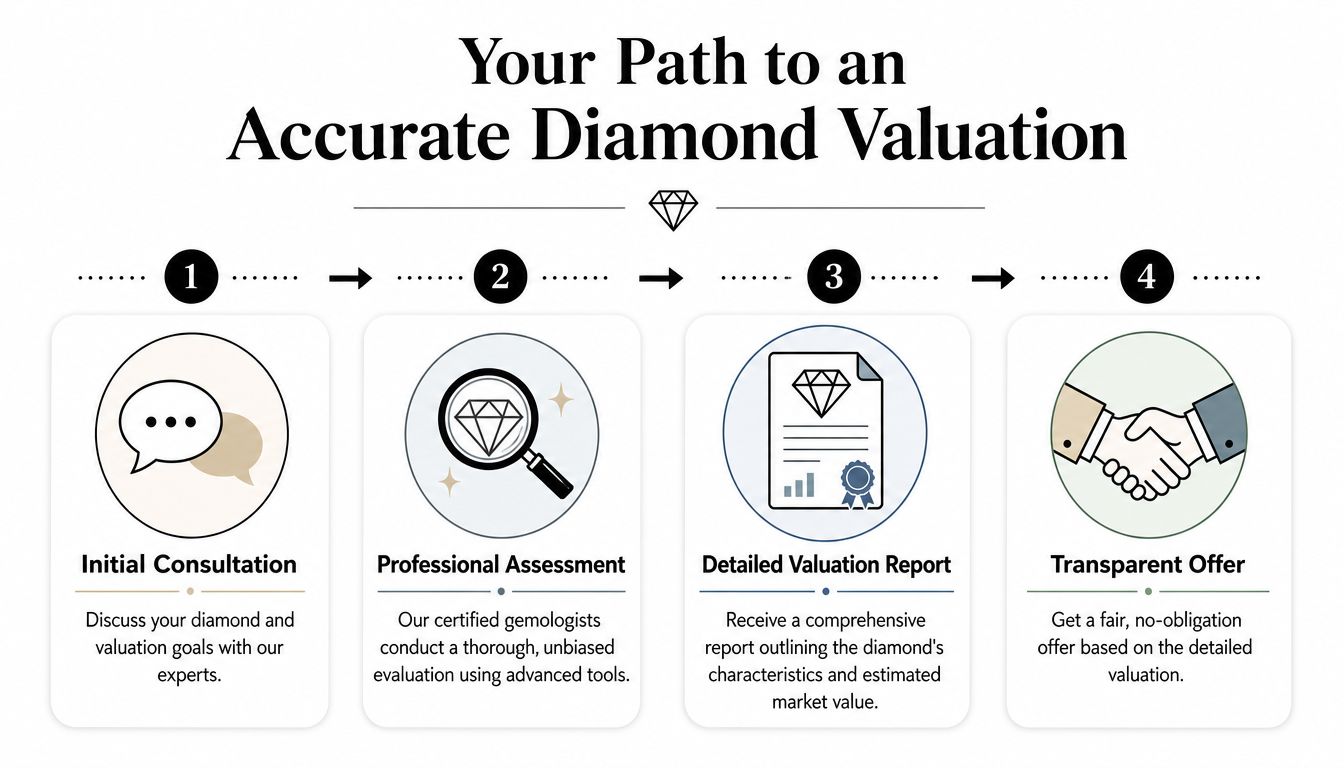
What to prepare before an evaluation
Gather the basics first. That usually means the grading report, any prior appraisal paperwork, purchase documentation, and photographs if the stone is currently in a bank box or secure storage.
If the diamond is mounted, note whether the mounting is original, branded, or custom. If it has previous auction exposure or notable provenance, organize that record clearly.
What a serious review should include
A proper review should cover more than the headline 4Cs. It should also consider finish, presentation, marketability, and whether the diamond belongs in a private dealer channel, a collector conversation, or a public auction path.
A practical evaluation process usually looks like this:
Initial review: Basic facts, documents, and your purpose, sale, loan inquiry, estate review, or appraisal context.
In-person assessment: Visual inspection, verification of grading details, and analysis of how the stone compares with relevant market examples.
Value discussion: A realistic explanation of likely market position, not just a flattering number.
Decision stage: You decide whether to hold, sell, consign, or seek a second opinion.
For owners trying to estimate resale logic before an appointment, this overview of a diamond resale value calculator helps explain why broad calculators can only give a starting point, not a final answer.
Frequently Asked Questions About Valuing Large Diamonds
Is an insurance appraisal the same as resale value
No. Insurance appraisals are usually designed around replacement assumptions. A resale offer reflects what a current buyer believes the stone can command in the present market.
Does shape matter for a 100-carat diamond
Yes. Shape affects visual spread, brilliance style, rough yield, and buyer preference. At this level, shape also influences whether the stone feels commercial, elegant, or museum-grade.
Are natural and lab-grown 100-carat diamonds valued the same way
No. They aren't treated as interchangeable in the market. For a major stone, origin changes buyer interest, comparables, and resale behavior.
Can provenance really increase value
Yes, but only when it's credible and supported. A documented history tied to an important owner, house, or sale can improve desirability. An unverified story usually doesn't.
Is there a standard price per carat for every 100-carat diamond
No. Public results show a broad spread because quality and rarity drive pricing. At this size, the market doesn't reward weight alone.
Should I sell locally or pursue a wider market
That depends on the stone and your priorities. Local in-person evaluation can be efficient and discreet, especially for owners in Atlanta and the greater Georgia market, but some stones may warrant broader exposure after expert review.
If you own a large diamond and want a professional, discreet opinion, Antwerp Diamond is a practical next step. You can request an evaluation online or arrange a private appointment in Atlanta, including Buckhead and nearby areas, to review the stone, its documentation, and its likely market position without pressure.