

An iced out Cuban chain is a style of jewelry with thick, interlocking oval links, usually made in solid gold, with the visible surface covered in small diamonds. In the established market, these pieces typically sell for 50% to 100% or more above intrinsic gold value because buyers are paying for gemstones and labor, and fully diamond Cuban links often start around $25,000 and can reach the hundreds of thousands depending on carat weight, diamond quality, and design intricacy.
If you're looking at one right now, the question usually isn't just whether it looks impressive. It's whether it's real, what its value is, how fast it will wear, and what you could realistically get if you sell it in Atlanta, Buckhead, Sandy Springs, Alpharetta, Roswell, Brookhaven, Midtown Atlanta, or elsewhere in Georgia.
That distinction matters. Retail asking price, insurance value, pawn value, and resale value are not the same thing. A well-made iced out Cuban chain can hold strong value because of its gold content, diamond quality, and craftsmanship. A poorly made version with plated metal and simulated stones can lose its appeal quickly and be difficult to resell.
Table of Contents
What Exactly Is an Iced Out Cuban Chain
An iced out Cuban chain combines two defining features. First, it uses the Cuban link pattern, which is known for thick, interlocking, oval-shaped links that sit flat and create a heavy rope-like appearance. Second, it uses a continuous diamond surface, usually done with pavé or micro-pavé setting so the chain looks fully covered in stones.
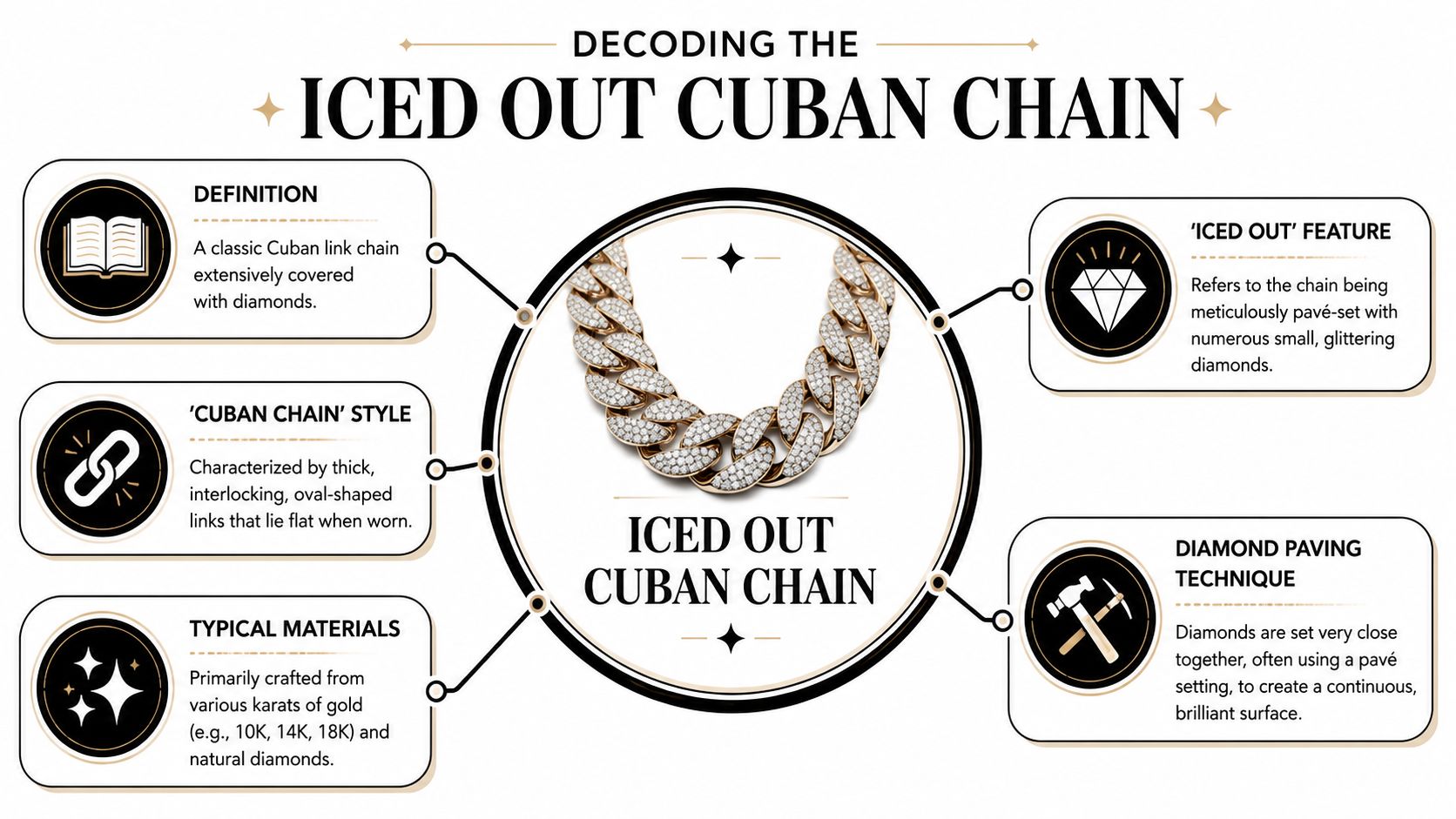
Core construction details
From a trade perspective, construction tells you more than the shine does. A documented technical benchmark for this category describes an iced out Cuban chain as being made in 10K or 14K solid gold with a continuous pavé setting of real diamonds, with total diamond weight typically ranging from 5.76 to 34.68 carats depending on width and length. The same market reference notes widths from 7mm to 18mm, lengths from 18 to 24 inches, and gold mass examples from 26.1g for 7mm up to 507.60g for 16mm, which is why wider and heavier pieces usually command stronger market value and durability expectations (technical iced chain specifications).
When I evaluate one, I look at the build in this order:
Link geometry: The links should articulate smoothly and lie flat without awkward gaps.
Metal integrity: Solid gold behaves differently from hollow construction or plated base metal.
Stone coverage: A true iced look depends on consistent coverage, not scattered stones on the top surface only.
Setting quality: Good pavé work holds stones evenly and keeps the surface clean, tight, and bright.
If you're comparing styles, this guide to buying gold chains helps frame how link type, metal purity, and construction affect wear and resale.
Practical rule: If a chain dazzles from across the room but feels light, uneven, or poorly finished in hand, the build likely doesn't match the look.
Why the style matters culturally and financially
The Cuban link didn't appear out of nowhere. Its rise is tied to the 1970s hip-hop community, with mainstream popularity linked to 1973, when hip-hop is historically credited as starting with DJ Kool Herc in the Bronx. Early Cuban links were heavy solid gold pieces, and the iced out version developed later as the style evolved into a diamond-covered status symbol (history of Cuban link chains).
That history matters because buyers aren't only paying for raw gold and stones. They're paying for a recognizable luxury form with cultural weight, strong visual identity, and labor-intensive finishing. In resale, those factors don't replace material value, but they do shape demand.
How to Tell Real Gold and Diamonds from Fakes
A fake iced out Cuban chain usually gives itself away in the metal, the setting, or the way the stones behave in light. You don't need a lab to spot early warning signs, but you do need to know what you're looking at.
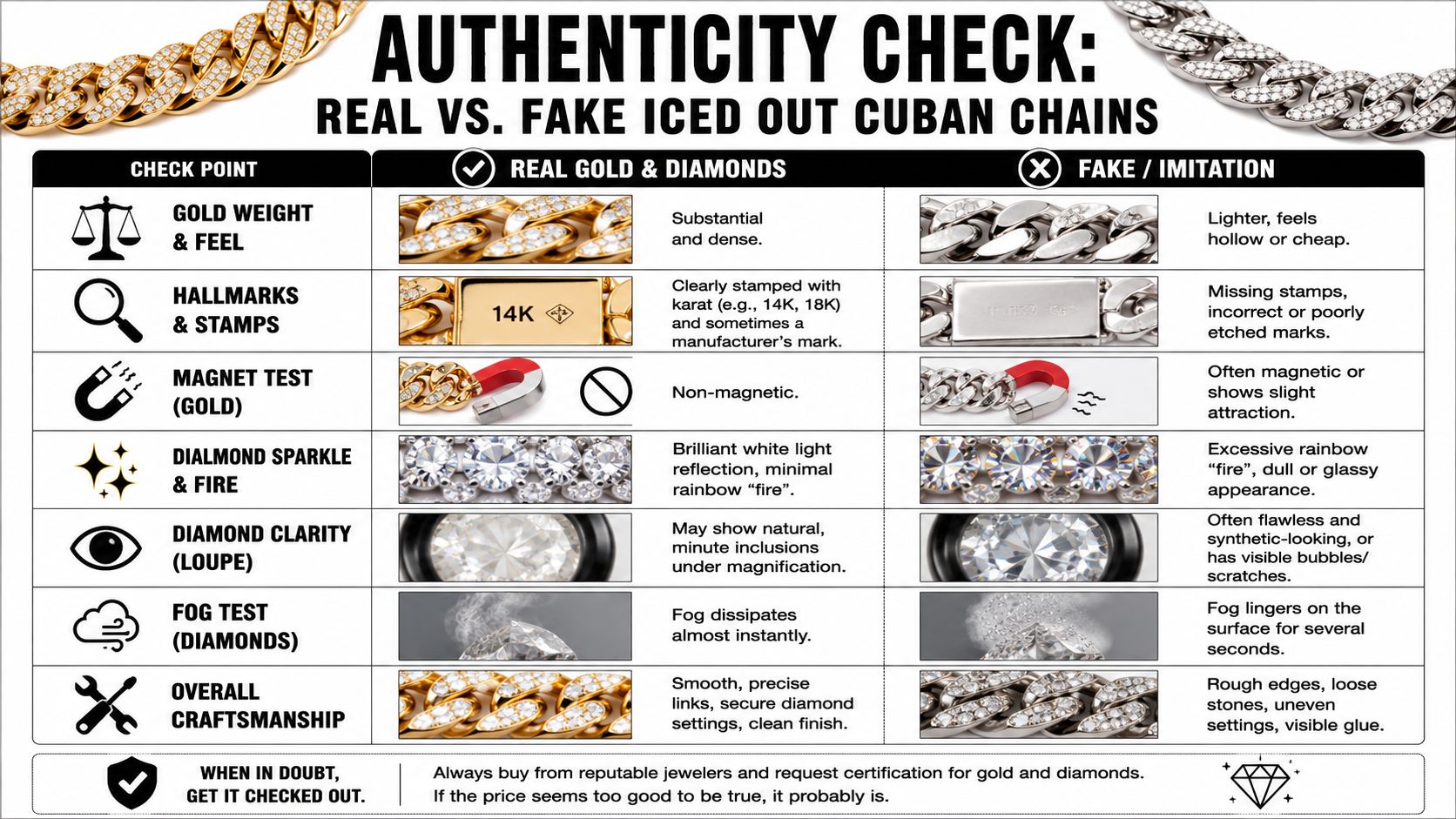
Real versus imitation at a glance
Feature | Real gold and diamonds | Fake or imitation |
|---|---|---|
Weight and feel | Dense, substantial, balanced | Often light, hollow, or cheap-feeling |
Hallmarks | Clear karat stamp such as 10K or 14K | Missing, crude, or suspicious marks |
Magnet response | Gold itself is non-magnetic | Base metals may react |
Sparkle pattern | Bright white return with controlled fire | Often flashy, glassy, or overly rainbow-like |
Loupe view | Natural inclusions may appear | Can look too perfect, scratched, or bubbly |
Craftsmanship | Even settings, smooth links, secure finish | Rough edges, loose stones, glue, uneven rows |
Checks that actually help
Start with the metal. A solid gold chain should feel heavier than most first-time buyers expect. It should also have legible hallmarks in a discreet location, usually near the clasp. A magnet test can help identify obvious base metal construction, but it isn't a complete authenticity test. Non-magnetic does not automatically mean solid gold.
Then study the stones. Real diamonds tend to return bright white light in a more controlled way than cubic zirconia. Under magnification, I look for consistency in setting, seat cuts, prongs or beads, and whether the stones are properly aligned. Sloppy pavé work often shows up before a stone falls out.
A simple buyer checklist works well:
Check the stamp: Look for 10K or 14K marks and a maker's mark if present.
Inspect under magnification: Uneven seats, chipped corners, and glue residue are major red flags.
Feel the links: Real Cuban links should move smoothly, not scrape or bind.
Look at wear points: Clasps, back edges, and underside surfaces often reveal plating loss first.
Ask for documentation: If the seller claims real diamonds, paperwork should support the claim.
A good starting point for stone basics is what genuine diamond meaning actually involves.
The underside of a chain often tells the truth faster than the top. Sellers polish the face. They rarely hide the back as well.
One durability issue is worth taking seriously. Consumer discussions have reported that stainless steel and CZ-based chains can lose their iced appearance within 6 to 12 months because of stone chipping and metal tarnishing (consumer durability discussion). That doesn't mean every imitation piece fails quickly, but it does mean appearance alone is a poor proxy for long-term value.
What Drives the Value of an Iced Out Chain
When an appraiser values an iced out Cuban chain, the question isn't "How shiny is it?" The key consideration is how gold content, diamond quality, workmanship, and saleability converge within the present market.
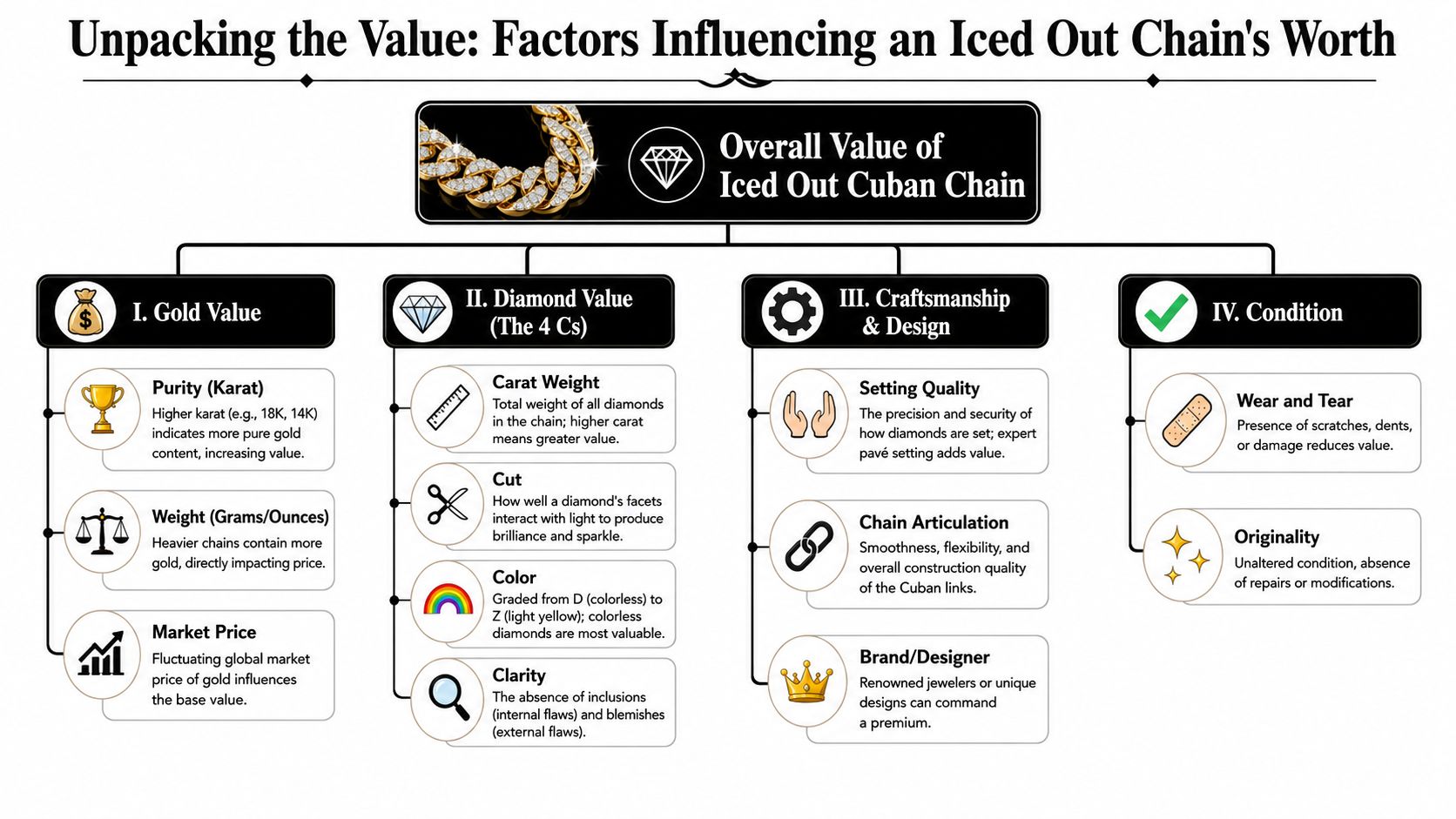
The four value pillars
The first pillar is gold. Purity matters because 14K contains more gold than 10K, and weight matters because heavier chains have more recoverable precious metal. In a resale setting, gold gives the piece a base level of intrinsic value.
The second pillar is diamonds. Even when a chain contains many small stones rather than one large center stone, quality still matters. Appraisers look at total carat weight, cut performance, color range, clarity range, and whether the diamonds are natural, consistent, and securely set. For shoppers who want a clearer framework, this overview of how much a diamond is worth explains why not all carat weight is equal.
The third pillar is craftsmanship. On a Cuban link, this includes articulation, clasp quality, underside finishing, and how well the pavé work follows the curves of each link. Poor craftsmanship lowers resale confidence because repair risk is higher.
The fourth pillar is condition and provenance. Damage, missing stones, poor repairs, and altered clasps all cut value. Clear documentation, prior appraisals, and original purchase records can improve buyer trust.
Why labor changes the math
A lot of owners focus on melt value and miss the biggest pricing reality. An iced out Cuban link chain typically costs 50% to 100% or more above intrinsic gold value because the buyer is also paying for gemstones and the skilled labor needed to set them across the entire link structure (pricing premium over gold value).
That premium isn't automatic in resale. Retail labor cost and resale demand are different things. But if two chains have the same gold weight, the one with better diamond quality and cleaner workmanship will usually be easier to appraise accurately and easier to sell.
How Much Does an Iced Out Chain Cost
The short answer is that true diamond-set Cuban links sit in the high-end part of the market. Iced out diamond Cuban link chains start around $25,000 and can reach into the hundreds of thousands of dollars, with price driven by total carat weight, diamond quality, and design intricacy (diamond Cuban link pricing range).
Why two chains can look similar and price very differently
Two chains can appear similar in a photo and differ dramatically in actual value. The main reasons are metal purity, whether the chain is solid or hollow, whether the stones are natural diamonds or simulants, and how refined the setting work is.
A few common pricing splits explain most of the spread:
Gold purity: A chain in 14K generally carries more intrinsic gold value than one in 10K.
Diamond quality: Better cut, stronger color, and cleaner clarity raise both price and buyer confidence.
Build quality: Hand-finishing, smooth articulation, and secure pavé work separate luxury pieces from mass-produced inventory.
Documentation: Certified or well-documented stones are easier for the next buyer to trust.
If you're comparing karat options, the difference between 14K and 18K gold is worth understanding before you judge a quote.
One point that surprises many owners in Georgia is that resale value rarely matches original retail. Retail includes design overhead, inventory costs, and markup. Resale depends on what a buyer can verify, what condition the chain is in, and how liquid that specific piece is in the current secondary market.
A chain isn't worth what the receipt says. It's worth what a qualified buyer can verify and confidently resell.
Maintaining and Caring for Your Chain
An iced out Cuban chain can look durable, but pavé-set jewelry is never maintenance-free. The goal is to protect both appearance and structure, especially around the clasp, link edges, and high-friction contact points.
Daily habits that protect value
Store the chain separately in a soft pouch or a lined jewelry box compartment. That reduces scratching on the gold and lowers the chance of one piece catching another and stressing the links or settings.
Keep it away from harsh cleaners, pool chemicals, and rough gym use. Repeated impact and chemical exposure can loosen small stones over time, dull the finish, and wear down the tiny beads or prongs that hold pavé in place.
A practical routine looks like this:
Wipe after wear: Use a soft lint-free cloth to remove skin oils and residue.
Store flat: Don't toss it into a pile with bracelets, watches, or other chains.
Avoid impact: Take it off before sports, heavy lifting, or any activity where it can strike hard surfaces.
Watch the clasp: Clasps and safety latches often show wear before the links do.
When to get professional service
At home, use warm water, mild soap, and a very soft brush if the setting is stable. Rinse thoroughly and dry with a lint-free cloth. Never scrub aggressively, and don't use ultrasonic or steam cleaning unless a jeweler has confirmed the chain's condition and setting style can handle it.
Professional inspection matters because small problems are easier to fix than major stone loss. If a row looks uneven, a stone sounds loose, or a link starts feeling stiff, stop wearing it until someone checks it.
For owners who want to preserve resale potential, the rule is simple. Clean gently, store carefully, and service early. A chain in crisp condition is easier to appraise, easier to insure, and easier to sell.
How to Get an Accurate Appraisal and Sell Your Chain
Selling an iced out Cuban chain goes more smoothly when you treat it like a documented luxury asset, not just a piece of jewelry. Buyers pay more confidently when they can verify what they're seeing.
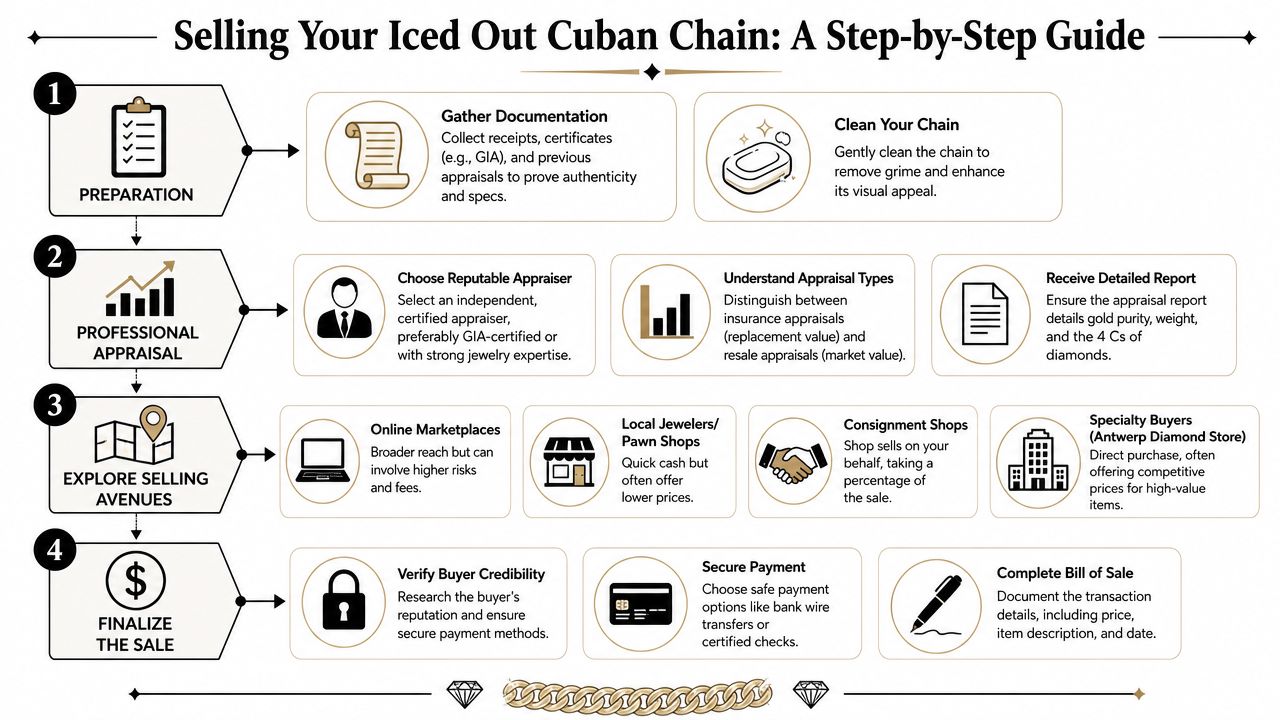
What to gather before an appraisal
Start with every piece of supporting paperwork you have. That can include the original receipt, prior appraisals, diamond certificates, repair invoices, and any written specs from the jeweler who made or sold the piece.
Documentation matters more now than many sellers realize. One market report states that projected 2025 demand for "certified diamond" iced chains is up 30%, while 60% of sellers lack documentation, which creates a trust problem for valuation and resale (documentation and certified diamond demand). If your chain has paperwork, bring it.
Before the appointment:
Clean it lightly: Remove surface grime so the appraiser can inspect the setting clearly.
Photograph the piece: Capture the clasp, hallmarks, top surface, and side profile.
List known repairs: Honest disclosure helps avoid confusion during inspection.
Separate fact from assumption: "It was sold to me as diamond" is not the same as verified grading or testing.
What an appraiser checks
A serious appraisal should include non-destructive testing of metal and stones, weight measurement, examination of hallmarks, assessment of craftsmanship, and a review of condition. The appraiser should distinguish between insurance-style replacement value and realistic secondary-market value.
A strong in-person evaluation usually focuses on:
Appraisal factor | What gets checked | Why it matters |
|---|---|---|
Metal | Karat purity, total weight, construction | Establishes intrinsic base value |
Diamonds | Whether stones are natural or simulants, consistency, setting quality | Affects resale confidence and pricing |
Condition | Missing stones, worn settings, repairs, clasp wear | Damage lowers offer strength |
Marketability | Style appeal, build quality, buyer demand | Determines how liquid the piece is |
For a better sense of the process, how to appraise jewelry breaks down what qualified evaluators look for.
Bring the paperwork even if you think it isn't important. One receipt, old appraisal, or repair record can answer questions that would otherwise lower confidence.
Selling options in Atlanta and beyond
If you're in Atlanta, Buckhead, Sandy Springs, Alpharetta, Roswell, Brookhaven, Midtown Atlanta, or elsewhere in the greater Georgia market, you generally have three routes. You can sell to a local jeweler or buyer, use an online marketplace, or work with a specialist buyer who evaluates high-value assets regularly.
Each route has trade-offs.
Online marketplaces: Broader audience, but more negotiation, more fraud risk, and more time spent proving authenticity.
General local buyers: Fast and convenient, but some focus mainly on scrap or quick-turn inventory.
Specialty luxury buyers: Often better suited for diamond-set jewelry because they understand construction, documentation, and secondary-market demand.
When you're comparing offers, ask direct questions:
Is the offer based on gold only, or gold plus diamond value?
Were the stones tested individually or sampled?
Is condition affecting the offer?
Is the buyer evaluating it for scrap, estate resale, or luxury resale?
That last point changes everything. A broken chain with low-grade stones may trade close to material value. A well-made, wearable piece with strong documentation can be evaluated as a finished luxury item.
In my experience, sellers do best when they arrive prepared, understand the difference between sentiment and market value, and choose a buyer who can explain the numbers in plain English.
Frequently Asked Questions About Iced Out Chains
Can you wear an iced out Cuban chain every day
You can, but daily wear increases the chance of scratched gold, loosened stones, and clasp wear. If you wear it often, inspect it regularly and avoid impact-heavy activities.
Is an appraisal the same as a selling offer
No. An appraisal can estimate value for a specific purpose, such as insurance or resale reference. A purchase offer reflects what a buyer is willing to pay based on present market conditions, condition, and resale confidence.
Does a heavier chain always mean a better investment
Not always. More gold weight helps, but buyers also care about diamond quality, craftsmanship, condition, and whether the piece is easy to authenticate and resell. A heavier chain with weak stones or poor workmanship may be less attractive than a better-made piece.
If you want a professional opinion on an iced out Cuban chain, Antwerp Diamond offers a practical next step. You can request an evaluation, visit the Atlanta area location for a private review, or bring in your chain for an in-person assessment if you're comparing resale, appraisal, or loan options.