
To sell a diamond ring online effectively, you need to understand its specifications, get a professional evaluation, and choose a secure selling method. In most cases, resale value is typically 30% to 50% of the original retail price, so the smartest approach is to maximize your net proceeds, not just chase the biggest opening quote.
If you're reading this, there's a good chance you have a ring in a drawer, a box, or a safe and you're wondering what it's worth, how to sell it without getting burned, and whether an online buyer can be trusted. Those are the right questions. The online market can work well, but only if you control the process, compare offers properly, and protect the ring during every step.
A lot of sellers get stuck on the wrong benchmark. They look at the original receipt or an insurance appraisal, then feel blindsided when real offers come in lower. The better way is to treat your ring like a secondary-market asset: evaluate the stone accurately, understand how buyers think, and compare what you will receive after fees, shipping conditions, and payout terms.
Table of Contents
How to Prepare and Value Your Diamond Ring
The strongest online sales start before you contact a buyer. If you don't know exactly what you're selling, you can't judge whether an offer is fair.
A realistic starting point is this: engagement rings usually resell for 30% to 50% of original retail price, and some sellers receive 20% to 45% depending on the stone's grading, certification, and current demand, according to myGemma's diamond ring resale guide. That gap exists because buyers are pricing for the secondary market, not retail markup.
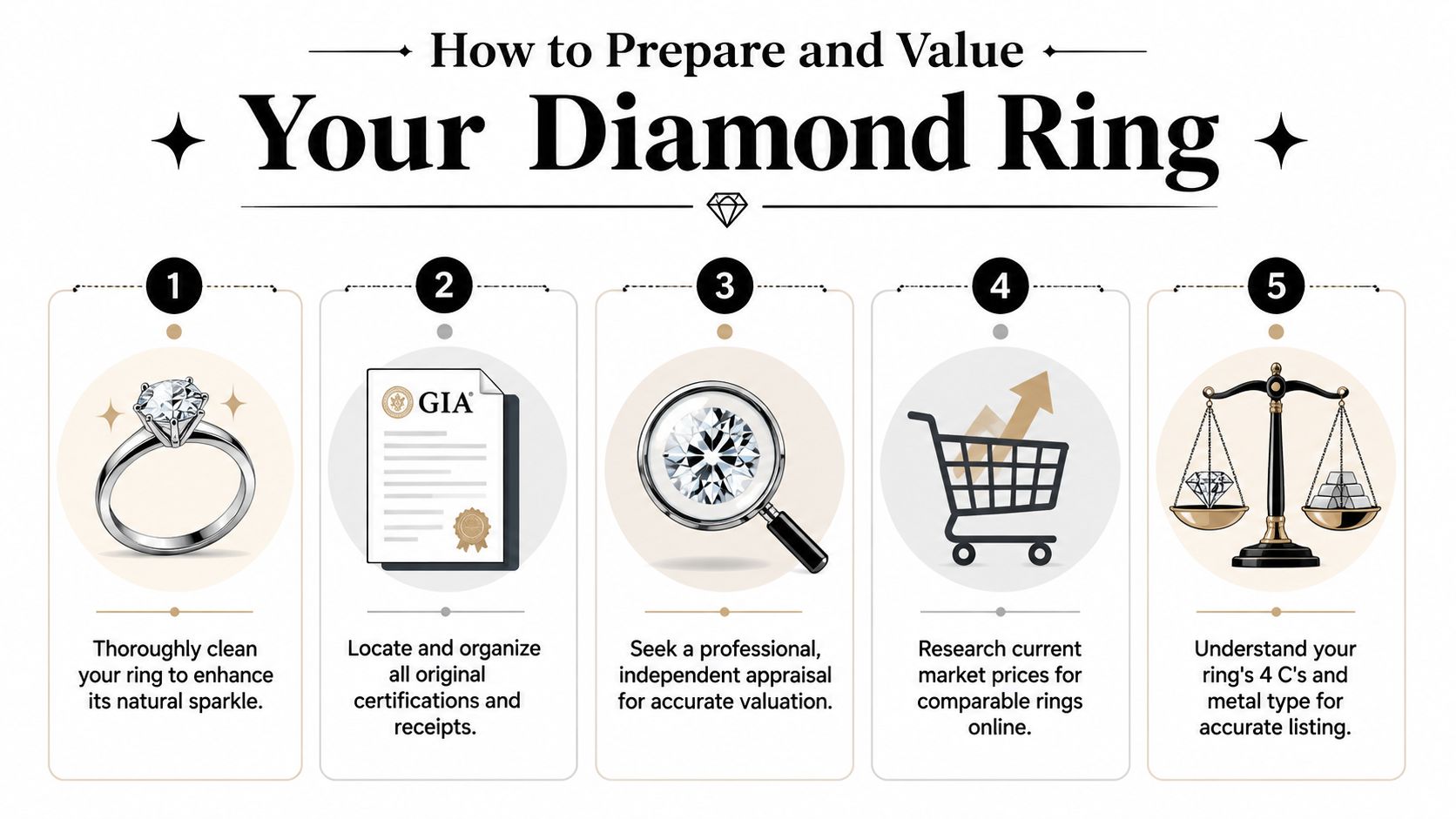
Start with the documents and the diamond details
Before you submit a quote request, gather everything tied to the ring.
That includes the grading report, original receipt if you still have it, prior appraisals, designer paperwork if the setting is branded, and any service records. A GIA report or equivalent grading report matters because it gives buyers confidence in the diamond's identity and quality without forcing them to rely only on your description.
If you don't have a current evaluation, it's worth getting a professional jewelry appraisal. An appraisal won't magically set the sale price, but it can help you confirm what you have before you enter negotiations.
Use this prep checklist:
Clean the ring carefully: Dirt under the stone and residue on the metal make a ring look weaker than it is.
Record the basics: Note carat weight, cut, color, clarity, shape, metal type, ring size, and any visible brand marks.
Photograph the paperwork: Buyers often ask for the certificate number or clear images of the report.
Check for repairs or damage: Loose prongs, chips, and worn shanks affect how a buyer prices risk.
Save everything in one folder: That speeds up quote requests and reduces back-and-forth.
Know what actually drives resale value
Most sellers focus on carat weight first. Buyers don't.
They start with the full grading profile. The 4Cs, carat, cut, color, and clarity, still drive value, but specialists also look at details like fluorescence and symmetry, and Circa's guidance on selling diamonds notes that a GIA or equivalent report materially improves buyer confidence.
Practical rule: A larger diamond with weaker cut or poor paperwork doesn't automatically beat a smaller stone with strong grading and a trusted lab report.
The setting also deserves attention. A plain mounting may add modest resale appeal if it's wearable and well made. A highly personalized setting can limit the buyer pool because the next owner may need to remake it. On the other hand, a branded setting can matter more than many sellers expect, especially when the ring is best marketed as finished jewelry rather than just a loose stone.
Here's a simple way to think about value drivers:
Factor | Why it matters in resale |
|---|---|
Certification | Reduces buyer uncertainty |
Cut quality | Stronger visual performance and broader demand |
Color and clarity | Affect comparables and liquidity |
Shape | Some shapes move faster than others depending on current demand |
Setting and brand | Can either help or narrow the resale audience |
Condition | Repairs and refurbishment lower a buyer's margin |
If you want a rough orientation before speaking with a buyer, a diamond resale value calculator can help frame expectations. Use it as a benchmarking tool, not as a final offer.
Use the right benchmark before you ask for offers
A common pitfall in many online sales occurs when sellers rely on an insurance appraisal and assume that's what the ring is worth in cash.
It isn't. Insurance values are built around replacement cost, not immediate resale value. White Pine Diamonds' selling guide specifically warns against using an insurance appraisal as a resale benchmark and recommends comparing similar rings in the secondary market instead.
The fastest way to misprice your ring is to treat an insurance number as a cash number.
A better approach is to benchmark the ring against comparable secondary-market listings, then request several preliminary evaluations from qualified buyers. You're not trying to prove the ring is special. You're trying to understand what a knowledgeable buyer can realistically resell.
That mindset changes everything. It keeps expectations grounded, helps you reject weak offers confidently, and prevents the disappointment that comes from comparing a resale quote to a retail fantasy.
Where to Sell Your Diamond Ring Online for the Best Price
Where you sell determines how much friction, risk, and delay you'll tolerate. It also determines how much money you keep.
Most sellers don't need the platform with the loudest marketing. They need the channel that balances buyer reach, fees, security, and payout speed.
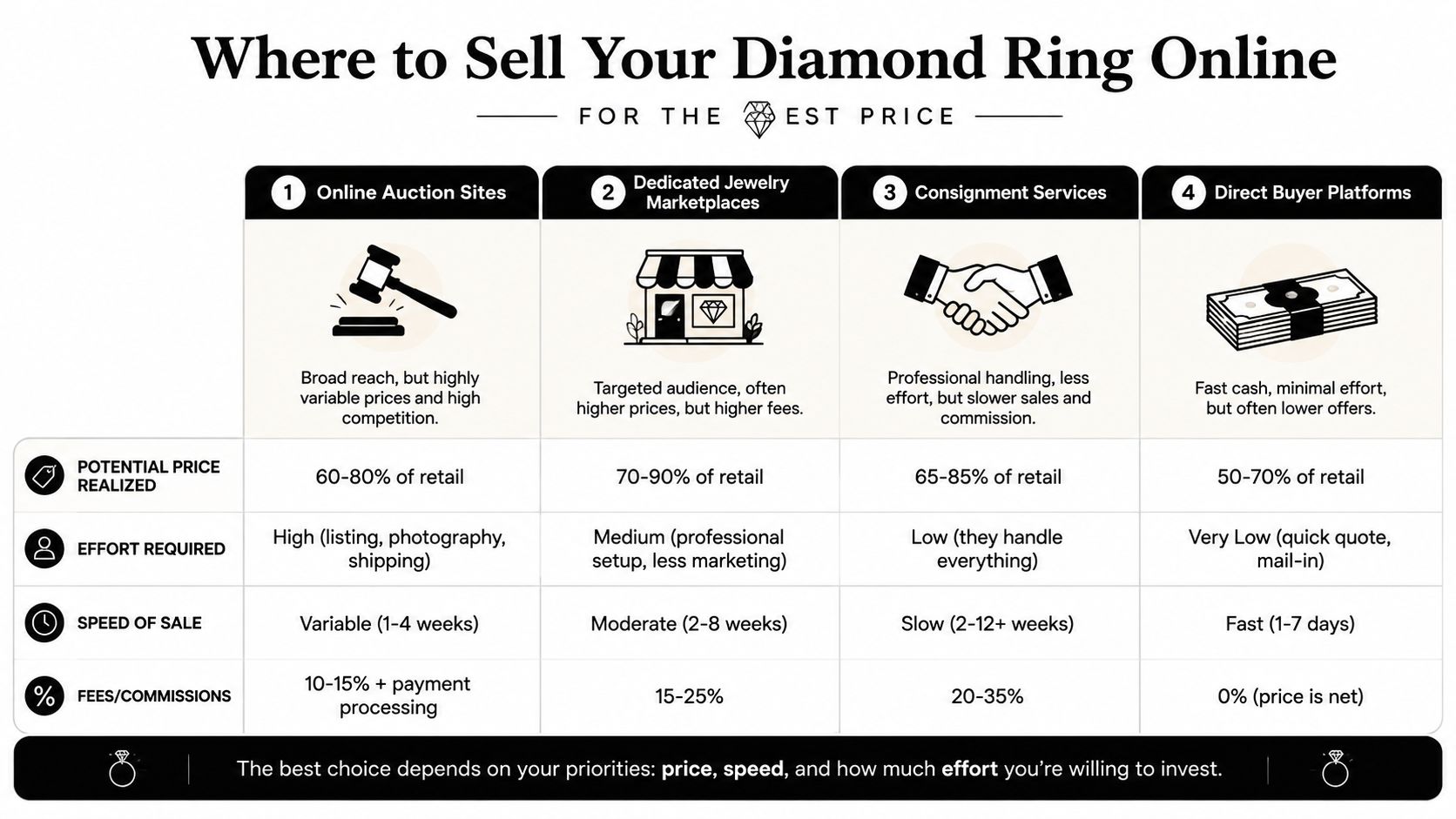
The four main online selling channels
Private marketplaces give you the most control, but they also give you the most work. You have to create the listing, answer questions, screen buyers, handle payment risk, and ship the ring yourself. For some sellers, that works. For many, it turns into weeks of wasted time and uncomfortable negotiation.
Auction-style platforms can create excitement, but they don't guarantee the outcome you want. The ring still needs to appeal to the right bidders at the right time, and your final result can be diluted by platform mechanics and commissions.
Consignment services reduce your workload because they handle the presentation and buyer interaction. The trade-off is slower payment. Your ring must sell before you get paid, and the timeline can stretch if the piece is niche or priced aggressively.
Direct specialist buyers are usually the cleanest path for people who value certainty. You submit details, receive a preliminary quote range, ship under insured terms, then accept or decline the final offer.
Here is the comparison most sellers care about:
Channel | Best for | Main drawback |
|---|---|---|
Private marketplace | Sellers willing to manage everything | Highest fraud and shipping exposure |
Auction platform | Sellers testing broad demand | Outcome and fees can be unpredictable |
Consignment | Sellers who can wait | Delayed payout |
Direct specialist buyer | Sellers who want speed and clarity | Offer may look lower before you factor in fees and risk |
Later in the process, this overview of where to sell jewelry online can help you compare channels in more detail.
A short overview can also help if you're still sorting options:
Why net proceeds matter more than the headline offer
This is the piece most guides skip. The advertised offer is not the same as the money in your pocket.
According to StoneAlgo's comparison of online diamond selling options, the actual cost of online selling is often hidden in fees, auction mechanics, and bid spreads, and one comparison found fees as high as 21% on a $6,000 sale depending on platform. That's exactly why a higher-looking marketplace number can still leave you with less money than a straightforward direct offer.
Don't compare gross offers. Compare net payout, inspection terms, return terms, and how long the money takes to arrive.
Ask each buyer or platform these questions before you proceed:
What is my net amount: After commission, payment processing, listing fees, and any shipping or inspection charges.
Is this a direct purchase or a marketplace listing: Those are very different models.
Who controls the return shipping if I decline: That should be explicit.
When do I get paid: After acceptance, after delivery, or only after resale.
When a local appointment still helps an online seller
Even if you plan to sell online, an in-person evaluation can sharpen your position. If you're in Atlanta, Buckhead, Roswell, Sandy Springs, Alpharetta, Brookhaven, Midtown Atlanta, or elsewhere in the Georgia market, seeing a qualified buyer face to face can help you confirm condition, paperwork, and whether the ring is better sold as complete jewelry or as a stone-focused piece.
For some sellers, a secure in-person evaluation in Buckhead removes a lot of uncertainty. If you prefer to start remotely, a simple and secure selling process gives you a cleaner framework than posting a listing and hoping the right stranger appears.
How to Photograph and Describe Your Ring for Sale
Good presentation doesn't create value, but it does protect value. Poor photos make buyers assume they're missing something.
That matters whether you're creating your own listing or submitting a ring for a quote review.
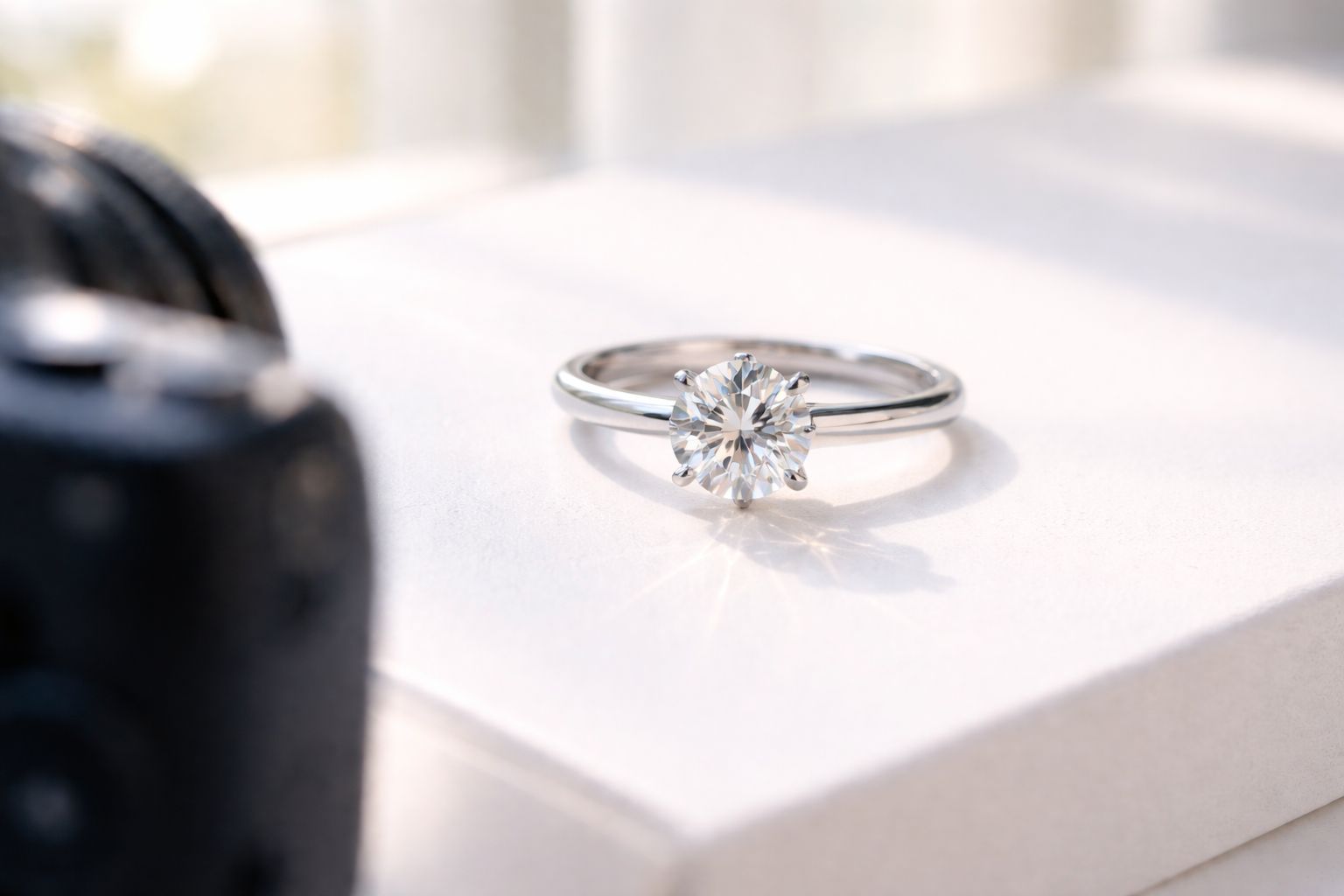
Take photos that reduce buyer hesitation
Use indirect natural light near a window. Avoid yellow indoor light, heavy filters, and over-sharpening. A clean white or neutral background usually works best because it keeps attention on the stone and the mounting.
You don't need a professional studio. You do need consistency.
Photograph these views:
Top-down view: Shows shape, face-up appearance, and overall symmetry.
Side profile: Reveals setting style, prong height, and ring condition.
Close-up of the diamond: Helps a buyer assess brilliance and visible inclusions.
Band and hallmarks: Show metal stamps, brand marks, or serial details if present.
Any flaws: Chips, worn prongs, scratches, or missing accent stones should be visible.
If you want to improve image quality without making the photos look artificial, MyImageUpscaler's product photo guide has practical tips on clarity, cropping, and presentation that translate well to jewelry listings.
For a more jewelry-specific walkthrough, this guide on how to photograph jewelry can help you avoid the common mistakes that make a strong ring look average.
Write a description that sounds credible
A buyer trusts specifics, not adjectives. "Stunning" and "gorgeous" don't help much. A factual description does.
Start with the objective details you know: stone shape, approximate carat weight, metal type, ring size, whether you have a GIA report, and whether the setting is branded or custom. Then disclose condition.
Here's the difference:
Weak description: "Beautiful diamond ring, sparkles like crazy, must sell fast."
Better description: "Round brilliant diamond engagement ring in platinum, with grading report available. The ring shows normal surface wear from use, and the center stone is secure in the setting."
That second version sounds real. Buyers respond better to transparency because it lowers the chance of surprises during inspection.
Keep your wording clean and direct. If you don't know a detail, say that it hasn't been independently confirmed yet. That's better than overstating and having the offer revised downward later.
Safely Managing Offers, Shipping, and Payment
A ring can attract a strong headline offer and still leave you with less money, more delay, and more risk than a lower quote from a better buyer. That is where online sales are won or lost. Net proceeds depend on what happens after the first number hits your inbox.
Treat every offer as a package of terms. Price matters, but so do inspection rules, return shipping, insurance coverage, and how quickly cleared funds reach you. Sellers who focus only on the top line often end up absorbing costs or accepting a revised offer after the ring is already in transit.
Read the offer the way a buyer would read your listing
Slow the process down before you say yes.
A serious buyer should explain exactly how the quote becomes a final offer. Some buyers make a strong preliminary offer, then leave themselves broad room to reduce it after inspection. That does not always mean bad faith. Fine jewelry does need in-hand verification. But the adjustment standard should be clear. If the offer can change, ask what would justify a revision. A grading discrepancy, damage, or undisclosed repairs are reasonable triggers. Vague language is not.
Review these points before you ship:
Inspection contingency: What specific issues allow the buyer to change the offer?
Return terms: If you decline the final number, who pays return shipping and how fast is the ring sent back?
Insurance during transit: Who carries the risk if the package is lost or damaged?
Payment method: Bank wire, ACH, check, or store credit?
Timeline: How long from acceptance to payout?
A clear framework helps when comparing specialist buyers against auction-style marketplaces. This guide on where to sell jewelry for cash is useful for judging how different offer structures affect what you keep.
If you cannot understand the payment and return terms in one careful read, stop and ask again.
Ship only under the buyer's insured process
Shipping is a risk-control step, not clerical work. I have seen sellers lose control by mailing a ring on their own, with the wrong carrier, limited insurance, or packaging that signals jewelry inside. Once that package is out of your hands, a preventable mistake can wipe out the gain from chasing a slightly higher offer.
A reputable buyer should provide a prepaid, insured label or a documented shipping method, plus packing instructions. Follow that process exactly. Before sealing the parcel, photograph the ring, the certificate, and the condition of the piece from multiple angles. Save those images with the date. Keep copies of every email, label, and tracking update until funds have cleared.
For outer-packaging basics, simple materials like labels for fragile items shipping can help if the buyer instructs you to prepare the parcel yourself. Do not add branding or any wording that suggests jewelry, diamonds, or valuables.
Use this checklist:
Photograph the ring and all paperwork before packing
Use only the insured shipping method approved by the buyer
Keep the exterior plain and discreet
Save the receipt, tracking record, and correspondence
Confirm delivery and intake as soon as the package arrives
Choose payment terms that leave no loose ends
The cleanest transaction is one with a final written offer, a defined inspection window, and a payment method that does not leave room for confusion. Specialist buyers often beat anonymous marketplaces here. The top offer on a peer-to-peer platform can shrink fast once selling fees, payment holds, dispute risk, and return exposure are factored in.
Ask direct questions before approval. Is payment sent the same day the offer is accepted, or after an internal hold? Are funds wired, or is a check mailed? If you reject the final offer, when is the ring returned, and under whose insurance?
Those details are part of your sale price. A lower quote with buyer-paid insured shipping, no selling fees, and prompt payment can produce more cash in your pocket than a higher public listing price with deductions and risk attached.
Common Questions About Selling Diamond Rings Online
Sellers usually understand the broad process after a little research. The harder questions are the practical ones that affect price in practice.
Can I sell a diamond ring without a certificate
Yes, you can. But you should expect more scrutiny and, in many cases, less buyer confidence.
Certification helps because it gives the buyer a reliable third-party description of the stone. Without it, the buyer has to do more verification work and price in more uncertainty. That doesn't mean the ring is unsellable. It means you should be especially careful about how you present the ring and who you approach.
If you're unsure whether the stone has been represented accurately in the past, start by reviewing what a genuine diamond meaning covers. That helps you speak the same language as the buyer when questions about natural origin, grading, or identification come up.
Should I remove the diamond from the setting
Usually, no. Not before a qualified buyer evaluates the piece.
Many sellers ask whether the diamond should be sold loose, whether the setting adds value, and whether the ring should be marketed as diamond jewelry instead of just the stone. Elgrissy Diamonds' discussion of selling old diamonds points out that these exact questions are common and that certification, condition, and brand or setting details affect value in practice.
Here is the practical rule:
Leave it intact first: A buyer can assess the ring as a complete piece.
Separate only if advised: Some mountings add little, while others, especially branded ones, can matter.
Don't damage the asset: Removing a stone carelessly can create avoidable risk and cost.
A ring isn't always worth more broken into parts. Sometimes the complete piece is the easier and more valuable sale.
How long does it take to sell online
It depends on the channel you choose and how quickly you need liquidity.
A direct buyer is usually the shortest path because the process moves from quote request to inspection to decision without waiting for a retail buyer to appear. Marketplace and consignment models often take longer because they depend on someone else choosing your ring at your target price.
The timeline also depends on the ring itself. Clean documentation, strong photos, a recognized grading report, and realistic expectations all shorten the process. Unclear paperwork, vague descriptions, and inflated pricing do the opposite.
If your priority is speed with structure, submitting for a buyer evaluation is usually more predictable than building a public listing and managing every inquiry yourself.
Are local buyers or online buyers better in Georgia
For many sellers in Atlanta and the surrounding Georgia market, the answer isn't purely local or purely online. It's a mix.
A local review can help you confirm what you have, ask questions in real time, and avoid shipping a ring blindly to an unfamiliar party. That can be especially useful in Buckhead, Sandy Springs, Alpharetta, Roswell, Brookhaven, and Midtown Atlanta, where many sellers want discretion and a private setting. Online selling expands your reach, but local expertise can make your online decision stronger.
If you want to understand the current market side of the equation before choosing a channel, it helps to understand the current market value of your diamond. That way, you're deciding from a position of knowledge, not urgency.
Your Next Step to a Confident Sale
Two offers can differ by very little on paper and still leave you with a meaningfully different result once commissions, shipping liability, return risk, and payment timing are factored in. Sellers often focus on the top-line quote and miss the part that matters. The amount that reaches their account, with the least exposure along the way. That is the standard to use now.
If you want to sell with confidence, compare your final net after every fee, confirm who carries the risk in transit and during inspection, and favor buyers who can explain how they priced the ring in clear resale terms. A slightly lower initial offer from a specialist buyer can beat a higher marketplace listing once delays, price cuts, and seller-side risk are accounted for.
If you'd like a confidential evaluation or want to compare an online quote against a local expert review, Antwerp Diamond offers a practical next step. You can start with a no-obligation assessment or arrange a private appointment in Atlanta, including Buckhead and nearby areas, to review your diamond ring in person before making a decision.