
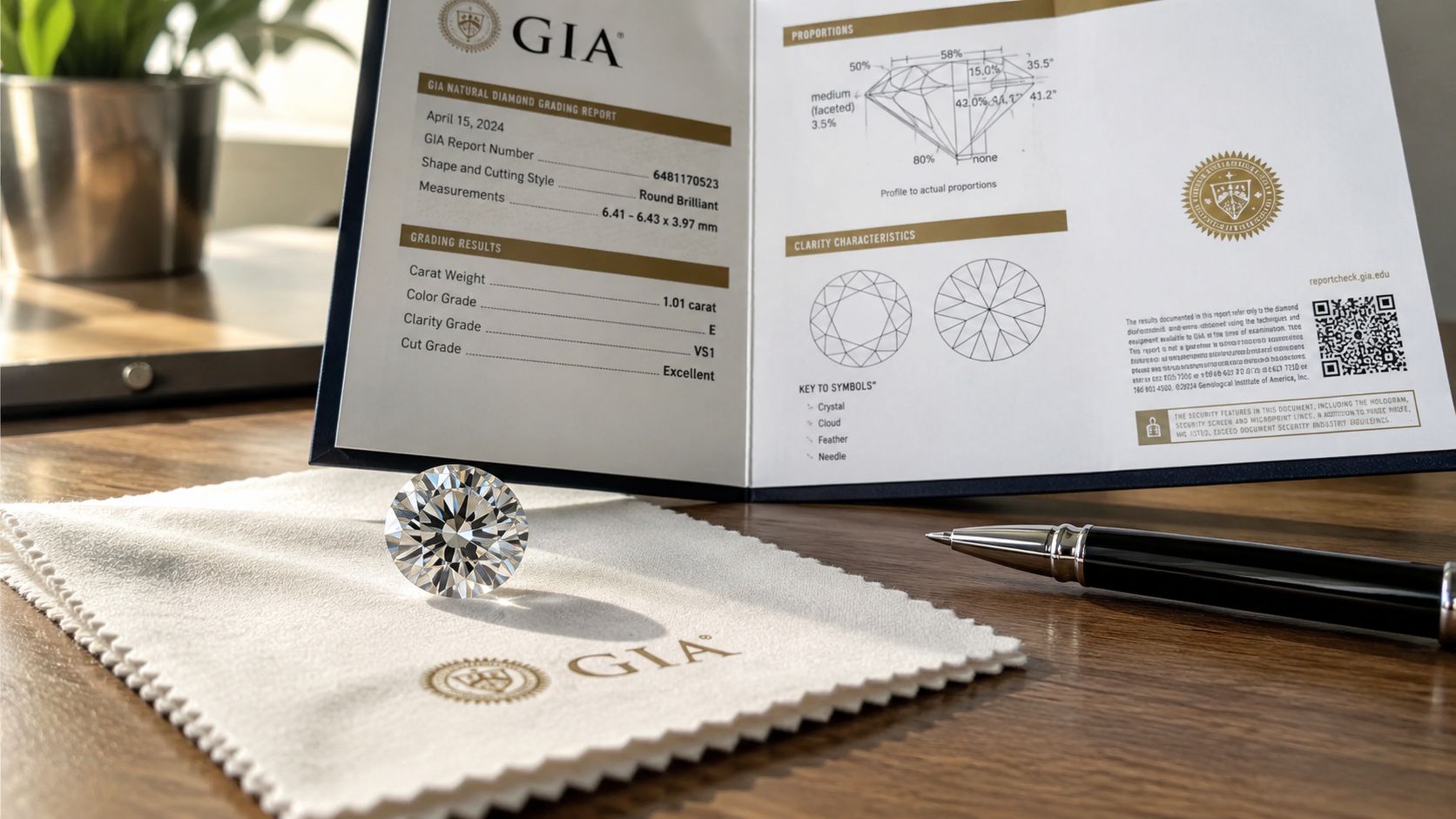
Selling a diamond usually means accepting far less than the original store price, often around 25% to 40% of retail in the secondary market. The best way to improve your outcome is to get the diamond professionally evaluated, gather any grading paperwork, compare multiple offers, and choose the sales route that fits your stone and your timeline.
If you're reading this, you're probably staring at a ring box, a loose stone, or an inherited piece of jewelry and wondering what it's worth, who buys diamonds, and whether taking the first offer is a mistake. Those are the right questions. A diamond sale goes well when you prepare the item properly, understand how buyers price it, and make one important decision most sellers miss: whether to sell the diamond loose or in its setting.
Table of Contents
Get Your Diamond Ready for a Top Offer
A strong diamond sale starts before anyone names a number. Buyers pay more confidently when the stone is easy to identify, easy to verify, and presented with paperwork that reduces uncertainty.
Start with the diamond itself
First, have the piece cleaned professionally. Dirt, lotion, and residue can hide inclusions, mute brilliance, and make a stone look less lively than it really is. A buyer who's evaluating several diamonds quickly will respond better to a stone that shows its true face-up appearance.
Then decide whether you're valuing a mounted diamond or a loose one. One practical selling workflow recommends separating the stone from the setting before valuation, getting a current grading report, and then seeking quotes from a specialist diamond dealer because the exact loose-stone weight and updated grading can materially affect the offer. That same guidance specifically recommends recertifying reports older than 10 years in some cases, especially when the existing paperwork no longer reflects the way buyers will assess the stone today (expert workflow for preparing a diamond for sale).
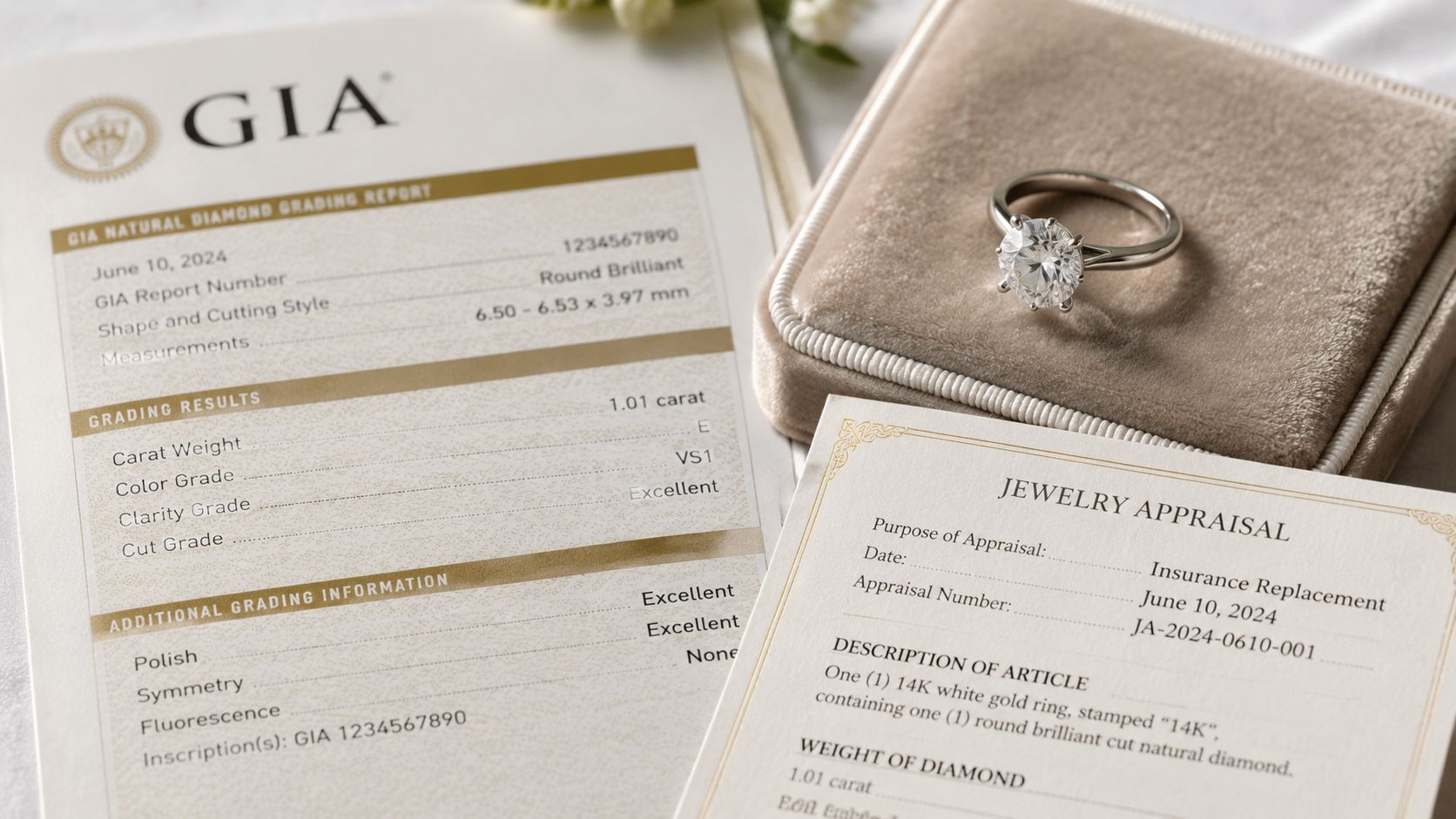
Practical rule: If the grading report is old, missing, or tied to a ring that prevents an exact loose weight, don't assume buyers will fill in the gaps in your favor.
If you keep high-value pieces at home while preparing them for sale, basic handling and storage matter too. For owners who want to find the best collectible storage, it's worth thinking about security, humidity, and documentation habits the same way collectors do with art, watches, and other portable valuables.
Gather the paperwork buyers actually use
Sellers often bring the wrong documents. The original sales receipt can be useful. An old insurance appraisal can provide background. But the document that usually carries the most weight in a diamond sale is a current grading report from a respected lab, especially GIA.
Bring together:
The grading report: If you have a GIA dossier or full report, include it.
Past appraisals: These help with identification, even if they aren't the same as resale pricing.
Sales receipt or warranty documents: Especially useful if the ring is branded.
Repair or service records: These can clarify condition and any changes to the piece.
If you're not sure how much a grading report influences marketability, reviewing a GIA certified engagement ring guide can help you understand why certification affects buyer confidence.
A well-prepared seller doesn't just look organized. They reduce risk for the buyer. That usually leads to a cleaner conversation, fewer disputes about quality, and a firmer offer.
Understand How Your Diamond Is Valued
The biggest mistake in how to sell diamonds is treating the original purchase price as today's value. Retail and resale are different markets, with different cost structures and different buyers.
Why the retail price rarely helps you now
One independent resale guide states that a diamond item in the second-hand market typically sells for 25% to 40% of original retail because retail pricing includes markups for branding, distribution, and store overhead (diamond resale reality explained). That gap shocks many first-time sellers, but it isn't evidence that your diamond is bad. It means the resale market pays for the stone's current marketability, not for the original store experience.
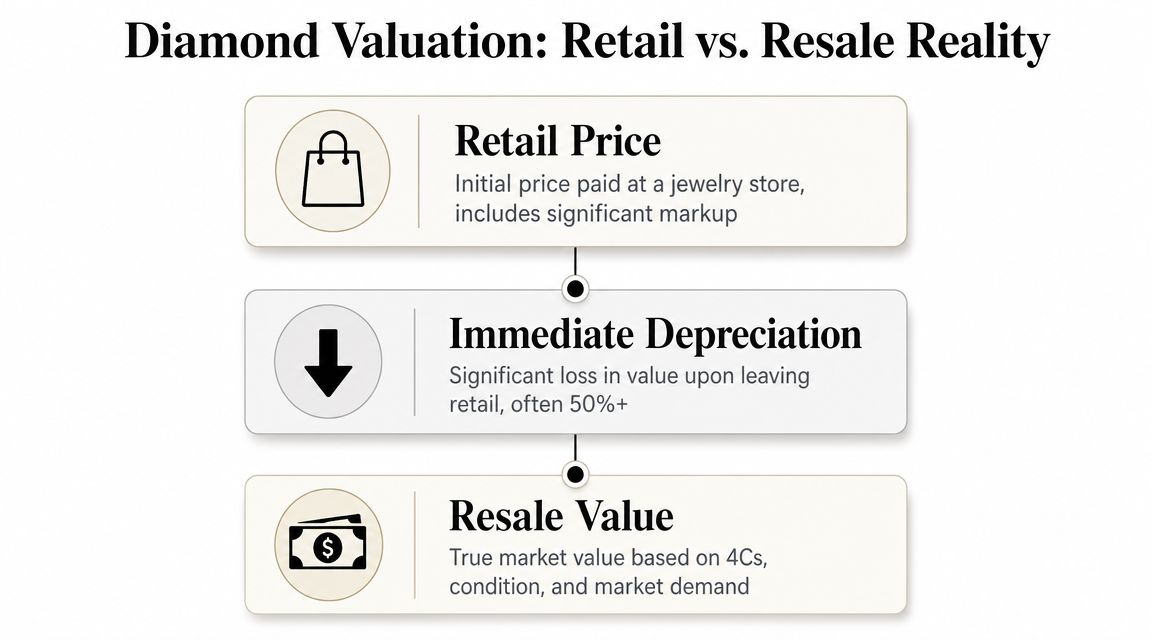
That is why sellers who compare several bids tend to handle the process better than sellers who anchor to an insurance number or a memory of what was paid years ago.
How the 4Cs affect a real offer
Buyers don't value a diamond by sentiment. They look at the 4Cs, and they do it through a resale lens.
Cut: Cut drives light performance and visual appeal. Two diamonds with similar carat weight can attract very different offers if one presents better.
Color: Color matters because it changes how broadly the stone appeals in the market.
Clarity: Clarity influences both rarity and salability, but only to the extent that buyers in the target market care about the difference.
Carat weight: Weight matters, but exact weight matters more than many sellers realize, especially around category thresholds.
A seller who understands these basics can ask better questions. Why was the offer adjusted for fluorescence, shape, or condition? Is the quote based on a mounted estimate or an exact loose weight? Those are stronger questions than asking whether the buyer can "do better."
A serious offer should connect back to the stone's measurable characteristics, not vague language.
If you want a clearer baseline before speaking with buyers, this guide on how much a diamond is worth gives useful context on the pricing factors buyers focus on.
Where demand is strongest
Broad market demand also shapes liquidity. Market analysis projects the global diamond jewelry market at about $115.44 billion in 2026 and $167.93 billion by 2032, with a projected 6.30% CAGR. That same analysis says engagement and bridal jewelry account for roughly 70% to 80% of global diamond jewelry sales, and about half of global consumer demand comes from the U.S., with more than half in 2022 during an unusual year. It also notes that loose lab-grown diamonds increased in value share from 8.3% in 2020 to 17.3% in 2022 (diamond jewelry market analysis and demand mix).
For a seller in Atlanta, Buckhead, Sandy Springs, Alpharetta, Roswell, Brookhaven, Midtown Atlanta, or the broader Georgia market, that matters in practical terms. Certified natural diamonds in classic bridal categories usually have the deepest buyer pool. Unusual shapes, niche designs, or stones without documentation can still sell, but they often require more targeted positioning.
Loose Stone or Intact Jewelry Which Sells Better
This is the decision most guides rush past. They shouldn't. Selling the ring and selling the diamond are sometimes two different transactions hiding inside one piece of jewelry.
When keeping the ring intact makes sense
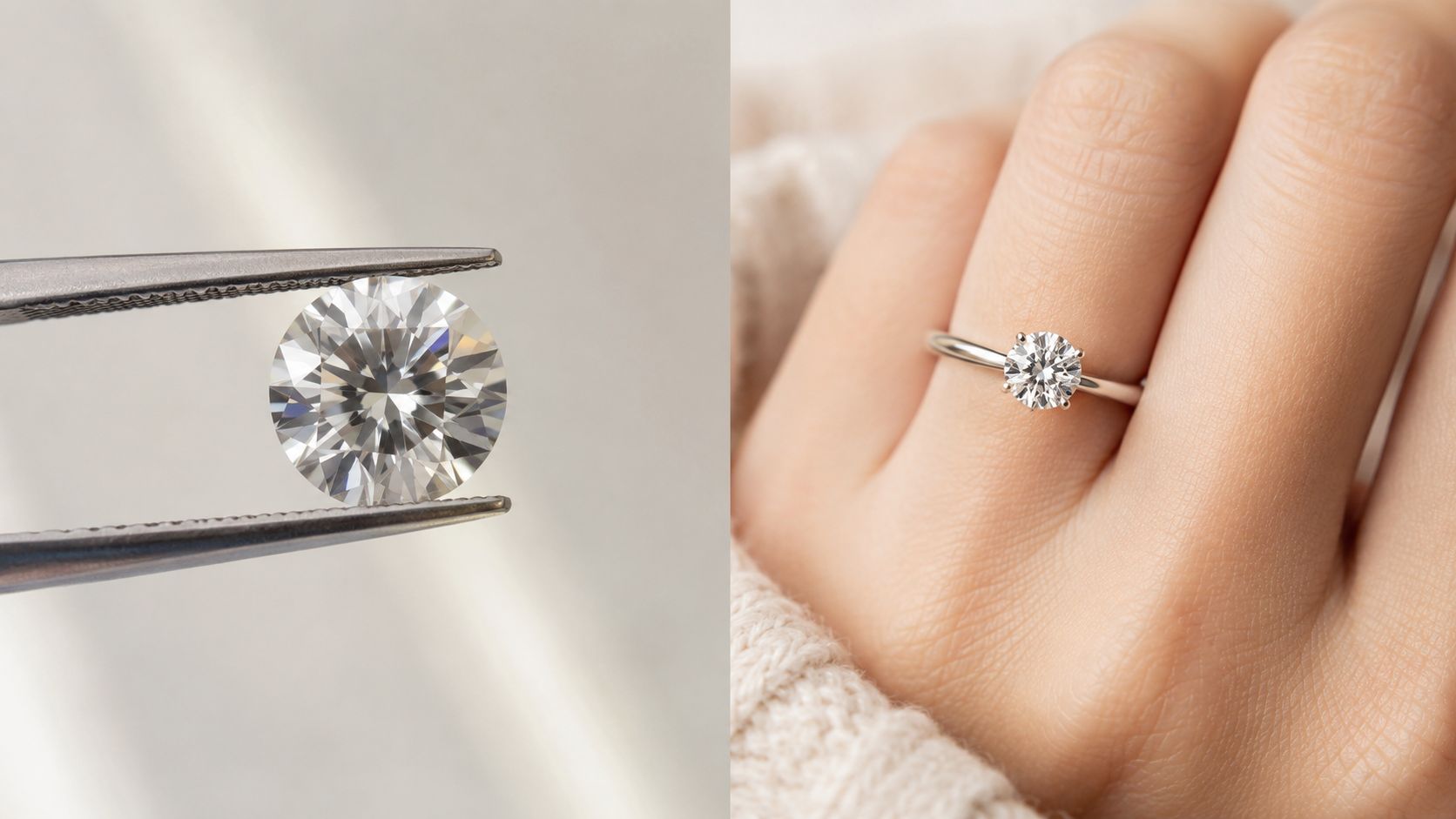
If the setting itself carries value, separating the stone can destroy part of what a buyer wants. The American Gem Society notes that buyers may value the gemstone and metal separately, but sellers may do better keeping the piece intact when the setting is branded, antique, or designer, such as Cartier or Van Cleef & Arpels (guidance on selling jewelry or diamonds).
That usually applies in three situations:
Designer mountings: The brand identity matters.
Antique or estate pieces: The craftsmanship and period style matter.
Cohesive signed jewelry: Collectors want the complete object, not loose components.
If you're unsure whether your stone is the main value driver or whether the piece has broader jewelry value, understanding what makes a diamond genuine can help separate authenticity questions from resale strategy.
When removing the stone can improve the quote
A generic modern setting often doesn't add much beyond metal value. In that case, a buyer may quote the center diamond as the main asset and treat the mounting separately.
That's often the cleaner route when:
The ring is a standard solitaire or halo with no brand premium.
The center stone is clearly the most important component.
The mounting makes it hard to confirm exact weight or inspect the stone fully.
You want a specialist diamond price instead of a blended jewelry quote.
A mounted ring can hide useful information. A loose stone lets the buyer assess weight, measurements, and grading with less guesswork.
The right answer depends on the item, not on a rule of thumb. When sellers ask me how to sell diamonds for the strongest net result, I usually tell them to evaluate the jewelry as two assets first, the stone and the mounting, and only then decide whether they should travel together.
Choosing Your Best Path to Sale A Channel Comparison
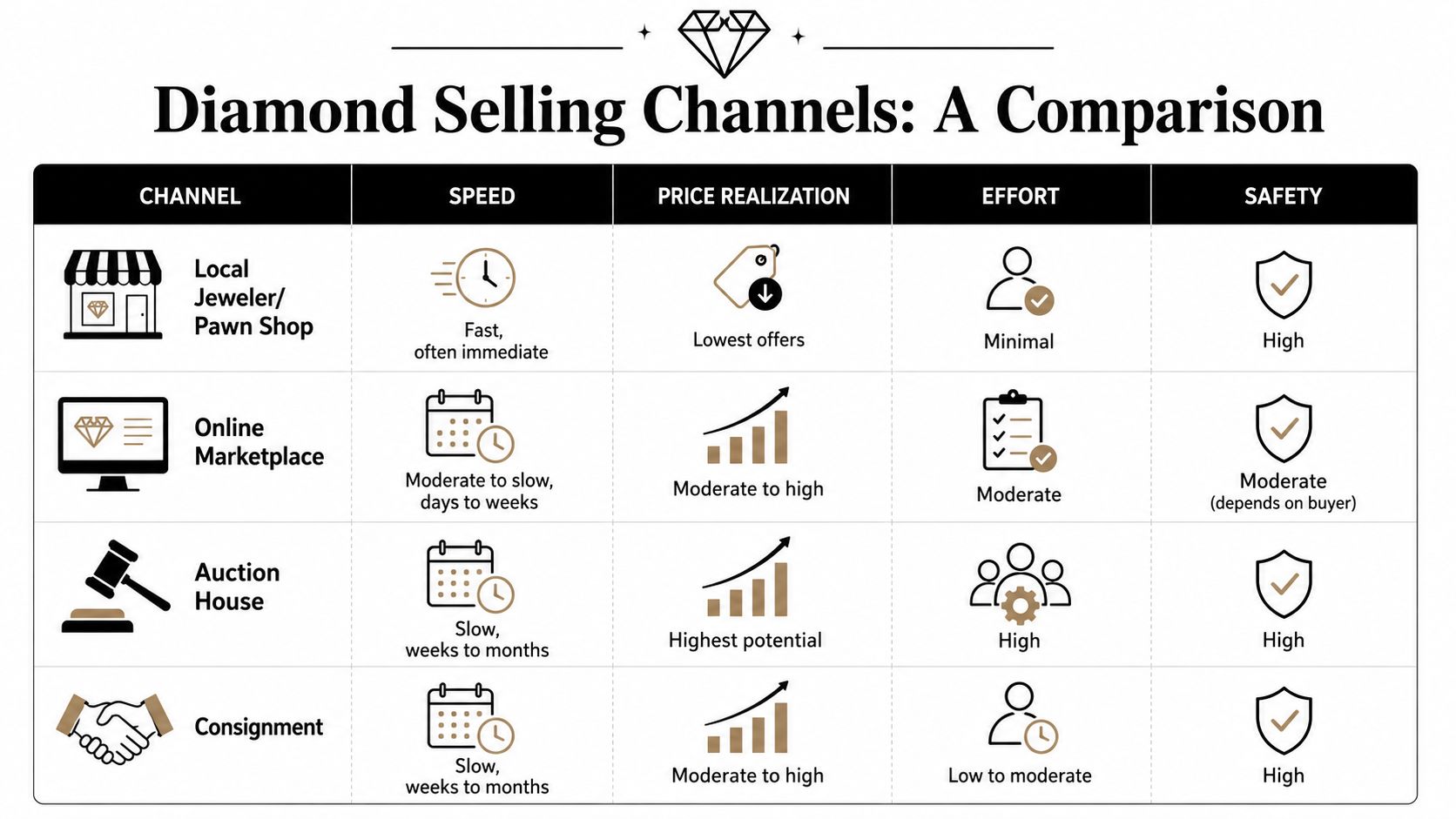
A seller with a one carat diamond ring can get very different results depending on where it goes next. One buyer sees a fast-turn center stone. Another sees a complete piece of jewelry. A third sees a consignment item that may sit for weeks. Channel choice changes the outcome almost as much as the diamond itself.
Match the channel to the asset
This is the part many sellers skip. They compare buyers before they decide what they are asking the buyer to purchase.
If your strongest value is in the center diamond, a direct diamond buyer usually gives the clearest answer. If the piece has designer, antique, or signed-jewelry appeal, an auction house, broker, or jewelry-focused consignment partner may present it better to the right audience. The wrong channel can flatten the value of a good item. A rare estate ring shown to a stone buyer may be priced too narrowly. A commercial round brilliant listed at auction may collect fees without gaining enough bidding interest to justify the wait.
Sotheby's explains the trade-off well in its overview of selling diamonds through auction, marketplace, or private sale. Sellers need to compare speed, fees, and final net proceeds rather than focusing only on the headline offer.
A short explainer can help if you're weighing channel options:
Diamond Sales Channel Comparison
Channel | Payout Potential | Sale Speed | Security Level |
|---|---|---|---|
Direct specialist buyer | Often strong for well-documented diamonds and straightforward resale goods | Usually fast | Generally strong when handled through an established business |
Auction house or broker | Better suited to rare stones, signed pieces, or jewelry with collector demand, though fees affect the net result | Slower | Usually structured, with formal procedures and more paperwork |
Consignment | Can support a higher asking price, but payment depends on when the item sells and on the contract terms | Slow to variable | Depends on the store, insurance terms, and payout policy |
Online marketplace | Broad exposure, but the seller does the work and takes on more screening and transaction risk | Variable | Depends on platform protections, payment method, and buyer quality |
Which route fits your priorities
Direct specialist buyers fit sellers who want a clear offer, a shorter timeline, and less operational hassle. That route also works well when the stone should be evaluated on its own merits, especially if you already know whether you are selling the diamond loose or leaving it mounted. In practice, this is often the cleanest option for standard solitaires, halo rings without brand premium, and loose certified stones.
Auction and brokerage channels make more sense when scarcity or presentation can create competition. Fancy shapes with unusual size or color, branded jewelry, and period pieces can justify the slower process. The trade-off is control. You may wait longer, pay more in fees, and still end up with a net figure that is only modestly better, or sometimes worse, than a direct offer.
Consignment sits in the middle. It can work for sellers who are patient and comfortable tying up the item for an uncertain period. Read the contract closely. Check who sets the price, who can approve discounts, how insurance is handled, and when you are paid after a sale.
Online marketplaces offer reach, but they ask the most from the seller. You need sharp photography, accurate grading details, prompt communication, fraud awareness, and a clear return policy. For many first-time sellers, that labor and risk offset the chance of a higher asking price.
If you want a broader look at how these channels work across diamonds, estate pieces, and signed jewelry, this guide on where to sell fine jewelry is a useful comparison. Antwerp Diamond is one example of a direct-buyer option for sellers who want an in-person evaluation or a remote submission without using auction or open marketplace channels.
Finalizing the Sale Securely and Confidently
At the finish line, details matter. A fair price can still turn into a bad transaction if the payment method, shipping process, or documentation is sloppy.
Negotiate from facts, not from emotion
A good negotiation isn't dramatic. It is specific.
Ask what the buyer is basing the offer on. Is it the report grade, an in-house condition check, current demand for that shape, or the fact that the stone is mounted? If you've done the preparation work, you'll be able to tell whether the explanation makes sense.
Useful seller habits include:
Ask for the logic: Why is the buyer pricing it as jewelry, as a loose stone, or as materials?
Compare more than one offer: Different buyers specialize in different inventory.
Stay realistic: The market decides the range, not the original proposal from the retail counter.
Know when to walk away: Pressure tactics usually signal a process problem.
The strongest sellers are calm, prepared, and willing to leave without forcing a deal.
How to handle shipping, payment, and in person appointments
For remote sales, seller guidance recommends insured shipping for the full sale amount, signature confirmation, and waiting until payment has fully cleared before shipping to the buyer. The same guidance stresses detailed documentation of the 4Cs, measurements, metal type, condition, and multiple clear photos under natural light to reduce lower offers and avoidable disputes (safe online diamond selling checklist).
That advice is practical because disputes usually start with uncertainty. Missing dimensions, weak images, or vague descriptions leave room for renegotiation after the item arrives.
If you're meeting in person in the greater Georgia market, choose a private professional setting. Buckhead, Atlanta, Roswell, and nearby areas give sellers access to established luxury buyers, but the setting still matters. A private appointment, a written offer explanation, and secure payment methods are all worth asking for.
For people comparing remote and local selling processes, guidance used for online watch buyers also applies in principle to diamonds: document the item carefully, verify the process before shipping, and don't release possession until the payment side is settled.
Frequently Asked Questions About Selling Diamonds
Do I need a certificate to sell a diamond?
No, but it usually helps. A current grading report makes the sale easier because it reduces uncertainty for the buyer. Without one, expect the buyer to rely more heavily on in-person evaluation.
Can I sell an inherited diamond with no paperwork?
Yes. Start with an independent appraisal or evaluation so you know what you have. Inherited pieces often sell just fine, but missing documentation means the item has to prove itself through condition, grading, and marketability.
Should I sell to a jeweler, auction house, or private buyer?
It depends on your priorities. If you need speed and simplicity, a direct buyer often makes sense. If the piece is rare or strongly collectible, a slower route may deserve consideration.
Will I owe tax when I sell a diamond?
Tax treatment depends on your situation, where you live, and whether there is a gain or loss. This is not tax advice. It's smart to ask a qualified tax professional if the transaction is significant.
What if the diamond is mounted in a ring?
That can help or hurt, depending on the setting. Designer, antique, or signed mountings may be worth preserving. Generic settings often lead buyers to focus mainly on the center stone and the metal separately.
If you want a professional opinion before making a decision, you can contact Antwerp Diamond for a no-pressure evaluation. A private review can help you understand whether your diamond should be sold loose or in its setting, how buyers are likely to price it in the current market, and which sale route fits your timeline in Atlanta and the wider Georgia market.