
Understanding the Estate Jewelry Appraisal: Purpose and Value Types
An estate jewelry appraisal evaluates inherited fine jewelry to determine its Fair Market Value (FMV) for probate, estate tax compliance, or equitable division among heirs. Performed by a certified, USPAP-compliant appraiser, this formal valuation establishes what an item would realistically sell for between a willing buyer and seller on the secondary market. In the gemological trade, "estate jewelry" encompasses any previously owned fine jewelry—ranging from modern second-hand pieces to antique heirlooms over a century old.
When executing an estate or settling a family trust, you cannot rely on a one-size-fits-all valuation. Different legal and commercial situations require completely different valuation standards. Using an insurance replacement figure for your tax filings could trigger an inflated, unnecessary tax bill, while presenting scrap melt calculations during probate could result in disputes among heirs.
Knowing what is fine jewelry versus fashion pieces is the first step, but establishing the legal baseline comes down to selecting the correct definition of value.
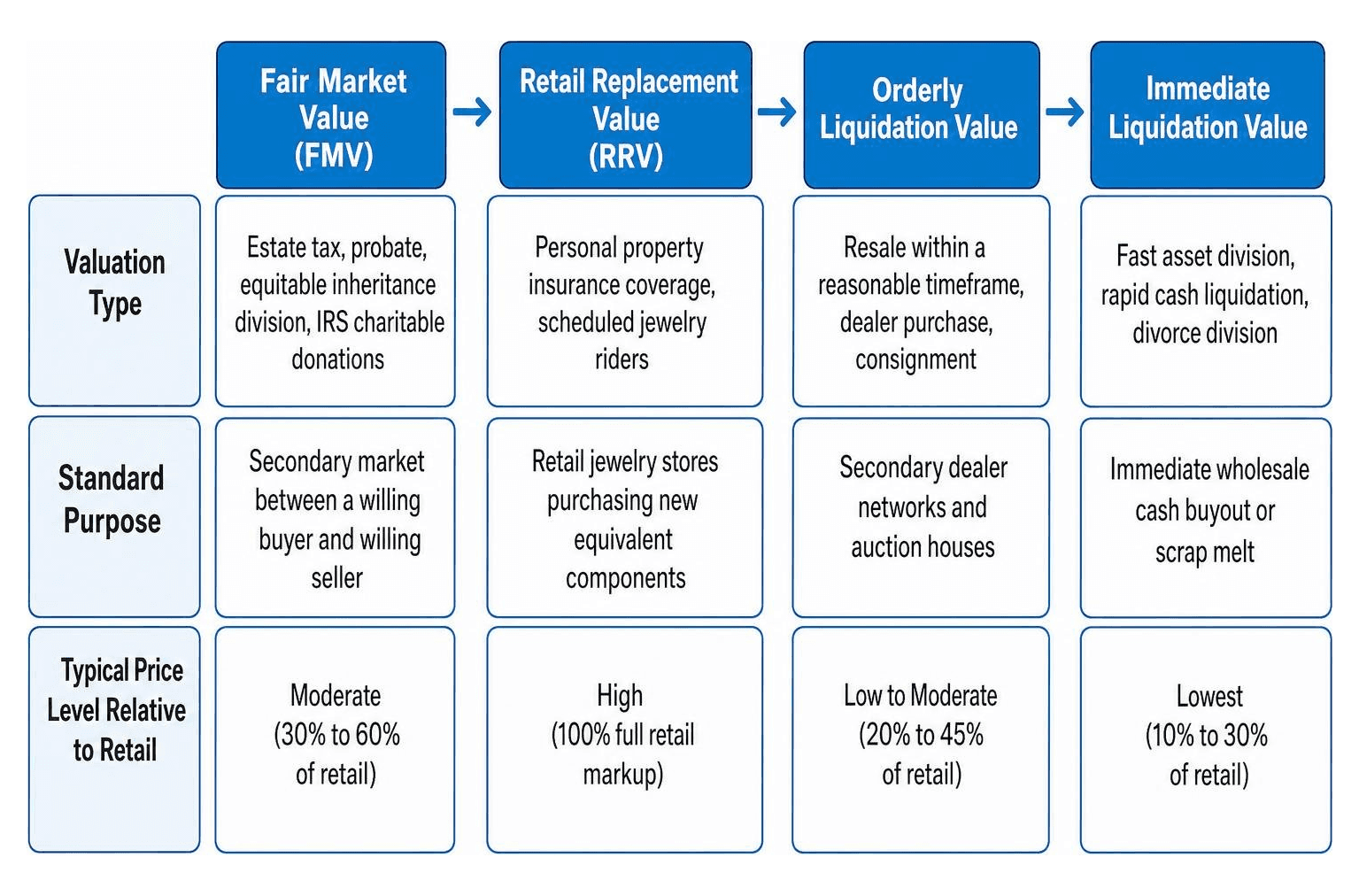
Valuation Type | Standard Purpose | Market Context | Typical Price Level Relative to Retail |
|---|---|---|---|
Fair Market Value (FMV) | Estate tax, probate, equitable inheritance division, IRS charitable donations | Secondary market between a willing buyer and willing seller | Moderate (30% to 60% of retail) |
Retail Replacement Value (RRV) | Personal property insurance coverage, scheduled jewelry riders | Retail jewelry stores purchasing new equivalent components | High (100% full retail markup) |
Orderly Liquidation Value | Resale within a reasonable timeframe, dealer purchase, consignment | Secondary dealer networks and auction houses | Low to Moderate (20% to 45% of retail) |
Immediate Liquidation Value | Fast asset division, rapid cash liquidation, divorce division | Immediate wholesale cash buyout or scrap melt | Lowest (10% to 30% of retail) |
Fair Market Value vs. Insurance Replacement Value in an Estate Jewelry Appraisal
The most common trap for executors is mixing up Fair Market Value (FMV) and Retail Replacement Value (RRV).
Retail Replacement Value is calculated for insurance underwriting. It reflects what it would cost to walk into a traditional brick-and-mortar jewelry showroom today and manufacture a brand-new replica of the lost or stolen piece, complete with retail markups, labor, overhead, and insurance carrier margins.
By contrast, Fair Market Value is the legal benchmark defined by IRS Publication 561 and IRS Revenue Procedure 66-49. Under these standards, FMV represents the price at which property would change hands between a willing buyer and a willing seller, neither being under any compulsion to buy or to sell, and both having reasonable knowledge of relevant facts. It takes into account historical wear, the secondary market, and actual realized prices from recent comparable auctions.
When filing estate tax returns or distributing pieces equitably among beneficiaries, obtaining a formal FMV assessment ensures you do not artificially inflate the estate's overall taxable value.
Liquidation Value for Divorce, Quick Settlement, and Resale
Liquidation value reflects what you can realistically walk away with in cash when time is limited. In divorce proceedings, bankruptcy settlements, or situations where heirs prefer immediate funds over holding onto heirlooms, appraisers determine either orderly or immediate liquidation value.
Immediate liquidation values take into account wholesale buying margins, refining fees for melting down precious metals, and the current secondary demand for loose gemstones. Using tools like a diamond resale value calculator can give you a baseline of loose stone wholesale values, but an appraiser evaluates the structural and collectible merit of the complete piece.
A piece's intrinsic metal worth serves as a pricing floor, but true market liquidation considers whether the item can be resold as a wearable finished piece or strictly as raw scrap metal.
Key Factors That Determine Estate Jewelry Worth
When an appraiser examines an estate piece, they do not just look at its shine. A comprehensive evaluation requires forensic gemology and historical market analysis. According to insights from this estate jewelry value guide, seasoned collectors and appraisers look closely at the subtle interplay between manufacturing techniques, physical condition, and brand provenance.
Precious Metals, Hallmarks, and Maker Signatures
Precious metal content provides the intrinsic baseline for any piece of fine jewelry. Appraisers check purity stamps (such as 14K, 18K, 750, 950 Plat, or historic assay office hallmarks) to determine the exact percentage of pure gold, platinum, or silver.
However, maker marks and signatures can elevate a piece well above its raw metal weight:
Signed Designer Jewelry: Iconic jewelry houses like Cartier, Tiffany & Co., Van Cleef & Arpels, David Webb, and Buccellati command substantial premiums on the secondary market. A signed 18k gold vintage bracelet can easily fetch three to ten times its melt value due to collector demand.
Assay & Guild Marks: European hallmarks, maker cartouches, and patent stamps help establish chronological production dates and authenticate origin.
Condition & Structural Integrity: Alterations, resized shanks that clipped hallmarks, lead-solder repairs, and missing accent stones directly affect overall market value. Original, unaltered pieces with crisp hallmarks always command top dollar.
Gemstone Quality, Diamond Cuts, and Era Identification
The historical era of an heirloom plays a major role in its desirability and market value. Historical timeframes each showcase distinctive diamond cutting styles and manufacturing hallmarks:
Victorian Era (1837–1901): Often features yellow gold or silver-topped gold, romantic motifs, rose cuts, and old mine cut diamonds with small tables and open culets.
Edwardian Era (1901–1915): Known for intricate platinum filigree, delicate milgrain borders, and early old European cut diamonds.
Art Deco Era (1920–1935): Emphasizes geometric symmetry, calibré-cut accent stones, platinum mountings, and early transitional diamond cuts.
Retro & Mid-Century (1940s–1960s): Characterized by bold, sculptural rose and yellow gold cocktail mountings set with rubies, sapphires, and larger center diamonds.
Evaluating vintage pieces also extends to historical timepieces, where a proper vintage watch valuation considers original dials, movement reference numbers, case unpolished status, and factory service history. For gemstones, appraisers must also determine whether colored stones have undergone heat treatments, fracture filling, or oiling, all of which heavily influence secondary market pricing.
How to Choose a Qualified Appraiser and What to Expect
In the United States, there are currently no state or federal licensing laws mandating specific educational credentials for jewelry appraisers. Because anyone can legally hang a shingle and declare themselves an appraiser, selecting a certified professional is critical.
To protect yourself and your estate, always look for the following credentials:
Gemological Competence: Look for a Graduate Gemologist (G.G.) diploma from the Gemological Institute of America (GIA) or its equivalent (FGA). This ensures the evaluator can accurately distinguish natural stones from lab-grown synthetics, identify treatments, and grade the 4Cs.
Appraisal Society Accreditation: Choose an independent jewelry appraiser certified by recognized appraisal organizations like the National Association of Jewelry Appraisers (NAJA) or the American Society of Appraisers (ASA). These associations require testing in appraisal methodology, valuation theory, and market research.
USPAP Compliance: The Uniform Standards of Professional Appraisal Practice (USPAP) represents the recognized ethical and performance standards across North America. The IRS strictly mandates that tax-related appraisals be completed by a "qualified appraiser" adhering to USPAP guidelines.
FTC Adherence: The Federal Trade Commission strictly regulates commercial jewelry descriptions and prohibits deceptive, inflated valuations.
The Step-by-Step Estate Jewelry Appraisal Process and Cost Breakdown

When you schedule an estate valuation, the process follows a structured path. Understanding the workflow helps you navigate the appointment with confidence and keeps costs predictable. For more details on preparation, check out our jewelry appraisal tips 2026.
Turnaround time for a multi-piece estate collection generally ranges from 2 to 7 business days, depending on how much historical research and gemological testing is required.
In terms of pricing, professional appraisers charge either by the hour or a flat rate per item. You should never work with an appraiser who charges a percentage of the jewelry's appraised value—this practice creates a direct conflict of interest, incentivizes inflated numbers, and violates USPAP ethics. Standard industry rates range from $50 to $150 per single item, or $150 to $300+ per hour for comprehensive multi-piece estate collections.
Preparing Inherited Pieces and Essential Documentation
Before heading into your appointment, keep these practical tips in mind:
Do Not Clean Antique Pieces Aggressively: Avoid harsh household chemicals or ultrasonic cleaners. You risk dislodging loose gems or stripping away desirable natural patina from vintage silver and gold.
Bring Everything Unsorted: Many families accidentally tuck valuable platinum or high-karat gold pieces into costume jewelry boxes, or mistake fine Victorian glass paste for diamonds. Let the gemologist do the sorting in front of you.
Gather Supporting Paperwork: Bring along any original sales receipts, old insurance policies, box packaging, or prior certificates. A vintage piece paired with a historic gia ring appraisal or original brand warranty card can add immediate credibility and provenance value.
Appraising Without Paperwork: If you have zero documentation, do not worry. A seasoned gemologist uses electronic metal testers, specific gravity balances, refractometers, and gemological microscopes to identify metal fineness, calculate diamond carat weights in their mountings, and confirm authenticity from scratch.
When to Reappraise and How Valuation Compares to Selling Cash Value
Jewelry appraisals are not permanent records; they are snapshots of dynamic financial markets on a specific date. Precious metal spot prices fluctuate daily, while gemstone markets shift with changes in consumer demand and supply.
Most major insurance carriers suggest updating retail replacement appraisals every three to five years. If an appraisal is decades old, you run two distinct risks: you may be drastically underinsured if precious metal prices have spiked, or you may be overpaying monthly insurance premiums on an inflated, outdated retail quote.
Appraisal Value vs. Realized Resale Cash Offers
One of the hardest moments for heirs is realizing that an appraisal document stating a "$10,000 replacement value" does not mean a buyer will hand over a check for $10,000.
When you decide on selling inherited jewelry, you enter the secondary resale market. Retail replacement appraisals include original design licensing, master goldsmith labor, gallery retail markups, marketing budgets, and profit margins.
When you sell, dealers purchase based on what they can realistically resell the item for in the secondary wholesale or dealer-to-dealer network, minus their carrying costs, refurbishment expenses, and necessary profit margins. Knowing where to sell fine jewelry allows you to bypass middleman fees and secure transparent, market-based cash offers based on real-time collector demand.
Frequently Asked Questions About Estate Jewelry Appraisals
How much does a professional estate jewelry appraisal cost?
Professional appraisal fees typically run between $50 to $150 per individual piece, or $150 to $300 per hour for larger estate collections requiring extensive research. Fees depend on the complexity of the mountings, the number of gemstones that need measuring and grading, and whether the assignment requires USPAP-compliant reporting for federal tax or court proceedings.
Can estate jewelry be appraised without original receipts or certificates?
Yes. Qualified gemologists regularly appraise heirloom collections without any original receipts or grading reports. Using specialized gemological tools—including binocular microscopes, refractometers, spectroscopes, and non-destructive precious metal testers—an appraiser can accurately identify the metal purity, grade the gemstones, calculate carat weights in their settings, and evaluate maker hallmarks.
How often should an executor or heir update an estate appraisal?
If an inherited collection is kept for personal use and scheduled on an insurance policy, reappraisals should be completed every 3 to 5 years. For formal probate and estate tax purposes, the appraisal must reflect the Fair Market Value on the exact date of the decedent's passing (or the alternate valuation date six months later), which does not require recurring updates unless the estate settlement spans multiple tax years.
Conclusion
Managing an inherited jewelry collection comes with significant legal, financial, and emotional responsibilities. As an executor or heir, securing the correct type of appraisal protects you against tax complications, guarantees fair and amicable distribution among family members, and ensures valuable heirlooms are properly documented.
If your ultimate goal is turning inherited pieces into liquid funds without the hassle of formal legal paperwork, we are here to help. At Antwerp Diamonds in Atlanta, GA, we buy fine jewelry, luxury watches, diamonds, and designer accessories directly for cash. We provide private, appointment-only consultations, free evaluations, transparent market-driven valuations, and immediate payouts without hidden fees or consignment delays.
Whether you need to liquidate an entire estate collection or learn more about how to appraise jewelry, our experienced team gives you the clear, straightforward guidance you need to make informed financial decisions.