

Understanding Jewelry Appraisal Types and Valuation Standards
When seeking a jewelry appraisal, understanding that a single item can have several different values depending on the document's purpose is vital. An appraisal is not a fixed universal price tag; it is an expert valuation calculated for a specific market standard. Obtaining an evaluation without understanding its intended function can result in mismatched coverage or unexpected tax issues.
Choosing the wrong valuation standard can lead to serious financial issues—such as overpaying on insurance premiums due to inflated replacement figures or unexpected tax penalties from improper valuations.
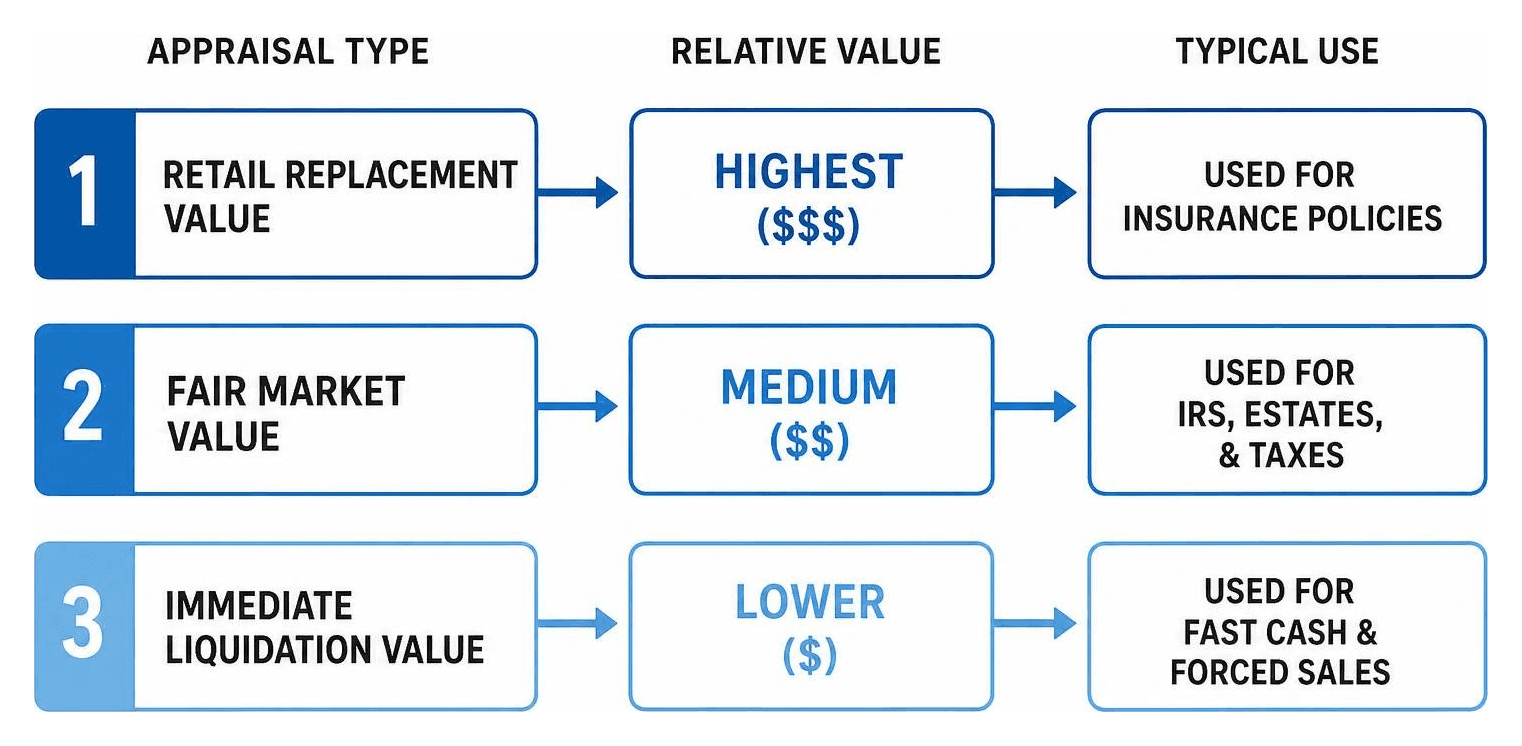
Insurance Replacement Value (Retail)
This is the most common appraisal type for personal property. Insurance replacement value estimates the total cost required to rebuild or replace an item with a brand-new equivalent of equal quality in a traditional retail jewelry store.
Because this figure covers retail markups, detailed labor costs, custom craftsmanship, and potential sales tax, it represents the highest monetary valuation for a piece. Insurance policies use this figure to schedule riders for high-value items. If you want to learn more about how components like metal setting and gemstone quality factor into these values, check out our guide on How To Appraise Jewelry.
Fair Market Value (FMV)
Fair market value represents the price that a willing buyer and a willing seller would reasonably agree upon in an open, competitive market, where neither party is under compulsion to buy or sell and both have reasonable knowledge of relevant facts.
This valuation reflects the used or pre-owned secondary market value rather than retail replacement costs. The IRS strictly requires fair market value for estate tax filings (IRS Form 706), divorce property settlements, and non-cash charitable donations over $5,000 (IRS Form 8283).
Immediate Liquidation Value
Liquidation value represents the net cash price an owner can expect to receive during a rapid, forced sale under severe time constraints. This standard is frequently utilized in bankruptcy proceedings, urgent debt liquidations, or legal dispute settlements. It reflects wholesale liquid cash values rather than retail or secondary market prices.
Appraisal Type | Intended Legal Purpose | Typical Market Level | Expected Price Level |
|---|---|---|---|
Insurance Replacement | Insurance scheduling & policy protection | Full retail jewelry store | Highest valuation |
Fair Market Value | IRS taxes, estate division, charitable donations | Secondary resale / auction market | Moderate valuation |
Immediate Liquidation | Bankruptcy, urgent settlements, forced liquidations | Wholesale / cash-buyer market | Conservative valuation |
What Information Is Included in a Jewelry Appraisal Report?
A compliant, professional jewelry appraisal report must provide a complete, defensible record of your item. Under standard industry frameworks—such as the Uniform Standards of Professional Appraisal Practice (USPAP) Standards 7 and 8—a formal report should clearly detail:
Gemstone Quality & Analysis: Exact millimeter measurements, color grade, clarity grade, cut quality, and calculated carat weight. It must detail whether stones are natural, lab-grown, or treated with heat or fracture filling.
Precious Metal Purity: Metal type (e.g., platinum, 14k gold, 18k gold) verified through acid or XRF testing, alongside verified hallmark stamps.
Item Description & Mounting Details: Construction type (custom, cast, die-struck), setting styles, metal weight in grams or pennyweights, and overall wear and physical condition.
Visual Documentation & Plotting: High-resolution color photographs and gemstone plotting diagrams showing internal inclusions, structural characteristics, or surface blemishes.
Valuation & Appraiser Credentials: The explicit valuation standard used, effective date, appraiser signature, and national accreditation status.
Can You Rely on an Online Jewelry Appraisal?
The rise of digital valuation tools and artificial intelligence has made virtual evaluations appealing. Online AI tools can offer rapid estimates in 20 to 30 seconds for around $13 to $26 per item, making them convenient for satisfying basic curiosity.
However, remote estimates cannot replace hands-on gemological inspections. An appraiser viewing photos online cannot accurately determine precious metal purity, verify exact diamond carat weights, test gemstone fluorescence, or detect hidden structural flaws and microscopic stone chips.
Major insurance carriers, the IRS, and legal courts rarely accept AI-generated or purely remote documents. For formal coverage or legal protection, an in-person, hands-on evaluation by a certified appraiser is indispensable. For high-end horology, online evaluations follow specific parameters; explore our resource on Watch Appraisal Online to learn more.
Finding Qualified Appraisers and Navigating Legal Guidelines
Choosing a trustworthy evaluator requires understanding appraiser credentials. Surprisingly, in the United States, there are currently no federal or state licensing requirements to practice as a jewelry appraiser. Anyone can print a business card and claim to offer appraisal services regardless of background.
Therefore, consumer diligence is essential. You must independently verify that an appraiser holds appropriate gemological training and accredited valuation credentials.
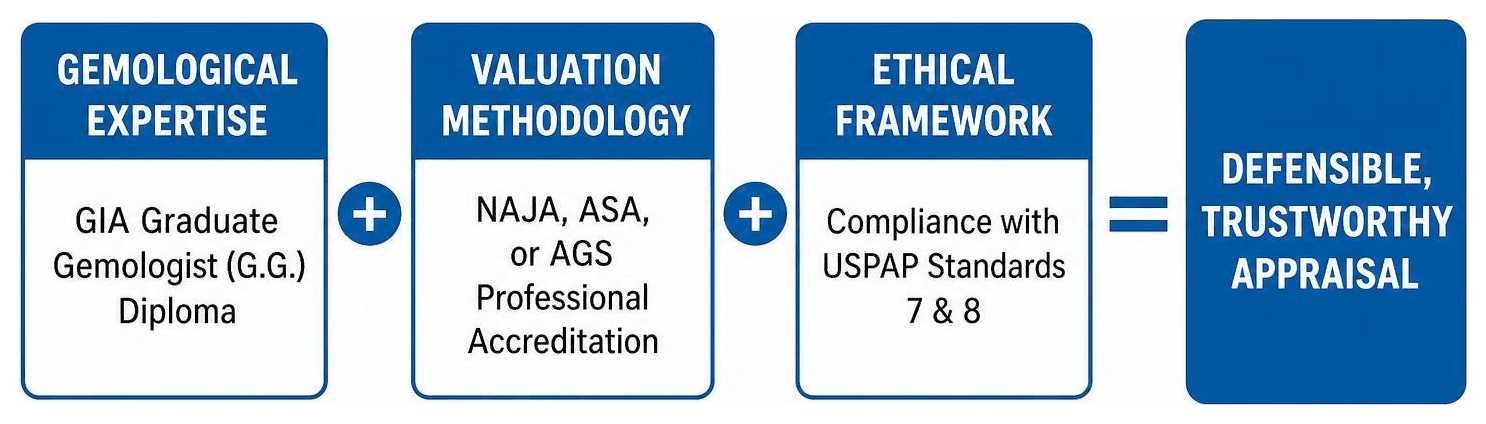
Look for professionals holding a Graduate Gemologist (G.G.) diploma from the Gemological Institute of America (GIA) or equivalent training from top gemological laboratories. This ensures scientific competency in identifying gemstones, synthetic materials, and treatments.
Additionally, ensure your appraiser holds accredited membership in a recognized appraisal association, such as:
National Association of Jewelry Appraisers (NAJA): The only national US appraisal organization dedicated exclusively to fine gems, jewelry, and watches, upholding strict continuing education mandates.
American Society of Appraisers (ASA): Recognized globally for strict standards, offering formal appraisal methodology courses such as the ASA Core Principles.
American Gem Society (AGS): Highly regarded for rigorous ethical standards, expert title certifications, and independent gemological laboratories.
Working with an Independent Jewelry Appraiser who does not buy or sell jewelry eliminates direct conflicts of interest, ensuring an unbiased appraisal report.
Difference Between Diamond Grading Reports and Appraisals
A common area of confusion for consumers is mixing up a laboratory diamond grading report with a jewelry appraisal.
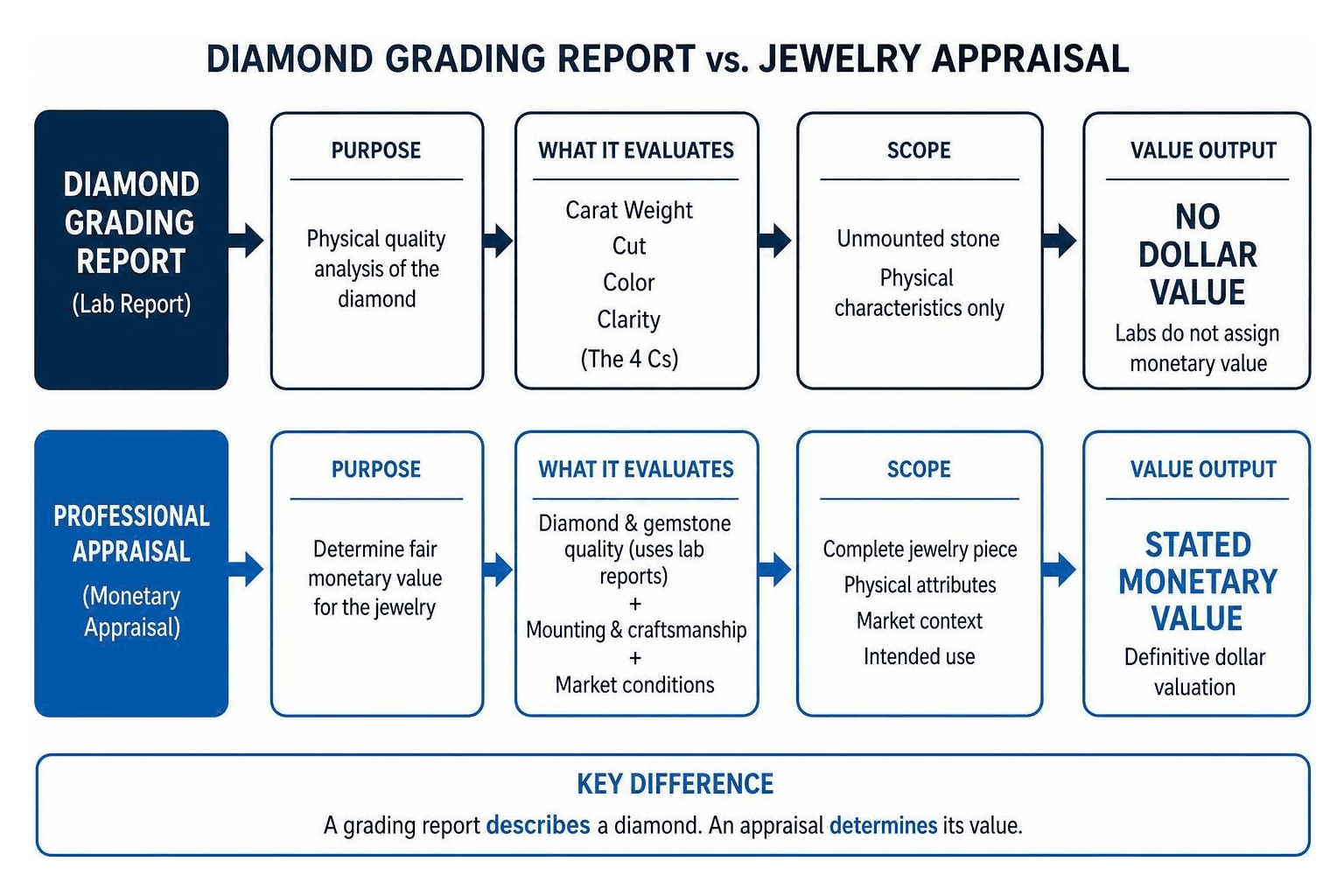
A diamond grading report (issued by independent labs like GIA, AGS, or IGI) evaluates the physical characteristics of an unmounted stone—specifically its carat weight, cut, color, and clarity (the 4 Cs). Laboratories never assign a monetary dollar value to a stone on a grading report.
Conversely, a jewelry appraisal translates physical qualities, mounting craftsmanship, metal content, and current market conditions into a definitive dollar valuation. Appraisers utilize laboratory grading reports as foundational evidence to calculate precise values; if you want to understand these underlying market calculations, try our tool to Calculate Diamond Price.
Jewelry Appraisal Cost Factors and Updating Schedules

Understanding fee structures ensures you pay a fair price for appraisal services. Standard single-item written appraisals typically range from $100 to $250, while hourly rates for complex collections or large estates generally run between $150 and $350 per hour.
Several operational factors influence total appraisal pricing:
Item Complexity & Labor: An intricate Art Deco brooch featuring dozens of pavé-set diamonds and colored gemstones requires significantly more testing and measurement time than a smooth 14k gold band.
Carat Weight & Liability: Larger diamonds (such as a 5-carat stone vs. a 0.50-carat stone) carry increased liability risks and deeper examination requirements for internal inclusions, often resulting in tiered fee structures.
Appraiser Qualifications: Senior appraisers holding master credentials command higher hourly fees due to decades of specialized expertise and advanced laboratory equipment.
Purpose & Legal Depth: Comprehensive reports for IRS estate tax filings or court expert witness testimony require extensive market research and carry higher costs than standard insurance schedules. For estate collections, review our dedicated guide to Estate Jewelry Appraisal.
Insurers generally recommend updating written appraisals every 3 to 5 years. Precious metals like gold, platinum, and fine gemstone prices fluctuate substantially over time, leaving outdated policies vulnerable to underinsurance during claims. Updates usually cost roughly 50% of the initial appraisal fee.
Frequently Asked Questions About Jewelry Valuation
How often should I update a jewelry appraisal for insurance?
You should update your jewelry appraisals every 3 to 5 years. Market values for gold, platinum, and high-grade diamonds fluctuate continuously. Maintaining current reports ensures your insurance policy covers the full replacement cost if an item is lost, stolen, or damaged.
Is an appraisal value the same as the cash resale price?
No. An insurance replacement appraisal reflects full retail retail prices for a brand-new item. Cash resale prices reflect immediate secondary market demand. To estimate what your item might yield on the resale market, use our Diamond Resale Value Calculator.
Why are percentage-based appraisal fees illegal?
Under Federal Trade Commission (FTC) guidelines and professional ethical rules (like USPAP), charging a percentage fee based on an item's appraised value creates an unethical conflict of interest. An appraiser motivated by a percentage fee has an incentive to artificially inflate valuations. Legitimate appraisers charge flat per-item fees or hourly rates.
Conclusion
A professional jewelry appraisal serves as a financial safety net for your meaningful fine jewelry, heirlooms, and luxury watches. By matching the right valuation standard to your financial goals and selecting an accredited, USPAP-compliant gemologist, you ensure your valuation is defensible, precise, and secure.
When you are ready to convert fine jewelry, diamonds, or luxury timepieces into immediate funds, understanding retail replacement versus cash resale value is key.
At Antwerp Diamond Store, we buy luxury watches, fine jewelry, and designer items for cash. We offer free evaluations, transparent market-based offers, and immediate payouts through a private, appointment-only process designed around your privacy and convenience. Contact our team today to evaluate your luxury items with confidence.