Current Price of Diamonds: Quick Market Answer
The current price of diamonds depends on the stone's carat weight, cut, color, clarity, shape, grading report, and whether the figure is a wholesale asking price, retail listing price, or resale offer.
For a quick August 2026 benchmark:
Natural diamond benchmark | Typical current price |
|---|---|
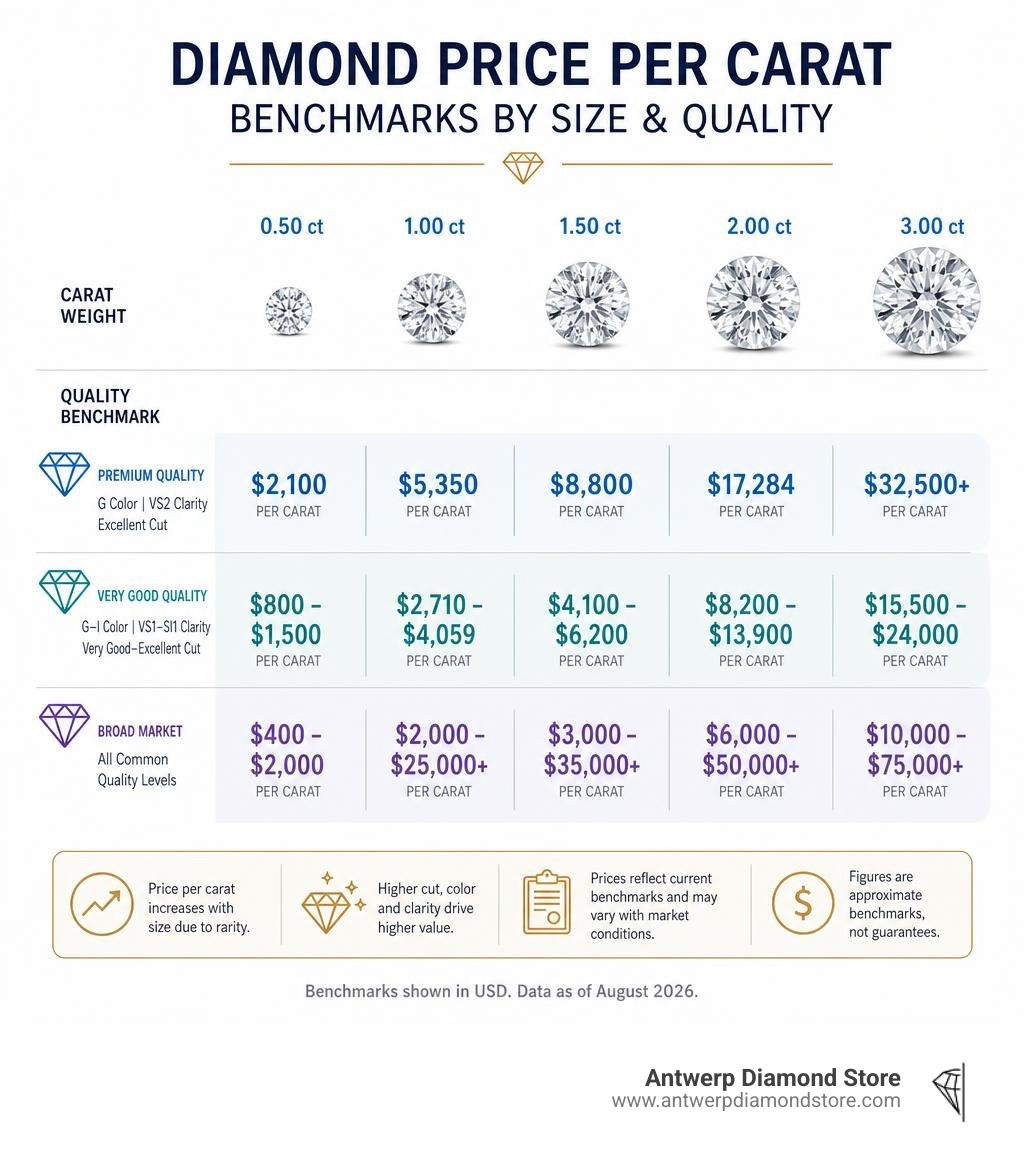
1 ct round, G color, VS2 clarity, Excellent cut | About $5,350 |
1 ct round, G-I color, VS1-SI1 clarity | About $2,710-$4,059 |
1 ct round, all common quality levels | Roughly $2,000-$25,000+ |
0.5 ct round, broad market index | About $1,049 |
2 ct diamond, broad market index | About $17,284 |
These figures are useful starting points, not guaranteed sale prices. A highly graded 1-carat diamond can cost many times more than an eye-clean stone with slightly lower color or clarity. Large diamonds also rise in price faster than their weight alone suggests because they are much rarer.
For anyone selling a diamond, the key distinction is simple: a retail listing price is not the same as a direct cash valuation. The actual offer should reflect the diamond's verified grading, condition, demand, and the current natural-diamond market.
Key Drivers Influencing the Current Price of Diamonds
Navigating the diamond market without understanding valuation drivers is a bit like shopping for a vintage luxury car based solely on the color of the paint. While the outer sparkle catches your eye, the underlying mechanics determine true value. Diamond values are established through a standard unit known as Price Per Carat (PPC), which is calculated by taking the total diamond price and dividing it by the stone's exact weight.
To understand why two loose diamonds of the exact same weight can carry vastly different price tags, we must look closely at the primary grading criteria established by major gemological laboratories: cut quality, color grade, clarity tier, and overall carat weight.

Cut Quality Premiums and Light Performance
If color and clarity define a diamond’s natural purity, cut quality determines its soul. Cut quality reflects how precisely raw diamond rough was faceted to bounce light back to the viewer's eye. A stone with flawless clarity and top-tier color will still look dull and glassy if its cut proportions are poorly executed.
In the natural diamond market, cut quality commands an unmistakable financial premium. While standard commercial price charts assume an average cut baseline, diamonds graded as Ideal or Super Ideal routinely fetch a 10% to 15% price increase over average cuts. When cut proportions, facet symmetry, and optical polish are optimized, diamond cut proportions can influence final price variations by as much as 30% to 40%.
For example, a properly proportioned 1-carat round brilliant diamond should possess a table and depth percentage that gives it an edge-to-edge diameter measuring between 6.3 mm and 6.5 mm. If a diamond cutter preserves excessive weight at the bottom of the stone (a deep cut), the diamond appears smaller face-up and loses critical brilliance, resulting in steep market discounts. Understanding how these proportions interact allows you to calculate diamond price differentials accurately before making a buying or selling decision.
Color and Clarity Premiums: D vs. H and VVS2 vs. SI1
Color and clarity grades create distinct valuation tiers across the global market:
Colorless Tier (D–F): Completely clear to the naked eye and under magnification. Demands a 30% to 50% price premium over near-colorless tiers.
Near-Colorless Tier (G–J): Offers exceptional visual value. Appears face-up white when set in standard precious metal jewelry settings.
Very Very Slightly Included Tier (VVS1–VVS2): Contains minute internal inclusions that are difficult even for trained gemologists to locate under 10x magnification.
Slightly Included Tier (SI1–SI2): Features noticeable inclusions under 10x magnification, though SI1 stones remain predominantly eye-clean.
To put these grading jumps into monetary terms, consider a 1-carat round diamond. Moving from an H color to a D color can elevate price-per-carat figures dramatically, even when clarity remains unchanged. Similarly, jumping from an SI1 clarity grade to a VVS2 clarity grade creates a 40% to 60% price differential.
While top-grade stones like D color, Flawless (FL) or Internally Flawless (IF) diamonds command top dollar—with 1.00–1.19 carat D/IF round diamonds averaging around $12,516 per carat—smart market participants frequently focus on the visual "sweet spot." Choosing a G or H color paired with a VS1 or VS2 clarity gives you a face-up white, eye-clean appearance at a fraction of the cost. If you are wondering how much is a diamond worth in today's shifting conditions, evaluating where it lands across these combined color and clarity thresholds is your necessary first step.
Inclusions Impact: Eye-Clean vs. Visible Inclusions
When evaluating diamonds weighing between 0.70 and 1.19 carats, the placement and visibility of internal inclusions become major price swing factors. An inclusion is a natural microscopic structure—such as a tiny feather, mineral crystal, or pinpoint cloud—trapped inside the crystal lattice during the diamond's formation under severe Earth mantle pressure.
The market distinguishes sharply between "eye-clean" diamonds (where inclusions cannot be seen without magnification) and stones with visible inclusions:
Eye-Clean Baseline (VS2–SI1): Inclusions are completely hidden from the naked eye. These stones maintain stable demand among retail buyers and estate collectors alike.
Visible Inclusions (SI2–I1): Inclusions can be seen by the naked eye without magnification. These stones face significant market discounts, often selling at a 20% to 35% reduction compared to eye-clean SI1 or VS2 stones of similar color and weight.
If an inclusion sits directly under the center table facet or appears dark and carbonaceous, it disrupts light reflection and weakens structural durability, driving valuation down further. If you are trying to understand what is an inclusion in a diamond, keep in mind that non-visible inclusions offer great buying value, whereas heavy central inclusions hurt secondary market liquidation value. For live benchmark monitoring across these specific carat and clarity tiers, refer to the 1 Carat Round Diamond Price | $4,048 | Aug 2026 chart feed.
Comprehensive Price per Carat Breakdown by Weight and Shape
A diamond's shape directly affects its raw yield and light dynamics, making shape one of the largest factors behind price per carat variances.
Diamond Shape | Relative Price vs. Round Brilliant | Typical Market Characteristic |
|---|---|---|
Round Brilliant | Baseline (Highest PPC) | Highest wastage of rough stone (~50%); maximum light performance |
Cushion Cut | 35% to 43% lower | Softened edges, excellent light dispersion, lower rough wastage |
Princess Cut | 30% to 35% lower | Square geometry preserves up to 80% of original rough crystal |
Oval Cut | 20% to 25% lower | Elongated shape offers a 10-15% larger visual surface area |
Pear & Marquise | -20% to +30% variable | Marquise cuts carry premiums in specific sizes due to cutting complexity |
Round vs. Fancy Cuts: Oval, Cushion, Pear, and Princess
Why do round brilliant diamonds consistently command the highest price per carat across all weight brackets? The answer lies in diamond cutting physics and raw material loss. Cutting a round brilliant diamond requires polishing away roughly 50% or more of the original rough octahedron stone. That discarded mass represents lost yield, which gets baked directly into the finished stone's price per carat.
By contrast, fancy shapes allow master diamond cutters to preserve significantly more of the raw rough crystal:
Cushion Cuts: Offer the largest market discount, frequently selling for 43% less than equivalent quality round diamonds. A 1-carat cushion cut diamond typically trades between $1,900 and $3,300.
Princess Cuts: Preserve up to 80% of raw crystal material, yielding a 35% discount relative to round brilliants.
Oval Cuts: Cost 20% to 25% less per carat than round stones while delivering an elongated footprint that visually appears 10% to 15% larger to the viewer's eye.
Understanding total carat weight metrics and shape geometry is vital when evaluating multi-stone rings or specialized pieces. To dive deeper into overall gem measurements, explore our guide explaining what is ctw (carat total weight) in modern jewelry valuation.
Price Trends for Small Stones vs. Large Carat Sizes
Diamond pricing does not climb in a gentle linear slope. It curves upward exponentially. A 2-carat natural diamond does not simply cost twice as much as a 1-carat diamond—it typically costs 3 to 4 times more because larger natural diamond rough is exponentially rarer in nature.
For smaller stones in the 0.30 to 0.50 carat range, price-per-carat rates remain lower due to steady global inventory reserves. For example, a round natural diamond in the 0.30–0.39 carat weight bracket with D color and SI1 clarity averages around $1,511 per carat.
Once you jump across "magic size thresholds"—such as 1.00 ct, 1.50 ct, 2.00 ct, and 3.00 ct—the cost per carat shoots upward rapidly:
0.40–0.49 ct range: L color, VS2 clarity round diamonds drop as low as $801 per carat.
1.00–1.19 ct range: D color, IF clarity round diamonds average $12,516 per carat.
2.00–2.99 ct range: D color, IF clarity round diamonds surge to an average of $27,485 per carat, topping out near $27,695 per carat for peak certified specimens.
For exceptional museum-grade diamonds or ultra-large estate stones, you can read our detailed breakdown on how much is a 100 ct diamond worth.
Specific Carat Benchmarks: From 0.40ct E/VVS1 to 1.50-1.99ct G/VS1
To provide a clear snapshot of current benchmark values across popular middle-market sizes, let's look at average market listings compiled from real-time data:
0.40–0.49 Carat (E Color, VVS1 Clarity): Features an average price per carat of approximately $2,100 to $2,450, resulting in an average total cost of $950 to $1,150 per loose stone.
1.00 Carat Round Benchmark (D–H Color, VVS2–SI1 Clarity): The fair market median price for a standard 1-carat round diamond currently sits at $3,310, with a typical quality market range between $2,710 and $4,059.
1.50–1.99 Carat Range (G Color, VS1 Clarity): Trades at wholesale asking averages of approximately $4,690 to $5,850 per carat, yielding total individual stone valuations between $7,000 and $11,500 depending on exact proportions and certification.
To examine how these carat ranges scale across active live inventories, consult the updated market table at Round Diamond Prices by Carat | Aug 2026.
Historical Valuation and Market Trends Over 1 to 10 Years

Historical Price Fluctuations: 1, 3, 5, and 10-Year Analysis
Natural diamond valuations have experienced significant macro cycles over the past decade. Following strong demand highs in early 2022, wholesale and retail natural diamond indices underwent an extended downward adjustment of over 50%, reaching record lows on broad macroeconomic commodity indices like the Bloomberg DIAMINDX.
However, historical tracking data highlights notable trend shifts over different time horizons:
1-Year Trend: Overall natural round diamond indices moved roughly -12.9% to -13.6% year-over-year. This price reset opened attractive buying opportunities for collectors and engagement ring shoppers.
3 to 5-Year Cycle: Mid-tier commercial diamonds experienced corrections driven by shifting post-pandemic consumer spending and increased competition from laboratory-grown alternatives.
Recent Stabilization: Major trade benchmarks recorded market stabilization. All four primary categories in the Rapaport Trade Diamond Index (RAPI) held flat or posted positive monthly gains for the first time after a 13-month decline.
Specifically, 0.30-carat RAPI benchmarks rose 1.6% monthly (+9.4% YTD), 0.50-carat benchmarks rose 1.8%, 3-carat stones added 0.2%, and 1-carat benchmarks held flat at 0.0%. For official trade reporting on this stabilization cycle, review the Rapaport Press Release: Diamond Prices See Best Month Since Before Tariffs.
Macroeconomic Trends Affecting the Current Price of Diamonds
Beyond retail demand, macro supply chains and international policies actively shape global market prices:
Trade Tariffs & Polishing Exemption Rules: Recent policy changes impose a 10% import duty on diamonds polished in major manufacturing centers like India entering the US market. Conversely, origin nations like Belgium, Botswana, and Namibia benefit from tariff exemptions, creating regional cost differences.
Upstream Mining Suspensions & Closures: Global raw diamond supply has tightened naturally. Major operations like Canada's historic Diavik mine permanently ceased extraction after 23 years, leaving only two active Canadian diamond mines operating (Gahcho Kué and Ekati). De Beers also suspended production at its Venetia mine for two years to rebalance inventories.
Currency Exchange Fluctuations: For international dealers and retailers, shifts in local currencies against the USD directly impact landed inventory costs, even during periods when base USD index figures remain flat.
To read an in-depth trade analysis of how regional tariffs and currency movements affect inventory replenishment, see the industry report on Diamond Prices July 2026: What Canada Pays to Restock.
The Impact of Lab-Grown Diamonds on Natural Diamond Valuation
Lab-Grown Market Expansion and Secondary Resale Value
The rapid expansion of lab-grown diamonds (factory-synthesized via Chemical Vapor Deposition or High Pressure High Temperature processes) has reshaped the entry-level diamond market. Physically, optically, and chemically, lab-grown diamonds are identical to mined natural stones. However, their economic supply realities could not be more different.
Natural diamonds derive their value from genuine geological rarity—taking over a billion years to form deep within the Earth. Lab-grown diamonds can be produced in unlimited quantities in industrial facilities, causing their prices to drop consistently:
Price Differential: A 1-carat lab-grown diamond (VS2, G color) currently carries a median price of roughly $2,150, offering a 60% to 67% savings over a natural stone of identical specs ($5,350).
3-Carat Differential: For larger weights, lab-grown prices are up to 76% lower than natural equivalents.
Secondary Resale Realities: Because manufacturing costs for lab-grown stones continue to fall, synthetic diamonds retain little to no secondary market trade-in or cash resale value. Primary jewelry buyers should recognize that lab-grown purchases represent a non-recoverable consumer expenditure rather than a value-retaining asset.
To understand the long-term asset differences between these two options, explore our complete comparison guide on lab grown vs natural diamond. You can also run comparative valuations using our interactive diamond resale value calculator.
How Consumer Choices Impact the Current Price of Diamonds
Consumer preferences are driving a clear market split: price-sensitive shoppers buying temporary fashion pieces lean toward lab-grown alternatives, while buyers prioritizing long-term value retention focus on high-grade certified natural diamonds.
When evaluating a natural diamond's long-term worth, grading certification plays a vital role:
GIA & AGS Certification Standards: Non-profit educational laboratories like the Gemological Institute of America (GIA) provide strictly unbiased grading standards. A GIA certificate ensures your natural stone commands fair market value upon resale.
Third-Party Lab Premiums: GIA-certified natural diamonds command a consistent 3% to 5% price premium over stones graded by more lenient commercial laboratories.
Authenticity Verification: Understanding a genuine diamond meaning protects you against overpaying for inaccurate clarity or color claims.
If you are evaluating an estate piece or considering an engagement ring purchase, check out our guide on selecting a gia certified engagement ring to safeguard your investment.
Frequently Asked Questions About Diamond Valuation
What is the current average price per carat for a 1-carat round diamond?
The average price per carat for a 1-carat natural round diamond varies based on color and clarity. Within the popular D–H color and VVS2–SI1 clarity range, fair market median prices sit at $3,310, with overall market ranges spanning from $2,710 to $4,059. Top-tier specimens (such as a 1-carat D color, Internally Flawless stone) average around $12,516 per carat, while entry-level commercial stones sit near $2,000.
How do visible inclusions affect diamond pricing?
Visible inclusions lower a diamond's valuation significantly. Diamonds in the 0.70 to 1.19 carat range carrying SI2 to I1 clarity grades trade at discounts of 20% to 35% compared to eye-clean VS2 or SI1 stones of equivalent color and size. If inclusions are centralized under the table facet or compromise structural integrity, secondary market resale values drop further.
How do prices for 1.50–1.99 carat G/VS1 round diamonds compare to 1-carat stones?
Due to non-linear price scaling, a 1.50–1.99 carat G/VS1 round diamond commands a higher price per carat than a 1-carat stone of identical color and clarity. While a benchmark 1-carat G/VS1 stone trades between $3,300 and $5,350 total, a 1.50–1.99 carat G/VS1 diamond averages $4,690 to $5,850 per carat, pushing the total price for the loose diamond to between $7,000 and $11,500.
Conclusion
Understanding the current price of diamonds requires looking beyond simplified carat weight charts to evaluate the 4Cs, cut proportions, shape discounts, and international market supply trends. While overall natural diamond prices adjusted downward over recent years—creating favorable buying windows—market indicators point toward price stabilization across key commercial benchmarks.
Whether you are shopping for a loose diamond, planning an engagement ring, or appraising fine family heirlooms like a high-value diamond necklace and price, working with experienced professionals ensures you receive true market value.
At Antwerp Diamond Store, we buy fine luxury jewelry, certified loose diamonds, high-end watches, and designer handbags for direct cash. Operating in Atlanta, GA, we specialize in private, appointment-only transactions that deliver immediate, transparent, market-based payouts without hidden processing fees or consignment delays.
If you want to evaluate an individual loose stone or inherited jewelry piece, learn how much to value a diamond ring through our detailed appraisal resources, or get a discreet appraisal with Antwerp Diamond Store today.


