
Over 99.5% of all diamonds have at least one type of inclusion, and only about 1% contain recognizable crystals that are especially eye-catching, so an inclusion is a normal internal feature, not a rare accident. In plain English, it's an internal characteristic inside a diamond, such as a crystal, feather, cloud, pinpoint, fracture, or fluid-filled cavity, that formed while the stone was growing and is examined under 10x magnification.
If you're selling a diamond, appraising one, or trying to understand why two stones with the same carat weight can price very differently, inclusions are usually the reason. They affect how a diamond is graded, how durable it may be, and how confidently a buyer can identify it.
Table of Contents
What an Inclusion in a Diamond Really Means
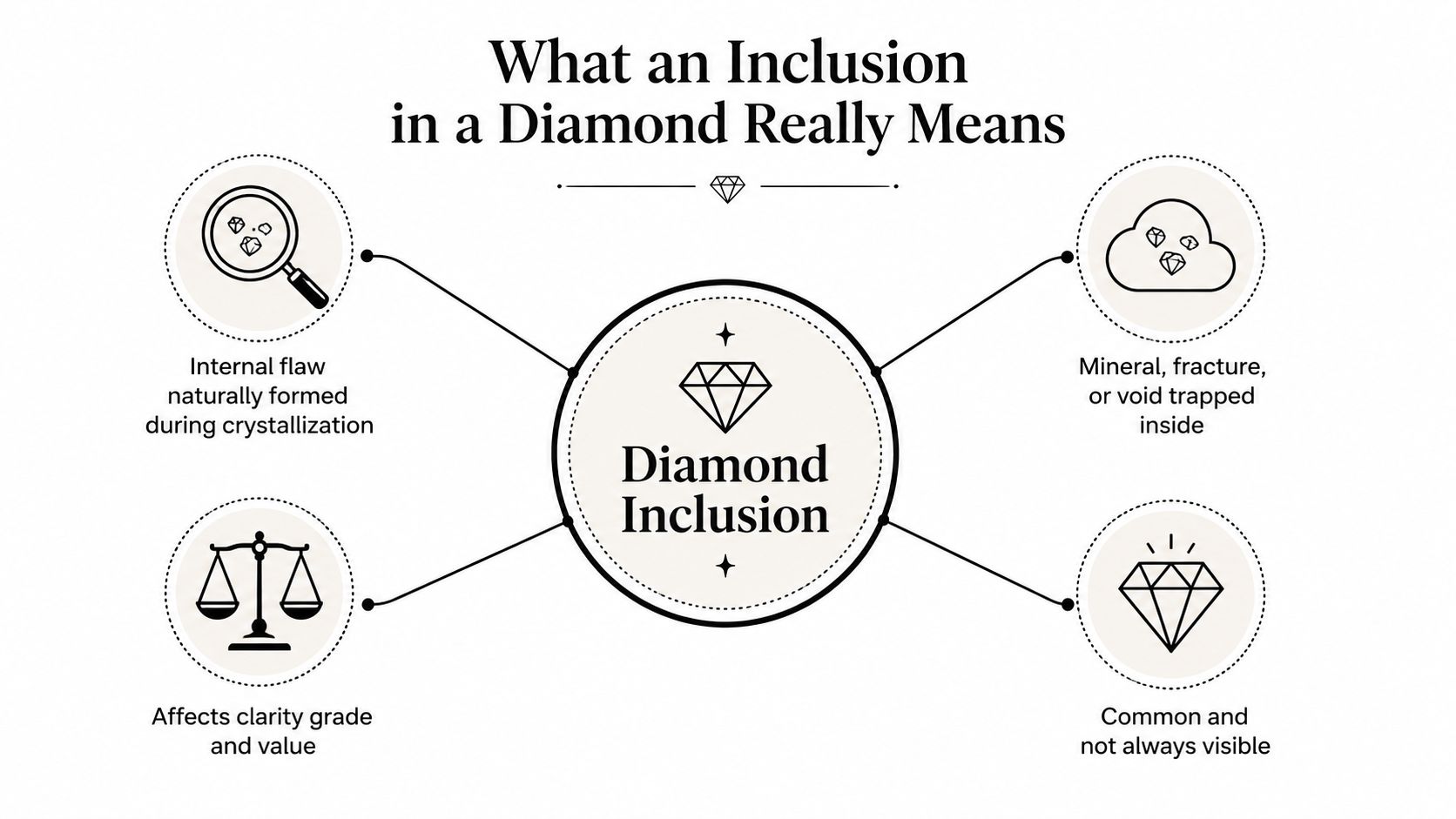
An inclusion is an internal feature trapped inside a diamond during growth. It can be a tiny crystal, a feather-like fracture, a cloud of pinpoints, or a fluid pocket, and gemologists use that term because the feature is inside the stone rather than on its surface. In everyday language, you can think of it as part of the diamond's internal fingerprint.
Why the term matters in real buying
That internal fingerprint is one reason grading labs and buyers care so much about inclusions. The GIA distinguishes inclusions from blemishes, which are surface-only features, and treats them as part of clarity grading rather than just random damage. A trained grader looks at what the feature is, where it sits, and how easy it is to see under 10x magnification. GIA's clarity guidance makes the same point, inclusions are assessed as internal characteristics, not just as imperfections.
Practical rule: a diamond can have inclusions and still be an excellent stone, but what matters is how visible the inclusion is and whether it affects durability.
That is why two diamonds with the same carat weight can sit in very different price ranges. One may have small internal features tucked where they don't show, while another may have a visible feature under the table that pulls down clarity and market appeal. If you want a simple mental model, use this one, an inclusion is what's happening inside the diamond, and a blemish is what's happening on the outside.
For a plain-language overview that also helps when you're comparing diamond terminology, see this genuine diamond meaning guide.
Inclusions vs. Blemishes and the Main Inclusion Types
A clarity report separates internal features from surface marks because the two affect a diamond in different ways. A scratch on the outside can be a blemish, while a trapped speck inside the stone is an inclusion. Both can change how the diamond looks under magnification, but they are not graded the same way.
The inclusion types you're most likely to see
Gemologists use specific names for the internal features they find in a diamond. A crystal is another mineral trapped inside the diamond, a feather is a fracture that can look wispy or white, a pinpoint is a tiny speck, and a cloud is a group of pinpoints that can create haze. Needles are long, thin internal lines, graining refers to irregular growth patterns, and twinning wisps are twisted internal features formed during growth. A knot is a crystal that reaches the surface, while a cavity is a small surface opening often linked to a crystal falling out during polishing. A GIA-oriented glossary of inclusion terms shows how these features are categorized in practice.
The next question is how those features behave in real life. Pinpoints and small needles are often minor unless they are grouped together. Crystals can be easy to overlook or very noticeable, depending on color and placement. Feathers matter more when they reach the surface or sit near an edge. Cavities and knots deserve extra attention because they can affect durability as well as clarity.
A single feather near a facet junction can matter more than a cluster of pinpoints tucked low on the stone.
That is where first-time sellers can get tripped up. The inclusion type matters, but type plus location matters more. A stone with a few tiny internal marks near the girdle may read very differently on a report than a stone with one larger feature under the table, even if both sound “included” in everyday speech. If you want a clearer example of how a higher-clarity stone can still be discussed in a real buying context, this VVS diamond earrings guide for men shows how clarity language gets used in practice. For sellers who want more context on how clarity affects real pricing decisions, this diamond value guide is a useful companion.
How Inclusions Drive the Clarity Grade
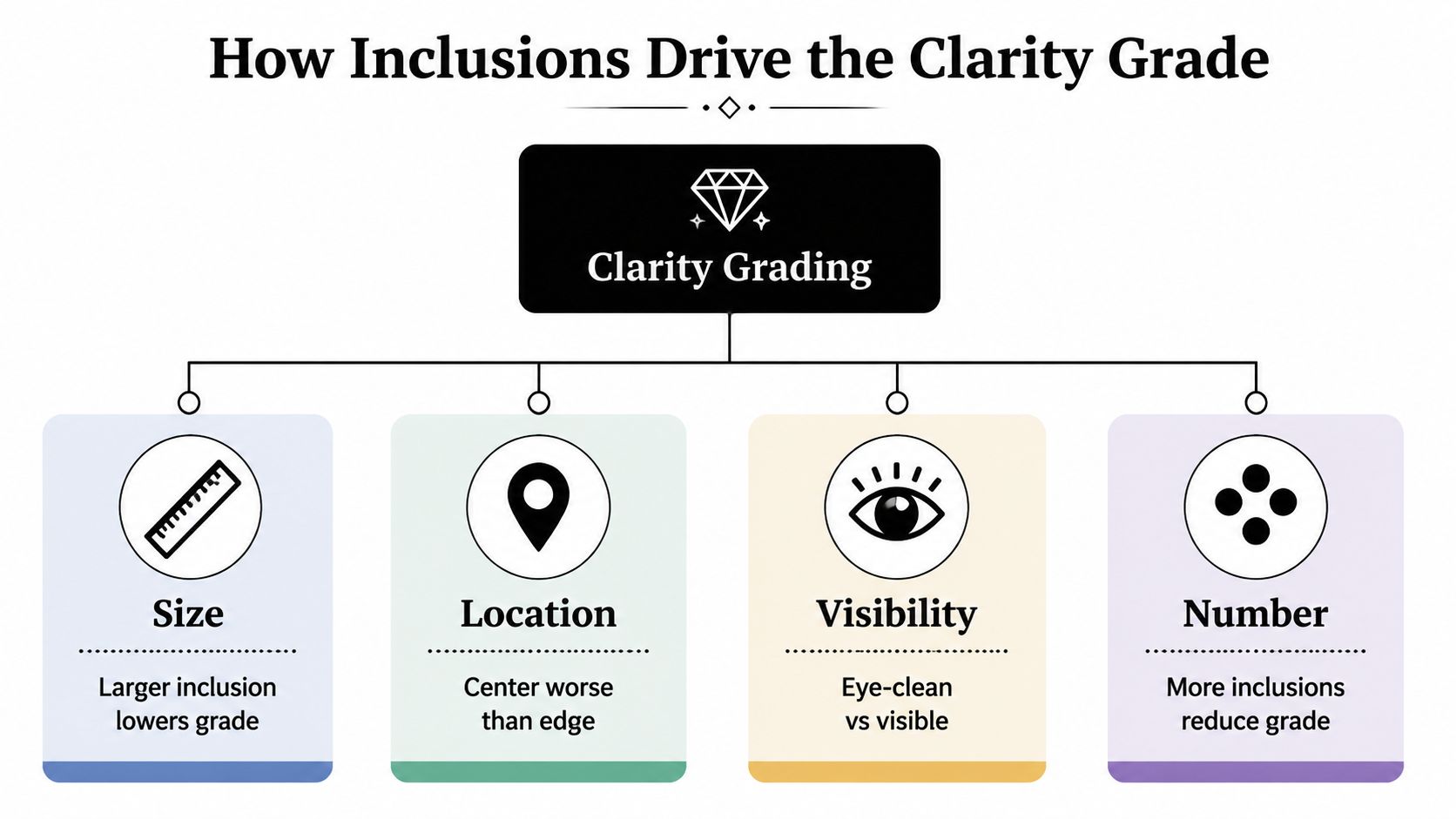
A grader starts with a stone under 10x magnification and looks at more than the inclusion itself. Size, location, number, and visibility all shape the final call, because a tiny mark hidden near the edge does not behave the same way as a larger feature under the center. That is why two diamonds can share a similar-looking report and still look very different once you inspect them closely.
Reading the clarity line without overcomplicating it
The clarity scale moves from Flawless and Internally Flawless through VVS, VS, SI, and I grades. You do not need to memorize every label to use the scale well. The useful part is the pattern, fewer and less visible inclusions usually mean a higher grade, and a better chance that the diamond looks clean to the naked eye.
A seller can see that difference in a simple side-by-side comparison. A small crystal tucked off to the side may have little effect on the report, while a larger feather running toward the girdle or into a facet junction can matter more because it is easier to spot and may affect durability. The grading report should be read with the plotting diagram, since the diagram shows where the features sit and how a grader likely weighed them.
For anyone balancing beauty and budget, eye-clean often matters more than chasing the highest letter grade. A stone in the VS or SI range can still look very clean in normal wear if the inclusion is small and placed well. A higher clarity grade does not automatically mean a more attractive diamond, and it does not always mean a better choice for the person buying it.
If you are comparing stones for resale or appraisal, a diamond pricing overview helps explain why two diamonds of similar size can still trade at different values.
What Inclusions Mean for Appearance, Durability, and Value
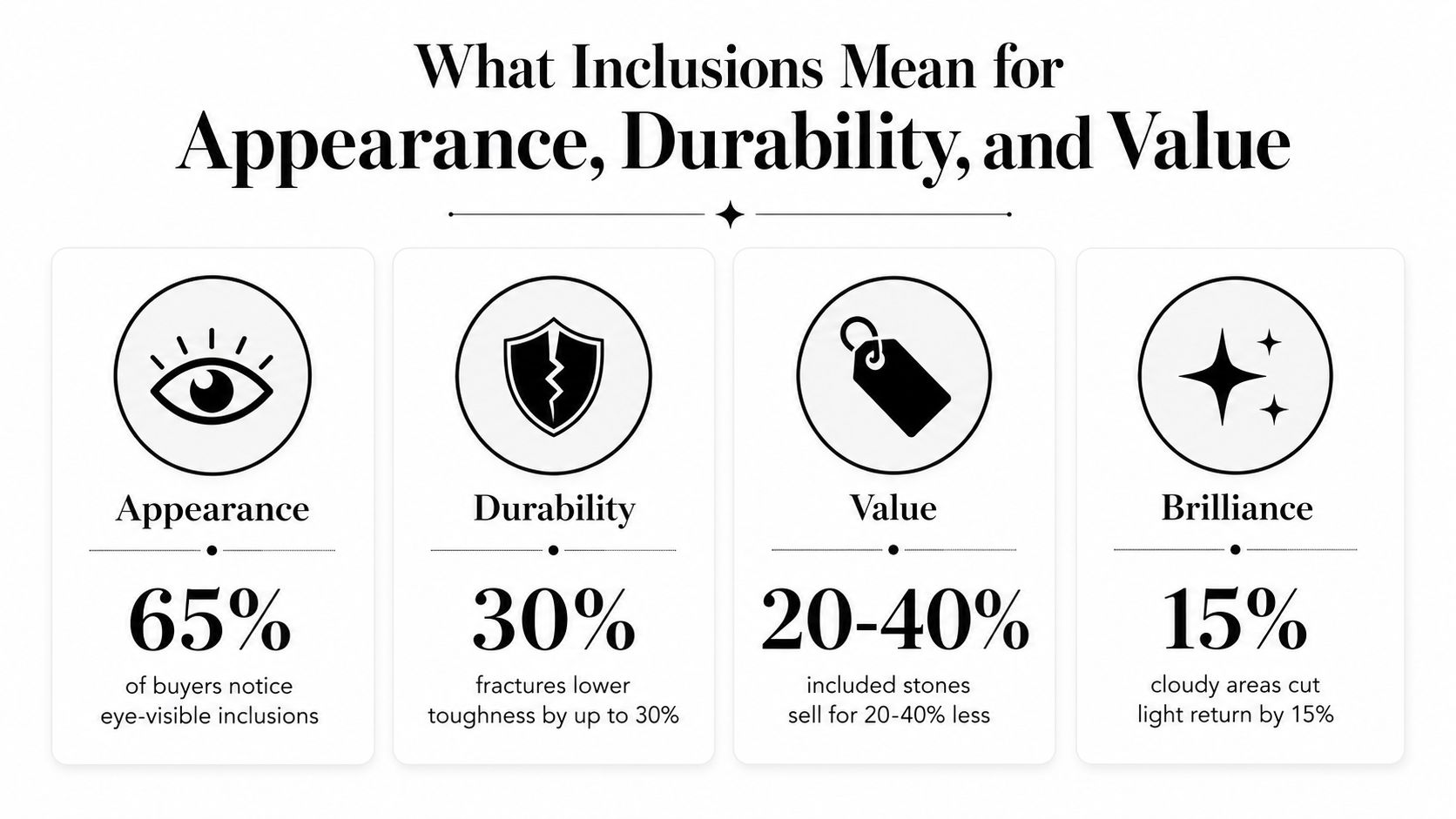
Inclusions affect four practical things, appearance, durability, value, and identification. Those are the questions that matter when a diamond is being sold, appraised, or screened for authenticity, because the presence of an inclusion is less important than what that feature does.
Appearance and durability
An eye-visible inclusion, especially a dark crystal or a cloudy patch under the table, can interrupt brilliance and draw the eye away from the sparkle. By contrast, a tiny pinpoint near the girdle may never be noticed in normal wear. The difference is not academic, it changes how the stone feels in the hand and how confident a buyer feels looking at it.
Durability is the other side of the story. Feathers that reach the surface and cavities at facet junctions can be more vulnerable to impact, especially in rings worn every day. That doesn't mean every included stone is fragile, it means some inclusion types deserve a closer look before setting or resale.
Value and identification
Field data from Botswana's major diamond mines shows how small the inclusion-bearing subset can be in large production runs. In a sample of 332,000 diamonds, inclusion-bearing stones averaged 3.0% at Jwaneng, 2.5% at Damtshaa, 2.2% at Letlhakane, and 3.5% at Orapa. The same research also reports ranges such as 2.1% to 4.9% at Damtshaa and 1.5% to 5.5% at Letlhakane, which reinforces a practical point, clearly inclusion-bearing stones are a minority even in major mining output. The Botswana mine study is especially useful here because Botswana is a major diamond-producing region.
That rarity is part of why cleaner diamonds command premiums, but it also explains why inclusions are so valuable for identification. They help separate natural, treated, and synthetic stones, so the same internal feature can lower resale value in one context and prove origin in another. In other words, inclusions are not only a grading issue, they're also part of the stone's identity.
If you're trying to understand how all of that translates into offers, a jewelry appraisal guide gives helpful context for sellers.
How Professionals Inspect and Plot Inclusions
Serious evaluation starts with light, magnification, and positioning. A grader usually uses a loupe or microscope at 10x magnification, then rotates the stone to inspect the crown, pavilion, and girdle. That movement matters because an inclusion that hides from one angle can become obvious from another, especially if the stone has strong contrast or a reflective facet pattern.
What the plotting diagram really shows
A diamond report often includes a plotting diagram, which is a map of the stone marked with inclusion symbols. Internal characteristics are typically shown in red, while blemishes are shown in green. That diagram is one of the most useful identity tools in the trade because it shows not just that an inclusion exists, but where it sits and how it was recorded at grading time.
When a seller brings a diamond for review, the specialist checks whether the stone matches its paperwork. That means comparing the plotted features to the actual diamond, looking for treatment flags, and making sure the stone hasn't been recut, chipped, or altered since the report was issued. In-person evaluation matters here because a photo can miss a faint feather or a small cavity that appears only under rotated lighting.
The most useful question is not “does the diamond have inclusions?” It's “do the inclusions in front of me match the report, and do they change how the stone should be handled?”
That is also where origin-related interpretation has become more important. Natural diamonds form over long geological time, while lab-grown stones form in a controlled environment, so inclusion patterns can help specialists separate origin and verify claims. For buyers and sellers, the key point is simple, a remote glance can miss detail that a proper loupe exam catches.
Treatments, Enhancements, and What Must Be Disclosed
Some diamonds are not just included, they're treated to make those inclusions less visible. Two common clarity treatments are laser drilling and fracture filling. Laser drilling uses a tiny laser to create a channel to a dark inclusion so it can be lightened, while fracture filling uses a glass-like material to reduce the look of a feather or cavity.
How treatments differ from untreated stones
These treatments are legal and widely used, but they change how the stone should be described. A treated diamond is not the same thing as a natural untreated diamond, and it should be graded and sold accordingly. The treatment can improve appearance, but it also creates a disclosure issue that buyers need to understand before making an offer.
Major labs mark such stones as clarity enhanced, and trade rules require sellers to disclose non-permanent treatments. The Federal Trade Commission's jewelry guidance is the practical benchmark many sellers use when they talk about disclosure obligations in the U.S., especially where treated stones are being resold or appraised. The FTC's Jewelry Guides are the right reference point for that disclosure standard.
A seller who skips disclosure can create a problem later, especially if the stone is reappraised or offered to a professional buyer who identifies the treatment. A properly disclosed treated diamond can still have a market, but the buyer needs to know exactly what they are evaluating.
For owners who want a concise comparison of grading and evaluation language, GIA-certified ring guidance helps put reports and treatments in context.
Practical Tips for Sellers and an Inspection Checklist
Bring the diamond exactly as it is, along with any paper trail that helps identify it. That means the stone itself in a secure parcel, any grading report from GIA or another lab, prior appraisals, and anything that mentions treatment, repair, or recutting. If the stone is mounted, say so up front, because settings can hide both inclusions and small surface features.
What a buyer will check in person
A serious evaluator looks for more than the printed grade. They confirm whether plotted inclusions match the report, look for fresh chips or feathers, and check whether the stone still matches the document after wear. They also assess whether a visible inclusion sits in a harmless place or in a spot that affects value more heavily, such as through the table or along a vulnerable edge.
Clean presentation helps. A loose, wiped stone is easier to inspect than a dusty mount, and a well-lit view gives the examiner a fair look at the inclusion pattern. If you're also comparing how appraisals work for mixed luxury items, Carti's AI chatbot for jewelry stores can be a useful educational resource for understanding how jewelry businesses organize intake and evaluation workflows.
Seller checklist: diamond, grading report, prior appraisal, treatment paperwork, secure packaging, and clear disclosure about any repair history.
Local buyers in Atlanta, Buckhead, Sandy Springs, Alpharetta, Roswell, and Brookhaven can often review stones in person, which is especially useful when the goal is a fair comparison against a grading report. Sellers outside Georgia can still use insured shipping for a remote evaluation, but the closer the inspection gets to the stone itself, the better the comparison usually is. For a deeper look at what appraisers compare, this jewelry appraisal article is a practical companion.
Frequently Asked Questions About Diamond Inclusions
Does an inclusion always lower value?
No. Value depends on the inclusion's type, size, location, and visibility, not just its existence.
Do inclusions make a diamond weaker?
Sometimes. Surface-reaching feathers, cavities, or knots can affect durability, while many internal inclusions don't change everyday wearability.
Do natural and lab-grown diamonds show the same inclusion patterns?
Not usually. Both can contain inclusions, but their formation history differs, so specialists often use inclusion patterns as part of origin screening.
Is a diamond with visible inclusions still worth selling?
Yes. A visible inclusion may reduce price, but a properly identified stone can still have real resale value if the buyer can assess it accurately.
If you're trying to sell a diamond and want a clear reading of what its inclusions mean, the smartest next step is an in-person evaluation. A trained buyer can compare the stone to its report, explain how the inclusions affect clarity and durability, and help you understand the offer before you decide anything.
Bring your diamond, report, and any treatment paperwork to Antwerp Diamond for a careful, no-pressure evaluation. If you're in Atlanta or nearby, an in-person review can quickly show whether the inclusions affect clarity, durability, or resale value in a meaningful way.