
You're probably looking at a pair of men's diamond studs right now and asking the question: is VVS clarity worth paying for, or are you buying a label more than a visible upgrade? The short answer is this: VVS diamond earrings for men make sense when you want premium clarity, larger stones, or stronger long-term desirability, but for many everyday studs, especially smaller sizes, VVS can be more than you need visually.
That's what makes this category tricky. The diamonds can be excellent, the styling can be timeless, and the quality can be real, but the smartest purchase usually comes down to matching clarity, size, setting, and intended use instead of chasing the highest grade on paper.
Table of Contents
What Does VVS Mean for Diamond Earrings
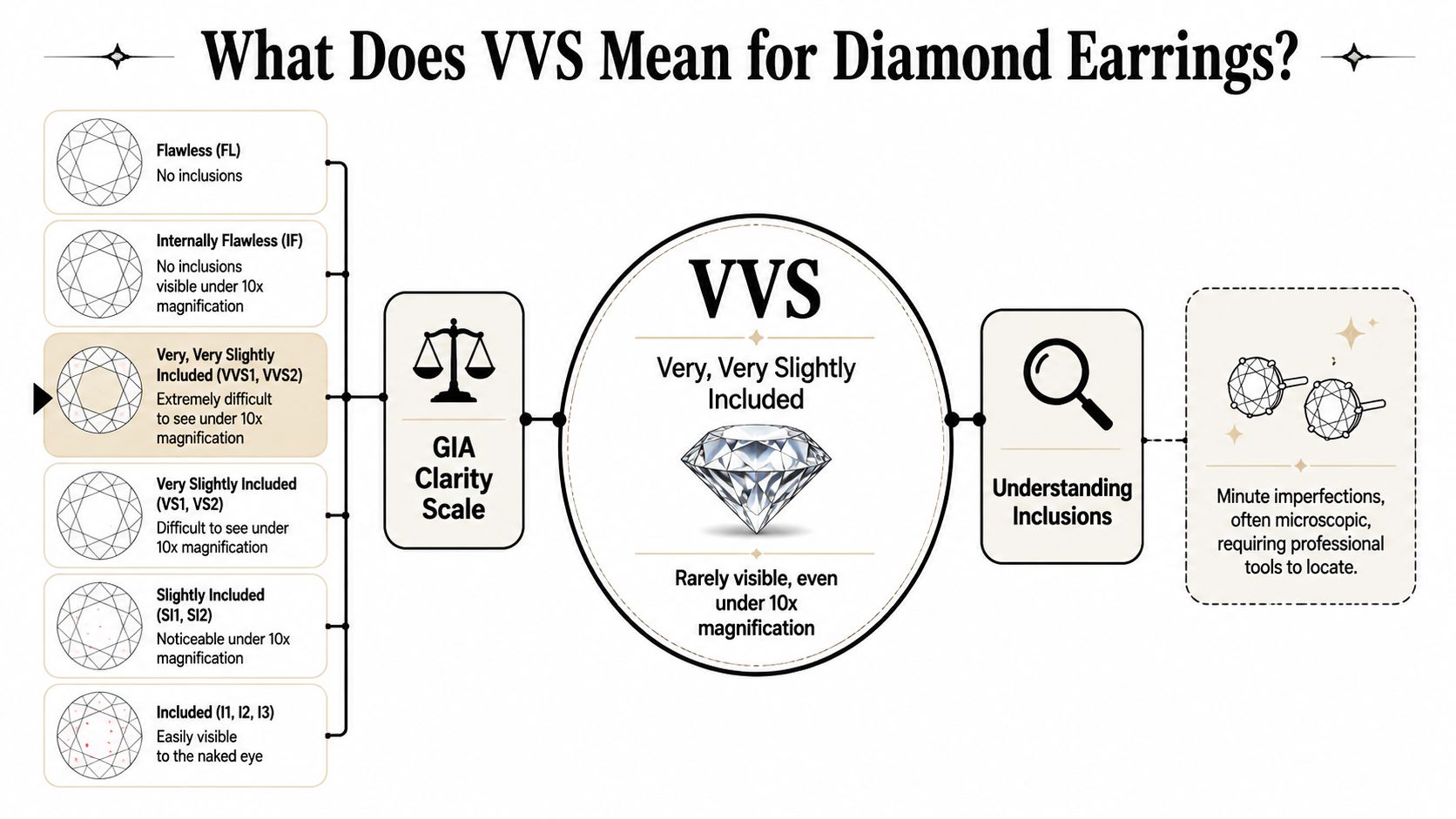
VVS stands for Very Very Slightly Included. In plain English, that means the diamond has tiny internal characteristics that are so small they generally require 10x magnification to detect, which is why VVS sits in the premium end of the clarity scale for diamond jewelry.
If you think of a clean room with one microscopic speck of dust in the far corner, that's the basic idea. The room still looks pristine. The speck exists, but you won't see it without deliberately searching for it under the right conditions.
How VVS fits on the clarity scale
On the standard clarity ladder, VVS falls below Flawless and Internally Flawless, and above VS and SI grades. That matters because clarity affects how uninterrupted light travels through the stone.
According to Diamondere's guide to men's VVS diamond earrings, VVS clarity has microscopic inclusions visible only under 10x magnification and can deliver up to 95% internal light return compared with lower grades such as SI1. That optical purity is one reason VVS diamonds have a crisp, sharp appearance.
Practical rule: In earrings, clarity matters most when the stone is clean enough that nothing distracts from the face-up look. Past that point, cut quality usually does more visual work than chasing an even higher clarity grade.
Why clarity matters more in some earrings than others
Men's earrings concentrate a lot of attention in a small space. A stud sits close to the face, catches direct light, and doesn't have much metal or design around it to hide imperfections. That's why buyers gravitate toward better clarity in this category.
Still, clarity doesn't work alone. A poorly cut VVS diamond won't outperform a well-cut diamond from a slightly lower clarity tier. In practice, the best-looking men's studs are balanced. They combine solid cut precision, a setting that suits the wearer, and a clarity level that makes sense for the size.
For clients comparing luxury categories beyond earrings, the same principle shows up in watches and other pieces where visible refinement matters. The difference is that diamonds reveal that refinement through light return, not branding. If you want a broader perspective on how premium grading affects desirability across jewelry categories, see this look at VVS diamonds in watches.
Choosing the Right Style and Size for Men
A client walks in wanting VVS studs and points straight at the biggest pair in the case. Ten minutes later, we are usually talking less about clarity and more about proportions, setting height, and whether the earrings will suit his ear. That is the true selection process. In men's earrings, style and size decide how expensive the piece looks from normal viewing distance.
Best styles for everyday wear
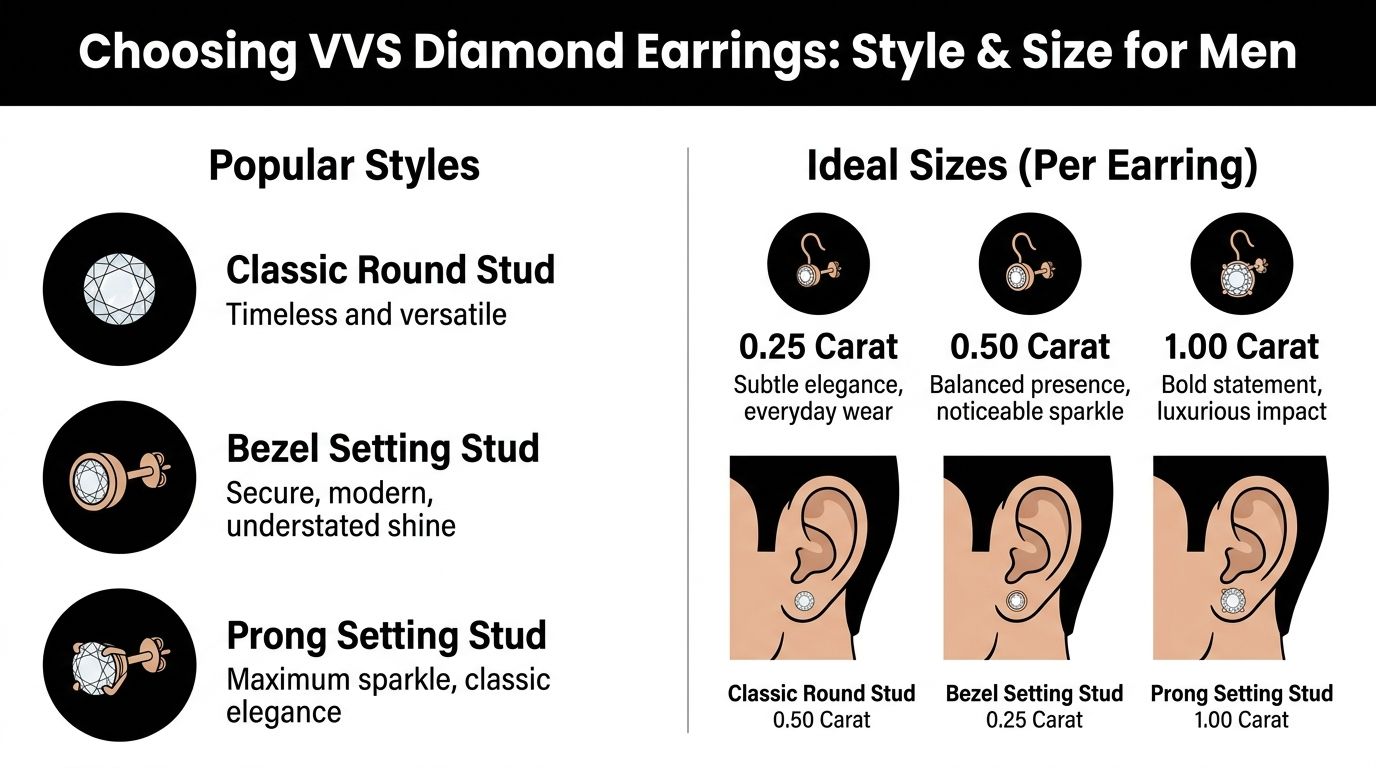
For daily use, a stud still makes the most sense. It wears close to the ear, reads clean, and does not fight with a watch, chain, or fine clothing. The Diamond Guys' overview of men's diamond earrings notes that men's diamond studs commonly span a broad size range, with round, princess, and emerald cuts among the standard choices, and prong and bezel settings leading the category.
The better question is not which style is "best." It is which style makes the VVS premium visible enough to matter.
Style | What works | Trade-off |
|---|---|---|
Round brilliant stud | Strong light return, forgiving face-up look, easiest for everyday wear | More common, less distinctive |
Princess cut stud | Crisp, modern shape with a sharper edge profile | Corners need protection and can show wear faster in rough use |
Emerald cut stud | Clean, quiet look that highlights clarity more directly | Less sparkle, so cut precision and transparency matter more |
Prong setting | Shows more of the diamond and keeps the look lighter | Sits a bit higher and leaves the stone more exposed |
Bezel setting | Secure, low-profile, excellent for active wear | Looks slightly smaller face-up and covers more of the edge |
Round brilliants hide small clarity features better because the facet pattern breaks up what the eye sees. Emerald cuts do the opposite. On an emerald cut stud, a buyer paying for VVS may see more benefit, especially once the stones get larger. On a small round stud, that same premium often buys grading prestige more than visible improvement.
A useful companion resource for anyone buying their first pair, especially if the piercing itself is new, is this guide to earrings for ear piercing. It helps frame the difference between fashion preference and what's comfortable for healing or long daily wear.
How size reads on the ear
Size changes the value equation fast. A well-cut smaller stud often looks sharper and more expensive than a larger pair that sits too high, spreads past the lobe, or overstates the wearer's style.
For most men, the sweet spot is a stud that stays proportionate to the lobe and close to the skin. Bayam Jewelry's guidance on men's earring sizing gives practical benchmarks for how common stud diameters present, which is useful for comparing what looks subtle, balanced, or bold before you buy. In practice, smaller sizes tend to make the jump from VS to VVS harder to appreciate face-up, while larger stones give clarity more room to show.
For clients, I establish this guideline: If the goal is a discreet everyday stud, put the budget into cut and clean proportions first. If the goal is a larger solitaire look, especially in a step cut or a very open setting, VVS starts making more sense because the stone has nowhere to hide.
This video gives a helpful visual sense of how men's studs present on the ear:
Smaller studs usually look more expensive than oversized ones when the proportions fit the earlobe and the setting sits close to the skin.
Metal and fit details that affect comfort
Metal affects both appearance and wear. White gold keeps the look bright and puts visual attention on the diamond. Yellow gold adds contrast and can make a modest stone feel more intentional. Platinum is dense, durable, and secure, but some clients prefer the lighter feel of 14K gold for long daily wear.
Fit matters just as much. Bayam Jewelry also notes that a standard men's stud often uses a 20G post with a 6 mm length, while thicker 18G or 16G posts can work better for larger or older piercings. That detail affects whether the earring sits upright, droops forward, or feels stable through a full day.
For buyers comparing materials and construction standards, this guide explaining what qualifies as fine jewelry is a useful reference.
What to Expect for Price and Value
A client sits across the counter choosing between two pairs that look nearly identical on the ear. One pair is VVS. The other is VS. The price gap is large enough to upgrade the setting, increase the size, or remain in your pocket. That is the core buying question with men's studs. When does VVS buy something you will see, and when are you paying for a cleaner grading report more than a better-looking earring?
Price moves fast in this category because several cost drivers stack together: natural versus lab-grown, total carat weight, cut precision, color, metal, and whether the diamonds are matched tightly as a pair. Clarity is only one part of that equation. In small studs, it is often not the part that changes what other people notice first.
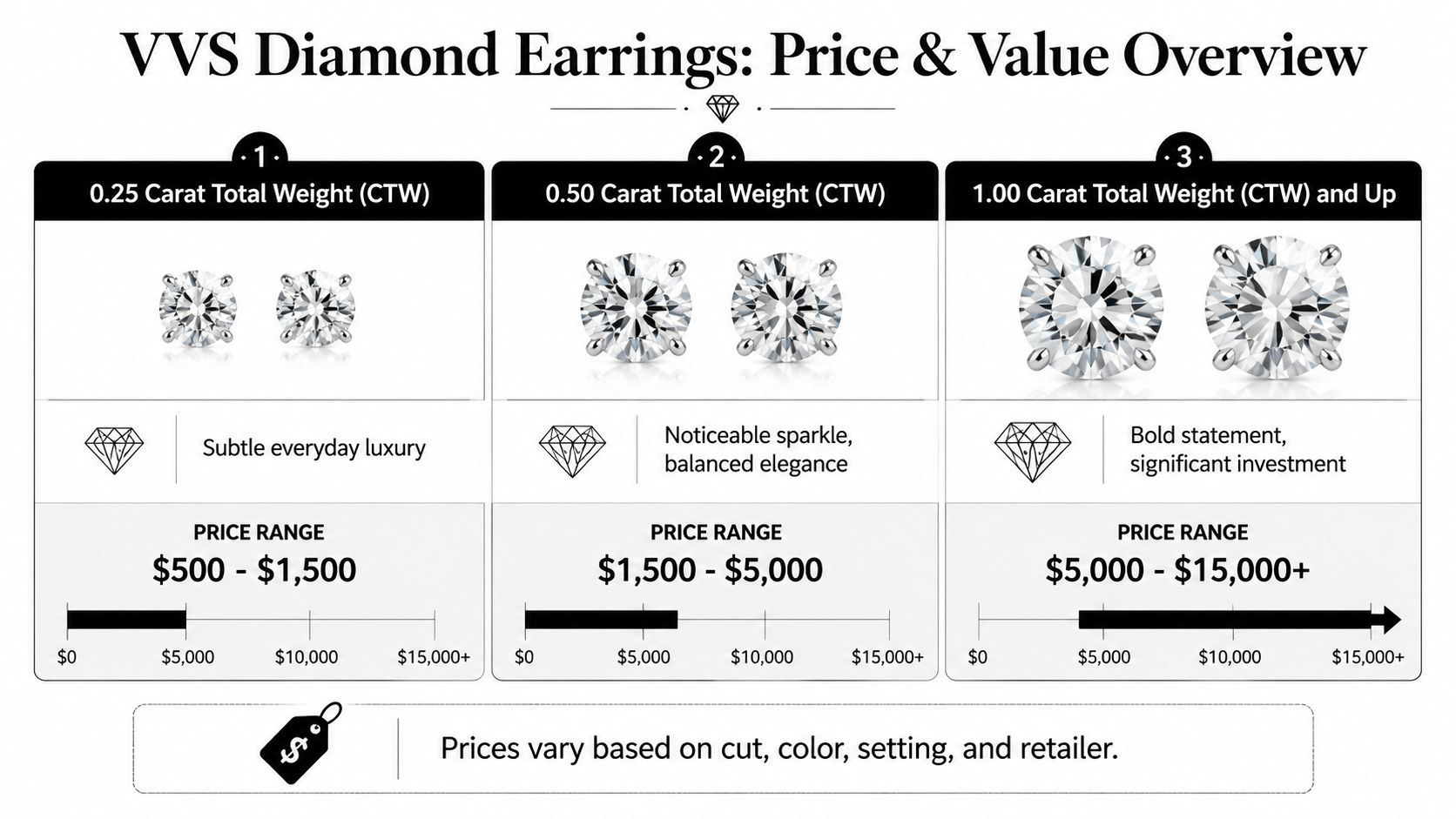
When the VVS premium is justified
I usually see the VVS premium make sense in four situations.
The stones are large enough to invite scrutiny. As carat weight rises, inclusions are easier to find, especially in bright lighting and close-set conversations.
The design leaves nothing to hide. A clean solitaire stud or open basket puts the diamond on display, so clarity matters more than it does in a heavier halo or more covered setting.
The buyer cares about paper quality as much as face-up appearance. Some clients want the reassurance of an upper-tier grade and are willing to pay for it.
The pair is being bought as a high-spec piece from the start. In that part of the market, buyers compare details line by line, and VVS can help the pair stay competitive.
There is also a practical resale angle, but it is narrower than many sellers suggest. Trade buyers and informed secondhand buyers do pay more attention to clarity once the stones are substantial and the rest of the specs are strong. On modest everyday studs, resale is driven more by whether the pair is natural or lab-grown, the total weight, the lab paperwork, and the condition of the mount.
When VVS is usually an overpayment
For smaller men's studs, VVS is often where budget discipline matters most. If the earrings are being worn daily, viewed at normal distance, and sized for a discreet look, a well-cut VS pair usually delivers the same visible result on the ear for less money.
That is the trade-off many buyers miss. They focus on the clarity line item because it sounds prestigious, while the visible win often comes from better cut, better matching, or slightly more spread. I would rather see a client buy a brighter, well-proportioned VS pair than a duller VVS pair with weaker life.
This is especially true in rounds under about 0.50 carat per ear. At that size, inclusions that separate VVS from VS are often microscopic in real wear. You still want eye-clean stones. You do not always need near-flawless ones.
A practical value framework
Use this filter before paying the VVS premium:
Set the size target first. Decide what the earring needs to do on the ear. Subtle, balanced, or statement.
Protect cut quality. If the choice is VVS with average make or VS with stronger light return, take the better-cut pair.
Match clarity to size. Smaller studs can often sit comfortably in VS. Larger solitaires have a better case for VVS.
Consider how the earrings will be used. Daily wear usually rewards durability, comfort, and overall look more than microscopic clarity gains.
Price the alternatives side by side. If the VVS jump costs enough to move you into a better size or setting elsewhere, compare the visual result objectively.
For buyers trying to benchmark what drives retail diamond pricing, this breakdown of how much a diamond is worth helps put clarity premiums in context.
Bottom line: VVS is worth paying for when the stones are large, exposed, and being judged as high-spec diamonds. For compact men's studs worn every day, VS is often the sharper value.
How to Verify Authenticity and Certification
When you're paying for VVS, documentation matters. Without credible grading, you don't know whether you're buying VVS, VS, or something lower represented optimistically.
What to check on the paperwork
Start with the grading report. The most important details for men's studs are the basics you can verify clearly:
Clarity grade: Look for whether the stone is listed as VVS1 or VVS2.
Carat weight: Confirm whether the listing refers to a single stone or the pair.
Cut information: This matters heavily for brightness.
Color and measurements: These help explain why two earrings with similar weights can look different.
If the seller claims the stones are certified, ask whether each diamond has an individual report or whether the pair is being sold with broad in-house paperwork only. For better stones, that distinction matters.
Red flags that should slow you down
A few warning signs come up repeatedly in the trade:
No lab report for a premium-priced pair
A vague claim like “VVS quality” without a grading document
A mismatch between the paperwork and the earring itself
No explanation of whether the stated weight is per stone or total pair weight
A seller who avoids close inspection under magnification
Laser inscriptions can also help tie a stone to its report when present. They aren't the only authentication tool, but they're useful because they link the physical diamond to a documented grade.
For readers comparing paperwork standards and what GIA documentation means, this article on a GIA certified engagement ring gives a useful overview of how grading reports support buyer confidence.
Care and Maintenance for Lasting Brilliance
A client buys VVS studs for the sharp, clean look, then comes back a few months later wondering why they seem flatter and less lively. In daily wear, the usual cause is not the clarity grade. It is buildup under the stone and wear in the setting. That distinction matters, especially if you paid a premium for VVS and want the earrings to keep looking worth it.
Cleaning without damaging the setting
For men's studs, the underside is the problem area. Skin oil, shampoo, sunscreen, and soap residue collect behind the diamond first, and that film cuts brightness faster than many owners expect. I tell clients to clean the back of the setting as carefully as the face of the stone.
A safe home routine is straightforward:
Use lukewarm water with mild soap: Skip abrasive cleaners and harsh household chemicals.
Use a very soft brush or lint-free cloth: Focus on the basket, prongs, and post where residue builds up.
Rinse thoroughly: Any leftover soap film will leave the diamond looking hazy.
Dry before putting the pair away: Moisture and trapped residue accelerate wear on the metal, not the diamond.
Ultrasonic cleaners can work, but they are not the right choice for every pair. If the studs have loose prongs, small accent stones, or older settings, vibration can turn a minor repair issue into a lost stone. For a premium pair, a bench jeweler's inspection is the safer call.
Storage and routine inspections
Diamonds resist scratching. Gold does not. Tossing stud earrings into a tray with chains, rings, and keys is a reliable way to scuff the mounting or bend a post.
Store each pair separately in a fabric-lined box or soft pouch. If you rotate between everyday studs and a finer VVS pair, keep the better pair protected instead of leaving it loose on a nightstand or in a travel case pocket.
The setting is the part that fails first. Prongs wear down, friction backs loosen, and screw backs can collect debris that keeps them from threading cleanly. Owners who wear studs to sleep, to the gym, or during frequent travel should have them checked more often than someone who wears them only for evenings out.
A yearly inspection is a good baseline, and it is also smart to keep current paperwork for insurance and resale. A recent jewelry appraisal for diamond earrings makes replacement or trade-in discussions much easier. For higher-value pairs, add specialty jewelry insurance so a lost earring does not turn into a full retail repurchase.
That upkeep ties back to value. If your earrings are small enough that VVS is mostly a paper premium, good maintenance does more for visible performance than paying another step up in clarity. If the stones are larger and the clarity upgrade was justified, proper cleaning and setting checks protect the exact qualities you paid for.
Selling or Upgrading Your VVS Diamond Earrings
At some point, many owners revisit their studs. Sometimes the goal is to sell. Sometimes it's to move from a starter size to something larger, or from a casual daily pair into a finer set with stronger matching and documentation.
What affects resale and trade-in interest
Resale demand is usually strongest when the earrings check several boxes at once:
Factor | Why buyers care |
|---|---|
Strong 4 Cs | Better marketability and easier comparison |
Matching stones | Pairs sell more confidently when they match well |
Precious metal setting | Gold and platinum support value |
Lab report or documentation | Reduces uncertainty |
Condition of posts and settings | Buyers price repair risk into offers |
Current style demand | Simple studs usually move more easily than niche designs |
In markets like Atlanta, Buckhead, Sandy Springs, Alpharetta, Roswell, Brookhaven, Midtown Atlanta, and the broader Georgia area, owners often bring in diamond jewelry after an inheritance, wardrobe shift, upgrade purchase, or need for liquidity. In those situations, value depends on what the item is today, not just what it cost at retail.
If you plan to hold the earrings rather than sell immediately, it's smart to think about protection as well as resale. Owners comparing coverage options often review guides on specialty jewelry insurance so they understand how documentation and condition affect insurability.
When upgrading makes sense
Upgrading usually makes more sense than replacing outright in three situations:
You bought too small the first time. This is common with first pairs.
Your taste changed. A bezel-set everyday stud may no longer suit your style.
You want better matching or stronger certification. Premium buyers often refine details after living with an initial pair.
If you're assessing whether a piece should be kept, upgraded, borrowed against, or sold, appraisal quality matters. A sound evaluation looks at the diamonds, the mounting, current demand, documentation, and condition together rather than quoting a generic number from memory. For a better sense of what professionals review during that process, see how to appraise jewelry.
FAQs About Men's VVS Diamond Earrings
Are lab-grown VVS studs a good option
They can be, especially if your priority is appearance rather than natural origin. The key is to evaluate them by the same practical standards: cut, setting quality, size, and documentation. If you want a larger look for the same budget, lab-grown can be a useful route.
What does CTW mean on men's earrings
CTW means carat total weight, which is the combined weight of both earrings. A pair listed as 1.00 CTW usually means about 0.50 carat per earring, assuming the stones are evenly matched.
Can you sleep or shower in diamond studs
It's better not to. Sleeping puts pressure on posts and backings, and shower products leave residue that dulls the stones. Regular removal also gives you a chance to notice a loose backing before it becomes a loss.
Are VVS earrings always better than VS earrings
Not always. For many smaller men's studs, the visible difference can be minimal in normal wear. VVS becomes easier to justify when the stones are larger, the buyer wants premium paperwork, or resale positioning matters.
Which setting is safer for daily wear
A bezel setting usually offers more protection because metal surrounds the stone. A prong setting often gives more sparkle because more of the diamond is exposed. The better choice depends on whether you prioritize security or maximum light return.
What if I'm buying for a new piercing
Comfort and fit matter just as much as diamond quality. If the piercing is new or you're planning one, it helps to review aftercare and placement from established piercing services before choosing an expensive pair you intend to wear regularly.
If you're evaluating VVS diamond earrings for men, or you want help understanding resale value, appraisal factors, or upgrade options, Antwerp Diamond is a trusted place to start. You can request an evaluation, visit the Atlanta area location, or bring in your jewelry for a confidential review with no pressure.